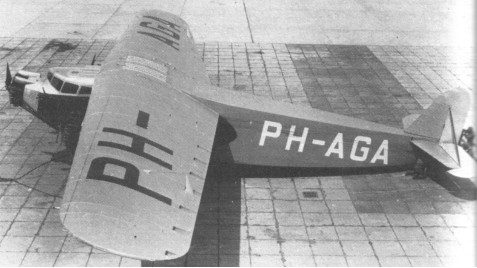
The F.IX, a 20 passenger airliner, two of which went into service KLM, was built under license in Czechoslovakia.
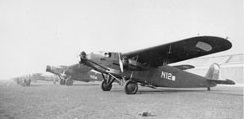
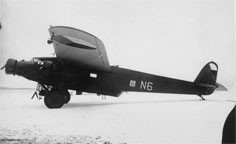
Though the Avia works produced some of Europe’s best fighters between the world wars, it was not judged economically feasible to attempt a heavy bomber. Accordingly, Avia, obtained a licence for the Fokker F.VII/3m, the pre-eminent civil transport of the 1920s, and while producing this for civil use also schemed a bomber version. The Czech army/air force, however, judged this aircraft too small. The upshot was a further licence for the Fokker F.IX, considerably bigger and weighing more than twice as much. In 1932, Avia built 12 F.IX bombers, powered by three Walter Jupiter VII engines rated at 450 hp, carrying an internal bomb load of up to 1500 kg (3307 lb) and with any of a variety of armament schemes involving manually-aimed Vickers 7.92-mm (0.312-in) Mk 30 guns above and below the fuselage and firing from beam windows. Some aircraft had a retractable ventral ‘dustbin’.
Avia F-IX
The Avia F-IX was used only in a bomber version through the 30s until the March 15, 1939 German Occupation.
Avia F-IX of No 5 Brno Bomber Regiment
Jugoslavia bought two slightly modified aircraft designated F 39, powered by 560 hp Gnome-Rhone Jupiters, and obtained a sub-licence for this version.
AVIA-Fokker F.IX Engines: 3 x Walter Jupiter VII, 450 hp Props: wood 2 blade Wing span: 27.5 m (90 ft 2.5 in) Length: 19.4 m (63 ft 7.75 in) Gross weight: 9160 kg (20194 lb) Empty weight: 5450 kg Maximum speed: 209 km/h (130 mph) Climb rate: 2.5 m/s Service ceiling: 5000 m Internal bomb load: 1500 kg (3307 lb) Undercarriage: fixed Crew: 2 pilots / 1 navigator
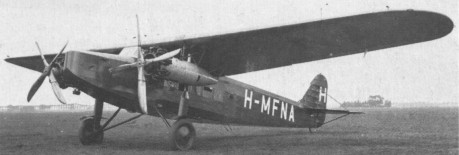
Designed to meet a KLM (Royal Dutch Airlines) requirement for a larger aircraft than the F.VII single-engined series, the 12 15 seat Fokker F.VIII flew in prototype form on 12 March 1927. The nose contained a hinged baggage compartment, and the two 358kW Gnome-Rhone Jupiter VI engines were slung beneath the wings and a crew of two.
The prototype and six production F.VIIIs were delivered to KLM in 1927-28. One of them, PH-OTO, was later converted to have two engines positioned in the wing leading edge. Another was delivered to the Hungarian airline MALERT in 1928, and Manfred Weiss in Budapest built two more for MALERT under licence and were completed as bombers with two machine gun posts.
The KLM aircraft were subsequently re-engined, various aircraft being powered by 515kW Wright R-1820 Cyclone or 373kW Pratt ‘& Whitney Wasp engines.
The only F.VIII to see service in military markings was the last Dutch production aircraft, sold by KLM to British Airways in 1936. It went to Sweden in 1939, and was subsequently donated to the Finnish air force, with whom it served in the Continuation War from 1941.
Engines: 2 x Gnome-Rhone Jupiter VI radial, 358kW Max take-off weight: 5700 kg / 12566 lb Empty weight: 3685 kg / 8124 lb Wingspan: 23.00 m / 75 ft 6 in Length: 16.75 m / 54 ft 11 in Height: 4.20 m / 13 ft 9 in Wing area: 83.00 sq.m / 893.40 sq ft Max. speed: 200 km/h / 124 mph Cruise speed: 170 km/h / 106 mph Ceiling: 5500 m / 18050 ft Range: 1045 km / 649 miles
The experimental fighter, the M.9, also called K.I (K= Kampfflugzeug =fighting aeroplane), first appearing in April 1915. In addition to the pilot, two 80 h.p. Oberursel engines were positioned in the central nacelle, and the two fuselages each had an air gunner in the nose. During tests the aeroplane proved useless.
Inspired by the RAF’s de Havilland Mosquito, Kurt Tank created the Ta-154 in response to an urgent requirement for a night-fighter to protect Germany from the RAF’s bombers. The Ta-154 was a heavily armed two-seat, twin-engined aircraft made largely of wood. The Ta 154V 1a 1st prototype TE+FE, Wn 100001 first flew on 01/07/1943, piloted by Sander, at Langenhagen, and on 07/07/1943, piloted by Kurt Tank at Langenhagen. Modifications to the engines changed them from Junkers Jumo 211F to 211N. Flight number 47 took place on 31/07/1943. On 05/08/1944 TE+FE suffered total destruction from air attack. The single seat V1 was not armed and tested general flight characteristics. The Ta 154V2 – Ta 154A-1/R1, first flown on 10/09/1943 by Sander or Melhorm at Langenhagen, was to test endurance, radiators and flash-concealers. Equipped with the FuG 212 and MG 81Z armament and powered by Junkers Jumo 211F and NR with water-methanol injection, Wn 100002, TE+FF was totally destroyed by air attack on 05/08/1944. Ta154V3- Ta 154A-0/U1 Wn 100003, TE+FG, was first flown on 25/11/1943 by Bartsch at Langenhagen. On 10/01/1944 it was received at Rechlin. On 20/01/1944 it made a belly landing at Sorau, and had another accident on 12/04/1944. In August 1944 it was totally destroyed by air attack. A FuG 212C-1 then C-2 were installed and power wasJunkers Jumo 211F & Junker Jumo 211N. Four MG15/20 guns were fitted. Ta 154 V4 Wn 100004, TE+FH, first flew on 10/01/1944 and was destroyed crash landing on 25/08/1944. Ta 154 V5 – Ta 154A-4 Wn 100005, TE+FI was first flown on 25/02/1944, by Bartsch at Langenhagen, and delivered to Tranewitz for armement tests on 10/03/1944. Engine failure occurred on 07/04/1944. It was moved to Detmold for modification as a night fighter on 14/08/1944. The engines were Junkers Jumo 211N then Junkers Jumo 213. Ta 154V6 – Ta 154A-4 was first flown on 18/03/1944, by Bartsch at Langehagen. From the 10/06/1944 to the 22/06/1944 it was tested at Rechlin. From 27/06/944 it was transformation into a night fighter at Detmold with 2 Junkers Jumo 213. Engines were Junkers Jumo 211N then 213A. The navigation indicator was a K 12.Wn 100006, TE+FJ. Ta 154V6 – Ta 154A-4 Wn 100006, TE+FJ, was first flown on 18/03/1944, by Bartsch at Langehagen. From 10/06/1944 to 22/06/1944 tests were at Rechlin. On 27/06/944 it was transformation into a night fighter at Detmold with 2 Junkers Jumo 213. Junkers Jumo 211N then 213A were fitted. Course indicator – K 12. Ta 154V7 Wn 100007, TF+FK, was first flown on 25/03/1944 and on 09/04/1944 damaged by air attack. 2 engine Junkers Jumo 211N with VS 11 props. Ta 154V8 TF+FL first flew 08/04/1944 piloted by Sander, for tests of engines and performances. On 06/08/1944 it was destroyed after an engine fire and belly landing crewed by Otto/Rettig. Engines were Junkers Jumo 213A, and props VS 9. The Ta 154V9 Wn 100009, TF+FM, was first flown 18/04/1944. Suffered an accident flown by Bartisch with Meyer as observer. The engines were Junkers Jumo 211N, and props VS 11. Ta 154V10 Wn 1000010, TE+FN, first flew on 04/06/1944 at Langenhagen. 15/07/1944 was its last known flight. The engines were initially Junkers Jumo 213 with VS-8 props, the Junkers Jumo 213A-1, with VS-111 props. Ta 154V11 Wn 1000011 was destined for static tests of series A. Ta 154V12: Wn 1000012. Ta 154V13: Wn 1000013. Ta 154V14: Static test for the C series. Wn 1000014. Ta 154V 15 – Ta 154A 2 was the prototype of the A-2, first flown on 06/04/1944, powered by Junkers Jumo 211R. Wn 1000015. Ta 154V 16 Wn 1000016 first flew on 20/04/1944, powered by Junkers Jumo 211R engines. Ta 154V 17 Wn 1000017 in 1944 was in the process of assembly at Erfurt but not completed. Ta 154V 18 Wn 1000018 flew on 29/04/1944 with two engines Junker Jumo 211R engines. Ta 154V 19 Wn 1000019 first flew on 01/07/1944, powered by two Junkers Jumo 211R. Ta 154V 20 – Ta 154C1 Wn 120105 (0035) was the prototype for the Ta 154 C-1, but it was not completed when captured on 01/07/1944. Ta 154V 21 – Ta 154C-2/3 Wn 120106 (0036), prototype for the Ta 154 C-2 then C-3, was not completed. Ta 154V 22: 1st flown on 12/06/1944 by Sander at Langenhagen.
Unfortunately, the RAF reached the factory producing the specialized glue first and the production aircraft were assembled using a cheaper alternative. Three aircraft soon disintegrated in flight and production was stopped while a solution was sought. Hermann Goering, who knew little about the programme, accused Tank of sabotage, and an unrelated crash saw cancellation of the whole programme in August 1944. A plan to use some of the completed aircraft packed with explosives to blow up US bomber formations did not proceed.
Ta 154V 1 TE+FE Wn 100001 Engines: Junkers Jumo 211F, later 211N. Seats: 1
Ta 154V2 – Ta 154A-1/R1 TE+FF Wn 100002 Engines: Junkers Jumo 211F and NR with water-methanol injection Armament: MG 81Z
Ta154V3- Ta 154A-0/U1 Wn 100003, TE+FG Engines: Junkers Jumo 211F & Junker Jumo 211N. Armament: Four MG15/20guns.
Ta 154 V4 Wn 100004, TE+FH
Ta 154 V5 – Ta 154A-4 Wn 100005, TE+FI Engines: Junkers Jumo 211N / Junker Jumo 213
Ta 154V7 Wn 100007, TF+FK Engines: Junkers Jumo 211N Props VS 11.
Ta 154V8 Wn 100008, TF+FL Engines: Junkers Jumo 213A Props: VS 9.
Ta 154V9 Wn 100009, TF+FM Engines: Junkers Jumo 211N Props: VS 11.
Ta 154 V10 Wn 1000010, TE+FN Engines: Junkers Jumo 213, later Junkers Jumo 213A-1 Props: VS-8, later VS-111
Ta 154V 15 – Ta 154A 2 Wn 1000015 Engines; Junkers Jumo 211R.
Ta 154V 16 Wn 1000016 Engines: Junkers Jumo 211R
Ta 154V 18 Wn 1000018 Engines: Junker Jumo 211R
Ta 154V 19 Wn 1000019 Engines: two Junkers Jumo 211R.
Ta 154V 20 – Ta 154C1 Wn 120105 (0035)
Ta 154V 22
Engine: 2 x 1500hp Jumo 211R Max take-off weight: 8930 kg / 19687 lb Wingspan: 16.00 m / 52 ft 6 in Length: 12.10 m / 39 ft 8 in Height: 3.50 m / 11 ft 6 in Max. speed: 650 km/h / 404 mph Crew: 2
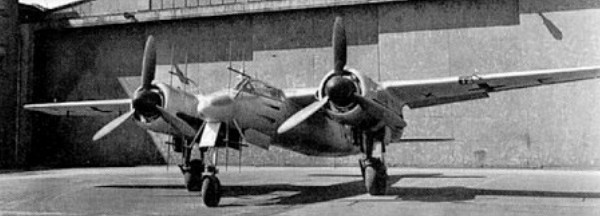
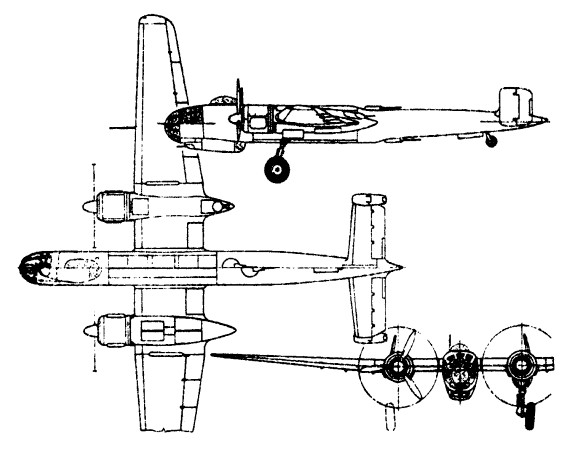
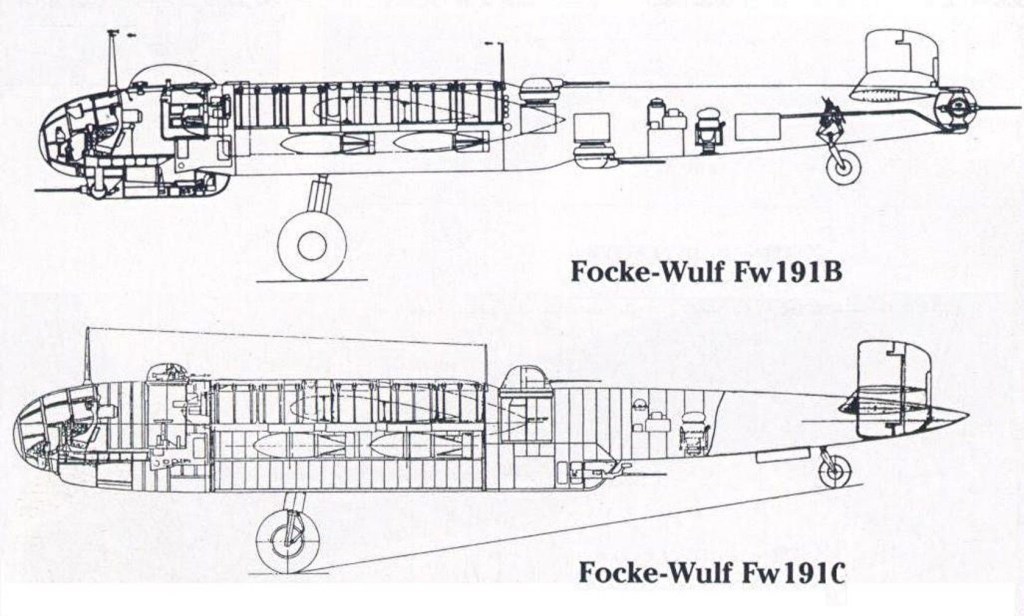
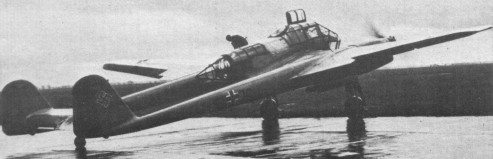
The Fw 191 was designed as a high-altitude, pressurised, bomber. Focke-Wulf built a technically complex machine around engines which did not exist, and the operation of the majority of the components was electric, which complicated problems. The second prototype had the elecric systems replaced by hydraulics. Development problems caused its abandonment. Three built.
Fw 191 V-1 Engines: 2 x BMW 801C1, 1600 hp Props: three-bladed VDM fixed pitch Wingspan: 26 m Length: 19,63 m Height: 5,50 m Wingarea: 70,40 sq.m Empty weight: 20400 kg Power loading: 6,375 kg/hp, Ceiling: 8500 m Range: 3500 km without bombs, 1400 km with load Armament: 3 x MG 151 20mm, 4 x MG 81 7,92mm Crew: 5 1st prototype, 1941,
Fw 191 V-2 Engines: 2 x BMW 801C1, 1600 hp Props: three-bladed VDM fixed pitch Wingspan: 26 m Length: 19,63 m Height: 5,50 m Wingarea: 70,40 sq.m Empty weight: 20400 kg Power loading: 6,375 kg/hp, Ceiling: 8500 m Range: 3500 km without bombs, 1400 km with load Armament: 3 x MG 151 20mm, 4 x MG 81 7,92mm Crew: 5
Fw 191 V-6 Engines: 2 x Junkers Jumo 22, 2500 hp Props, three-blade metal VDM fixed pitch. 1st flight: 12/1942
Fw 191 B Engines: 2 x Daimler-Benz DB 610, 2870 hp Props: three-bladed VDM fixed pitch Wingspan: 26 m Length: 19,63 m Height: 5,50 m Wingarea: 70,40 sq.m Empty weight: 23.587 kg MTOW: 25310 kg Wing loading: 335/359,517 sg/sq.m Power loading: 4,109/4,409 kg/hp Vmax: 565 km/h at 3960 m, 630 km/h at 9450 m ROC: 450 m/min Ceiling: 8780 m Range: 3860 km at 490 km/h, 1800 km at 565 km/h.
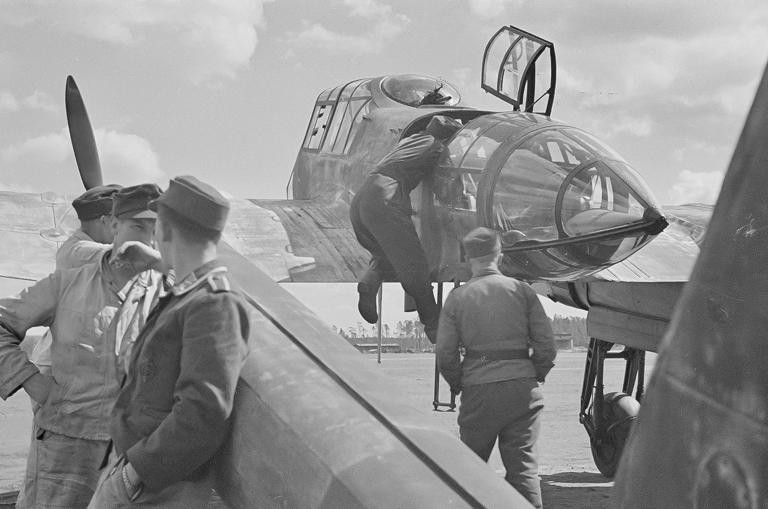
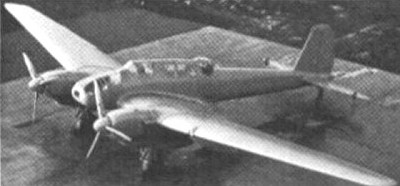
The Focke-Wulf Fw 189 was designed in response to the German Air Ministry specification issued in February 1937. This called for an aircraft with a crew of three and better performance than the Hs 126, then about to enter service as the standard reconnaissance aircraft.
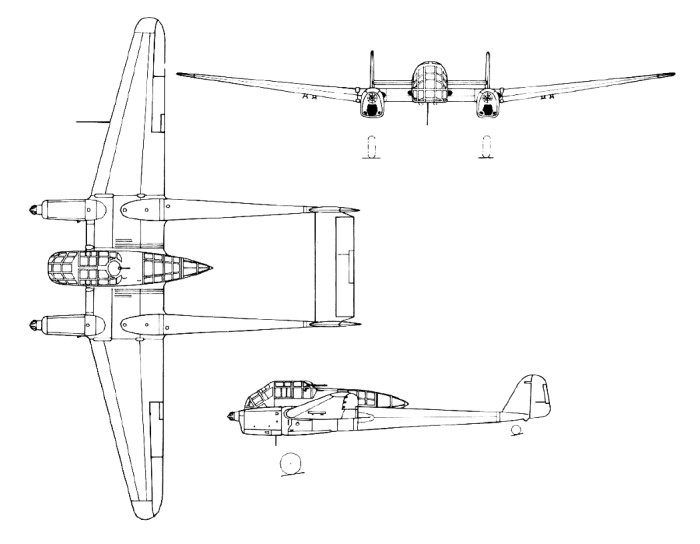
Arado, Blohm und Voss and Focke Wulf each produced a design in response to this specification. To meet this specification, Focke Wulf’s team under the leadership of Kurt Tank evolved a twin boom design. A 430 hp Argus As 410 12-cylinder air cooled inverted V type engine was installed at the front of each slender tail boom, driving a two blade propeller, and mounted on the centre section of the wing, between the booms, was an extremely well glazed nacelle accommodating the three man crew. Each tail boom terminated in a single fin and rudder, bridged by a centrally mounted tailplane.
The first prototype, the Fw 189 V1 (registration D-OPVN), made its maiden flight in July 1938. No armament was fitted to the Fw 189 V1, but the second prototype (D-OVHD), which flew in August 1938, was armed with a 7.9 mm (0.311 in) MG 17 machine gun in each wing root and three 7.9 mm MG 15 guns: one each in the nose, a dorsal blister, and the tailcone of the nacelle. The V3 (D-ORMH) was unarmed, but had the definitive 450 hp As 410-1A engines intended for production aircraft and automatic variable pitch propellers.
The success of the first three prototypes was rewarded with an order for a second series of four prototypes. The Fw 189 V4 fourth prototype was representative of the Fw 189A production configuration, but it was actually the Fw 189B, based on the V5, that was first to be ordered into production by the RLM in 1939. V4 had modified engine cowling, semi-cowled main wheels, a larger main wheels and only two machine guns. The wing root guns remained, as did the upper and rear pod guns, although the front gun was removed. The V4 was used for tests with smoke-screen equipment and with equipment for using poisoned gas and chemical weapons. V5 was the prototype for the B series of training aircraft. V6 was the prototype for the planned series of heavily armoured ground attack aircraft and V7 was to be built as a prototype of a twin-float version of the aircraft, although it was completed as one of three B-0 trainers.The Fw 189B (three B-0s and ten B-1s) was built as an unarmed, dual control five seat trainer, its modified nacelle lacking the nose and tailcone glazing of the A series prototypes.
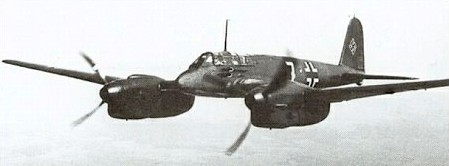
Production of the Fw 189A finally got under way in the spring of 1940, a batch of ten pre-production Fw 189A-0s for service trials being followed by the first series version, the Fw 189A-1. In the spring of 1940 Focke-Wulfe received an order for ten pre-production A-0s and twenty A-1s. The A-1 was armed with two fixed forward firing MG 17s and two flexibly mounted MG 15s. The first of these was carried in a circular glass turret on the roof of the cockpit, while the second was mounted in the conical rear cone of the pod, which could rotate through 360 degrees. The A-1 could also carry four 154lb/ 75kg bombs and an RB 20/30 camera as standard, with a wide range of other cameras available. Large scale production didn’t get under way until late in 1940. This began to reach Luftwaffe units in late 1940 and early 1941, and eventually equipped at least nine Aufklarungsgruppen (long range reconnaissance wings) and 15 Nahaufklarungsgruppen (short range reconnaissance wings), most of them on the Eastern Front. Known variously as the Uhu (owl), or as das Fliegende Auge (the flying eye) of the Wehrmacht.
Production Fw 189A-1s carried an armament similar to that of the second prototype, except that the nose machine gun was deleted. The second production version, the Fw 189A 2, differed in having 7.9 mm (0.311 in) MG 81Z (twin MG 81) guns in the dorsal and tailcone positions, instead of the MG 15s. The Fw 189A4 (the Fw 189A-3 was an unarmed trainer) was a ground support development of the A-2, having ventral armour plating and 20 mm (0.79 in) MG FF cannon instead of MG 17s in the wing roots. All except the A- 3 could carry four 50 kg (110 lb) bombs on racks under the outer wings. The Fw 189A-1/Trop was a hot climate version for service in the Mediterranean and North African theatres; the A-1/U2 and A-1/U3 were two special one off conversions for a VIP transport role; the single Fw 189E was another A-1, converted to 700 hp French Gnome Rhone 14M radial engines; and many A types were, in their later years, used for such secondary duties as liaison and casualty evacuation. Some even had a short spell as night fighters with I/NJG 100. A number of were purpose-built five-seat trainers.
The Fw 189 was given a high production priority and was produced at several factories across Europe, with new production lines being established in Prague and around Bordeaux although production began at Focke-Wulf’s own factory at Bremen. The type became the main German tactical reconnaissance aircraft from 1942 until the summer of 1944. Thirty eight aircraft were delivered by the end of 1940, sixty-one in 1941, fifty seven in 1942 and eleven in 1943. By this point production was being concentrated around Bordeaux, while the Bremen factory was focusing on the Fw 190. The second production line was in the Aero-Avia factory at Prague. This factory produced 151 aircraft in 1940-41, 183 in 1942 and three in 1943, for a total of 337. The final production line was set up around Bordeaux. At first the French factories assembled aircraft from German-built sub-assemblies, completing 87 aircraft in 1942. In 1943 the French factories were responsible for most remaining aircraft, before production of the Fw 189 was cancelled early in 1944. Eventually 864 Fw 189s were completed, 337 at Prague, between 250 and 300 in France (sources differ, and sub-totals often don’t add up), and the rest at Bremen. Production reached its peak in 1942.
At the start of the war German short range reconnaissance was carried out by squadrons designated as Aufklärungsstaffeln (Heer), abbreviated to Aufkl.(H) or (H). Thirty six such squadrons existed in August 1939, and were under army control. Each squadron was self-supporting and fully mobile and could move from location to location under its own steam. The first few Fw 189s reached experimental sections of the Luftwaffe in the spring of 1940. At about the same time some aircraft reached the reconnaissance squadrons for service trials, but large-scale deliveries didn’t really begin until the end of 1942. On 22 July 1941, at the start of the invasion of the Soviet Union, the number of reconnaissance squadrons had risen to 54, most of which were still using the Hs 126. Production of the Fw 189 increased in pace during the year, but even at the end of 1942 the Hs 126 still made up a significant proportion of the available aircraft. In the winter of 1941-42 the squadrons were organised into short-range reconnaissance groups, each of which was meant to contain three squadrons. On the southern sector there were nine groups with sixteen squadrons, of which six were still using the Hs 126. In the middle sector things were worse, with six groups and thirteen squadrons, of which nine still had the Hs 126. Finally both squadrons operating in the north were still using the older aircraft. Of a total of 31 short-range reconnaissance squadrons, 17, or just over half, were still using the older aircraft. By the summer of 1944 the Fw 189 had been forced out of the daytime skies, and the surviving aircraft were forced to operate at night, or as training and liaison.
In April 1937 Focke-Wulf received a contract to produce a single prototype, which made its maiden flight in July 1938 and it was this prototype that was evaluated by the Ilmavoimat / Maavoimat / VL team in August of the same year.
The Ilmavoimat viewed the Fw 189 as a rugged and simple aircraft to be used solely for short-range tactical reconnaissance and coordinating close air support and artillery strikes with forward ground operations. The intention was to operate the aircraft from rough forward air bases and for the aircraft to have a higher maximum speed than the Fi 156. It was also intended that the aircraft be used for front-line low-level reconnaissance and aerial photography. This aircraft had rated very highly in the evaluations, with excellent all-round visibility, good stability and responsiveness and able to maintain steady flight on one engine as well as being exceptionally agile and strongly constructed. The layout and positioning of navigational equipment and radios was carefully thought out, cockpit heating was efficient and it was easy to put the aircraft on target when laying down marker bombs.
The Ilmavoimat ordered twenty of the Focke Wulf Fw 189’s. There were some design modifications specified. The pilot and observer/controller were to sit side by side, making communications easy. Armour was added under the fuselage and engines and self-sealing fuel tanks were specified. Armament consisted of two machine guns on a flexible mount in a dorsal position and four fixed machine guns in the wing roots, firing forwards. After delivery, two Hispano-Suiza 404 20mm cannon were fitted in a blister beneath the fuselage. The rear gunner position of the German-version was eliminated to reduce weight and rather than 4 hardpoints for 50kg bombs, 8 hardpoints for 30kg phosphorus marker bombs were fitted. The aircraft was just entering production in Germany and with the German eager for hard currency, the Ilmavoimat got the first twenty aircraft of the German production lines, perhaps unfortunately as Focke Wulf used these to iron out some of their initial production line problems. Despite this, the Ilmavoimat found the Fw 189’s to be a superb front line reconnaissance aircraft, tough and durable, able to take a lot of damage and maneuverable enough to stay out of trouble even if caught on it’s own.
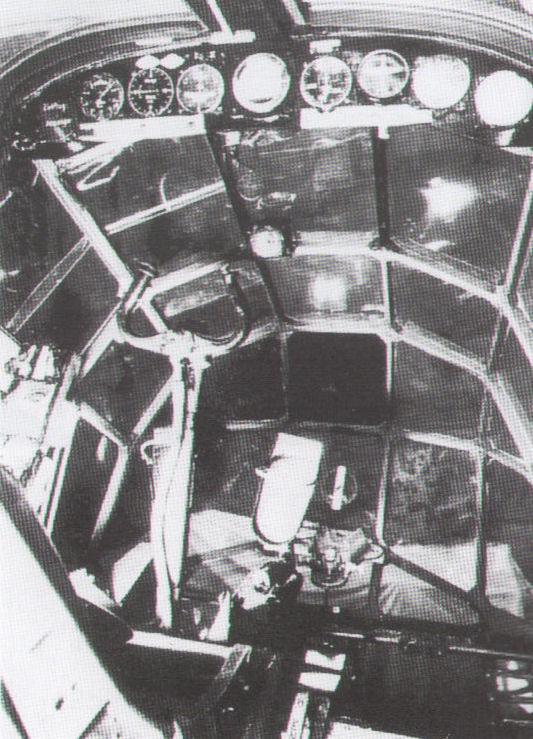
Fw 189 cockpit
The Ilmavoimat’s Fw 189’s were delivered in February 1939, much to the relief of the High Command, who were unsure which orders that had been placed would actually be fulfilled up until the moment that the aircraft actually arrived in Finland. To this end, after the Munich Crisis, and as part of Finland’s emergenmcy measures, it was specified that wherever possible, Finnish military equipment purchases would be carried on Finnish cargo ships wherever feasible, even if this meant additional shipping costs. After the Munich Crisis, as Finland experienced what would in later years be called “The Great Awakening,” a wide range of emergency measures were put in place and additional emergency funding for military equipment was provided. Among this funding was provision for a further twenty Fw 189’s. These were ordered in December 1939 and to the relief of the Ilmavoimat, actually delivered in May 1939. With tensions increasing with the Soviet Union, a further order was placed for forty Fw 189’s in July 1939, but this was cancelled by the German government on the 19th of August 1939, shortly after Molotov Ribbentrop Pact was signed.
Slovakia, a nominally independent republic which came into being following the Nazi dismemberment of Czechoslovakia, received 14 Fw 189A and Hungary about 30 A-2s.
Production ended in August 1944, by which time a total of 864 Fw 189s had been completed. Of these, 310 were produced by the SNCA du Sud Ouest at Bordeaux Merignac during 1942 44 and 337 Fw 189As by the Aero factory in Czechoslovakia between 1941 43.
The French total comprised 293 Fw 189As plus 17 examples of the Fw 189F 1, a version of the A 2 with 580 hp Argus As 411MA- 1 engines. Focke Wulfs total of 217 included six prototypes, 198 Fw 189As and 13 Fw 189Bs. The sixth prototype (V6) and modified first prototype (Vlb) were used flight test a very much smaller, well armoured two seat nacelle intended for the proposed Fw 189C assault version: other projects that did not come to fruition were the twin float Fw 189D and the 950 hp 402 engined Fw 189G.
Fw 189A-1 Engines: 2 x Argus As 410A-1, 347kW / 459 hp Wingspan: 18.4 m / 60 ft 4 in Length: 12.03 m / 39 ft 6 in Height: 3.1 m / 10 ft 2 in Wing area: 38.0 sq.m / 409.03 sq ft Max take-off weight: 3950 kg / 8708 lb Empty weight: 2805 kg / 6184 lb Wing load : 21.32 lb/sq.ft / 104.0 kg/sq.m Max. speed: 181 kts / 335 km/h / 208 mph Cruise speed: 170 kts / 315 km/h / 196 mph Service Ceiling: 7000 m / 22950 ft Range: 362 nm / 670 km / 416 miles Crew: 2-3 Armament: 2x MG 15 7,92mm, 2x MG 17 7,92mm, 4x 50kg Bomb.
Fw 189A 2 Engines: 2 x Argus As.410 A-1, 347kW / 459 hp. Span: 18.40 m (60 ft 4.5 in) Length: 12 m (39 ft 4.5 in) Gross weight: 3950 kg (8710 lb). Maximum speed: 350 km/h (217 mph).
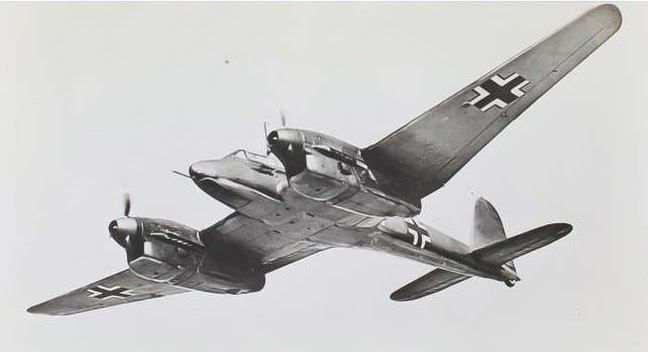
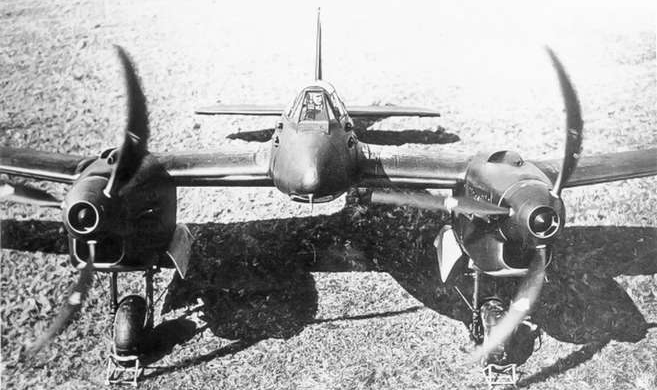
The Fw 187 was a heavy, single-seat, twin-engined fighter. Despite very good performance, the Luftwaffe showed no interest, as it was firmly committed to the Bf 110. Nine were built in total.
The first was destroyed in an accident on 14/05/1938. The third prototype featured a fuselage remodel and engine nacelles redesign and flew in 1938.
Fw 187 V 1 Engines: 2 x Junkers Jumo 210Da, 630 hp Props: three-bladed metal Junker-Hamilton Wingspan: 15,30 m Length: 11,10 m Height: 3,85 m Wingarea: 30,40 sq.m Vmax: 525 kph Seats: 1 Armament: 2 x MT MG 17 7,92 mm 1st prototype, D-AANA
Fw 187 V 2 Engines: 2 x Junkers Jumo 210G, 680 hp Props: three-bladed metal VDM fixed pitch Wingspan: 15,30 m Length: 11,10 m Height: 3,85 m Wingarea: 30,40 sq.m Vmax: 525 kph Seats: 2 Armament: 6 x MT MG 17 7,92mm First flown: 1937 D-ORHP.
Fw 187 V 3 Seats: 2 Armament: 2 x MG FF 20mm
Fw 187 V-4 Engines: 2 x Junkers Jumo 210G, 680 hp Props: three-bladed metal VDM fixed pitch Wingspan: 15,30 m Length: 11,10 m Height: 3,85 m Wingarea: 30,40 sq.m Vmax: 525 kph Seats: 2 Armament: 6 x MT MG 17 7,92mm
Fw 187 V-5 Engines: 2 x Junkers Jumo 210G, 680 hp Props: three-bladed metal VDM fixed pitch Wingspan: 15,30 m Length: 11,10 m Height: 3,85 m Wingarea: 30,40 sq.m Vmax: 525 kph Seats: 2 Armament: 6 x MT MG 17 7,92mm
Fw 187 V-6 Engines: 2 x Daimler-Benz DB 600A, 1075 hp Props: three-bladed metal VDM fixed pitch Wingspan: 15,30 m Length: 11,10 m Height: 3,85 m Wingarea: 30,40 sq.m Vmax: 630 kph Seats: 2 Armament: 6 x MT MG 17 7,92mm
Fw 187 To 0 Engines: 2 x Junkers Jumo 210G, 680 Props: metal VDM fixed pitch Wingspan: 15,30 m Length: 11,10 m Height: 3,85 m Wing area: 30,40 sq.m Empty weight: 3700 kg MTOW: 5000 kg Vmax: 525 kph @ 4000 m ROC: 2000 m in 1 min Ceiling: 10000 m Armament: 4 x MT MG 17 of 7,92mm and 2 guns 20 mm. Number built: 3
The Weihe was first flown in prototype form in 1935 as an advanced training, light 6 passenger transport and communications aircraft for the Luftwaffe, powered by two 179kW Argus As.10G engines. The main undercarriage retactable, and tail wheel fixed.
Before the outbreak of World War II Deutsche Luft-Hansa received eight as six-passenger commercial transports. Armament in the military training version comprised a gunner’s turret in the nose (which could be replaced by a metal cone for blind-flying instruction) and an aft gun position. The turret had space for an instructor and pupil for machine-gun and bomb-aiming training. Two seats side-by-side were provided in the cockpit for flying training, while a bomb trap with sights in a further compartment was provided for bombing instruction.
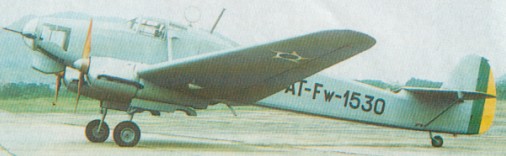
Fifteen were licence built by Brazil’s Oficinas Gerais da Aviation Naval during 1939-40. These were based on the Fw 58B-2 which was used as a gunnery trainer by the Luftwaffe.
Total production: 1350
V-1 Engines: 2 x Argus Ace 10c, 240 hp Props: two-blade metal fixed pitch Wingspan: 21,00 m Length: 14,00 m Height: 3,90 m 1 prototype
V-2: Armament: 1 MT MG 15 7,92 mm, 1 MT MG 15, 7,92 m 1 prototype.
V-4: Armament: 1 MT MG 15 7,92mm 1 prototype
Fw 58B-1 Engines: 2 x Argus Aces 10c, 240 hp Props: two-blade wood variable pitch Wingspan: 21,00 m Length: 14,00 m Height: 3,90 m Wingarea: 47,00 sq.m Empty weight: 2400 kg MTOW: 3600 kg Wing loading: 76,595 kg/sq.m Power loading: 7,5 kg/hp Vmax: 270 kph Vcruise: 240 kph Ceiling: 5600 m Range: 800 km Armament: 2 x MT MG 15, 7,92 mm
Fw 58B-2
Fw 58C Engines: Argus Ace 10c or Hirth HM 508D, 260 hp
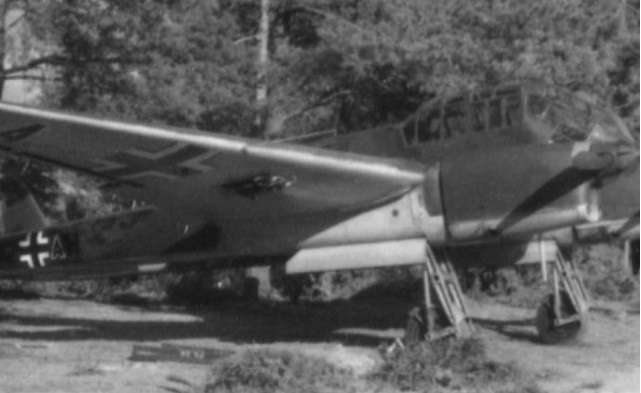
A twin-engined, three-seat strategic fighter, first flown in 1936. The Fw 57 was a contemporary of the Bf 110, with which it competed for orders. It featured a powered dorsal gun turret, and a glazed nose with twin semi-flexible cannon operated by the third crewmember. The Fw 57 was overweight and underpowered. Only three were built.
Fw 57 Engines: 2 x Daimler-Benz DB 600-A, 910 hp Props: metal three-blade fixed pitch Wing span: 25,00 m Length: 16,40 m Height: 4,08 m Empty weight: 6800 kg MTOW: 8300 kg Vmax: 404 kph Ceiling: 9100 m Armament: 2 x MG FF, 20 mm (nose) and 1 Mauser MG FF, 20 mm (dorsal turret).
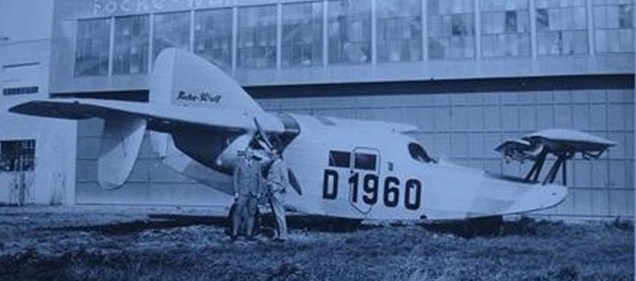
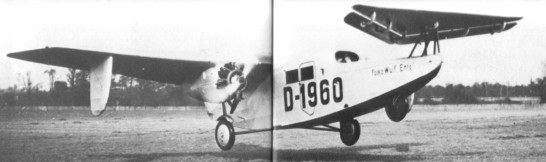
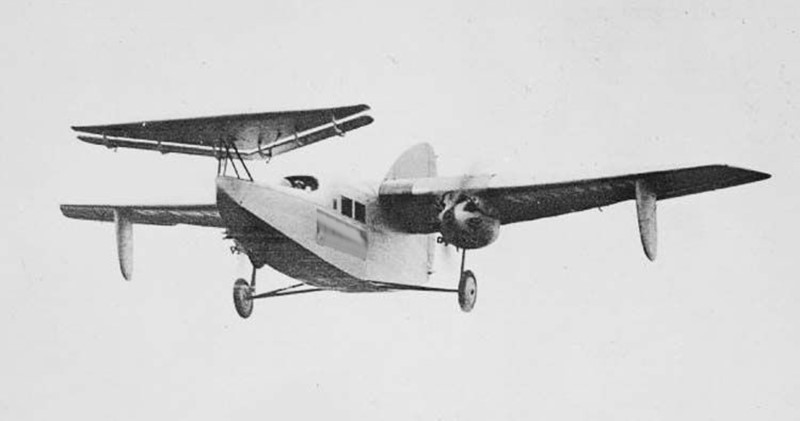
Focke Wulf Flugzeugbau G.m.b.H. built a twin engined canard in 1927. They called it the F.19 Ente, claiming that the tail first configuration gave it ‘exceptional stability and control at low speeds’. Stability and control in slow flight means safety.
Georg Wulf was killed September 29, 1927 test-flying an F-19 Ente canard.




 All Aero