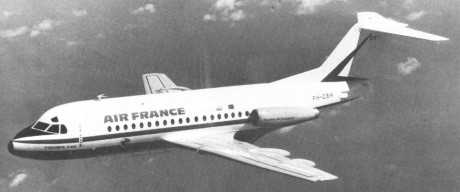
First details of the new Fokker F28 Fellowship were released in April 1962, and, with financial backing from the Netherlands government and risk-sharing support from MBB in West Germany and Shorts in the UK, a decision was made in 1964 to begin development and production of this new airliner.
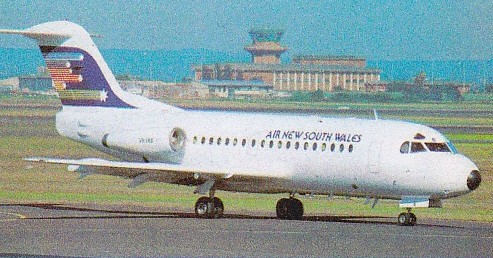
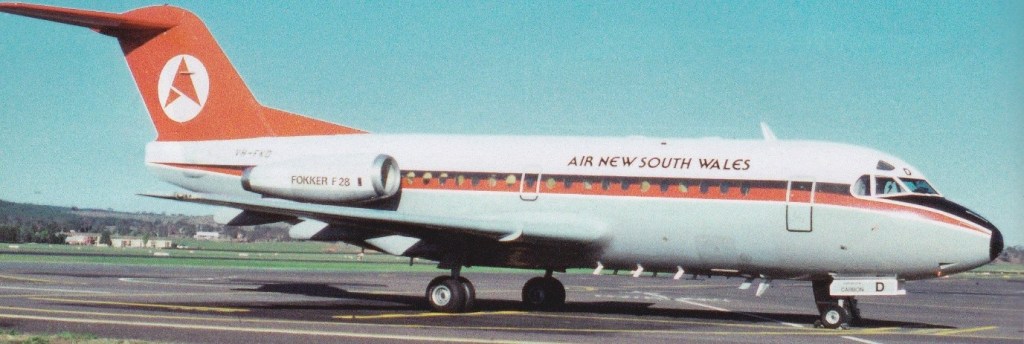
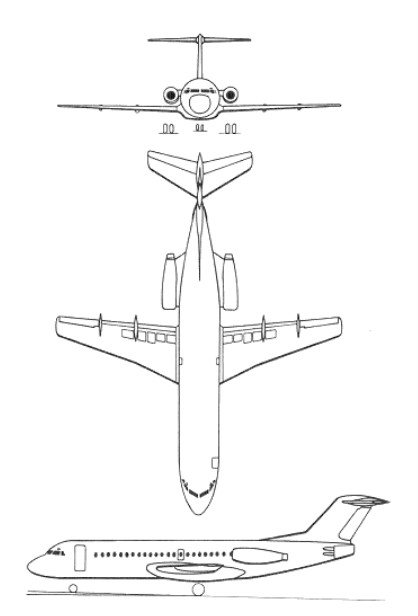
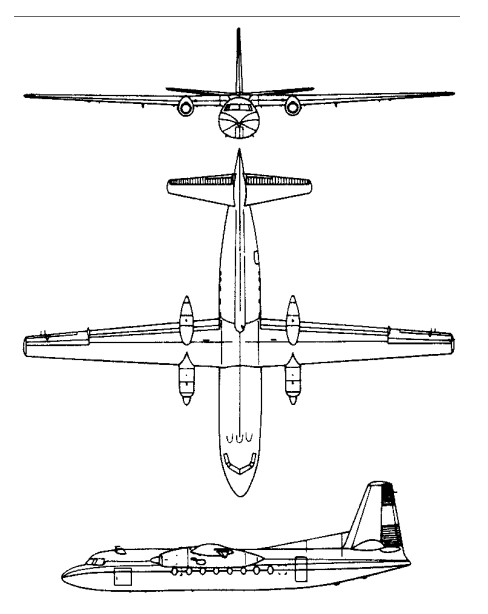
A cantilever low/mid-wing monoplane configuration with a circular-section fuselage, a T-tail unit with swept surfaces and retractable tricycle landing gear, the F28 was designed for two Rolls-Royce RB183 turbofan engines. Highly manoeuvrable in flight, it is designed for STOL with a wing sweepback of only 16 degrees for good handling at low speed, leading-edge slats and double-slotted flaps. There are no thrust-reversers; instead, the F 28 has powerful air brakes which, uniquely, form the tail end of the fuselage, and highly effective wheel brakes. The first of three prototypes made its maiden flight on 9 May 1967, and certification and delivery of the first production aircraft was achieved on 24 February 1969. This initial F28 Mk 1000 short-fuselage version could seat 55 to 65 passengers and was powered by two 4468kg thrust RB183-2 Mk 555-15 turbofans. It was available optionally as the F28 Mk 1000C for all-cargo or mixed passenger/cargo operations with a large cargo door incorporated in the port side of the forward fuselage, aft of the standard passenger door. Production was shared by Fokker-VFW of the Netherlands in association with MBB and VFW Fokker in Germany and Short Brothers in Great Britain. Shorts of Belfast designed the rear fuselage, MBB of West Germany the pods for the Rolls-Royce Spey turbofan engines, and Fokker’s German partner VFW, the tail and other fuselage sections.
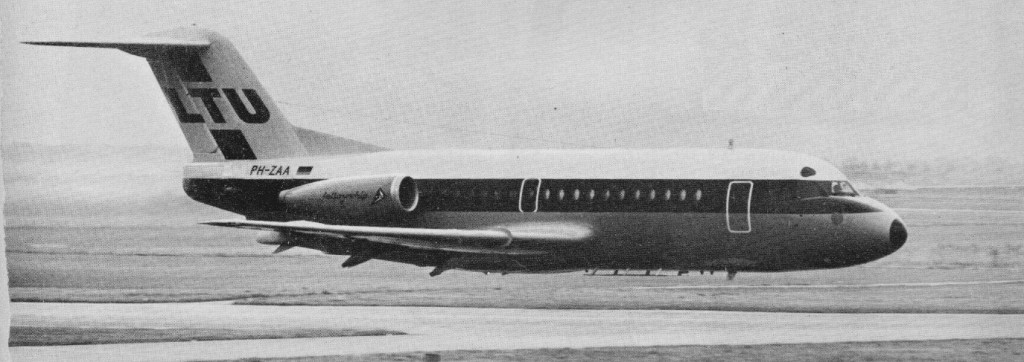
Fourth F-28 the day after its first flight
The fourth built, the first to be delivered, Fellowship A-4, went to Lufttransport Unternehmen L.T.U. of Dusseldorf, Germany.
This aircraft can take off from 6,000-foot long runways, or at altitudes as high as 15,000 feet. The generally similar F28 Mk 2000 differed only in having the fuselage lengthened by 2.21m to accommodate a maximum of 79 passengers. Later production versions were the F28 Mk 3000 and F28 Mk 4000 with the fuselage lengths of the Mks 1000 and 2000 respectively. The Mk 3000 is similar to the Mk 4000 with a short fuselage and seating for 65. The Mk 4000 is a long-fuselage version with high-density seating for up to 85. The F28 Mk 3000 was offered with a 15-seat executive interior, and the F28 Mk 4000 has maximum seating capacity for 85 passengers. Sales reached 241 before the Fellowship gave way to the Fokker 100 on the production line in 1987. The Mk 6000 is a long version with slatted wings and seating for up to 79 passengers. In mid-1991 Fokker stated that over 200 F28s were still in service and at least half of these were expected to be hush-kitted to Category 3 standard beginning in 1994, enabling them to continue in service for another 15 years.
Engine: 2 x Rolls-Royce “Spey 555-15”, 43.8kN Max take-off weight: 24720 kg / 54499 lb Empty weight: 14100 kg / 31085 lb Wingspan: 23.6 m / 77 ft 5 in Length: 27.4 m / 89 ft 11 in Height: 8.5 m / 27 ft 11 in Wing area: 76.5 sq.m / 823.44 sq ft Max. speed: M0.76 Cruise speed: 849 km/h / 528 mph Range w/max.fuel: 1990 km / 1237 miles Range w/max.payload: 1043 km / 648 miles Crew: 2 Passengers: 40-65
Fokker F 28 Fellowship Mk. 4000 Engine : 2 x Rolls Royce RB 183-2 Spey Mk 555-15H, 43851 N / 4470 kp Length : 97.146 ft / 29.61 m Height: 27.789 ft / 8.47 m Wingspan : 82.251 ft / 25.07 m Wing area : 850.356 sq.ft / 79.0 sq.m Max take off weight : 71001.0 lb / 32200.0 kg Weight empty : 37743.0 lb / 17117.0 kg Fuel capacity: 2,558–3,430 gals Cruising speed : 423 kts / 783 km/h Cruising altitude : 31988 ft / 9750 m Service ceiling: 35,000 ft Wing loading : 83.64 lb/sq.ft / 408.0 kg/sq.m Range : 2230 nm / 4130 km Range (max. weight) : 1010 nm / 1870 km Takeoff distance: 5,217 ft. Landing distance: 3,166 ft. Threshold speed: 127 mph; Crew : 2 Payload : 85 Pax.
The company’s design study of 1950 was for a 32-seat transport to be powered by two Rolls-Royce Dart turboprop engines. Known as the P.275 project, it was enlarged slightly and modified to incorporate a circular-section pressurised fuselage by 1952, when Dutch government backing was sought for its construction and development.
The type was then designated Fokker F27, and the first of two prototypes made its maiden flight on 24 November 1955 from Schiphol, powered by two Dart 507 turboprops. At the controls was Fokker’s chief test pilot, Mr H.V.B. Burgerhout, for the 34 minute flight. The first prototype did not have a pressurised cabin. For its first trials the prototype F.27 was powered by Rolls Royce Dart Mk. 507 engines, and in March 1956 these were replaced by Dart Mk. 511 engines.
F-27 No.1
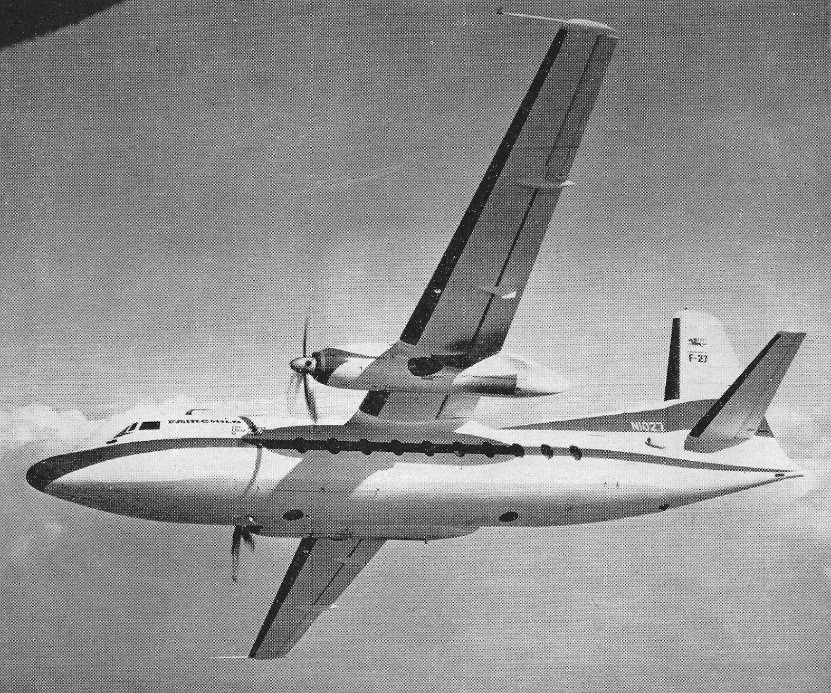
Two of the prototypes never flew at all, as they were used to investigate fatigue, wing loading and pressurisation problems (submerged in a water tank). Fokker installed a pneumatic system for the retractable undercarriage, because air is cheap, fast and non combustible. A high-wing monoplane, the F27 has a pressurised fuselage, retractable tricycle landing gear and accommodation for 28 passengers. The second prototype, with Dart Mk 511 engines and its fuselage lengthened by 0.91m to seat 32 passengers, was flown on 31 January 1957. Between the initial flights of these two prototypes, On April 26th 1956 it was announced that Fokker had concluded an agreement with the Fairchild Engine and Airplane Corporation for the manufacture and marketing of the F27 in North America, where it was known as the Fairchild F-27.
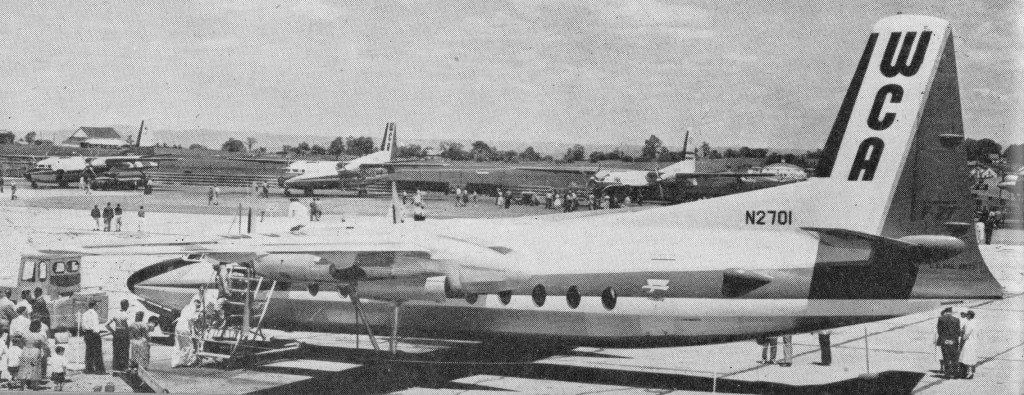
Fairchild F-27
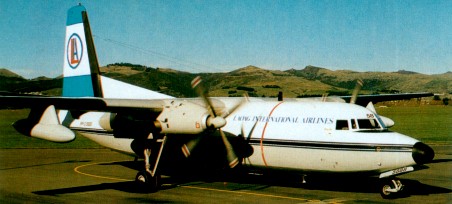
By April 1956 orders had come in for 30 aircraft. On March 23rd, 1958, the first production F.27 EI AKA for Aer Lingus, made its ¬maiden flight, to be followed on 12 April by the first American built F.27, for Pied¬mont Airlines. Fokker’s first F27 Friendship entered service with Aer Lingus in December 1958, but Fairchild had been a little quicker off the mark, its F-27 entering service with West Coast Airlines three months earlier. The American company had modified the interior layout to seat 40, increased the fuel capacity and made provision for weather radar in a lengthened nose; Fokker adopted similar improvements at a later date. The initial Dutch production version was designated F27 Mk 100 (Fairchild F-27), and was powered by two 1279kW Rolls-Royce Dart RDa.6 Mk 514-7 turboprops. A total of eighty-five Series 100 were built. It was followed by the similar F27 Mk 200 (Fairchild F-27A) with 1529kW Dart RDa.7 Mk 532-7 engines. Both airliners had standard accommodation for 40 passengers, but a high-density arrangement made it possible to seat 52. An executive version of the Mk 200 was available with the interior design to customer requirements. Subsequent versions include the F27 Mk 300 Combiplane (Fairchild F-27B), a passenger/cargo aircraft with Mk 100 powerplant, a reinforced cabin floor, cargo tie-down rings and a large cargo door forward of the wing on the port side. A similar Combiplane version of the Mk 200 had the designation F27 Mk 400, but no equivalent version was produced by Fairchild in America.
In 1964 the Sudanese air force ordered four F-27s for paratrooper and medical evacuation missions, incorporating upward-hinging cargo door forward and two sliding doors near the rear. They can carry 45 in canvas seats, 24 litters, or 13,000 lb of cargo. Nine F-27M Troopships were in service with the Netherlands air force.
In 1964 Fairchild was to start a production line again to produce 15 F-27s ordered by Ozark Airlines. Priced at $995,000 each, engines were to be Rolls Royce Dart 7s and the MTOW 42,000 lb.
The Mk.400M flew in April 1965. It can carry 6,000kg of cargo, 46 paratroops, or 24 stretchers and nine attendants. A number of civilian-standard F.27 Friendships, some with VIP inte¬riors, were sold to military operators. Formerly known as the Troopship, the Mk.400 military version was ordered for the Royal Thai Air Force. These aircraft, deliv¬ered in 1986 and early 1987, were multirole aircraft equipped for transport, target towing, and SAR duties. Fokker next developed a lengthened fuselage (by 1.50m) variant of the Mk 200. Designated F27 Mk 500, this failed to appeal initially to airline operators, but 15 were acquired by the French government for service with the nation’s Postale de Nuit. Friendship Mk 500s in service with airlines have standard accommodation for 52 passengers, with high-density seating for 60. Fairchild in America produced its own stretched variant, the FH-227. The FH-227 differed from the standard F27 by having a fuselage ‘stretch’ of 1.83m to provide accommodation for a maximum of 52 passengers, with increased baggage and cargo space, and by the installation of 1678kW Rolls-Royce Dart RDa.7 Mk 532-7 turboprop engines. The first of two FH-227 prototypes made its initial flight on 27 January 1966. Production of FH-227s and their variants had reached 79 when production ended. When the Fairchild Hiller FH.227 production line closed down more than 200 aircraft had been sold. Fairchild Stratos Corp. demon¬strated its F 27G variant in 1963, incorporating the refinements developed by Fairchild in the F 27F, and also has a large cargo door in the front fuselage, as used in the F 27B. It is intended for both military and civil use. The last production version was the F27 Mk 600, combining the Mk 200 fuselage without the reinforced cabin floor but with the cargo door of the Mk 300/400 Combiplanes. The F27 Mk 600 introduced an optional roller-track quick-change interior so that the type could be used for passenger/cargo services. Other versions included the F27 Mk 400M and F27 Mk 500M military aircraft, an F27 Mk 400M aerial-survey version and an F27 Maritime suitable for coastal patrol, fishery protection, and search and rescue. Late production aircraft had an updated flight deck and cabin interior. Manufacture was shared by Dassault-Breguet (France), MBB (Germany) and SABCA (Belgium). When production was terminated in 1986 in favour of the Fokker 50, the company had sold 581 F27s alongside 205 Fairchild-built F-27/FH-227 variants. In mid-1991 Fokker stated that around 450 F27s were still in service and that the highest-time aircraft had made some 80,000 flights. About 30 FH-227s of different marks remained in airline service in 1991. The Fokker F.27 Maritime prototype (PH FCX), a conversion from an ex airline F.27, was flown for the first time on 25 March 1976. This medium range maritime patrol aircraft was equipped for this role by the installation of adv¬anced avionics, including search radar and long range inertial navigation. Operated by a crew of up to six, the F.27 Maritime can carry fuel for an endurance of 10 to 12 hours or range of 3,107 miles (5000 km). A total of 17 of the Dart engined F.27 Maritimes was sold to seven customers. The four delivered to the Royal Thai Navy have a weapons capability, but are not equipped to full Enforcer standard.
F-27 Engines: 2 x Rolls-Royce Dart 7 535-7R, 1835 shp. Props: Dowty-Rotol 4-blade, 106-in. Seats: 56. Length: 82.3 ft. Height: 28.7 ft. Wingspan: 95.2 ft. Wing area: 754 sq.ft. Wing aspect ratio: 12.1. Maximum ramp weight: 45,200 lbs. Maximum takeoff weight: 45,000 lbs. Standard empty weight: 27,400 lbs. Maximum useful load: 17,800 lbs. Zero-fuel weight: 39,500 lbs. Maximum landing weight: 43,500 lbs. Wing loading: 59.7 lbs/sq.ft. Power loading: 12.3 lbs/hp. Maximum usable fuel: 9090 lbs. Best rate of climb: 1250 fpm. Certificated ceiling: 20,000 ft. Max pressurisation differential: 4.2 psi. 8000 ft cabin alt @: 20,000 ft. Maximum single-engine rate of climb: 413 fpm @ 150 kts. Single-engine climb gradient: 165 ft/nm. Single-engine ceiling: 9500 ft. Maximum speed: 259 kts. Normal cruise @ 20,000ft: 259 kts. Fuel flow @ normal cruise: 1542 pph. Endurance at normal cruise: 5.4 hrs: Stalling speed clean: 98 kts. Stalling speed gear/flaps down: 78 kts. Turbulent-air penetration speed: 183 kts.
Fokker F27 Mk 200 Engines: 2 x Rolls-Royce Dart Mk 536-7R turboprops, 1730kW Max take-off weight: 20410 kg / 44997 lb Loaded weight: 12148 kg / 26782 lb Wingspan: 29.0 m / 95 ft 2 in Length: 23.56 m / 77 ft 4 in Height: 8.5 m / 27 ft 11 in Wing area: 70.0 sq.m / 753.47 sq ft Cruise speed: 480 km/h / 298 mph Ceiling: 8990 m / 29500 ft Range: 1926 km / 1197 miles
F-27-400M Engine: 2 x R-R Dart turboprop. Installed pwr: 3590 kW. Span: 29 m. Length: 23.6 m. Wing area: 70 sq.m. Empty wt: 11,436 kg. MTOW: 21,545 kg. Payload: 6485 kg. Cruise speed: 430 kph. Initial ROC: 380 m / min. Ceiling: 7620 m. T/O run: 1020 m. Ldg run: 530 m. Fuel internal: 5900 kg (+1535 kg). Range/payload: 1300 km with 4765 kg. Capacity: 48 pax.
F27-500 Engines: 2 x RR Dart -7, 2050 shp. Seats: max 52. Wing span: 95 ft 2 in (29 m). Length: 82 ft 0.5 in (25.01 m). Height: 27 ft 11 in (8.5 m). Max TO wt: 43,500 lb (19,730 kg). Max level speed: 292 mph ( 470 kph).
F27 Mk 600 Seats: 44 plus crew Gross weight: 45,000 lbs Empty weight: 22,786 lbs Fuel capacity: 1,357–2,463 gal Engines: two 2,140 shp Rolls-Royce Dart turboprops Cruise speed: 298 mph Initial climb rate: 1,480 fpm Service ceiling: 29,500 ft Takeoff distance: 2,310 ft Landing distance: 3,290 ft.
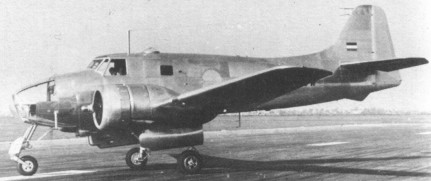
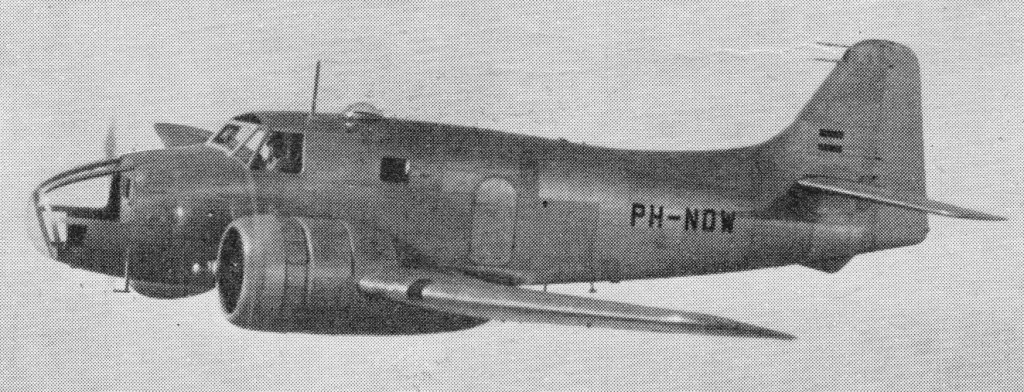
Development of the S.13 was started in 1947. This versatile aircraft could be used to train advanced pilots, navigators, bomb aimers, radio telegraphers and observers. It was also suitable for the training of paratroopers and for aerial mapping. Test pilot Burgerhout made the first flight of the S.13 at Schiphol on March 13th, 1950. An intended order from KLM did not materialise owing to a gift of Beechcraft aeroplanes from America. The sole prototype was used during the flood disaster of February 1953 to photograph the inundated areas.
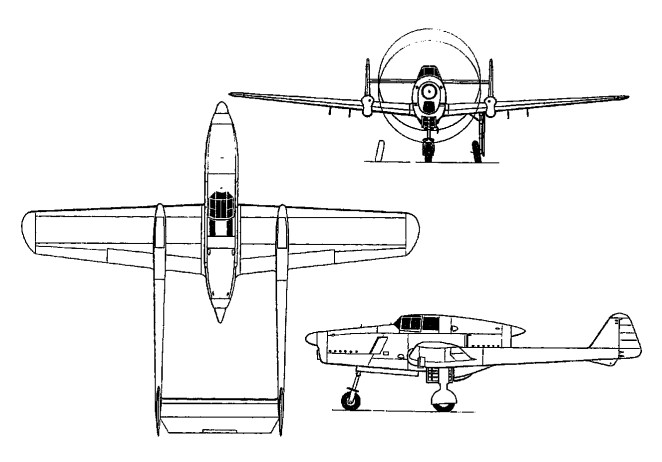
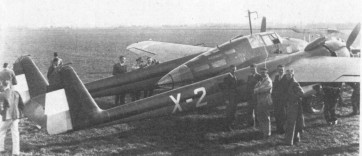
The D XXIII single-seat fighter push-pull prototype was powered by two 528hp Walter Sagitta I-SR engines and flying for the first time on 30 May 1939. Proving an attrac¬tion at the 1938 Paris Air Show, the maximum speed was 520 kph. Versions of the D XXIII were also proposed with Hispano- Suiza 12Xcrs, Junkers Jumo 210G and Rolls-Royce Kestrel XV engines, and although all-metal construction was intended, the prototype was fitted with a wooden wing of greater thickness/chord ratio in order to expedite the test programme. Owing to various problems, including rear engine cooling, only four hours of flight testing had been completed when the invasion of the Netherlands brought the D XXIII development programme to a halt. The proposed armament comprised two 7.9mm and two 13.2mm FN-Browning machine guns.
Engines: two 528hp Walter Sagitta I-SR Max take-off weight: 2950 kg Empty weight: 2180 kg / 4806 lb Wingspan: 11.50 m / 37 ft 9 in Length: 10.20 m / 33 ft 6 in Height: 3.80 m / 12 ft 6 in Wing area: 18.50 sq.m / 199.13 sq ft Max. speed: 525 km/h / 326 mph Cruise speed: 390 km/h / 242 mph
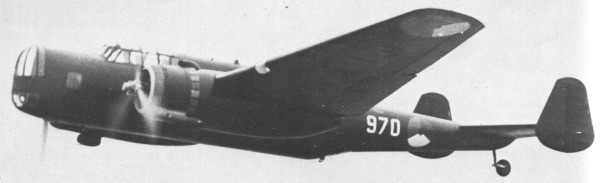
The Fokker T.IX was Fokker’s first all metal bomber and was designed to succeed the Martin bombers used by the Royal Dutch East Indies Army. In September 1939 the T.IX made its maiden flight. It had a maximum speed of 440 kph, an armament of three machine guns, and carried a 2,000kg bomb load. In May 1940 it fell into German hands, but they were only interested in its Bristol Hercules sleeve valve engines. Only the prototype was completed.
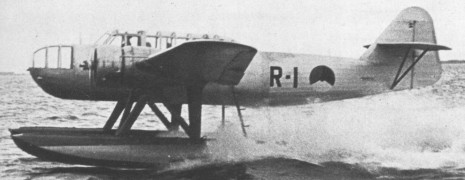
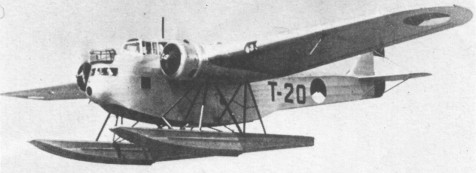
Designed to Netherlands naval air service specifications for a torpedo-bomber/reconnaissance aircraft suitable for home and the Netherlands East Indies service, the Fokker T.VIII-W floatplane was built in three versions. The T.VIII-Wg was of mixed wood and metal construction, the T.VIII-Wm was all metal and the T.VIII-Wc, a larger version of mixed construction.
An initial order for five aircraft was placed, and all were completed by June 1939, when a further batch of 26 was ordered, most of them intended as replacements for T.IVs in the East Indies, but none was delivered there. A total of 36 T.VIII-Ws was built, these comprising 19 T.VIII-Wgs, five T.VIII-Wcs and 12 T.VIII-Wms, the difference of five being accounted for by a Finnish order which was not delivered. These were of the T.VIII-Wc variant which had a 1.83m longer fuselage, 2.01m increase in wing span, an additional 8.00sq.m of wing area, and power provided by 664kW Bristol Mercury XI engines. In the event, the Fokker factory was overrun by the Germans before completion of this order, but the aircraft were finished and subsequently delivered to Germany along with 20 ex-Netherlands navy aircraft. A one-off landplane variant, the T.VIII-L built for Finland, was also seized by the Germans. Eight T.VIII-Ws had been flown to England along with other Dutch floatplanes on 14 May 1940, and on 1 June 1940 No. 320 (Dutch) Squadron RAF was formed at Pembroke Dock, to operate the T.VIII-Ws on convoy escort work. These aircraft carried RAF markings, plus a small Dutch triangle badge. Three of the aircraft were lost, and with no spares available the remaining aircraft were flown to Felixstowe for storage. They were joined by another in May 1941, when four Dutchmen escaped from Amsterdam and brought their T.VIII-W down on the sea near Broad-stairs. German navy operations with their group of T.VIII-Ws were confined mostly to patrol work in the Mediterranean.
T.8-Wg Engine: 2 x Wright Whirlwind R-975-E3, 336kW Max take-off weight: 5000 kg / 11023 lb Empty weight: 3100 kg / 6834 lb Wingspan: 18.0 m / 59 ft 1 in Length: 13.0 m / 42 ft 8 in Height: 5.0 m / 16 ft 5 in Wing area: 44.0 sq.m / 473.61 sq ft Max. speed: 285 km/h / 177 mph Cruise speed: 220 km/h / 137 mph Ceiling: 6800 m / 22300 ft Range: 2750 km / 1709 miles Armament: 2 x 7.9mm machine-guns, 605kg of bombs or one torpedo Crew: 3 Passengers: 6
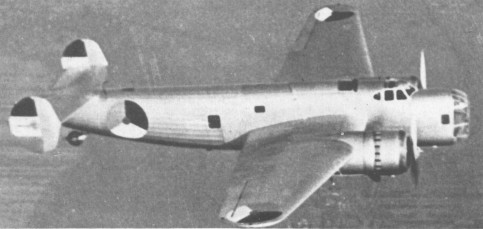
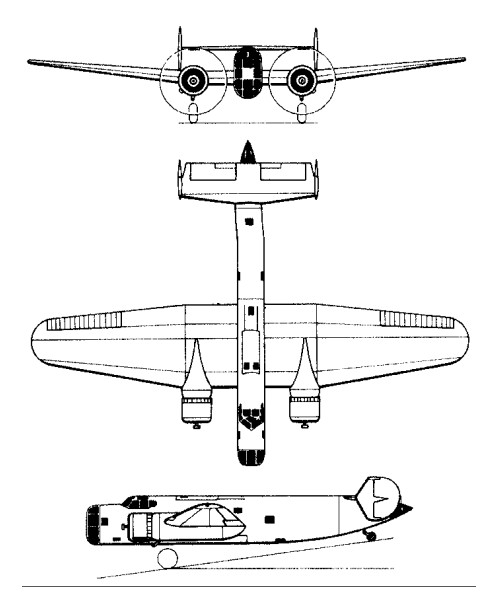
No T.V prototype was built, the first to fly on 16 October 1937 being one of a batch of 16 ordered for the Netherlands air force earlier that year. The aircraft went into service in 1938, with the only Dutch bomber squadron. The type was reasonably well protected by machine-guns and its bombload was carried internally. All 16 aircraft had been delivered before the outbreak of hostilities, but on the day of the German invasion only nine were serviceable. They destroyed almost 30 German aircraft on the ground at Waal-haven airfield and make heavy attacks on the bridges over the Maas before being destroyed (two were shot down by Dutch gunners), and only one T.V survived at the time of the Dutch surrender.
Fokker T.5 Engines: 2 x Bristol Pegasus XXVI, 690kW Take-off weight: 7235 kg / 15951 lb Empty weight: 4640 kg / 10230 lb Wingspan: 21.0 m / 68 ft 11 in Length: 16.0 m / 52 ft 6 in Height: 5.0 m / 16 ft 5 in Wing area: 66.2 sq.m / 712.57 sq ft Max. speed: 415 km/h / 258 mph Cruise speed: 320 km/h / 199 mph Ceiling: 7700 m / 25250 ft Range: 1630 km / 1013 miles Armament: 6 x 7.9mm machine-guns, 1000kg of bombs Crew: 5
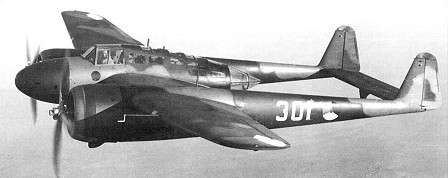
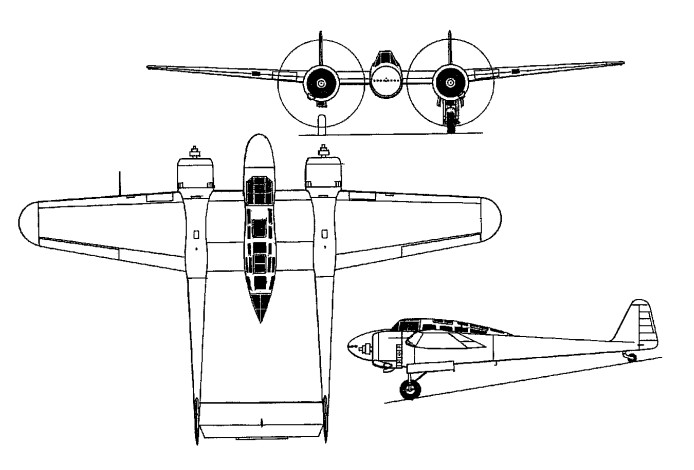
In November 1936 the prototype Fokker G.I heavy fighter was exhibited at the Paris Air Show, a static exhibition in the Grand Palais. The Fokker G.I, a twin engined, two seat aircraft which had been named “Le Faucheur” (The Reaper), had a role as a fighter/reconnaissance and light bomber aircraft.
After the Show, the G.I was taken to Eindhoven/Welschap airfield, from where its first flight was made on 16 March 1937. The G.1 made its maiden flight with two 750 hp Hispano Suiza engines. The Aviation Department objected to the Hispano Suiza engine because their other aircraft had been equipped with the Bristol Mercury. Moreover, the Hispano 80 02 was new and untried.
The G.I engines were changed to similarly rated Pratt & Whitney SB4-G Twin Wasp Juniors during reconstruction, after the G.I suffered brake failure and rammed a hangar at Schiphol on 4 July 1937. Demonstrations had already been given to the Netherlands army air corps at Soesterberg, and considerable interest was shown, resulting at the end of the year in an order for 36 aircraft to be designated G.I Mercury. In order to ease the spares situation, it was stipulated that these must have Bristol Mercury VIII engines. This was a larger version with the armament of two 23mm can¬non and two fixed 7.9mm machine guns, installed in the nose of the aircraft, and a rotatable 7.9mm machine gun in the tail, fitted in a kind of turret. The aircraft can also carry a 400kg bomb load. Its maximum speed is 470km/hr and the radius of action is approximately 1,400km. There is a two man crew. As a reconnaissance aircraft it has a range of 1,600km. The first production aircraft to fly, actually the second of the batch, became airborne only on 11 April 1939. It remained with the makers for production testing and modifications, and the first aircraft was delivered to Soesterberg on 10 July 1939. The G.1 Mercury was armed with a battery of eight 7.92 mm (0.312 in) machine¬guns in the nose of the nacelle, plus another flexibly mounted at the rear, and could carry 300 kg (660 lb) of bombs. Twenty three had been delivered by the time of the German invasion in May 1940, and although they fought well, when the fighting was over only one remained. This was flown to England by two escaping Fokker pilots. Export orders followed the aircraft’s debut at Paris and a number of foreign pilots came to Fokker to fly and evaluate the G.I Mercury export version. Orders were placed by Finland (26), Estonia (9), Sweden (18) and Republican Spain (12), while a licence-production agreement was in negotiation with Denmark and another with Manfred Weiss in Hungary. The Dutch embargo on weapons exports before World War II killed the Spanish order and the Dutch Government took over the aircraft at the end of 1939, but the Finnish batch was under construction when war broke out and a ban was then placed on its export. After lengthy negotiations a contract was drawn up to permit the G.I Mercury’s export on 17 April 1940, by which time 12 had been completed, apart from armament. By the time of the German invasion 12 of the Finnish G.I Mercurys and the nine confiscated Spanish machines were complete but the intended armament of two 23 mm (0.9 in) Madsen cannon and three 7.92 mm (0.312 in) machine guns had not been fitted. When Germany attacked the Netherlands on 10 May 1940, 23 G.ls were in service: 12 with the 4th Fighter Group at Alkmaar and 11 with the 3rd Fighter Group at Rotterdam/Waalhaven. The G.ls were successful in destroying several Junkers Ju 52/3ms during the early stages of the German invasion, but by the fifth day, when Dutch resistance ended, only a single example remained airworthy. The Germans occupied the Fokker factory, ordering completion of the 12 G.ls intended for Finland, and these were used subsequently by the Luftwaffe as fighter trainers. Test flights from the factory were made under German supervision, but on 5 May 1941 two Dutch pilots succeeded in evading an escorting German-flown G.I and escaped to England. Their G.I Mercury was taken to the Royal Aircraft Establishment, Farnborough, for examination, and used subsequently by Phillips and Powis (Miles Aircraft) at Reading for research into wooden construction. A total of 62 G.ls is believed to have been built, and none survived the war.
There never was a G.lA or a G.lB. They were officially clasified by Fokker as G.1 Wasp and G.l Mercury. Dutch air force referring to them as G.lW and G.lM.
Fokker G 1 Mercury Engines: 2 x Bristol Mercury VIII radial, 819 hp / 619kW Max take-off weight: 4800 kg / 10582 lb Empty weight: 3360 kg / 7408 lb Wingspan: 17.15 m / 56 ft 3 in Length: 11.50 m / 37 ft 9 in Height: 3.40 m / 11 ft 2 in Wing area: 38.30 sq.m / 412.26 sq ft Max. speed: 256 kts /475 km/h / 295 mph Cruise speed: 355 km/h / 221 mph Service ceiling: 9300 m / 30500 ft Range: 1400 km / 870 miles Armament: 9 x 7.9mm Madsen machine-guns, 400kg of bombs Crew: 2-3
G.1 Wasp Engines: 2 x 750 hp Pratt & Whitney Twin Wasp Junior.
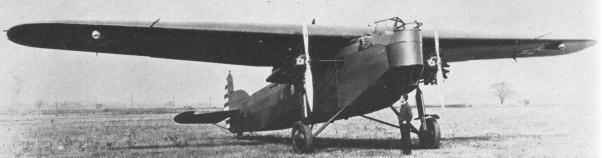
The XLB 2 was a bomber developed by the American Fokker factory and based on the F.VIIBm, the military designation of which was C 2. The XLB 2 had two Pratt & Whitney Hornet radial engines of 525 h.p. each. An observer/bomb aimer, armed with a machine gun, was positioned in the nose.
The T.IV, a large torpedo ¬bomber/scout on floats, was produced for the Naval Air Service in 1927. From 1927 to 1941 12 T-IVs were in service with the Naval Air Service at home and in the Netherlands East Indies. Portugal also acquired three of these aircraft. The T.IVA differed mainly in powerplant, having Wright Cyclone SR-1820-F2 radial engines in place of the T.IV’s 336kW Lorraine-Dietrich W-type engines. The more-powerful units required a strengthened airframe; at the same time an enclosed cockpit, as well as bow, dorsal and ventral gun positions, were installed. Twelve of these new aircraft were ordered for the Netherlands East Indies naval air force, and in 1936 the surviving T.IVs were brought up to T.IVA standard. Coastal and sea reconnaissance operations in the Netherlands East Indies were still being flown when the Japanese invasion began in 1942, and the T.IVA was also used for air-sea rescue work, proving to be reliable and seaworthy.
T.IVA Engines: 2 x Wright Cyclone SR-182.0-F2 radial, 559kW Max take-off weight: 7200 kg / 15873 lb Empty weight: 4665 kg / 10285 lb Wingspan: 26.20 m / 85 ft 11 in Length: 17.60 m / 57 ft 9 in Height: 6.00 m / 19 ft 8 in Wing area: 97.80 sq.m / 1052.71 sq ft Max. speed: 260 km/h / 162 mph Cruise speed: 215 km/h / 134 mph Ceiling: 5900 m / 19350 ft Range: 1560 km / 969 miles Armament: 3 x 7.9mm machine-guns, 800kg of bombs Crew: 4


 All Aero