Fouga CM.88 Gemeaux

Fouga CM.88 Gemeaux Mk. IV

Primarily a flying test aircraft, proposed uses were numerous and made it a real aircraft laboratory. It was a two-seater with 2 Pimene 110 kgf turbojets, which could fly up to 285 km / h with a service ceiling of 7000 meters.

Gemini, as Cyclops and Sylph which it is derived, is of mixed construction, wood and metal.
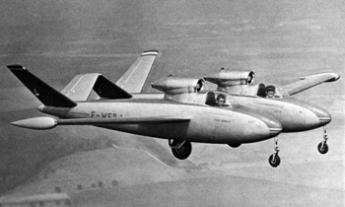
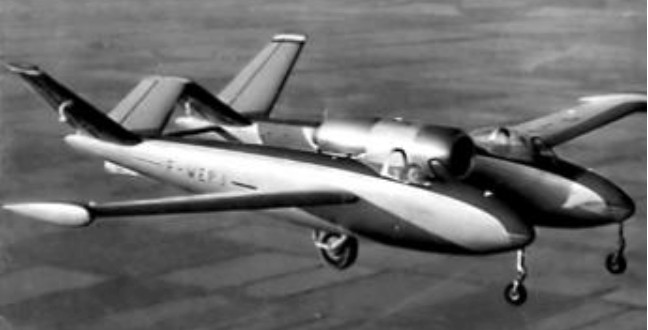
The fuselage has two hulls oval section connected by the central plane. Each body is identical to the Sylphe in its design and its dimensions. Gemini is dual – control, the control station located in the fuselage on the left.

The tail is two juxtaposed butterflies, forming a W, the V 2 not connected (the fuselages interconnected by a fixed horizontal plane).
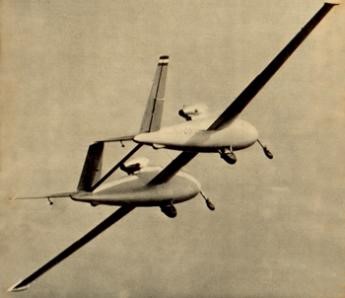
The Gemini Mark I, F- WEPJ, CM 88 R made its first flight on March 6, 1951, at the hands of Leo Bourriau. The first prototype was named “Castor and Pollux”.

The Mark V version with a Turbomeca Aspin II of 360 pounds thrust, made its first flight, piloted by Léon Bourriau, on June 21, 1952.
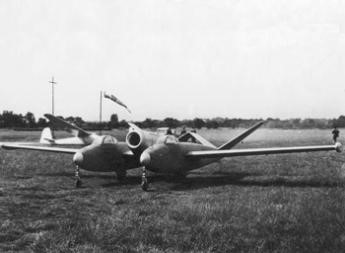
Fouga CM88R – Gemini Mark V

CM.88R Gémeaux I: Mar 1951, 2 x 100 kg Piméné turbojets, aka CM.88.R I
CM.88R Gémeaux II: June 1951, 2 x 300 kg Marboré I, aka CM.88.R II
CM.88R Gémeaux III: Aug 1951, 2 x 380 kg Marboré I, aka CM.88.R III
NB: CM.88.RIII/Gémeaux III was re-engined CM.88.R II/Gémeaux II
CM.88R Gémeaux III: Jan 1952, 2 x 400 kg Marboré I, aka CM.88.R III
CM.88.RIII/Gémeaux III re-engined with 400 kg Marboré II, Jan 1952
CM.88R Gémeaux IV: Nov 1951, 2 x 200 kg Turbomeca Aspin I, aka CM.88.R IV
NB: CM.88.RIV/Gémeaux IV was Gémeaux I re-engined with ducted turbojet
CM.88R Gémeaux IV: June 1952, 2 x 360 kg Turbomeca Aspin II, aka CM.88.R V
NB: CM.88.RV/Gémeaux 5 was CM.88.RIV/Gémeaux IV re-engined with Aspin II

Gallery

Engines: 2 x Turbomeca Piméné
Takeoff thrust: 100 Kg to 35000 rpm
Max thrust. Continue: 90 kg 34300 rpm
Wingspan: 10.76 m
Length: 6.66 m
Height: 1.93 m
Empty weight: 750 kg
Weight equipped: 585 kg
Engine weight: 150 kg
Fuel wight: 180 kg
Equipment: 166 kg
Total weight: 1096 kg
Fuel: Kerosene
Fuel capacity: 3 x 40 lt (wings), 2 x 50 lt (fuselage)
Oil capacity fuselage: 2 x 2 lt
Max speed SL: 285 km / h
Cruise speed (3000 m): 220 km / h
ROC: 3,5 m / s
Ceiling: 7,000m
Endurance: 1h 30 mi
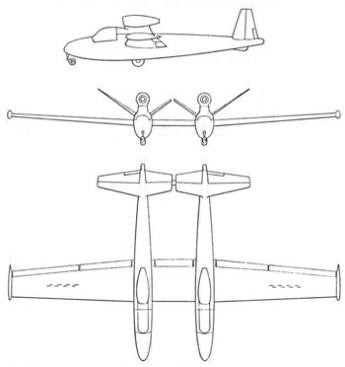
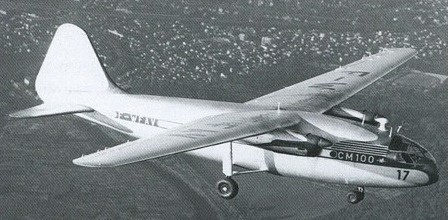
Fouga CM.10 / CM.100 / CM.101R /  Castel-Mauboussin CM.10

CM.100

The Castel-Mauboussin CM.10 transport glider was built for French military forces, also the CM.100 powered version with two Renault engines. In the latter CM-101R Renault engines were augmented by two Turbomeca Pimene turbojets.

CM.10 — 1947 wooden assault glider, 35 troops, 26.96 m span, 2 prototypes
CM.10: Fouga-built glider prototypes evaluated by Armée de terre, 1947
Prod. order for 25 (SNCAN-built) cancelled after crash of CM.10 n° 1
CM.100: 1949 powered vers., 2 x Snecma 12S (As 411), 1 built (F-WFAV)
NB: study begun Nov 1944 for Armée but civil vers. envisioned by SGAC
CM.101R: F-WFAV with added wingtip-mounted Turboméca Piméné turbojets
CM.103R: [Project] military CM.101R variant, 2 x Turboméca Marbore turbojets

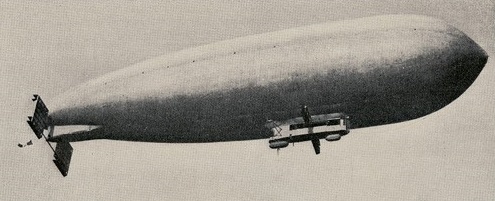
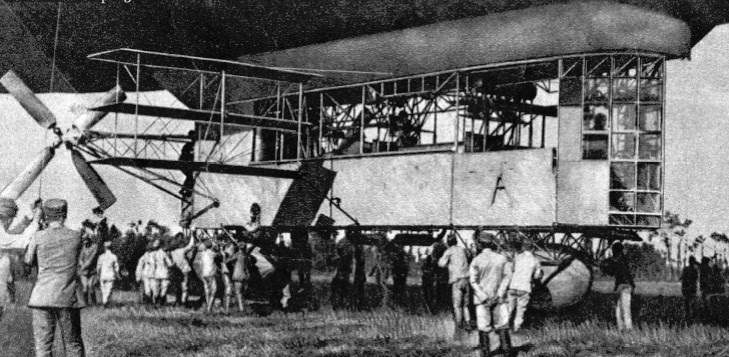
Forlanini F.5

The F.5, ordered by the Army and arriving in 1917, carried a crew of five, full defensive armament, a quantity of bombs, and travelled at an altitude of 6100m (20,000ft).

Of light construction in proportion to its size, the envelope was divided into several compartments with a strong, yet flexible internal keel, which allowed the nacelle to be frmly attached to the hull of the airship.

The F.5 was decommissioned on 6 February 1918, then at Baggio, on the western outskirts of Milan, the F.5 met a firey end when it burnt in is hanger on 25 March 1919.

Propulsion: Two FIAT S.76-A, 250 hp
Props: 4 blade
Volume: 17,783 cu.m / 628,000 cu.ft
Length: 300 feet (91 m)
Maximum width: 66 feet (20 m)
Gas cells: 12
Max speed: 75 kph / 46.6 mph
Diameter: 20m / 65.6 ft
Flight ceiling: 20,000 feet (6,100 m)
Payload: 20,227 lb (9175 kg)
Crew: 5: commander, two officers, two mechanics

Forlanini F.2 / Città di Milano

Enrico Forlanini designed and built a series of dirigibles, notably, in 1912, the Città di Milano, dedicated to his beloved home town. It showed exceptionally good characteristics of stability and controllability that won Forlanini international renown.

The F.2’s gondola was divided in three compartments: the command cabin, passenger cabin, and machine room. For safety all the material was treated with a fire suppressant and the envelope was double-skinned.

A coning tower was situated at the bow connected to a deep, V-shaped keel, which allowed access to the eight separate gas bags and the engine cars in a similar arrangement to the Zeppelins. The gass bags were in turn enclosed within an annular air ballonet positioned between the gas bags and outer cove. The 2 inch air space served the double purpose of acting as a ballonet and as an insulating air cushion to minimisw the effects of external temperature changes on the hydrogen gas.

Owned by the Royal Italian Army (Regio Esercito) and first flown on 17 August 1913, the Città di Milano completed 43 flights.

On 9 April 1914 the Città di Milano made an emergency landing during a storm, then was damaged by trees and terrain while moored. While attempting to deflate gas cells, it caught fire and was destroyed.

Propulsion: Two Isotta Fraschini petrol engine, 80 hp
Volume: 12,000 cu.m / 421,000 cu.ft
Length: 72 m
Gas cells: 12
Maximum speed: 70 km/h / 40 mph
Flight ceiling: 2400 m
Useful payload: 5 tonne

Ford 14-A

Ford 14-A N9660

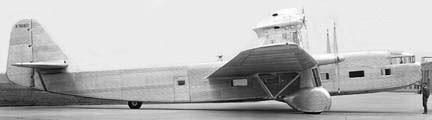
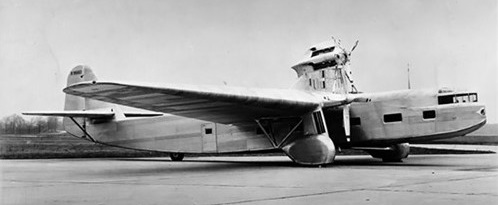
The 1930 10-A design study only went as far as a wind-tunnel model with four engines, two of them pylon-mounted in a tractor-pusher configuration. The design continued in the 12-A of 1931. The 12-A was a modified 10-A design with three engines (planned for 1000hp Hispano-Suiza + two 575hp P&W Hornet). Not built, but design elements went into the 14-A.

The 1932 Ford 14-A, NX9660, involved elements from the 10-A and 12-A designs, and was the last of the Ford Tri-Motors. Pullman-style seats converted into berths in the four main, climate-controlled, eight-passenger compartments. Wing motors, with four-blade propellers, were buried, and the third was pylon-mounted atop the fuselage; compressed air starters.

It was completed by Stout Metal but never flew and was cut up in 1933.

Engines: 2 x 715hp/533-kW Hispano-Suiza, 1 x 1,100-hp/820-kW Hispano-Suiza
Wing span: 110’0″ / 33.5 m
Length: 80’10” / 24.4 m
Seats: 40

Fokker F-100

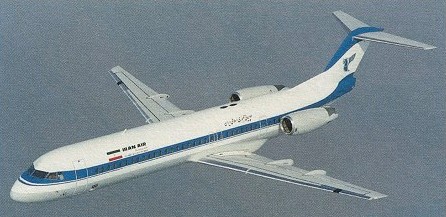
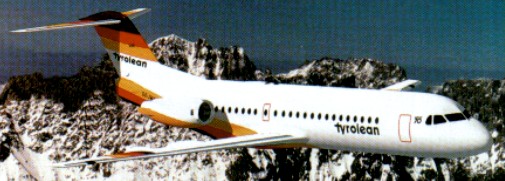
When Fokker announced a successor to the F27 in November 1983, they also launched a similar follow-on to the Fellowship jet airliner. Derived from the proven F28 Mk 4000 airframe, the new aircraft was designated the Fokker 100 roughly reflecting the number of passenger seats offered. Re-engined with new-technology fuel-efficient Rolls-Royce Tay turbofans and with a longer fuselage and redesigned and extended wings, other features include modernised systems incorporating a ‘glass cockpit’ and a revised cabin interior. Production is shared with Deutsche Airbus, Shorts, Grumman, Rolls-Royce and Dowty Rotol, with assembly and flight testing carried out by Fokker at Schiphol. IPTN of Indonesia also supply components.

Fokker F-100 Article

The F100 flight test programme involved two prototypes, the first making its maiden flight on 30 November 1986 followed by the second on 25 February 1987. Certification of the Tay 620-15 powered version was achieved in November 1987 and first customer delivery was made to Swissair in February 1988. The uprated Tay 650 version, ordered by US Air was certificated in July 1989 and delivered to the airline the same month. By mid-1991 Fokker had received orders for 232 F100s and had delivered 70. Options available on Tay 650 aircraft from 1993 include a higher gross weight of 45810kg and an integral wing centre-section fuel tank giving improvements in range between 160 and 450km. Another option available from 1994 will be a quick-change version equipped with a cargo door 3.4 by 1.9m installed on the port side of the fuselage ahead of the wing, together with a specially designed cabin interior. Conversion time (by three men) is claimed to be 20 minutes, enabling 88 passengers to be carried by day and an 11,500kg payload by night over 2800 km.

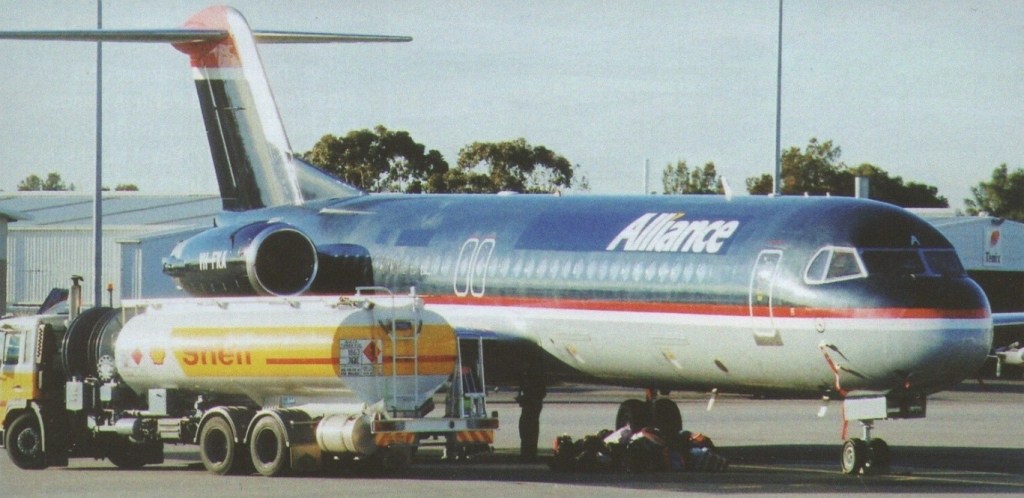
Alliance Airlines Fokker 100 VH-FKA – ex-US Airways – 1988

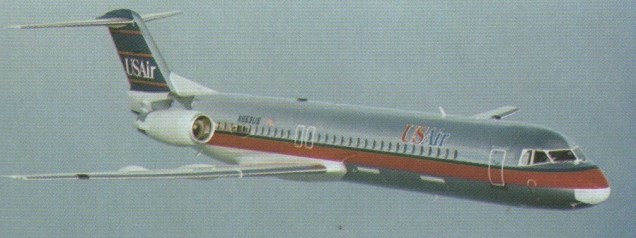
On 24 July 1989 USAir was the launch customer for the Fokker 100.

Rekkof Restart was formed with intention of restarting production of the Fokker 50 and 100, having bought tooling and rented the production factory in 1998.

Engine: 2 x Rolls-Royce Tay 650-15 turbofans, 6849kg
Max take-off weight: 43090 kg / 94998 lb
Empty weight: 24375 kg / 53738 lb
Wingspan: 28.0 m / 91 ft 10 in
Length: 35.5 m / 116 ft 6 in
Height: 8.5 m / 27 ft 11 in
Wing area: 93.5 sq.m / 1006.42 sq ft
Cruise speed: 837 km/h / 520 mph
Ceiling; 10670 m / 35000 ft
Range: 2956 km / 1837 miles
Passengers: 107

Fokker F-50

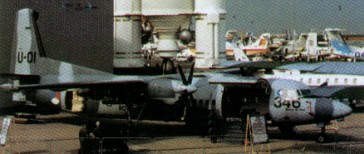
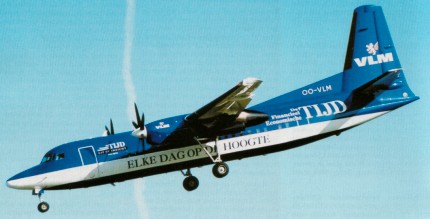
During celebrations held in November 1983 to mark the 25th anniversary of the F27 entering airline service, Fokker announced the launch of a 50-seat follow-on to be known as the Fokker 50. Based on the F27 airframe, but fitted with more fuel-efficient Canadian-built P&W 125B turboprops engines, 12 foot diameter, six-bladed DowtyRotol ‘quiet’ propellers, improved aerodynamics, a redesigned cockpit incorporating digital avionics CRT “glass” cockpit and a new cabin interior, the external differences include extra windows, twin-nosewheel landing gear and upturned wingtips. Much use is made of lighter composite materials, and F50 commonality with the F27 is only 20%.

Fokker F-50 Article

Production is shared with Dassault, Fuji Heavy Industries, Deutsche Airbus, SABCA, Dowty Rotol and Pratt & Whitney Canada with final assembly, systems integration and flight test carried out by Fokker at Schiphol. The first two prototypes were conversions of F27 airframes, with the first (PH-OSO), flying on 28 December 1985 followed by (PH-OSI) on 30 April 1986. The first production aircraft (PH-DMO) flew on 13 February 1987 and first delivery made (to DLT), on 7 August 1987.
By mid-1991 Fokker held firm orders from 18 customers for 132 Fokker 50s, and had delivered 116. The standard production variant was the 46/50-seat Fokker 50-100 and the 1998 build rate was 30 aircraft per year.
Four maritime/surveillance versions of the PW124-powered Fokker 50 supersed the F.27 Maritime models. The Maritime Mk.2 is the standard unarmed maritime patrol version for coastal surveillance and SAR, while the Maritime Enforcer Mk.2 is similar but has provision for external stores to allow ASW/ASV missions to be flown. Both variants are fitted with a Litton APS-140(V) or APS-504(V)5 360o scan search radar. The Enforcer also has a sonobuoy processing system. Intended for border surveillance and stand-off reconnaissance, the Sentinel Mk.2 has a Motorola APS-135(V) slide-looking airborne radar (Slar) under the fuselage. Other systems include a Doppler moving target indicator, a Litton/Itek long-range oblique photography (Lorop) system, and an optional computerised intelligence gathering system. The Kingbird Mk.2 is an AEW version.

Rekkof Restart was formed with intention of restarting production of the Fokker 50 and 100, having bought tooling and rented the production factory in 1998.

Engines: 2 x Pratt & Whitney Canada PW125B turboprops, 1864kW
Max take-off weight: 18990 kg / 41866 lb
Empty weight: 12570 kg / 27712 lb
Wingspan: 29.0 m / 95 ft 2 in
Length: 25.2 m / 82 ft 8 in
Height: 8.3 m / 27 ft 3 in
Wing area: 70.0 sq.m / 753.47 sq ft
Cruise speed: 522 km/h / 324 mph
Ceiling: 7620 m / 25000 ft
Range: 2630 km / 1634 miles
Passengers: 46-58

Maritime Enforcer Mk.2
Engine: 2 x PW124 turboprop.
Installed thrust: 3200 kW.
Span: 29 m.
Length: 23.56 m.
Wing area: 70 sq.m.
Empty wt: 14,100 kg.
MTOW: 21,545 kg.
Warload: 3930 kg.
Max speed: 480 kph.
Initial ROC: 390 m / min.
Ceiling: 7620 m.
T/O run: 1525 m.
Ldg run: 560 m.
Fuel internal: 9322 lt.
Range: 6820 km.
Endurance: 14.4 hr.
Air refuel: No.