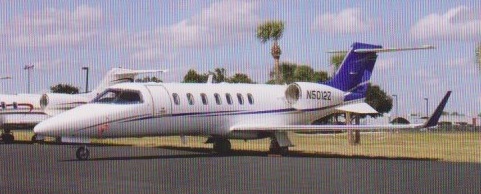
In 2002, Bombardier offered a smaller version of the Learjet 45, the model 40. The aircraft is designed for shorter hops with maximum Lear performance. The Learjet 40 features the same FADEC-equipped Allied Signal engines, all glass cockpit and systems as the Learjet 45, but with a slightly shorter fuselage. The Learjet 40 offers a 36% larger cabin and 35% more range than the Learjet 31 for only a 10% higher price. The 40 can fly with a full passenger load of seven and full fuel. With four passengers, it will travel from New York to Chicago in one hour and 35 minutes.
Engines: 2 x Allied Signal TFE731-20-AR, 15264 N / 1556 kp / 3,500-lb Length: 55.512 ft / 16.92 m Height: 14.14 ft / 4.31 m Cabin height: 4.921 ft / 1.5 m Cabin width: 5.118 ft / 1.56 m Cabin length: 17.717 ft / 5.4 m Wingspan: 47.769 ft / 14.56 m Max take off weight: 20354.4 lb / 9231.0 kg Empty wt: 13,888 lb Max cruise: 464 kt Cruising speed (mach): 0.81 mach Long range cruise: 430 kts Maximum range: 1857 nm / 3439 km Ceiling: 51,000 ft Takeoff distance (50ft): 5,250 ft Landing distance: 2,660 ft Crew: 2 Passengers: 7
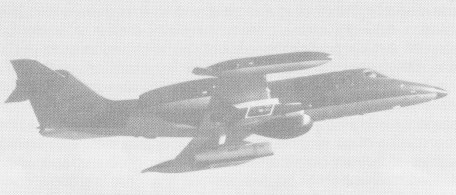
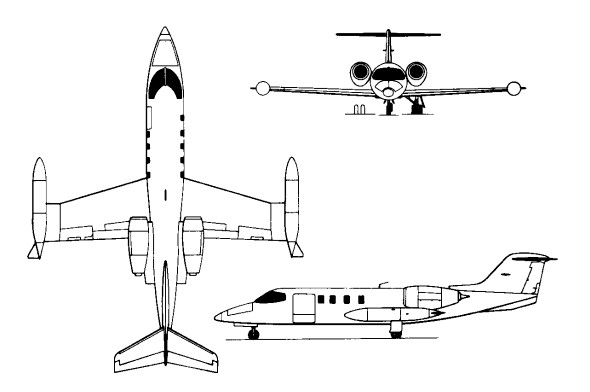
Compared with the Learjet 25s, the new Learjet 35 and Learjet 36 each had a 0.33m increase in length and, a 0.61m extension to each wingtip, outboard of the ailerons. They differed in fuel/seating capacity, the Learjet 36 seating up to six passengers but with the ability to trade two of them for the extra fuel to give non-stop capability across the North Atlantic. The pilot on the first flight of the Learjet 26 (later designated the Learjet 36) with two TFE engines took place on 4 January 1973, piloted by Bob Fisher and Robert Berry. Certification was gained and the first deliveries made in 1974. Two years later golf professional/ pilot Arnold Palmer used a Learjet 36 to establish a new round-the-world class record of 36990km completed in an elapsed time of 57 hours 25 minutes 42 seconds. Gates Learjet expanded the slow speed boundaries of their entire bizjet line by certificating their Century III wing leading edge and flight control system modification. Aircraft with the modification bear the designation “A” following their model numbers. The Century III modifications on model 35s and 36s reduced the stalling speed and gave better low speed flying qualities. The JMSDF has procured a number of Learjet 36As, known as U-36As, for target-towing, sea-skimming-missile simulation, and ECM. These aircraft have an under-fuselage radome for a surveillance radar, a tip-tank-mounted missile seeker simulator, jammer pods, and chaff dispensers. Under-wing stores capability is improved, and maximum take-off weight is increased.
By 1991 around 750 Learjet Model 35/36 variants had been sold, including approximately 200 special mission versions to 20 customers around the world.
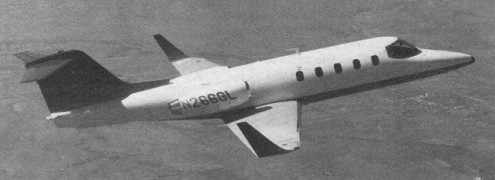
LR-36A Learjet Century III 36A Engines: 2 x Garrett TFE 731-2-2B, 3500 lbs / 1588kg thrust. Length: 14.83 m / 48 ft 8 in Height: 3.73 m / 12 ft 3 in Wingspan: 12.04 m / 39 ft 6 in Wing area: 23.53 sq.m / 253.27 sq ft Wing aspect ratio: 6.2. Maximum ramp weight: 18,550 lbs. Maximum takeoff weight: 18,300 lb / 8301 kg Standard empty weight: 9970 lbs. Maximum useful load: 5850 lbs. Zero-fuel weight: 13,500 lbs. Maximum landing weight: 15,300 lbs. Wing loading: 71.1 lbs/sq.ft. Power loading: 2.6 lbs/lb. Maximum usable fuel: 7440 lbs. Best rate of climb: 4339 fpm Certificated ceiling: 45,000 ft / 13715 m Max pressurisation differential: 9.4 psi. 8000 ft cabin alt @: 45,000 ft. Maximum single-engine rate of climb: 1276 fpm @ 200 kts. Single-engine climb gradient: 387 ft/nm. Single-engine ceiling: 23,500 ft. Maximum speed: 471 kts. Normal cruise @ 41,000ft: 459 kts. Fuel flow @ normal cruise: 889 pph. Stalling speed gear/flaps down: 99 kts. Balanced field length 4,784 ft Seats: 8.
Development by Garrett of the TFE731 turbofan engine, promising lower noise levels and greater fuel economy than the General Electric CJ610 turbojet which had been the standard Learjet engine, led to the Learjet 35 and Learjet 36 introduced in 1973. It had been intended originally to develop additional versions of the Learjet 25 as the Learjet 25B-GF (Garrett fan) and Learjet 25C-GF. A Learjet 25 served as, the engine test-bed, with a 1588kg thrust TFE731-2 engine in the starboard nacelle and the CJ610 retained on the port side. It was flown on 19 May 1971 followed by a second Learjet 25 with two TFE731-2s on 19 May 1971and, on 22 August 1973, the first Learjet 35 took to the air.
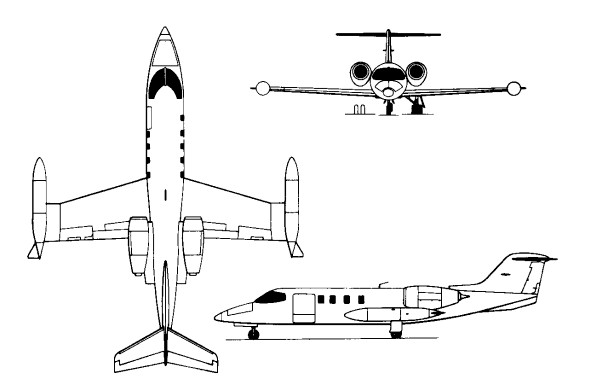
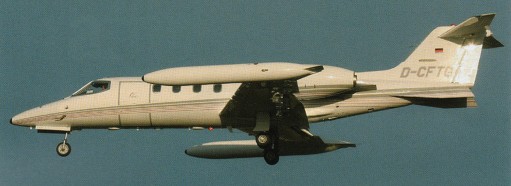
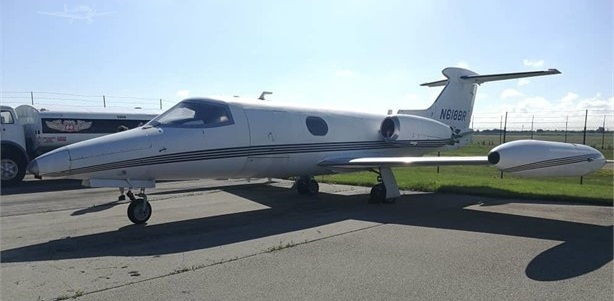
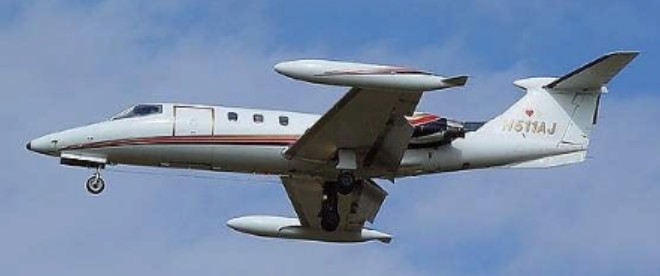
The 35 is a model 25B with a fuselage stretch (13 inches in the cabin), 0.61m increased wingspan outboard of the ailerons and the Garrett (Honeywell) TFE-731-2C engines (certified in 1974), with the 35A having a redesigned wing for better short field and low speed handling. The Model 35A incorporates wing-tip fuel tanks with an overall length of 48 ft 8 in (14,83 m). The engines are 3,500 lb st (15,6 kN) Garrett TFE731-2-211 turbofans. The 35 and 36 differed in fuel/seating capacity, the Learjet 35 carrying a maximum of eight passengers and, with reduced payload, having transcontinental range; and the Learjet 36 seating up to six passengers but with the ability to trade two of them for the extra fuel to give non-stop capability across the North Atlantic. Certification was gained and the first deliveries made in 1974. Gates Learjet expanded the slow speed boundaries of their entire bizjet line by certificating their Century III wing leading edge and flight control system modification. Aircraft with the modification bear the designation “A” following their model numbers. The Century III modifications on model 35s and 36s reduced the stalling speed and gave better low speed flying qualities. With the exception of the aerodynamic improvements to the Learjet wing, the new models introduced in 1976 did not represent profound applications of new technology. Rather, they were predictable examples of evolutionary changes.
The US Air Force leased 83 Model 35As as operational support aircraft between 1984-85 and bought them outright in 1986. These six-to eight-seat light jets are designated C-21A and were joined by four more in 1987, replacing T-39 Sabreliners. Gates offers a wide range of special-mission aircraft for military applica¬tions, based on the Learjet 35A/36A corporate jet. The principal versions are the RC-35A for aerial survey, photography, and reconnaissance with Lorop cameras and Slar; the EC-35A for electronic warfare training, weapons simu-lation, and operational ECM/ESM duties; and the utility UC-35A. In 1979 Gates unveiled a Sea Patrol model of the Lear 35A. Only two airframe mods were necessary to convert the 35A to the Special Missions role. A large belly radome has been fitted, housing the Litton 360 sea surveillance radar, while standard NATO underwing hardpoints have been attached, capable of carrying up to 500 lbs of external stores – sonobuoys, flares, smoke markers or rescue pods. These, plus the vast array of surveillance equipment fitted, has upped the aircraft’s empty weight some 1,300 lbs. APS weight is now 11,600 lb, maximum take-off weight 18,000 lbs. The maximum speed and altitude are down, from 0.83M to 0.79M, and about 5,000 feet from the stock 35A’s 41,000 ceiling, while fuel flow is up about 100 lb/hr. With intercept dash speeds of 480 knots, and long-range patrol cruise of 0.74 Mach (say 430 knots at 31,000ft), the manufacturers claim the Sea Patrol Lear can cover nearly twice the amount of ocean as a slower turboprop. With 6,238 pounds fuel capacity and a typical 1,200 lb/hr consumption from the Garrett turbofans, 4½ hours safe endurance is available at altitude (effectively 2,000 nm), while patrol range at wavetop height is still 1,000 miles. Gates Learjet Corporation reached a major milestone on 28 March 1980 when it delivered the 1,000th Learjet a Century III 35A.
In May 1981 the Fuerza Aerea Argentina took delivery of one Century III Learjet 35A configured for checkking air traffic radio and navigation aids. This was the fifth 35A delivered to the Fuerza Aerea, two being configured as high-altitude photographic aircraft. The Fuerza Aerea Uruguaya took delivery of a single Learjet 35A in March 1981. In September 1986 the USAF announced that the 80 C-2lAs (Learjet 35As) leased from Gates in 1983 as the second element of the Operational Support Aircraft (OSA) programme, were to be purchased outright. The aircraft were delivered between March 1984 and October 1985 to replace CT-39 Sabreliners in the high-priority-transport and other support roles. By 1991 around 750 Learjet Model . 35/36 variants had been sold, including approximately 200 special mission versions to 20 customers around the world.
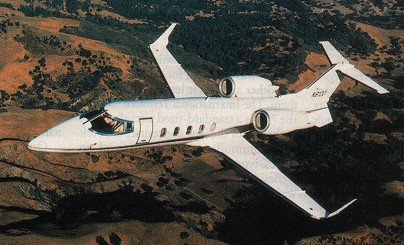
The Model 31 was announced by Learjet in September 1987 and combines the fuselage, eight-passenger cabin and 3,500 lb st (15,6 kN) Garrett TFE731-2-2B turbofans of the Model 35A/36A with a longer span wing with winglets plus the prominent ventral strakes known as Delta-Fins. The Learjet 31 aerodynamic prototype first flew on 11 May 1987 and the type was certificated by the FAA in August 1988. Able to carry seven passengers and two crew over ranges up to 3076km, the LJ31 can cruise at 15545m. Four EFIS-equipped versions were ordered by Singapore Airlines specially configured for crew training (S/Ns 31-033, 31-033A, 31-033C, 31-033D). They were basically LR31’s but with Honeywell EFIS and some of the vertical instruments out of the LR55, and had the ER fuselage tank. By mid-1991, when the type was superseded by the Model 31A and 31A/ER, about 30 had been delivered. The Learjet 31A replaced the earlier aircraft on the Wichita production line in July 1991 and features an integrated digital avionics package, and can also be equipped with a braking parachute installed internally under the tail. The extended-range Learjet 31A/ER is a Model 31A with a higher maximum takeoff weight and able to carry extra fuel.
Learjet 31A Engines: 2 x Garrett TFE731-2 turbofans, 1588kg Max take-off weight: 7030 kg / 15499 lb Empty weight: 4575 kg / 10086 lb Wingspan: 13.3 m / 43 ft 8 in Length: 14.8 m / 48 ft 7 in Height: 3.7 m / 12 ft 2 in Wing area: 24.5 sq.m / 263.72 sq ft Cruise speed: 832 km/h / 517 mph Ceiling: 15545 m / 51000 ft Range: 3076 km / 1911 miles
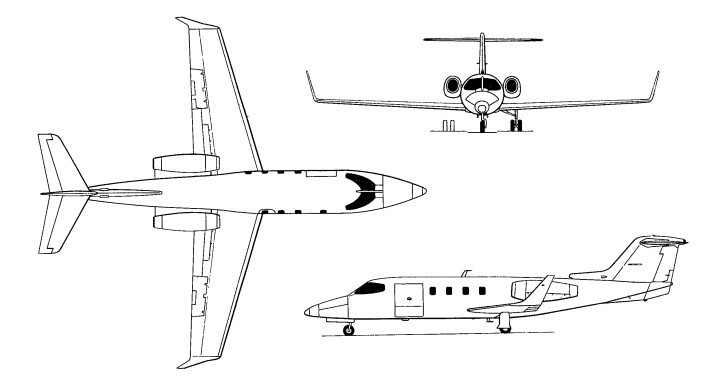
In January 1979 the company gained certification of the Learjet 28 and Learjet 29 Longhorn. Basically similar to the 10-seat Learjet 25D, these two models introduced a new wing of increased span. The introduction of winglets displaced the wingtip fuel tanks of earlier models, which meant that all fuel had to be carried internally. This incorporated a cambered leading edge and supercritical winglets to provide improved performance and cruise efficiency, and 51,000-foot performance. The longer-range Learjet 29 traded two passengers for an additional 379 litres of fuel. A line of five aircraft has been designated Longhorn series. They are the Learjet 28 and Learjet 29, both powered by General Electric turbojets, and the Learjet 54/55/56, and those three are powered by twin Garrett AiResearch fanjets. The wing also has been responsible for significantly improved short-field performance. The balanced field length for the 28/29 series is only 2,520 feet and 3,520 feet for the 54/55/56 series. In addition, the 28/29 is able to climb from takeoff directly to 51,000 feet. Wing manufacturing costs were considered prohibitive against the performance improvements gained and further development of both the Learjet 28 (five built) and 29 (two built) were terminated in August 1982. Around the same time, when sales of the Model 25 had reached 368, production was phased out in favour of the Learjet 35 and 36.
LR-29 Learjet Longhorn 29 First built: 1979. Engines: 2 x General Electric CJ610-8A, 2950 lbs / 1338kg thrust. Seats: 8. Wingspan: 13.35 m / 43 ft 10 in Length: 14.52 m / 47 ft 8 in Height: 3.73 m / 12 ft 3 in Wing area: 265 sq.ft. / 24.57 sq.m Wing aspect ratio: 7.2. Maximum ramp weight: 15,500 lbs. Maximum takeoff weight: 15,000 lb / 6804 kg Standard empty weight: 8924 lbs. Maximum useful load: 6756 lbs. Zero-fuel weight: 11,000 lbs. Maximum landing weight: 14,300 lbs. Wing loading: 56.7 lbs/sq.ft. Power loading: 2.5 lbs/lb. Maximum usable fuel: 5373 lbs. Best rate of climb: 6925 fpm Certificated ceiling: 51,000 ft. Max pressurisation differential: 9.4 psi. 8000 ft cabin alt @: 51,000 ft. Maximum single-engine rate of climb: 2125 fpm @ 220 kts. Single-engine climb gradient: 580 ft/nm. Single-engine ceiling: 29,000 ft. Maximum speed: 477 kts. Normal cruise @ 47,000ft: 448 kts. Fuel flow @ normal cruise: 1047 pph. Stalling speed gear/flaps down: 90 kts. Balanced field length 2,700 ft
In January 1979 the company gained certification of the Learjet 28 and Learjet 29 Longhorn. Basically similar to the 10-seat Learjet 25D, these two models introduced a new wing of increased span. Learjet’s Longhorn series combines a revolutionary wing design, two of the most advanced engines introduced to the market, and 51,000-foot performance. The line of five aircraft has been designated the Learjet 28 and Learjet 29, both powered by General Electric turbojets, and the Learjet 54/55/56, and those three are powered by twin Garrett AiResearch fanjets. All the models are designed with a larger wing incorporating near-vertical winglets that have replaced the traditional Learjet tiptanks. The wing’s increased aspect ratio and super-critical winglets provide substantial aerodynamic improvements that in turn produce greater fuel efficiency and improved flight performance at high and low altitudes. The wing also has been responsible for significantly improved short-field performance. The balanced field length for the 28/29 series is only 2,520 feet and 3,520 feet for the 54/55/56 series. In addition, the 28/29 is able to climb from takeoff directly to 51,000 feet. The Learjet 28 had 10-seat accommodation, but the longer-range Learjet 29 traded two passengers for an additional 379 litres of fuel. However, wing manufacturing costs were considered prohibitive against the performance improvements gained and further development of both the Learjet 28 (five built) and 29 (two built) were terminated in August 1982. Around the same time, when sales of the Model 25 had reached 368, production was phased out in favour of the Learjet 35 and 36.
LR-28 Learjet Longhorn 28 Engines: 2 x General Electric CJ610-8A, 2950 lbs thrust. Seats: 10. Length: 47.6 ft. / 14.52 m Height: 12.3 ft. / 3.73 m Wingspan: 43.8 ft. / 13.34 m Wing area: 265 sq.ft. / 24.6 sq.m Wing aspect ratio: 7.2. Maximum ramp weight: 15,500 lbs. Maximum takeoff weight: 15,000 lbs. Standard empty weight: 8968 lbs. Maximum useful load: 6532 lbs. Zero-fuel weight: 11,000 lbs. Maximum landing weight: 14,300 lbs. Wing loading: 56.7 lbs/sq.ft. / 277.0 kg/sq.m Power loading: 2.5 lbs/lb. Maximum usable fuel: 4684 lbs. Best rate of climb: 6925 fpm. Certificated ceiling: 51,000 ft. Max pressurisation differential: 9.4 psi. 8000 ft cabin alt @: 51,000 ft. Maximum single-engine rate of climb: 2125 fpm @ 220 kts. Single-engine climb gradient: 580 ft/nm. Single-engine ceiling: 29,000 ft. Maximum speed: 477 kts. Normal cruise @ 47,000ft: 448 kts. Fuel flow @ normal cruise: 1047 pph. Stalling speed gear/flaps down: 90 kts. Balanced field length 2,520ft
The Learjet 25, first flown in prototype form on 12 August 1966, was basically a Learjet 24 incorporating a fuselage stretch of 1.27m to provide seating for the crew of two and eight passengers. The Lear 25 set the time-to-climb record to 40,000 ft at 6 min 19 sec. Certificated on 10 October 1967, it was followed by improved Learjet 25B and Learjet 25C models in late 1970, the latter having additional 193 USG fuel capacity; thus, the Learjet 25B and Learjet 25C corresponded respectively to the Learjet 24E and Learjet 24F. Gates certified its Century III 24/25 Learjets to cruise at 51,000 feet, higher by 5,900 feet than the max for any other FAA certified commercial aircraft. Since pressurization failure at that altitude could be fatal no matter how enthusiastic one’s emergency descent were, the FAA’s certification tests were the same ones they’d planned to give the abortive Boeing SST¬ including firing pistols point blank at the cabin windows. In 1976 incorporation of the new cambered wing and aerodynamic improvements introduced simultaneously on the Learjet 24 models resulted in new Learjet 25D and Learjet 25F versions of the basic Learjet 25 and, similarly, all four Learjets became available later with General Electric CJ610-8A turbojets certificated for operation at an altitude of 15545m. In addition to civil operations, a number of Learjet 25s were acquired by air arms, including those of Argentina, Bolivia, Ecuador, Mexico, Peru and Yugoslavia. Their primary role in most cases was for high-altitude photography and remote sensing, with a large single or dual integral camera pod just forward of the wing. Such aircraft were convertible easily for high-speed cargo or VIP transport duties. Manufacture of the Learjet 25F ended during 1979, but the Learjet 25D continued to be built until August 1982, when sales of the Model 25 had reached 368, when the growing recession in the aircraft industry caused its production to be suspended indefinitely in favour of the Learjet 35 and 36.
LR-25 Engines: 2 x GE CJ610-6.
LR-25B
LR-25C Engines: 2 x General Electric CJ610 6 turbojets, 2,950 lbs thrust each. Length: 47 ft 7 in. Wingspan: 35 ft 7 in. Speed: 545 mph. Ceiling: 45,000 ft. Range: 2,550 mls.
Lear 25D Engines: 2 x GE CJ610-6, 2950 lb. Seats: 10. Wing loading: 64.7 lb/sq.ft. Pwr loading: 2.54 lb/lb. Max TO wt: 15,000 lb. Operating wt: 8055 lb. Equipped useful load: 6945 lb. Payload max fuel: 847 lb. Zero fuel wt: 11,400 lb. Range max fuel/cruise: 1635 nm/3.5 hr. Range max fuel / range: 1818 nm/ 4.4 hr. Service ceiling: 45,000 ft. Max cruise: 464 kt. Max range cruise: 418 kt. Vmc: 102 kt. Stall: 93-118 kt. 1.3 Vso: 121 kt. ROC: 6300 fpm. SE ROC: 1725 fpm @ 220 kt. SE Service ceiling: 23,500 ft. BFL: 3937 ft. Cabin press: 8.9 psi. Fuel cap: 6098 lb.
LR-25D Learjet Century III 25D Engines: 2 x General Electric CJ610-8A, 2950 lbs thrust. Seats: 10. Length: 47.6 ft. Height: 12.3 ft. Wingspan: 35.6 ft. Wing area: 232 sq.ft. Wing aspect ratio: 5.5. Maximum ramp weight: 15,500 lbs. Maximum takeoff weight: 15,000 lbs. Standard empty weight: 8350 lbs. Maximum useful load: 7150 lbs. Zero-fuel weight: 11,400 lbs. Maximum landing weight: 13,300 lbs. Wing loading: 64.7 lbs/sq.ft. Power loading: 2.5 lbs/lb. Maximum usable fuel: 6098 lbs. Best rate of climb: 6830. Certificated ceiling: 51,000 ft. Max pressurisation differential: 9.4 psi. 8000 ft cabin alt @: 51,000 ft. Maximum single-engine rate of climb: 1910 fpm @ 220 kts. Single-engine climb gradient: 521 ft/nm. Single-engine ceiling: 23,500 ft. Maximum speed: 475 kts. Normal cruise @ 41,000ft: 452 kts. Fuel flow @ normal cruise: 1088 pph. Stalling speed gear/flaps down: 97 kts.
Lear 25F Engines: 2 x GE CJ610-6, 2950 lb. Seats: 8. Wing loading: 64.7 lb/sq.ft. Pwr loading: 2.54 lb/lb. Max TO wt: 15,000 lb. Operating wt: 7990 lb. Equipped useful load: 7010 lb. Payload max fuel: 0 lb. Zero fuel wt: 11,400 lb. Range max fuel/cruise: 1913 nm/4.1 hr. Range max fuel / range: 2152 nm/ 5.2 hr. Service ceiling: 45,000 ft. Max cruise: 464 kt. Max range cruise: 418 kt. Vmc: 102 kt. Stall: 93-118 kt. 1.3 Vso: 121 kt. ROC: 6300 fpm. SE ROC: 1725 fpm @ 220 kt. SE Service ceiling: 23,500 ft. BFL: 3937 ft. Cabin press: 8.9 psi. Fuel cap: 7391 lb.
LR-25G Learjet Century III 25G Engines: 2 x General Electric CJ610-8A, 2950 lbs thrust. Seats: 10. Length: 47.6 ft. Height: 12.3 ft. Wingspan: 35.6 ft. Wing area: 232 sq.ft. Wing aspect ratio: 5.5. Maximum ramp weight: 16,500 lbs. Maximum takeoff weight: 16,000 lbs. Standard empty weight: 8650 lbs. Maximum useful load: 7850 lbs. Zero-fuel weight: 11,400 lbs. Maximum landing weight: 13,300 lbs. Wing loading: 71.1 lbs/sq.ft. Power loading: 2.8 lbs/lb. Maximum usable fuel: 6638 lbs. Best rate of climb: 5720. Certificated ceiling: 51,000 ft. Max pressurisation differential: 9.4 psi. 8000 ft cabin alt @: 51,000 ft. Maximum speed: 464 kts. Normal cruise @ 41,000ft: 452 kts.
The 5670kg gross weight limit to which the Lear Jet 23 had been developed proved in practice to be an unnecessary constraint. Most operators were already using two-man crews and, subsequently, CAB licensing requirements for low-capacity jet aircraft were eased. This allowed Lear to take advantage of the basic strength of the design to develop a new version, to FAR.25 standards, with a gross weight of 6123kg. Announced in October 1965, the Learjet 24 introduced among other improvements increased cabin pressurisation for operation at higher altitude.
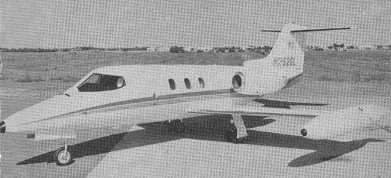
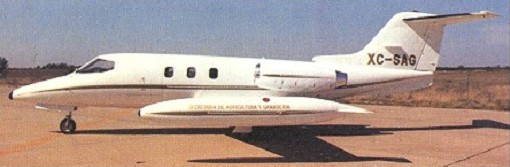
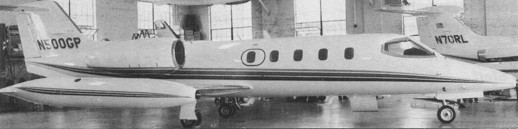
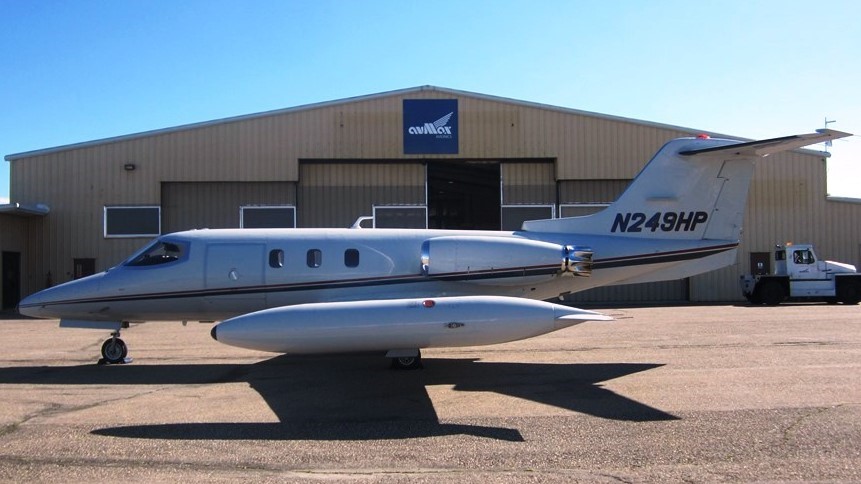
Distinguishing a Model 23 from a 24, however, is tougher, mainly because most of the changes were internal (im¬provements in the various systems) and on paper (weight and performance num¬bers). The two most obvious external dif¬ferences are the vortex generators¬small metal tabs that project above the wing ahead of the ailerons and the windshield. A Model 23 has a set of vor¬tex generators on the underside of the wing as well as the upper surface; 24s have them only on the upper surface. The Model 24’s windshield, befitting a transport category airplane, is a bird ¬proof design with a T shaped stiffener on the vertical post separating the two halves; if this stiffener is missing, you are looking at a Model 23. The factory’s rec¬ords, in 1978, indicated that 12 of the 88 Model 23s still flying were Model 24s in every respect except serial number.) The first Learjet 24 was flown on 24 February 1966 and gained certification the following month. In 1967 Bill Lear’s holdings in Lear Jet Corporation were acquired by the Gates Rubber Company. As a result, in January 1970 the Lear Jet Corporation was renamed the Gates Learjet Corporation. A year earlier the company had started delivery of a new Learjet 24B, differing primarily by having uprated 1338kg thrust General Electric CJ610-6 engines giving an additional 100 lb thrust over the -4. The Lear 24B was certified in 1969.
A lighter-weight Learjet 24C was then under development, but this was abandoned in December 1970 in favour of the Learjet 24D. This offered greater range as a result of increased fuel capacity and certification for operation at a higher gross weight. It was recognisable externally by deletion of the non-structural bullet at the junction of the horizontal and vertical tail surfaces and by having square instead of oval cabin windows. A Model 24D/A was also available with take-off weight restricted to 5669kg.
Lear 24D
In 1976 these two versions were superseded by the Learjet 24E and Learjet 24F, introducing a new cambered wing and aerodynamic improvements to reduce stall and approach speeds. Although the two models were generally similar, the Learjet 24F differed by having almost 18 per cent greater fuel capacity. Production of the Learjet 24E was terminated during 1979, and that of the Learjet 24F during 1980, 258 model 24s having been built. The improved model 24 with airline transport category certification was introduced, and in 1968, a stretched 10-seat model 25 was offered. This aircraft has the most exceptional climb rate in its class. The All Learjets are approved for operation at 45,000 feet, and they have much better short-field performance than is common in this category of aircraft. One reason for the climb and takeoff advantage is weight: The model 23, which needs only 2,300 feet to clear a 50-foot obstacle at gross-weight takeoff, weighs only 6,500 pounds empty and grosses at 12,500 pounds. It can fly at 26,000 feet with one engine inoperable. Gates certified its Century III 24/25 Learjets to cruise at 51,000 feet, higher by 5,900 feet than the max for any other FAA certified commercial aircraft. Since pressurization failure at that altitude could be fatal no matter how enthusiastic one’s emergency descent were, the FAA’s certification tests were the same ones they’d planned to give the abortive Boeing SST including firing pistols point blank at the cabin windows.
LR-24 Engine: GE CJ601-4. MTOW: 13000 lb. Max cruise alt: 45,000ft.
LR-24B Engines: 2 x GE CJ610-6. MTOW: 13,500 lb.
Lear 24D Maximum Take-off Weight: 13,500 lb Maximum Landing Weight: 11,880 lb Maximum Zero Fuel Weight: 11,400 lb Basic Empty Weight: 7,281 lb
Lear 24E Engines: 2 x General Electric CJ610-6, 2950 lb. Seats: 8. Wing loading: 55.6 lb/sq.ft. Pwr loading: 2.19 lb/lb. Max TO wt: 12,900 lb. Operating wt: 7440 lb. Equipped useful load: 5420 lb. Payload max fuel: 692 lb. Zero fuel wt: 11,400 lb. Range max fuel/cruise: 1171 nm/2.5 hr. Range max fuel / range: 1442 nm/ 3.5 hr. Service ceiling: 45,000 ft. Max cruise: 464 kt. Max range cruise: 418 kt. Vmc: 103 kt. Stall: 88-116 kt. 1.3 Vso: 114 kt. ROC: 7220 fpm. SE ROC: 2225 fpm @ 220 kt. SE Service ceiling: 28,500 ft. BFL: 3000 ft. Cabin press: 8.9 psi. Fuel cap: 4791 lb.
Lear 24F Engines: 2 x GE CJ610-6, 2950 lb. Seats: 8. Length: 43 ft 3 in. Wing loading: 58.3 lb/sq.ft. Pwr loading: 2.29 lb/lb. Max TO wt: 13,500 lb. Operating wt: 7545 lb. Equipped useful load: 5955 lb. Payload max fuel: 327 lb. Zero fuel wt: 11,400 lb. Range max fuel/cruise: 1403 nm/3 hr. Range max fuel / range: 1651 nm/ 4 hr. Service ceiling: 45,000 ft. Max cruise: 464 kt. Max range cruise: 418 kt. Vmc: 103 kt. Stall: 88-118 kt. 1.3 Vso: 114 kt. ROC: 7100 fpm. SE ROC: 2050 fpm @ 220 kt. SE Service ceiling: 27,000 ft. BFL: 3297 ft. Cabin press: 8.9 psi. Fuel cap: 5628 lb.
Learjet 24F Engines: 2 x General Electric CJ610-8A turbojets, 1338kg Wingspan: 10.85 m / 35 ft 7 in Length: 13.18 m / 43 ft 3 in Height: 3.73 m / 12 ft 3 in Wing area: 21.53 sq.m / 231.75 sq ft Max take-off weight: 6123 kg / 13499 lb Empty weight: 3204 kg / 7064 lb Max. speed: 880 km/h / 547 mph Cruise speed: 793 km/h / 493 mph Ceiling: 15545 m / 51000 ft Range: 2731 km / 1697 miles
Bill Lear Snr saw the cancelled Swiss FFA P-16 jet fighter as a basis for a twin-jet executive aircraft. He initiated preliminary design work at St Gallen, Switzerland, in November 1959 and sold his electronics company to the Siegler Corporation.
Using the basic design of the P 16’s wing, large tip fuel tanks and cruciform tail (hard tooling for which already existed), designed a compact fuselage that held two pilots and seven passengers. The engines were to be the civilian version of the military¬ proven General Electric J 85, which put out 2,850 pounds of thrust.
But the project soon bogged down, partly because of the Swiss Government’s rigidly structured bureaucracy and partly because Lear found himself constantly at odds with people who literally and figuratively didn’t speak his language. The final nail in the coffin may have been the Government’s attempt to tax the project before there was even sheet metal in the jigs. By early 1962, Lear was making arrangements to return to the U.S.
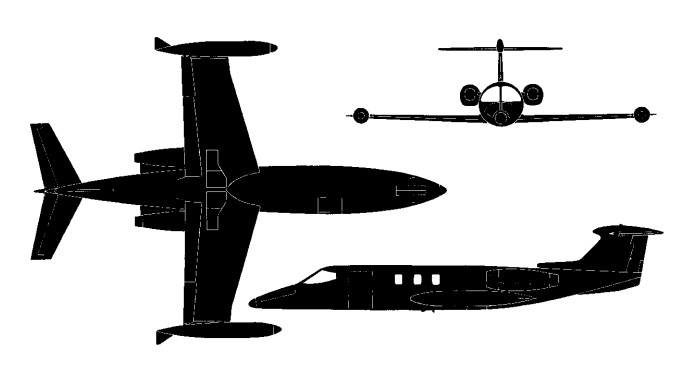
The SAAC designation was left behind, and the airplane became known simply as the Lear Jet Model 23. While the competition featured cabins that were similiar in size to existing corporate aircraft, Lear produced a smaller, circular cross section that was both light and very strong.
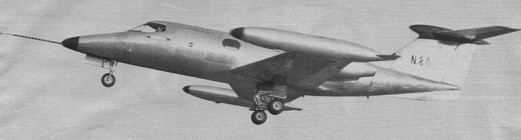
When the number one airplane was still a few months from its first flight, Lear heard rumblings about the cruciform tail: some engineers doubted that the elevator, with its fixed horizontal stabilizer, would be able to hold up the nose in forward CG. Lear put the project behind schedule in order to install a T tail.
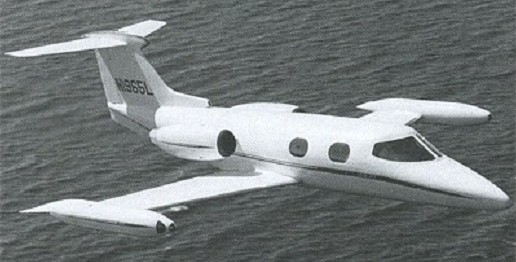
The prototype Lear Jet Model 23 (N801L) flew on 7 October 1963. Lear had hoped to save time by obtaining the type certificate under FAR Part 23 (the rules for aircraft under 12,500 pounds gross weight) rather than the more stringent Part 25, which governs transport category aircraft. But the Wichita FAA, then not very familiar with jets, tacked on some additional requirements that threatened to slow down certification. In reality, the airplane met or exceeded the most important of Part 25 criteria; the main exception was the bird proof windshield, later added as part of the changeover to the Model 24.
One of the FAAs additions required that Lear establish balanced field lengths; and it was here that disaster struck. Testing for single engine climb performance, with an FAA test pilot in the left seat and Lear’s pilot in the right, N801 Lima left the ground with one engine actually shut down (normally not done until the very end of the testing phase) and the spoilers inadvertently extended. In this configuration, it was something of a miracle that the airplane flew at all; as it was, even with the gear retracted, it refused to climb much beyond ground effect, and it just managed to clear some trees at the end of the field.
In the cockpit, meanwhile, confusion reigned: an engine restart was unsuccessful because of improper procedure, and neither pilot thought to check spoiler position. Soon the airplane began to settle slowly and, with a field just ahead, the pilots elected to put the gear down and ride it in. The loss of this prototype should have been a crippling blow.
The second and third prototype aircraft being first flown on 5 March and 15 May 1964 respectively. On July 31, 1964, less than two months after the accident and nine and a half months from the Lear Jet’s first flight, FAA Administrator Najeeb Halaby personally flew to Wichita to present the type certificate to Lear. The provisional airworthiness certificate took the plane out of the experimental class and authorised flights anywhere in the US for demonstration and service testing. Bill Lear promptly flew his jet to New York in 2 hr 21 min. The planned price of the Lear 23 was $575,000.
The first production Lear Jet was rolled out 20 months after ground was broken for the factory. Built in 135 days, it was delivered to the Rexall Drug & Chemical Corp of Cincinnati, Ohio, on 13 October 1964.
A new wing, incorporating milled skins to replace the use of built up material, was added at the 20th plane on the Lear Jet production line at Wichita.
Lear increased production to 10 airplanes per month. While the plant was being expanded, he began work on re-certifying the airplane under Part 25 (this later became the Model 24), developing a stretched version (the Model 25).
In 1965 a Lear 23 established a Los Angeles to New York and return record of 10 hrs 52 min flying time, and a time-to-climb record to 40,000 ft – 7 min 21 sec – with seven people on board.
Distinguishing a Model 23 from a 24, however, is tougher, mainly because most of the changes were internal (improvements in the various systems) and on paper (weight and performance numbers). The two most obvious external differences are the vortex generators¬small metal tabs that project above the wing ahead of the ailerons and the windshield. A Model 23 has a set of vortex generators on the underside of the wing as well as the upper surface; 24s have them only on the upper surface. The Model 24’s windshield, befitting a transport category airplane, is a bird proof design with a T shaped stiffener on the vertical post separating the two halves; if this stiffener is missing, you are looking at a Model 23. The factory’s records, in 1978, indicated that 12 of the 88 Model 23s still flying were Model 24s in every respect except serial number.)
Intended for single-pilot operation the basic layout was for a crew of two and for five to seven passengers. There were 104 Model 23s built, although the serial numbers only run from 001 through 099. The difference is five A models, the existence of which stems from the backlog of orders just after the airplane received its type certificate. Lear, during the course of a normal day’s wheeling and dealing, would promise yet another airplane to a special customer. To keep this person from having to wait a year for delivery, Lear would sneak him in at the head of the line by creating an A model and bumping all the numbers back one.
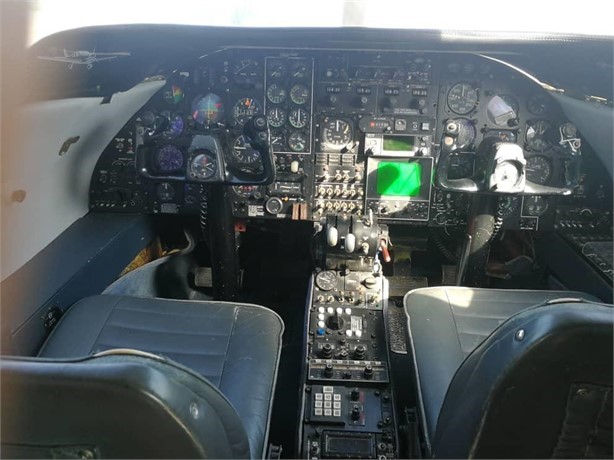
In those days, there was no such thing as a standard Learjet. True, the basic airframe/engine combination had been frozen by the type certificate, but the systems and, in particular, the instrument panel were considered fair game for new ideas. The first 30 production aircraft to be completed were powered by 1293kg thrust General Electric CJ610-1 turbojets, but the remainder of the production run of a little over 100 Lear Jet 23s had CJ610-4s of similar thrust. To Lear, all Learjets, even those brought in for routine maintenance, were prototypes. As a result, pilots about to fly an airplane only a few serial numbers away from their usual one still had to take time to locate switches in the cockpit. The first 14 air¬planes provide the most extreme example of this. They all had left hand control panels, so confident was Lear that single pilot certification was just around the corner. 012 set three official world records during a round robin flight between Los Angeles and New York, making the trip in 10 hours and 21 minutes, with two refueling stops. 055 set a time to climb record. With seven people on board, it went to 40,000 feet in seven minutes and 21 seconds, a record that later fell to a Model 25.
Several Model 23s have passed the 10,000 hour mark.
Engine: 2 x GE CJ610-1. MTOW: 12,500 lb.
Engine: 2 x General Electric CJ610-4 turbojets, 1293kg Max take-off weight: 5670 kg / 12500 lb Empty weight: 2790 kg / 6151 lb Wingspan: 10.85 m / 35 ft 7 in Length: 13.18 m / 43 ft 3 in Height: 3.84 m / 12 ft 7 in Wing area: 21.46 sq.m / 230.99 sq ft Max. speed: 903 km/h / 561 mph Cruise speed: 781 km/h / 485 mph Ceiling: 13715 m / 45000 ft Range: 2945 km / 1830 miles ROC: 6,900 fpm.
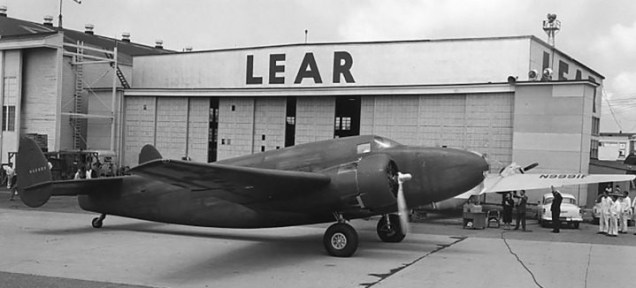
Shortly after World War II, Bill Lear bought a fleet of Lodestars. In 1953, Gordon Israel signed on with William Lear to redesign the Lockheed Lodestar into the Learstar executive transport. Lear tinkered with their noses and streamlined the fuselages. He added fairings to the landing gear and beefed up the horsepower. Lear’s new plane was one of the first truly executive aircraft, and Lear guaranteed a 300 mph cruise speed for businessmen who were in a hurry.
When the Learstar was finished, it was 52 knots faster than the stock Lockheed, and Lear eventually sold 72 of the big long range twins, one of them going to the Krupps of Germany on a delivery flight that went from Santa Monica to Dosseldorf, Germany with only one stop, at Frobisher.


 All Aero