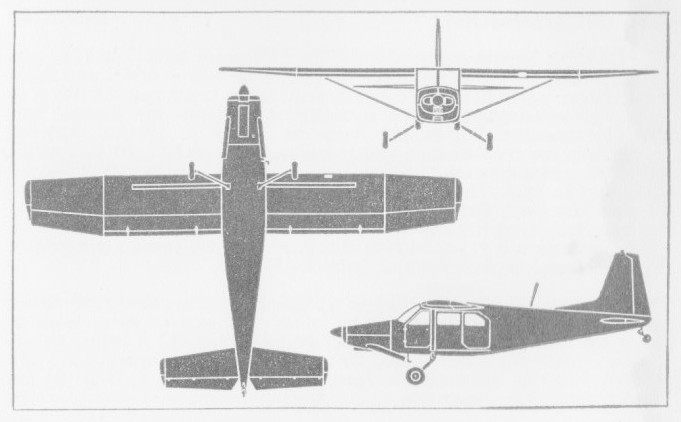
Designed for the Italian air force as an introductory trainer. The MB.308 first entered production in 1947 with either the 85 hp Continental C85 or 90 hp C90 engine.
The MB.308 is of wood construction with plywood and fabric covering.
Eighty MB.308s were acquired by the Italian Air Force and subsequently leased to Italian clubs.
The three-seat MB.308G featured the C90 engine and additional cabin windows. The MB.308G was manufactured under licence in Argentina by German Bianco SA from 1958, along with te MB.308-100 model with a 100 hp Continental O-200-A engine.
Engine: Continental C-85, 85 hp Cruise: 90 kt. Endurance: 5 hr. Range: 700 km.
Engine: Continental C90-12F, 90 hp Wingspan: 32 ft 9 in Length: 21 ft 5 in Height: 7 ft 1.5 in Wing area: 169.2 sq.ft Empty weight: 948 lb Normal loaded weight: 1540 lb MTOW: 1610 lb Max speed: 124 mph at 3280 ft Max cruise 70%: 106 mph Time to 3280 ft: 5 min Service ceiling: 13,120 ft Max range: 445 mi Range ax payload: 370 mi Endurance: 4 hr 45 min
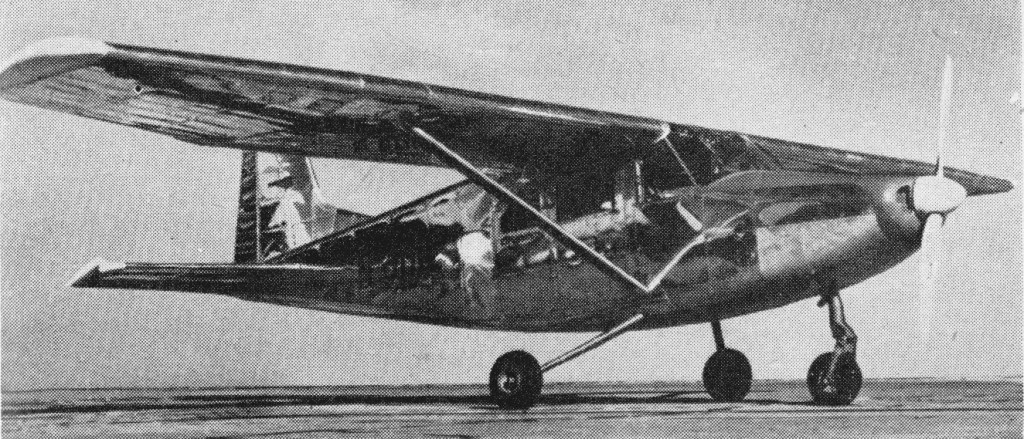
Under the Lockheed name, designed by the Mooney brothers as a single-engine light transport aircraft in the same general class as the Cessna 180-185, it made extensive use of castings and forgings for ruggedness and simplicity. The wing is NACA 23016 at the root and NACA 4412 at the tip. Lockheed flew the first prototype on 15 September 1959. As its massive overheads in its main factories would price the six-seat aircraft out of its intended market, Lockheed looked for licensees in other countries for production. A new factility was purpose-built for Lockheed-Azcarate SA at San Luis Potosi, Mexico, where the LASA-60 was produced.
The prototype Lockheed-Azcarate LASA 60 was certificated early in 1960, and registered in Mexico.
The first Mexican built LASA-60 flew on 21 March 1961. Eighteen LASA 60 built in Mexico in 1960 were for the Fuerza Aerea Mexicana until the withdrawal of that type in 1968 69. They were delivered to the Mexican Air Force’s No.209 Search and Rescue Squadron.
Plans for manufacture by Lockheed-Kaiser in Argentina were abandoned. The main licencee was Italy’s Aermacchi who acquired exclusive manufacturing rights.
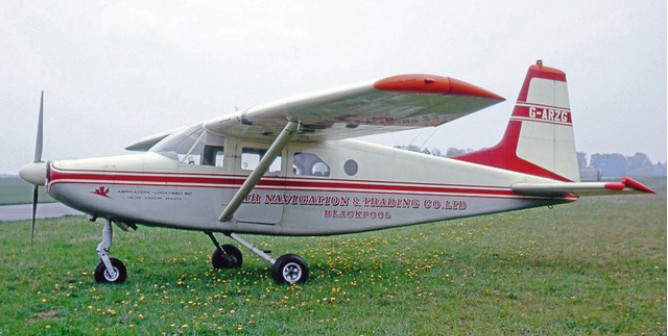
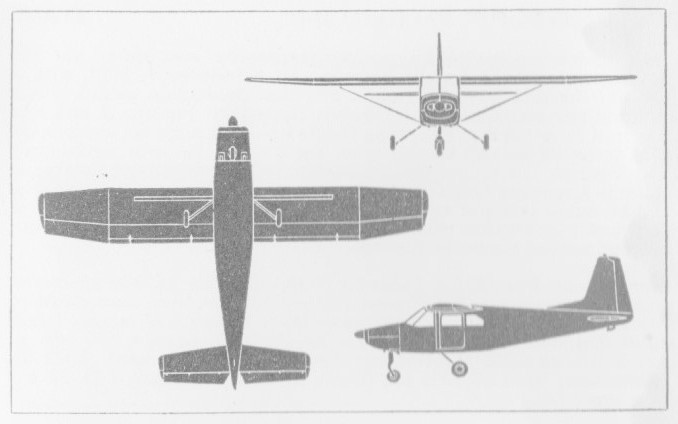
Designated AL,60, the first Aermacchi-built aircraft flew on 19 April 1961, the basic production model being the AL 60B-1.
The AL 60B-2 was powered by a turbo-supercharged 260 hp Continental TSIO-470-B engine.
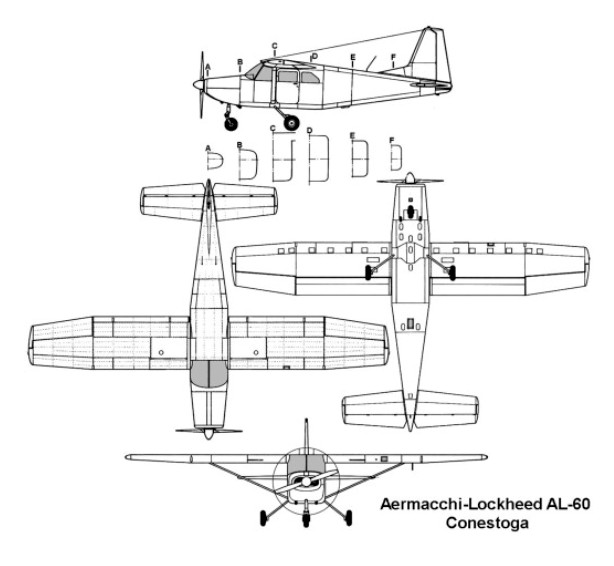
The AL.60C featured an up-rated engine and a parachute door. Flown for the first time in prototype form in early 1963, the AL 60C-4 the C-4 featured a tail wheel undercarriage and was the most powerful yet flown. The AL 60C-4 evolved to meet Italian Air Force requirements for parachute training, the dropping of supplies, and a sturdier undercarriage for rough field operation. Accommodating up to six persons, the AL 60C-4 has duplicate freight doors and an additional door for pilot entry. Apart from the doors, engine and undercarriage, the AL 60C-4 is essentially similar to other versions, and is of all metal construction with a D-spar torsion box wing structure and a semi-monocoque fuselage.
With a tail wheel, as the AL.60 C-5 Conestoga, which 10 were supplied to the Central African Republic from 1971 (two remaining in late 1997) and Mauretania (one remaining in late 1997).
The AL 60D-3 was powered by a 310 hp Continental GIO-470-A engine.
The AL.60F-5 version with nose wheel undercarriage was sold to the Rhodesian Air Force.
Other variants were made under license in South Africa.
AL 60B-1 Engine: 250 hp Continental IO-470-R Wingspan: 39ft 4 in Length: 28 ft 1 in Height: 10 ft 8 in Wing area: 210 sq.ft Empty weight: 2024 lb Loaded weight: 3752 lb Max speed: 148 mph at SL Cruise: 75%: 140 mph ROC: 890 fpm Max range: 350 mi
AL 60B-2 Engine: 260 hp Continental TSIO-470-B
AL 60C-4 Engine: 340 hp Piaggio-Lycoming GSO-480-B1 Wingspan: 39 ft 4 in Length: 28 ft 1 in Height: 8 ft 6 in Wing area: 210 sq.ft Empty weight: 2344 lb Loaded weight: 4200 lb Max speed: 160 mph at SL Max speed: 170 mph at 6500 ft Cruise: 75%: 144 mph ROC: 920 fpm Service ceiling: 19,200 ft Max range: 445 mi
AL.60F-5 Conestoga / Trogan Engine: Textron Lycoming IO-720-A1A, 400 hp Wing span: 39 ft 4 in / 11.99m Aspect ratio: 7.35 Wing area: 210.44 sq.ft / 19.55 sq.m Length: 28 ft 10.5 in / 8.8m Height: 10 ft 10 in / 3.3 m Empty wt: 2394 lb / 1086 kg Operating wt: 2731 lb / 1239 kg MTOW: 4500 lb / 2041 kg Internal fuel: 75.9 Imp.Gal / 345 lt Max payload: 1440 lb / 653 kg Max speed SL: 135 kt / 156 mph / 251 kph Max ROC SL: 1085 fpm / 331 m/min Max cruise 10000ft: 125 kt / 144 mph / 232 kph Service ceiling: 13,615 ft / 4150m Econ cruise 5000 ft: 94 kt / 108 mph / 174 kph TO run MTOW: 645 ft / 196m TO to 50 ft MTOW: 1100 ft / 335 m Ldg dist from 50 ft: 845 ft / 258m Range: 560 nm / 645 sm / 1037 km Seats: 8
Derived from the earlier Valmet L.70, through an intermediate design known as the L.80TP, the Valmet L.90TP completed its maiden flight in June 1986. The Redigo differed from the L.70 primarily in having an Allison 250-B17D turboprop power plant, a new, increased-span wing, and a retractable undercarriage. The wing is NACA 63-218(mod B3) at the root and NACA 63-412(mod B3) at the tip. The L.90TP is designed to take student pilots through the first 100 hours of training, for graduation directly on to a suitable advanced trainer. Six underwing hardpoints can carry a total of 800kg of stores. In 1996 Aermacchi took over L-90TP RediGO from Valmet of Finland and redesignated it the M-290TP RediGO.
Valmet L 90 TP Redigo Engine: 1 x Allison 250 turboprop B17F, 309 shp. Length: 25.919 ft / 7.9 m Height: 9.514 ft / 2.9 m Wingspan: 33.793 ft / 10.3 m Wing area: 159.307 sq.ft. / 14.75 sq.m Max take off weight: 2976.8 lb / 1350.0 kg Weight empty: 1962.5 lb / 890.0 kg Max. weight carried: 1014.3 lb / 460.0 kg Max. speed: 181 kt / 335 km/h Landing speed: 50 kt / 93 km/h Cruising speed: 165 kt / 305 km/h Initial climb rate: 1929.13 ft/min / 9.8 m/s Service ceiling: 25000 ft / 7620 m Wing load: 18.66 lb/sq.ft / 91.0 kg/sq.m Range: 810 nm / 1500 km T/O run (to 15m): 310 m. Fuel internal: 360 lt. Ldg run (from 15m): 360 m. Endurance: 5+ hr. Crew: 2 Armament: ext. 800kg 4 pods
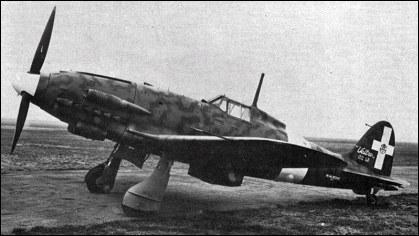
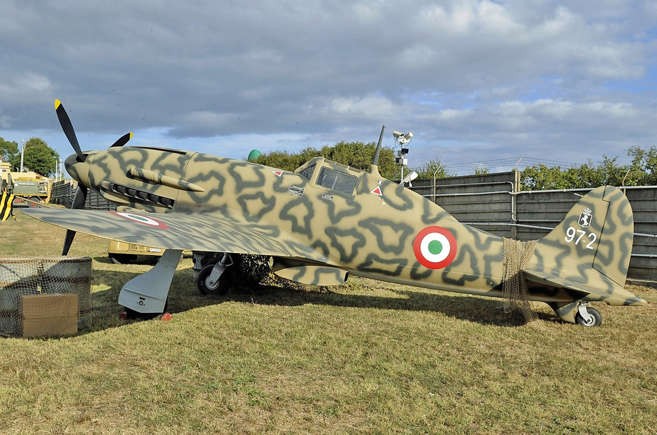
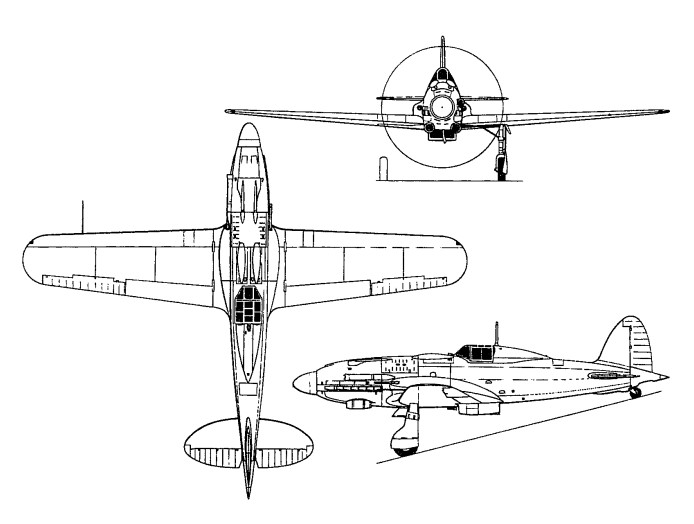
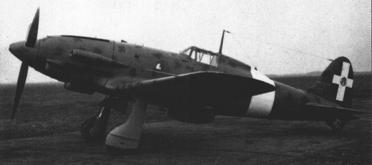
Re-powering the Folgore with a 931kW Fiat R.A.1050 RC.58 Tifone engine – a licence-built Daimler-Benz DB.605 resulted in the Veltro (Greyhound).
First flown as a prototype on 19 April 1942, production aircraft entered service in the following year but saw little action before the Italian surrender to the Allies. Most of the 262 MC.205V production aircraft served with the fascist Italian and German air arms. Later aircraft had two 20-mm cannon in place of the two rifle-calibre wing machine-guns to provide an effective armament.
A variant that failed to enter production was the MC.205N Orione high-altitude fighter with increased-span wings and an armament of one 20-mm cannon and four 12.7-mm (0.5-in) machine-guns in the N-1 variant or three cannon and two machine-guns in the N-2 variant.
Engine: Fiat RA. 1050 RC.58 Tifone, 1455 hp Length: 29 ft 0.5 in / 8.58 m Height: 9.974 ft / 3.04 m Wingspan: 34 ft 8.7in / 10.58 m Wing area: 180.835 sq.ft / 16.8 sq.m Max take off weight: 7514.6 lb / 3408.0 kg Weight empty: 5691.1 lb / 2581.0 kg Normal TO weight: 3224kg / 7,108 lb Max. speed: 347 kts / 642 km/h at 23620 ft Cruising speed: 270 kts / 500 km/h Service ceiling: 53707 ft / 16370 m Wing load: 41.62 lb/sq.ft / 203.0 kg/sq.m Range: 562 nm / 1040 km Crew: 1 Armament: 2x MG 12,7mm, 2x MG 7,7mm up to 320 kg (1706 lb) of bombs
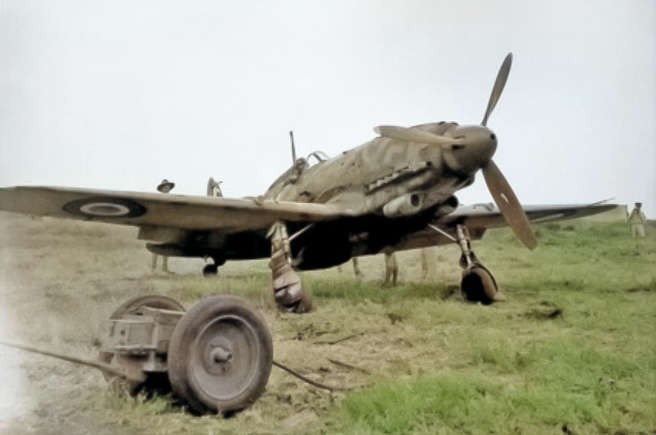
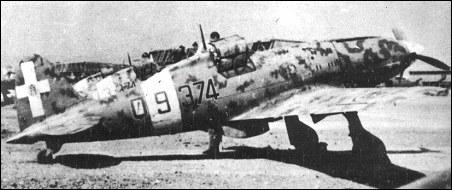
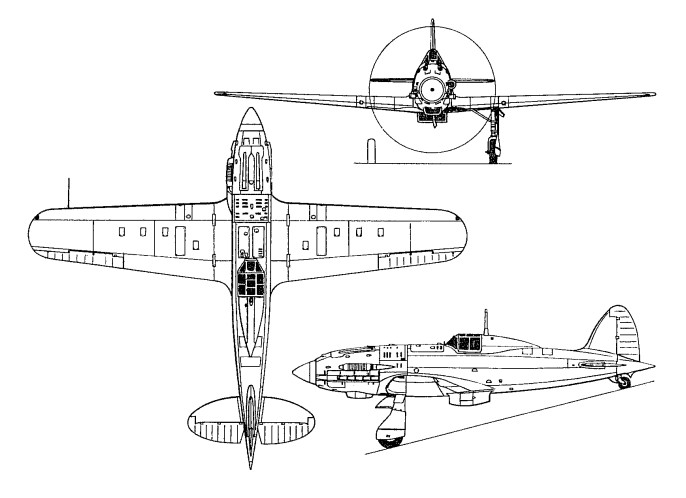
Mario Castoldi’s Macchi C.202 Folgore (thunderbolt) was developed from the radial-engined C.200, and powered by a Daimler- Benz DB 601A-1 produced under licence as the Alfa Romeo RA 1000 RC 411.
First flown by Carestiato on 10 August 1940, the C.202 Series 1 production version entered service with the 1° Stormo at Udine in the summer of 1941, this unit arriving in Libya in the following November. The Folgore was a low wing monoplane with inward retracting undercarriage and two 12.7mm Breda-SAFAT machine-guns in the nose; there was also provision for two 7.7mm guns in the wings.
The aircraft was developed and produced in 11 series with imported or licence-built engines. Later aircraft featured increased armament with the addition of two rifle-calibre wing machine-guns. Variants used in small numbers were the tropicalised MC.202AS and the dual-role MC.202CB that could be used as a fighter-bomber with 320 kg (706 lb) of bombs under the wings or as a long-range escort fighter with underwing drop tanks. The type was also trialled as the MC.200D with a chin radiator. It served with 45 Squadriglie of the 1°, 2°, 3°, 4°, 51°, 52°, 53° and 54° Stormi in North Africa, Sicily, Italy, the Aegean and Russia. Production totalled about 1,500, of which 392 were produced by the parent company and the remainder by Breda.
Ultimate wartime development of the C.200/202 series of Italian fighters was the Daimler Benz-powered C.205.
Engine: l x Alfa Romeo AR.1000 PC 41-1 Monsone, 876kW (1,175 hp) Span: 10.58m (34 ft 8.7 in). Length: 8.85m (29 ft 0.5 in). Normal T/O weight: 2937 kg (6,475 lb). Max speed: 370 mph at 16,405 ft. Operational range: 475 miles. Armament: 2 x 12.7-mm (0.5-in) mg and (later aircraft) 2 x 7.7-mm (0.303-in) mg.
Engine: Alpha Romeo RA.1000 RC.41 Monsone, 1159 hp Length: 29.035 ft / 8.85 m Height: 9.974 ft / 3.04 m Wingspan: 34.711 ft / 10.58 m Wing area: 180.835 sq.ft / 16.8 sq.m Max take off weight: 6637.1 lb / 3010.0 kg Weight empty: 5181.8 lb / 2350.0 kg Max. speed: 321 kts / 595 km/h Service ceiling: 37730 ft / 11500 m Range: 413 nm / 765 km Wing load: 36.7 lb/sq.ft / 179.0 kg/sq.m Crew: 1 Armament: 2x MG 12,7mm Breda-SAFAT, 2x MG 7,7mm Breda-SAFAT
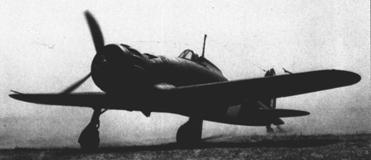
First flown on 24 December 1937 by Giuseppe Burei, the prototype featured an enclosed cockpit and retractable tailwheel, both features being disliked by most service pilots and were eliminated from the MC.200A1 initial production model.
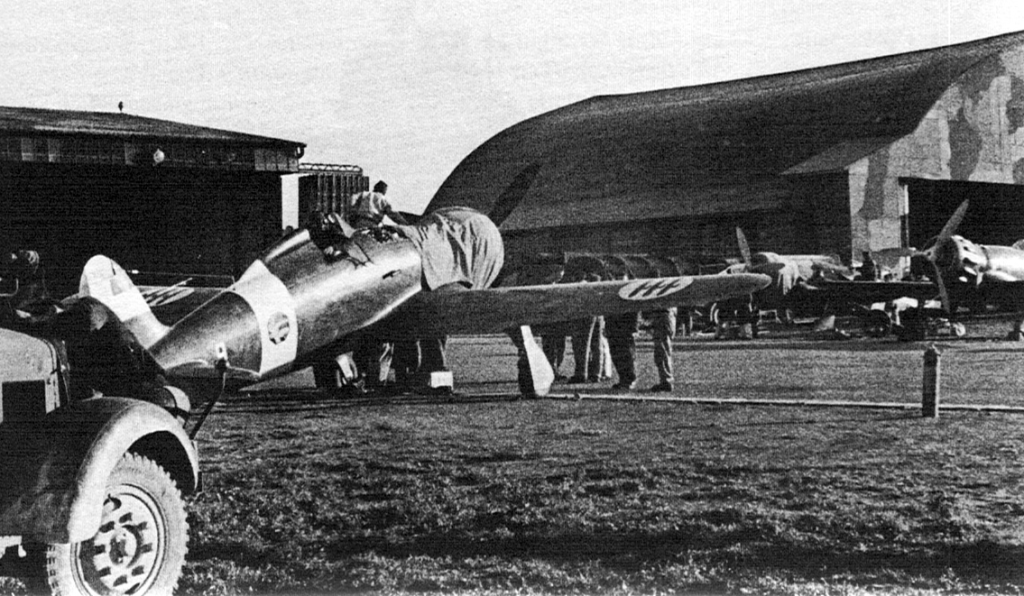
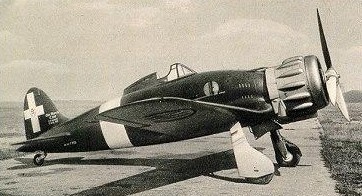
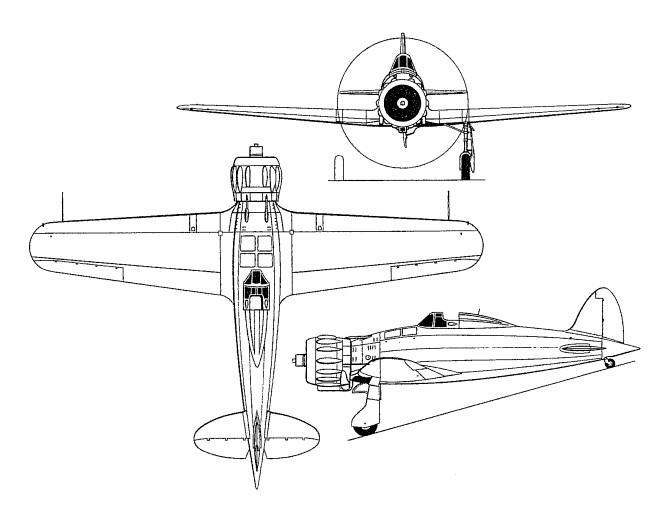
The Mario Castoldi designed radial-powered Fiat C.200 Saetta (lightning) arrived in service in 1939. The first C.200 unit, the 4° Stormo, expressed a preference for the CR.42 and reverted to the biplane in 1940.
The MC.200A2 was equipped two 7.7-mm (0.303-in) machine-guns in the wings.
When Italy entered the war on 10 June 1940, two home-based stormi were combat-ready with the C.200, being first flown in action over Malta in September that year.
The C.200, named the Saetta (lightning), equiped the 1°, 2°, 3°, 4° (in mid-1941) and 54° Stormi, and the 8°, 12°, 13°, 21″ and 22° Gruppi.
The attrition suffered by all Italian air force units quickly reduced the number of C.200s. Some 51 Saettas of the 22° Gruppo operated in the Odessa zone of the Eastern Front from August 1941 onwards, proving capable of matching the older Soviet fighters in the early stages of that campaign. By the time of the Italian armistice in September 1943 the Regia Aeronautica’s total inventory of serviceable C.200s stood at only 33. Production by Macchi, Breda and SAI Ambrosini totaled 1,153 aircraft in 25 series, and other variants were the MC.200AS tropicalised fighter and the MC.2000B able to operate as a fighter-bomber with 320 kg (706 lb) of bombs or as a long-range escort fighter with drop tanks. The MC.201 variant was to have had the 746-kW (1,000-hp) Fiat A.76 RC 40 in a modified fuselage.
Because all three Aeroplane Works within a range of German bombers were, a new plant was built at the village of Kunovice in South Moravia. There were 70 production MB-200s built there.
Macchi MC 200 Saetta Engine: Fiat A. 74 RC.38, 858 hp Length: 26ft 10.5 in / 8.19 m Height: 11.483 ft / 3.5 m Wingspan: 34 ft 8.7in / 10.58 m Wing area: 180.835 sq.ft / 16.8 sq.m MTOW: 5711.0 lb / 2590.0 kg Normal T/O weight: 2200 kg / 4,850 lb Weight empty: 4178.5 lb / 1895.0 kg Max. speed: 271 kt / 502 km/h at 14,765ft Cruising speed: 246 kt / 455 km/h Service ceiling: 29199 ft / 8900 m Wing load: 31.57 lb/sq.ft / 154.0 kg/sq.m Max range: 470 nm / 870 km Crew: 1 Armament: 2x MG 12,7mm Breda-SAFAT, 2x MG 7,7mm
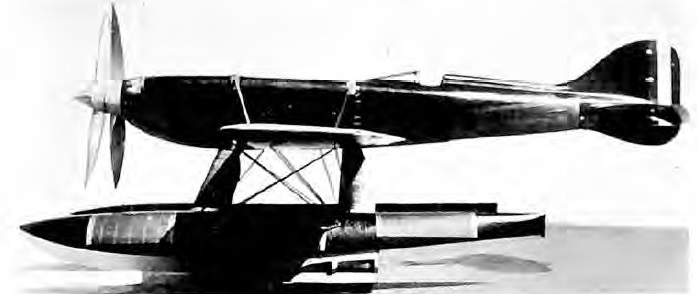
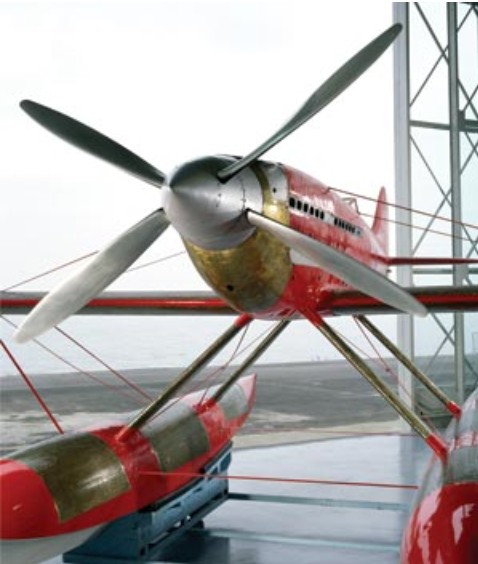
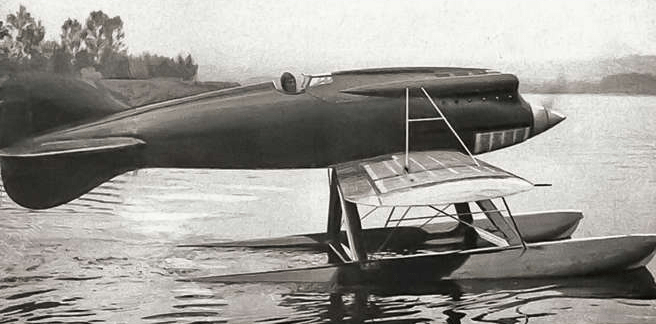
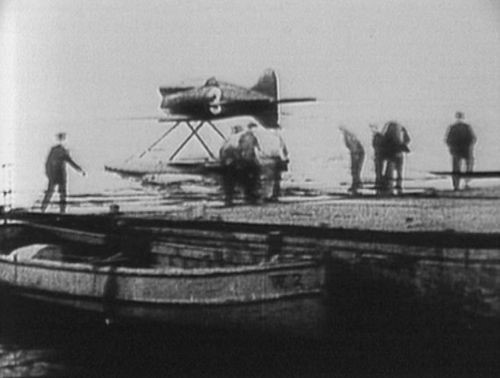
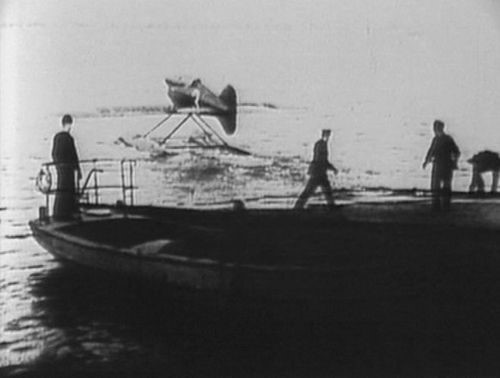
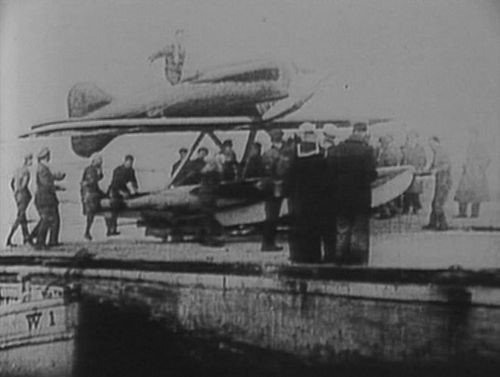
Designed by Mario Castoldi over three years from 1931 to 1933, it was hoped this plane would enter (and win) the Schneider Trophy race of 1931 but the plane could not be ready in time for that contest (the winner was the British Supermarine S.6B).
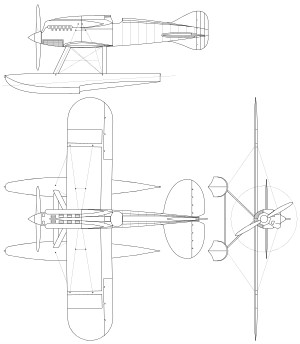
First flown in June 1931, the MC.72 was a single-seat twin-float seaplane. The unique engine was effectively two in tandem driving separate (counter-rotating) propellors.
In late 1927, Italian Mario de Bernardi upped the world absolute speed record mark to 298 mph with a Macchi M-52 seaplane developed from the M-39 in which he had won the 1926 Schneider Race. He soon raised the mark to 318 mph with the same airplane.
Problems with the Fiat 24 cylinder engine hp prevented it taking part in the Schneider seaplane contests, but Francesco Agello boosted the 3 km speed record with it to 423.57 mph 10 April 1933 and then 100 km speed record to 390.8 mph. The Coupe de Vitesse Louis Bleriot record of 30 min was raised to 384.86 mph. A world speed record was established on October 23, 1934 at 440.67 mph / 709 km/h. This world speed record lasted for five years – but as a record for a piston-engine seaplane it has never been broken (likely because development of racing seaplanes essentially came to an end with the end of the Schneider Trophy contest).
The Schneider Trophy never experienced any casualties during competition, but several pilots were killed training for the races. Italy had five casualties: Vittorio Centurione in 1926 in a Macchi M-39; Giuseppe Motta in 1929 in a Macchi M-67; Tomasso Dal Molin in 1930 in a Savoia S.65; Giovani Monti and Stanislao Bellini in 1931 in a Macchi MC-72.
As a result of three consecutive victories for the British, the Schneider races were over.
Engine (1934): Fiat AS.6 24 cyl., 2300 hp Engine (1934): Fiat AS.6 24 cyl., 2500 hp Engine (1934): Fiat AS.6 24 cyl., 2800 hp Prop: Twin CR
Engine: 2 x Fiat A.S.6, 2280kW Take-Off Weight: 2907 kg / 6409 lb Empty Weight: 2500 kg / 5512 lb Wingspan: 9.5 m / 31 ft 2 in Length: 8.2 m / 26 ft 11 in Height: 3.3 m / 10 ft 10 in Max. Speed: 702 km/h / 436 mph Crew: 1
In 1922 Mario Castoldi moved to Macchi Aeronautica, where he became famous for designing a series of seaplanes that set world speed records. His first winning plane was the Macchi M.39 seaplane. It was designed in 1925-26 to compete in the Schneider Trophy race of 1926. Powered (like all the Macchi planes from this time) by a Fiat engine it managed a top speed of 396 km/h (246 mph) and won the contest for that year.
Macchi M.39
Italian Mario de Bernardi won the 1926 Schneider Race with a Macchi M-39.
Macchi M.39
The Schneider Trophy never experienced any casualties during competition, but several pilots were killed training for the races. Italy had five casualties: Vittorio Centurione in 1926 in a Macchi M-39; Giuseppe Motta in 1929 in a Macchi M-67; Tomasso Dal Molin in 1930 in a Savoia S.65; Giovani Monti and Stanislao Bellini in 1931 in a Macchi MC-72.
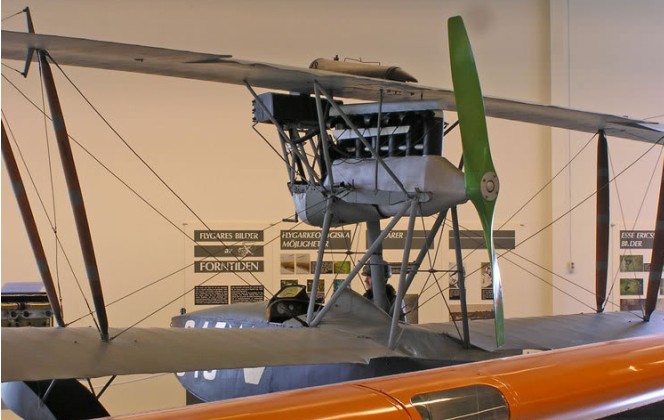
The Macchi M.5 was Italy’s first flying-boat fighter and first single-seat aircraft. A total of 244 M.5s were built, equipping five Italian maritime patrol squadrons from early 1918 until after the Armistice. The M.5mod was equipped with a 250hp engine.
Replica: Petroelje Macchi M.5
Macchi M.5mod Engine: 1 x 250hp Isotta-Fraschini V6B liquid-cooled Take-off weight: 1080 kg / 2381 lb Wingspan: 9.95 m / 32 ft 8 in Length: 8.10 m / 26 ft 7 in Height: 2.95 m / 9 ft 8 in Max. speed: 209 km/h / 130 mph Ceiling: 5000 m / 16400 ft Climb to 4000m: 20 min Armament: 2 x 7.7mm mg Crew: 1