Construction of this little aircraft is orthodox, with fabric-covered steel-tube fuselage and fabric-covered two-spar metal wings. It is fitted with a 250 h.p. Lycoming O-540-A1B5 engine, and the 40 gal of internal fuel can be supplemented by external tanks carried on the wing bracing struts.
The Kanpur-1 prototype was tested with spray-bars.
The basic version is a four-seat military AOP and liaison aircraft, but the Kanpur-II is suitable for a wide range of other duties, including agricultural work.
Kanpur I Span: 37 ft 0.5 in Length: 26 ft 6 in Height: 7 ft 6 in Wing area: 200 sq.ft Gross weight: 2,600 lb Empty weight: l,700 lb Max speed: 137 mph Econ cruising speed: 100 mph Max rate of climb at SL: l,155 ft/min Service ceiling: 20,500 ft TO distance to 50ft: 750 ft Landing distance from 50ft: 720 ft; Range with max payload: 460 miles
In 1950, Aircraft Manufacturing Co. acquired the rights to produce a refined four-seat version of the Johnson Rocket, which it called the Texas Bullet. The original Rocket was powered by a 185-hp four cylinder Lycoming engine; the Texas Bullet changed over to a Continental of the same rating. Also, the fabric covering of the Rocket was traded for an all-metal, flush-riveted skin, and a redesigned tail was added. The Bullet sported a top speed of 210 mph, a cruise speed of 183 mph, and a climb rate of 900 fpm. Overall, the new refinements added only 100 pounds to the empty weight, and 50 pounds were added to the fully loaded weight. Exhaust gasses from the engine of the Rocket and Bullet were led into a unique “jet assist” cylinder below the fuselage. It was claimed that the device converted engine exhaust into useful thrust at speeds faster than 40 mph. Also, both aircraft made use of a Hartzell hydro-selective two-blade variable-pitch propeller.
Don Gabriel My wifes Aunt and Uncle died in Va after he had bought a used Texas Bullet….an airline pilot wanted to buy it, met the relatives, Aunt and Uncle (owners) let the Airline pilot fly it and they rode along in it…..shortly after takeoff something happened and it went down in the woods short of the runway…..all were killed after it crashed and burned….. I forgot to mention that at that time I held a Commercial Pilots License and had asked to fly that plane several times…..the relative who owned it said it scared him and he had not flown it prior to the crash…..he had years of flying planes he had owned but this one killed him and his wife along with the airline pilot….FAA never came out with a reason for the crash…….. November 2025
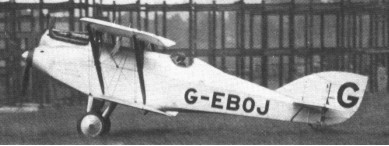
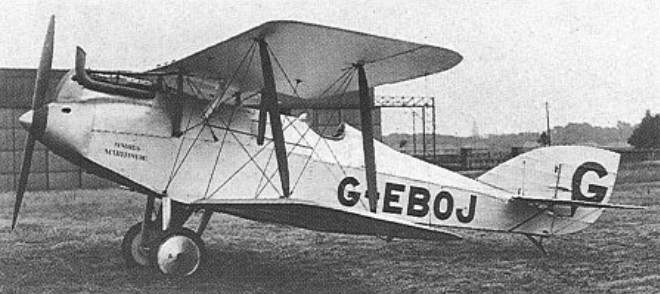
In 1926, John Kenworthy developed a single-seat fighter based on the F.4 Buzzard but utilising a 330 hp A.D.C. Nimbus six-in-line water-cooled engine. Referred to as the “Nimbus-Martinsyde”, with an essentially similar airframe to the Buzzard, it featured modified vertical tail surfaces with a horn-balanced rudder and revised aft upper fuselage decking. Its intended armament was two synchronised 0303-in (7,7-mm) Vickers machine guns, but these were never installed. Two prototypes were built and flown, both participating in the King’s Cup Air Race on 9-10 July 1926, and in 1927, the first prototype was modified with faired undercarriage legs and cylinder head fairings. No orders were placed for the Nimbus-powered aircraft and both prototypes were scrapped.
Engine; ADC Nimbus, 330hp Span, 32 ft 9 in (9,98 m) Length, 26 ft 10 in (8,18 m) Height, 9 ft 6 in (2,89 m) Wing area, 320 sq ft (29,73 sq.m) Empty wt; 2014lbs, 914kg Loaded wt; 2665lb, 1209kg Max speed sea level, 150mph, 241 kph at sea level Climb to; 10,000ft: 7min 30sec Climb to 15,000ft: 14min Climb to 20,000ft: 25min Service ceiling; 23,500ft Endurance: 2.5hrs
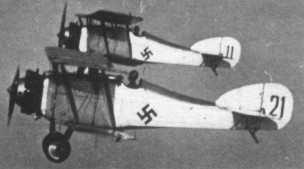
With the liquidation of the Martinsyde Company in February 1924, and the acquisition of its stores, stocks and goodwill by the Aircraft Disposal Company (A.D.C.), development of the Buzzard continued under the design leadership of John Kenworthy. This resulted in the A.D.C.1, which was fundamentally an F.4 Buzzard airframe with a 380 hp Armstrong Siddeley Jaguar radial engine. The prototype A.D.C.1 was first flown on 11 October 1924, subsequently participating in the 1925 and 1926 King’s Cup races, and considerable foreign interest was displayed in the type. In the event, only one order for the A.D.C.1 materialised, from Latvia and comprising eight aircraft which were delivered in 1926, at least two of these surviving until 1938.
Engine, Armstrong Siddeley Jaguar radial, 380 hp Span, 32 ft 9 in (9,98 m) Length, 25 ft 0 in (7,62 m) Wing area, 320 sq ft (29,73 sq.m) Empty weight, 1,865 lb (846 kg) Loaded weight, 2,650 lb (1202 kg) Max speed, 163 mph (262 km/h) at sea level Time to: 5,000 ft (1525 m), 2.42 min Time to 10,000ft: 5min 30sec Time to 15,000ft: 17min 30sec Service ceiling; 27,000ft Armament: two synchron¬ised 0.303-in (7,7 mm) Vickers guns
The Nova was a two seat, three surface aircraft with a water cooled Rotax 563 engine with a pusher propeller. The engine turned out to be problematic and after successful flight tests the project was scraped. Dave Morss was the test pilot.
Aircraft Spruce is a prime supplier of materials & components used in the Stallion kits utilising the same landing gear and basic wing as the Lancair IV. The Stallion will carry 6 people and or/cargo (1,600 lb useful load) over a long distance, with a cruise speed of 200+ knots at 9,000 feet, the Stallion burns 13.8 gph of fuel for 16.7 miles/gallon, with 180 gallons. For loading, a large 74 inch by 36 inch removable panel is located on the right side. Normal access is achieved from the left side, clamshell door. The pilots seat is moved forward to allow easy access to the back seats and it is moved back to allow access to the pilot and copilot seat. The top of the left door hinges up to allow taxing with the left door open and the bottom door hinges down and provides a step for both the back and front seats. All seats are attached with quick release pins and can be removed in seconds for carrying cargo. Some of the other features of the high wing include reduced aerodynamic drag compared to low and mid wing aircraft and gravity fuel feed.
Stallion Engine: Continental IO-550-G, 230 hp HP range: 180-350 Speed max: 260 mph Cruise: 237 mph Range: 2600 sm Stall: 67 mph ROC: 1600 fpm Take-off dist: 1200 ft Landing dist: 700 ft Service ceiling: 28,000 ft Fuel cap: 180 USG Weight empty: 2200 lb Gross: 3800 lb Height: 9 ft Length: 25 ft Wing span: 35 ft Wing area: 190 sq.ft Seats: 6 Landing gear: nose wheel
Stallion Engine: IO-550-G, 300 hp @ 2700 rpm. Propeller: McCauley or Hartzell, 3 bladed, constant speed. HP range: 180-350. Wing area: 140 sq.ft Seats: 6 Cockpit width: 49 inch Landing gear: nose / retractable Gross landing weight: 3,800 lb Empty weight: 2,200 lb Payload: 1,100 lb Fuel Capacity: 180 USG Span: 35.00 ft Flaps: Full Slotted Length: 25.0 ft Height: 9.50 ft Cabin width: 49.00 inch Stall speed, with flaps: 62 kts/71 mph High speed cruise @ 2500 rpm: 200 kts/235 mph Maximum speed @ 2700 rpm: 220 kts/253 mph Rate of climb: 1,600+ fpm Take off roll (with 10 deg. flaps): 1,800 ft Range: 2,200 nautical miles
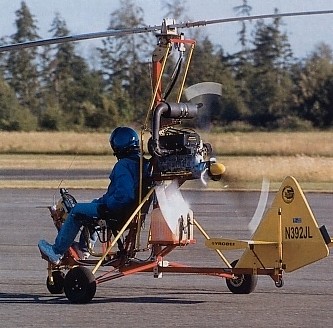
It was decided to build and aircraft that was very much like the Bumblebee, but constructed using as much in the way of standard ultralight parts and over-the-counter gyroplane components as possible. The result was the Gyrobee, which first took to the air in June of 1990 and debuted in the pages of Rotorcraft magazine in the October-November 1990 issue. The Gyrobee had a low-rotor disc loading as its core concept, which allows it more decent performance on 40 hp, and the designer planned for a 215-pound pilot. A single seat open frame autogyro with the frame bolted together, the engine used is the 40 hp Rotax 447, Prop: 60” x 38” 2 blade laminated maple (LEAF), and Rotordyne 25’ x 7 3/8” bonded aluminium rotor blades. The Gyrobee is a non-commercial model whose plans were available for free download on the Internet at http://taggart.glg.msu.edu/gyro/gbplans.php, consisting of 126 pages of text and drawings. Aerotec, Inc. is a separate company that sets airframe kits and engines based on the Gyrobee plans.
Engine: Rotax 447, 40 hp Prop: 60” x 38” 2 blade laminated maple (LEAF) Rotor blades: Rotordyne 25’ x 7 3/8” bonded aluminium Width: 7’8” Height: 8’ Length: 12’ Empty wt: 246 lb Useful load: 250 lb Gross wt: 496 lb Take-off Run: 600-800 ft Minimum Level Flying Speed: 8-9 mph Best Climb Airspeed: 35 mph Cruise Airspeed: 45-50 mph Maximum Level Flight Airspeed: 60 mph Maximum Rate-of-climb: 750 fpm Endurance: 60 min (10 min. reserve) Flight Range: 45-50 miles (no wind, 10 min. reserve)
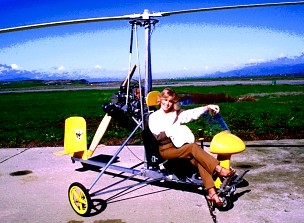
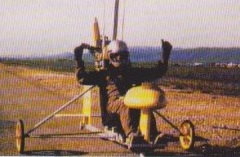
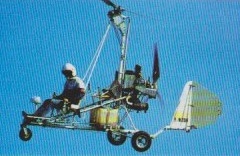
In 1984 the world’s first ultralight gyroplane made its debut in the pages of Ultralight Aircraft magazine. This was Martin Hollmann’s Bumblebee. Hollman had originally planned to market Bumblebee kits, but only a small run had been produced. A single seat open frame autogyro with an airframe of bolted 2×2 aluminium tubing and a simplified rotor head. Big enough for a large pilot, the plans sold for US$200 in 2001 and US$250 in 2009. Able to take either a 40-hp Rotax 447 or a 38.5-hp Kawasaki engine, the take-off distance is 230 ft on a calm day and useful load is 270 pounds.
Engine: Rotax 447, 40 hp Prop: 66” x 68” wood Rotor blades: 23’ x 7” aluminium/composite Disk area: 415 sq.ft Width 7’4″ Height 7’8″ Length 12′ Empty Weight 230 lbs Useful Load 300 lbs Gross Weight 500 lbs Fuel cap: 5 USG Min Speed 10 mph Cruise 40 mph Top Speed 70 mph Range: 65 sm Service ceiling: 16,000 ft Seats: 1 Landing gear: nose wheel
Engine: Rotax 503, 52 hp Rotor span: 7 m MAUW: 230 kg Empty weight: 115 kg Fuel capacity: 20 lt Max speed: 150 kph Cruise speed: 90 kph Minimum speed: 25 kph Climb rate: 5 m/s Seats: 1 Fuel consumption: 15 lt/hr
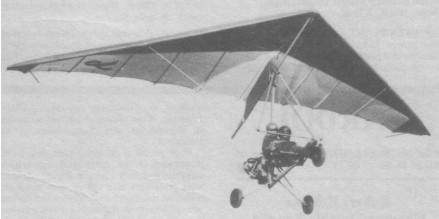
The Air Concept Safari Bi FR440/Alpha 18 is a tandem two seat single engined flex wing aircraft with weight shift control. Rogallo wing with fin. Pilot suspended below wing in trike unit, using bar to control pitch and yaw/roll by altering relative positions of trike unit and wing. Wing braced from above by kingpost and cables, from below by cables; floating cross tube construction with double surface on half chord, enclosing cross tube; pre formed ribs. Undercarriage has three wheels in tricycle formation; no suspension on any wheels. Push right go left nosewheel steering independent from yaw control. Optional brake on nosewheel. Aluminium tube trike unit, without pod. Engine mounted below wing driving pusher propeller. The Safari Bi was designed along the same principles as the single seater trike units from Air Concept, also using rectangular section Duralumin 6061T5 spars measuring 2.4 x 1.6 inch (60 x 40mm). As with virtually all tandem weight shift machines, the control bar is as easy to handle from the front seat as from the rear, but the Safari Bi takes dual control a stage further, as the throttles are accessible to both occupants and the nosewheel steering is twinned to the rear. The Safari Bi/Alpha 18 model uses a 190sq.ft (17.6 sq.m) wing which differentiates it from the two other two seaters offered from this manufacturer. As indicated from the FR440 part of the name, it is equipped with a Fuji Robin EC44 of nominal 440 cc capacity. The choice is left to the purchaser as to which version to fit either the EC44PM of 50 hp with electric start, or the EC44 2PM of 53 hp but hand started. Folded, the trike unit measures 6.7 x 2.8 x 3.4 ft (2.00 x 0. 80 x 1.00 m) and the wing 19.9 x 1.0 x 1.0 ft (6.00 x 0.30 x 0.30 m). Options include, apart from the choice of engine type, a nosewheel brake, a supplementary fuel tank and fairings. The Safari Bi FR440/Alpha 20 is a combination of the Safari Bi FR440 trike unit with the Alpha 20 wing variations on the same theme but a system which offers an excellent choice to the customer. The EC44 2PM engine is optional. The Safari Bi FR330/Alpha 20 is basically similar to the Safari Bi FR440/Alpha 18 but with a lower power engine and the Alpha 20 wing with a larger surface area. The structure of this trike unit is the same. The Robin EC34PM can be had with or without electric start and, married to a 214 sq.ft (19.8 sq.m) Alpha 20 wing, gives a lower stall speed than the Safari Bi FR440/Alpha 18 at any given angle of incidence. Available ready to fly or alternatively as a kit, the kit includes all the parts and accessories necessary to build the trike unit and requires only a drill and a few spanners to assemble it. All cutting, piercing, preparation of cables and other operations which could be hard for an amateur are done by the manufacturer. Detailed plans come with each kit.
Safari Bi FR440/Alpha 18 Engine: Robin EC44, 50hp at 6500rpm Propeller diameter 54 inch, 1.38 m Toothed belt reduction, ratio 2.2/1 Max static thrust 261 lb, 118 kg Power per unit area 0.26hp/sq.ft, 2.8 hp/sq.m Fuel capacity 2.6 US gal, 2.2 Imp gal, 10.0 litre in main tank; 6.1 US gal, 5.1 Imp gal, 23.0 litre in res Length overall 9.8ft, 3.00m Height overall 9.8ft, 3.00m Wing span 32.2ft, 9.80m Chord at root 8.2ft, 2.50 m Chord at tip 3.4ft, 1.00m Dihedral 4 degs Nose angle 122 degs Total wing area 190 sq.ft, 17.6 sq.m Wing aspect ratio 5.5/1 Wheelbase 5.7ft, 1.70 m Nose¬wheel diameter overall 16 inch, 40cm Main wheels diameter overall 16 inch, 40 cm Empty weight 254 lb, 115kg Max take off weight 773 lb, 350kg Payload 519 lb, 235kg Max wing loading 4.07 lb/sq.ft, 20.0 kg/sq.m Max power loading 15.5 lb/hp, 7.0kg/hp Load factors; +6.0, 3.0 ultimate Max level speed 53 mph, 85 kph Never exceed speed 56 mph, 90kph Max cruising speed 37mph, 60kph Economic cruising speed 34mph, 55kph Stalling speed 23 mph, 38 kph Max climb rate at sea level 500 ft/min, 2.5 m/s Min sink rate 370 ft/min at 28 mph, 1.9 m/s at 45 kph Best glide ratio with power off 8/1 at 29 mph, 47 kph Take off distance 115 ft, 35 m Land¬ing distance 130 ft, 40 m Service ceiling 10,000 ft, 3050 m Range at average cruising speed 100 mile, 160 km
Safari Bi FR440/Alpha 20 Engine: Robin EC44, 50hp at 6500rpm Propeller diameter 54 inch, 1.38 m Toothed belt reduction, ratio 2.2/1 Max static thrust 261 lb, 118 kg Power per unit area 0.23hp/sq.ft, 2.3 hp/sq.m Fuel capacity 2.6 US gal, 2.2 Imp gal, 10.0 litre in main tank; 6.1 US gal, 5.1 Imp gal, 23.0 litre in res Length overall 9.8ft, 3.00m Height overall 9.8ft, 3.00m Wing span 32.8ft, 10.0m Chord at root 8.2ft, 2.50 m Chord at tip 3.4ft, 1.00m Dihedral 4 degs Nose angle 122 degs Total wing area 214 sq.ft, 19.8 sq.m Wing aspect ratio 5.1/1 Wheelbase 5.7ft, 1.70 m Nose¬wheel diameter overall 16 inch, 40cm Main wheels diameter overall 16 inch, 40 cm Empty weight 254 lb, 115kg Max take off weight 773 lb, 350kg Payload 519 lb, 235kg Max wing loading 3.61 lb/sq.ft, 17.7 kg/sq.m Max power loading 15.5 lb/hp, 7.0kg/hp Load factors; +6.0, 3.0 ultimate Max level speed 47 mph, 75 kph Never exceed speed 56 mph, 90kph Max cruising speed 31mph, 50kph Economic cruising speed 28mph, 45kph Stalling speed 21 mph, 33 kph Max climb rate at sea level 500 ft/min, 2.5 m/s Min sink rate 310 ft/min at 25 mph, 1.6 m/s at 40 kph Best glide ratio with power off 8/1 at 27 mph, 44kph Take off distance 100ft, 30 m Land¬ing distance 100 ft, 30 m Service ceiling 10,000 ft, 3050 m Range at average cruising speed 93 mile, 150km
Safari Bi FR330/Alpha 20 Engine: Robin EC34Pm, 32 hp at 6500 rpm Propeller diameter 54 inch, 1.38 m Toothed belt reduction, ratio 2.0/1 Max static thrust 203 lb, 92 kg Power per unit area 0.15hp/sq.ft, 1.6hp/sq.m Fuel capacity 2.6 US gal, 2.2 Imp gal, 10.0 litre in main tank; 6.1 US gal, 5.1 Imp gal, 23.0 litre in res Length overall 9.8ft, 3.00m Height overall 9.8ft, 3.00m Wing span 32.8ft, 10.0m Chord at root 8.2ft, 2.50 m Chord at tip 3.4ft, 1.00m Dihedral 4 degs Nose angle 122 degs Total wing area 214 sq.ft, 19.8 sq.m Wing aspect ratio 5.1/1 Wheelbase 5.7ft, 1.70 m Nose¬wheel diameter overall 16 inch, 40cm Main wheels diameter overall 16 inch, 40 cm Empty weight 221 lb, 100 kg Max take off weight 662 lb, 300kg Payload 441 lb, 200 kg Max wing loading 3.09 lb/sq.ft, 15.2kg/sq.m Max power loading 20.7 lb/hp, 9.4kg/hp Load factors; +6.0, 3.0 ultimate Max level speed 44 mph, 70 kph Never exceed speed 56 mph, 90 kph Max cruising speed 31 mph, 50 kph Economic cruising speed 28 mph, 45 kph Stalling speed 20 mph, 32 kph Max climb rate at sea level 300 ft/min, 1.5 m/s Min sink rate 300 ft/min at 24 mph, 1.5 m/s at 40 kph Best glide ratio with power off 8/1 at 28 mph, 45 kph Take off distance 100 ft, 30 m Land¬ing distance 100 ft, 30 m Service ceiling 10,000ft, 3050 m Range at average cruising speed 124 mile, 200 km