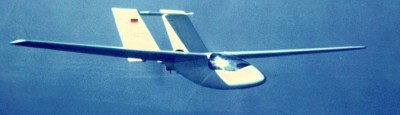
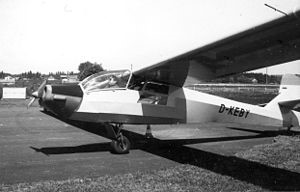
Designed and built by the Stuttgart Akademische Fliegergruppe (Akaflieg) in Germany, the FS-26 was an experimental single-seater, aimed at investigating the characteristics of a motorglider equipped with a reflex airfoil and a separate horizontal stabilizer. Made of fibreglass, the FS-26 re-used the cockpit of the Phoebus sailplane modified to include the engine controls and instruments, and the long retractable landing gear. The aircraft was powered by a Hirth F10A engine, located at the rear of the fuselage. In soaring configuration, the propeller blades could be folded and the engine cowling openings were closed. The wing used an Eppler 515 airfoil, and could be divided into three parts for trailering on the road. The connections between the fuselage and the wing had been carefully studied, as well as the engine cooling. The FS-26 made its first flight on September 25, 1970. After several tests, this aircraft was donated to the Wasserkuppe Soaring Museum.
Wing span: 12.60 m Length: 3.94 m Wing Area: 13.20 sq.m Airfoil: Eppler 515 Empty weight: 250 kg Max. weight: 360 kg
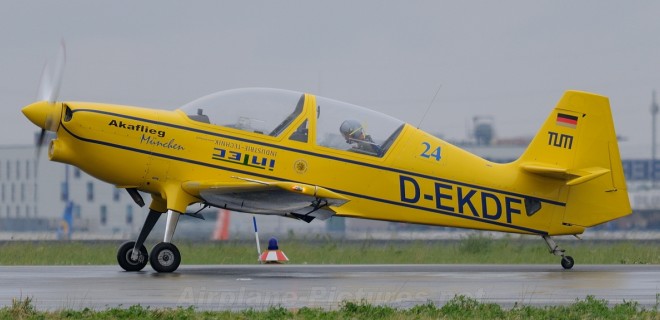
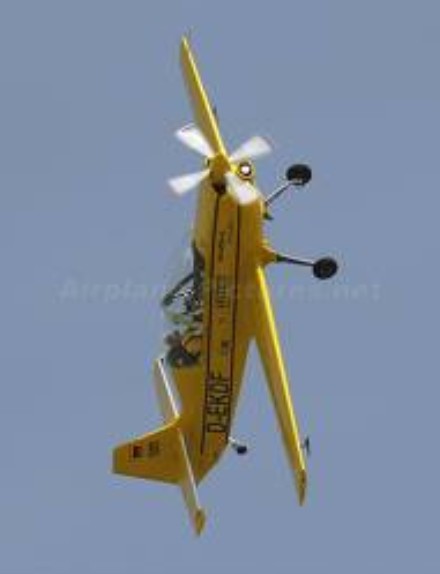
Students at Akaflieg München recognized that the requirements of an aerobatic aircraft and glider tug coincided, both needing a high power-to-weight ratio, high rate of climb at relatively low speed, and high control authority. To meet these requirements design and construction of the Mü30 Schlacro (SCHLepp-ACRObatic) began in 1985 led by Dieter Thomas. Initially it was intended to fit a Porsche PFM 3200, obtained from Porsche at no cost. Use of the PFM 3200 promised to cut operating costs and environmental impact dramatically, with the engine certified to use MOGAS in place of the very expensive AVGAS, but Porsche abandoned development of the PFM3200 in 1992, leaving the Mü30 without an engine.
During development the ailerons were optimized for maximum roll rate, the wings revised with carbonfibre structure and the center of gravity adjusted by moving the wings 150mm (6ins) forward, compensating for a heavier Lycoming engine and ensuring reserve for possible future re-design.
Work on the prototype continued and an alternative engine installation was designed for the 223 kW (300 hp) Lycoming AEIO-540 driving a four-bladed propeller. First flight with the Lycoming engine was carried out in 2000 with flight testing continuing till 2003. Problems with cooling the Lycoming engine necessitated the complete re-design of the cooling air intake, exhaust system and cowling.
Flying re-commenced on 16 February 2007, resuming flight tests which proved to be satisfactory and certification is well advanced. Initial problems with lateral stability have been overcome by altering the control geometry and flight tests by Uli Schell have revealed the aircraft to have adequate stability and be easy to control. Flight testing was completed by New Year’s Eve 2007, with the exception of Vd (Maximum Design Dive Speed – 1.2x Vne) which had earlier highlighted problems with the elevator trim. After thickening the trailing edge of the elevators the trim problems were alleviated and the Vd test was carried out successfully.
Mü30 Engine: Lycoming AEIO-540, 223 kW (300 hp) Length: 7.5 m Wingspan: 9 m Empty weight: 748 kg Maximum speed: 400 km/h (216 mph)
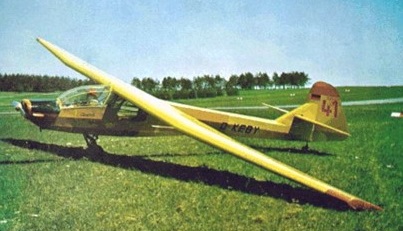
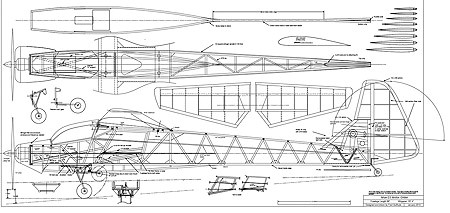
In 1957 the students at Akaflieg München began the design and construction of the Mü23 Saurier two-seat motor-glider. Using the classic ‘Munich School’ construction technique, the Mü23 was built using fabric covered welded steel tube for the fuselage and wooden wings and tail covered with plywood and fabric. The pilot sitting directly behind the engine under a built-up transparent canopy and the passenger sitting in a compartment under the centre section of the wing, similar to the seating arrangement of the Akaflieg München Mü10 Milan.
Using the Mü Scheibe aerofoil section imbued the Mü23 with excellent low speed characteristics and short landings and takeoffs, but development was slowed by problems with the chosen engines, initially a Volkswagen VW1200, later a Braendle ZB700 and finally a Volkswagen VW1500N which gave satisfactory performance.
Once the performance of the aircraft could be guaranteed with the VW1500N engine, the Mü23 took part in sailplane and motor glider competitions with some success. In 2010 the Mü23 is undergoing restoration.
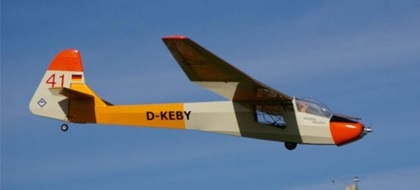
This unique single-seat powered sailplane, created by the Darmstadt Akaflieg, looks exactly like a Standard Class high-performance sailplane except for its low-mounted wing. It features a retractable two-blade folding propeller, driven by twin Fichtel & Sachs modified KM 914V engines situated in the nose cone.
The D-39 is an adaptation of the basic D-38 airframe, having the same glassfibre/balsa sandwich construction with ailerons of glassfibre/Klegecel foam sandwich, and Schempp-Hirth airbrakes on the upper wing surfaces. No flaps are fitted. It is equipped with a manually-retractable sprung monowheel, and accommodation comprises a semi-reclining seat under a flush canopy, the rear section of which is detachable.
D-39 Engines: 2 x Fichtel & Sachs KM 914V, 35 kW (47 hp) Wing span: 15.0 m / 49 ft 2 in Length: 7.15 m / 23 ft 5.5 in Height: 1.02 m / 3 ft 4.5 in Wing area: 11.0 sq.m / 118.4 sq ft Wing section: Wortmann FX-61 -184/60-126 Aspect ratio: 20.5 Empty weight: 280 kg / 617 lb Max weight: 400 kg / 882 lb Water ballast: None Max wing loading: 36.3 kg/sq.m / 7.43 lb/sq ft Max speed: 135 kt / 250 km/h Stalling speed: 39 kt / 72 km/h Min sinking speed: 1.0 m/sec / 3.3 ft/sec Best glide ratio: 36 at 56.5 kt / 105 km/h T-O run: 200 m / 656 ft Rate of climb at S/L: 240 m/min / 787 ft/min Range: 500 km / 269 nm
The Airtrike Eagle 5 is a German ultralight trike, designed and produced by Airtrike of Berlin. The aircraft is supplied as a complete ready-to-fly-aircraft.
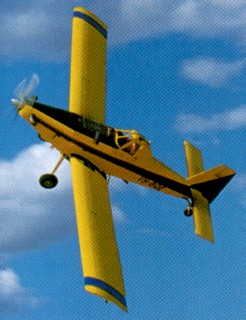
The Air Tractor AT-802 was designed primarily for the air tanker role. It was the first single engined fire fighter (as the AT-802F) to be designed from the ground up and with a similar hopper capacity to the twin engined Grumman S2F’s used by the Californian Division of Forestry.
The AT-802 is, in appearance, an enlarged AT-503. The length is 3l feet and the wingspan is 58 feet. The 800 gallon hopper also incorporates computer controlled hopper doors to drop the load of retardant as required. The first dual cockpit AT-802, N802LS, was flown on 30 October 1990, and was fitted with a P&W PT6A-67R of 1424 hp. By the time the aircraft was ready for production, it was certified for the installation of a PT6A-4SR or -6SB, both of 1173 hp. A single seat version, the AT-802A, N 1558W, flew on 6 July 1992, fitted with a -6SB turbine. The empty weight for the single seater is 6200 lbs and they both have an operating weight of 16000 lbs. The introduction of Hoerner wingtips increased the span to 59.2 ft and a 2 in extencion of the engine mount was incorporated to ease the C of G limit on the two seaters.
Croatia ordered three AT-802A Fire Boss amphibians, the first delivered to Zadar-Zemunik in March 2007.
Croatian AT-802A Fire Boss
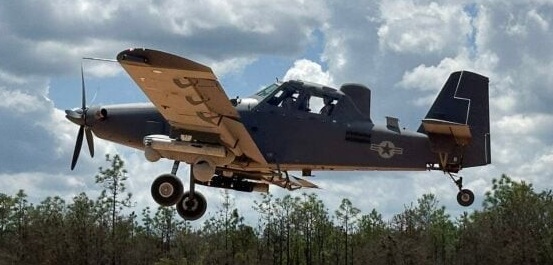
The U.S. Air Force’s newest light attack and reconnaissance aircraft, the OA-1K Skyraider II, was undergoing developmental testing in July 2025 at Eglin Air Force Base as part of its path toward operational service within Air Force Special Operations Command (AFSOC).
OA-1K Skyraider II
According to the Air Force, the aircraft is being evaluated by the 96th Test Wing in partnership with U.S. Special Operations Command to verify its airworthiness and validate manufacturer L3Harris’ performance claims. The effort also includes mission-effectiveness assessments to determine how well the aircraft performs in austere and remote environments, where AFSOC personnel often operate. The OA-1K Skyraider II is designed as a cost-effective, crewed aircraft capable of supporting special operations forces in geographically isolated regions. It is equipped for mission sets that include close air support, precision strike, and armed intelligence, surveillance, and reconnaissance (ISR). The platform is based on the rugged AT-802 airframe and has been adapted for military use with integrated sensors and weapons systems. One of the Skyraider II’s most distinctive features is its tailwheel landing gear—a configuration not seen on an active-duty U.S. Air Force aircraft in over 50 years. This unusual design element required the test team to develop new evaluation methods tailored to the aircraft’s landing characteristics. “There was quite a bit that went into this, from making sure we were compliant on the regulatory side, to ensuring we had the proper operations support for the Skyraider II,” said Maj. Stephen Wakefield of the 96th Test Wing. Due to the unique configuration, Air Force pilots received additional training using the Skyraider II’s civilian counterpart, the AT-802, to gain proficiency with tailwheel aircraft handling. The Air Force says this type of training was essential to safely operate the aircraft during its early evaluation phase. Maj. Jacob Marsh, a test pilot with the 96th TW, said flying the OA-1K has been both demanding and rewarding. “Flying the OA-1K has been a rewarding experience and certainly something that has required me to bring my skills to work every day,” Marsh said. “The fun of flying it is just a perk of the job.” Marsh, who previously flew un-augmented UH-1N helicopters at the United States Naval Test Pilot School, noted the coordination required in the OA-1K shares similarities with rotary-wing operations, particularly at lower airspeeds. The test campaign has so far included evaluations of human factors, handling qualities, and austere landing capabilities. Future trials will involve weapons release and sensor performance tests. The manufacturer, L3Harris, states the aircraft can fly at 245 miles per hour at 10,000 feet and has a range of 1,500 miles at an altitude of 8,000 feet. The Skyraider II is being positioned as a rugged, flexible platform that can operate from unprepared runways and support combat operations where more complex and expensive aircraft may be unavailable or unsustainable. This matches AFSOC’s need for adaptable aircraft in environments where logistics are limited and risk is high. While the Skyraider II is not intended to replace high-performance fighters or dedicated ISR platforms, it offers commanders a versatile tool to support missions ranging from overwatch and target identification to rapid strike against time-sensitive threats—all while operating from forward locations with minimal infrastructure.
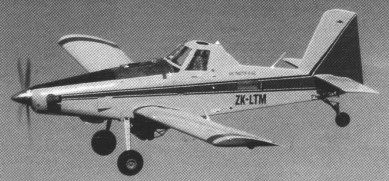
The first Air Tractor AT-602 aircraft had its maiden flight in 1995, deliveries beginning with N6084K in January 1996. The 602 shares many of the components of the larger AT-802A (including the fin and rudder).
AT-602 Engine: PT6A-60AG or -45R, 1050 shp Prop: five-blade Wing span: 56 ft Length: 32 ft 6 in Wing area: 336 sq.ft Empty weight: 5,600 lb Operating weight: 12,500 lb Hopper cap: 630 US gallon