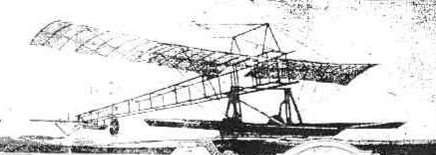
Designed and constructed by Reyburn Watres of Scranton, Pennsylvania, in 1910. Powered by a vertical type motor of four cylinders.
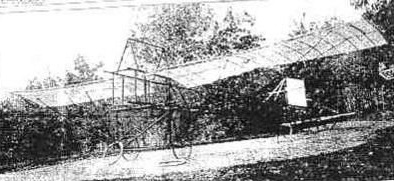
Watres flew his aircraft a number of times, primarily at his airfield in the Lake Wallenpaupack region.
Designed and constructed by Reyburn Watres of Scranton, Pennsylvania, in 1910. Powered by a vertical type motor of four cylinders.
Watres flew his aircraft a number of times, primarily at his airfield in the Lake Wallenpaupack region.
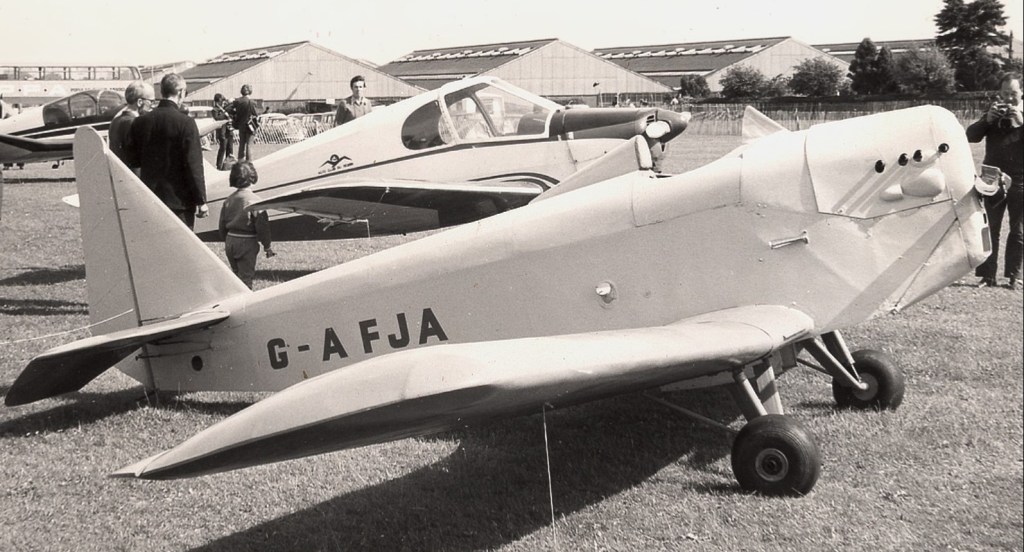
The Watkinson Dingbat was a 1930s British ultralight monoplane designed by E.T. Watkinson and C.W. Taylor.

The Dingbat, otherwise known as the Taylor Watkinson Ding-Bat, was a low-wing monoplane powered by a 30 hp (22 kW) Carden-Ford engine. It had a single-seat open cockpit and a fixed conventional landing gear. It was built at Teddington in Middlesex and registered G-AFJA snDB.100 it was first flown at Heston Aerodrome in June 1938.

It was stored during the Second World War, but rebuilt to flying condition by J.H.Pickrell and D.O.Wallis in 1959.
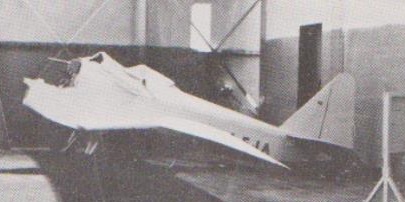
It lapsed again into disuse and was stored at Overton Strip, Hannington, until restored by A.J.Christian, First flying again in early 1974.
After a crash at Headcorn on 19 May 1975, it was rebuilt, and was still registered in 2010.

Powerplant: 1 × Carden Ford water-cooled 4-cylinder piston engine, 32 hp (24 kW)
Wingspan: 28 ft 0 in (8.53 m)
Wing area: 125 sq ft (11.6 m2)
Length: 16 ft 0 in (4.88 m)
Height: 6 ft 3 in (1.91 m)
Empty weight: 460 lb (209 kg)
Gross weight: 700 lb (318 kg)
Maximum speed: 90 mph (140 km/h, 78 kn)
Cruise speed: 80 mph (130 km/h, 70 kn)
Stall speed: 39 mph (63 km/h, 34 kn)
Range: 200 mi (320 km, 170 nmi)
Crew: 1
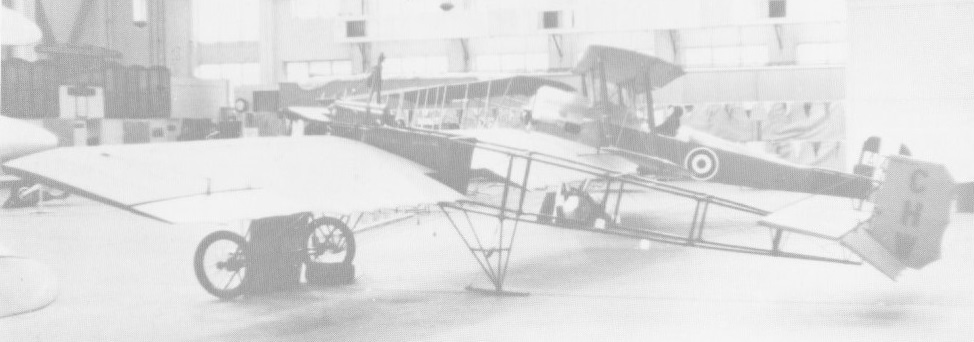
Designed by Charles Horace Watkins in 1907 the Monoplane was built at Mynachdy Farm, Maendy, Cardiff, Wales, over the following couple of years. Although it made ts first hops from the farm probably early in 1910 its first real flights came later in the year when it is reported to have flown over Whitchurch, Glam, and in the same year its first cross-country was made to a ridge on the Caerphilly Mountain and back. It was powered by a 40 hp three cylinder engine modified from an Anzani and cast in the Cardiff Railway Works. It is claimed that this aircraft, named the ‘Robin Goch’, made the first night flight over Wales in 1910.
It was flown until about 1918 when it was grounded by a cracked cylinder head. It was stored at Mr Watkins garage until 1959 when it was moved to St.Athan for display where it has since remained.
Mr Watkins died in December 1976 aged 92.
In November 2025 the Watkins monoplane is displayed at the Waterside Museum Swansea.
Engine: modified Anzani, 40 hp
Wingspan: 32 ft
Length: 21 ft 6 in
All up weight: 600 lb
Max speed: 60 mph
Range: 180 miles
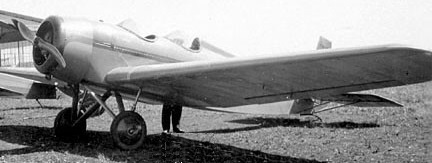
The 1929 SL-1 was designed by Wallace “Chet” Cummings featuring a laminated plywood-clad, steel-tube, monocoque fuselage. Originally tried with 55hp Velie M-5, the price was $2,950.
The one prototype, NX470E c/n 1, received ATC 2-182 and at least five production models were as built as SL-2:
NC102V c/n 102, N460W c/n 106, N461W c/n 103, NC487N c/n 101, NC11950 c/n 105, maybe c/n 104.
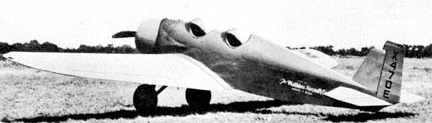
The sport design failed to make it in a slumping market.
SL-2 Skylark
Engine: 60hp LeBlond 5D
Wingspan: 37’0″
Length: 23’6″
Useful load: 517 lb
Max speed: 103 mph
Cruise speed: 80 mph
Stall: 38 mph
Sats: 2
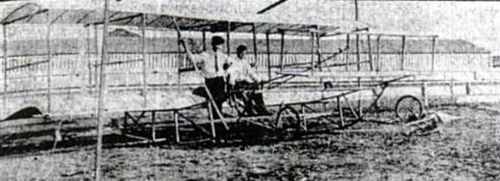
Waldo Waterman’s first powered creation (he built gliders in 1909), in 1910 in league with Kenneth Kendall, was a single place, open cockpit biplane, 2-cylinder Speedwell pusher.
It was so badly underpowered it had to be assisted by automobile tow to get off the ground, but it did and made a few flights before becoming ensnarled in the tow rope on a take-off. It crashed and Waterman earned two fractured ankles for his efforts. Although based on the Curtiss, it had an innovative concept of wheels that could be folded up via a lever-and-wires arrangement in order to land on its skids—this lever also shut off the motor at the same time.
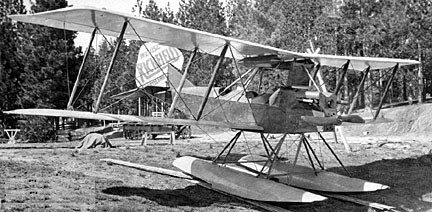
The 1924 Waterman-Boeing C were modified surplus USN floatplanes for passenger operations. Waterman was able, through craft, to buy six Model Cs for $200 each (USN cost $10,250 each, and selling nationally in lake areas for $2,000 each) for use a basis for his Big Bear (CA resort) Airlines.
The five place Waterman-Boeing C was later converted to wheels and Renault engine, expanded four place front cockpit, internal gas tanks relocated under the top wing, and enlarged tailskid.
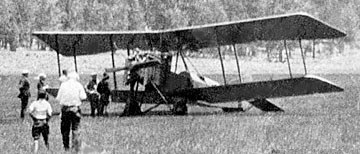
One plane is seen in the 1926 film, “Mantrap,” in which Waterman also played a bit part, and two were destroyed in filming “Dawn Patrol” as the ones that crash on take-off during a raid on the German aerodrome.
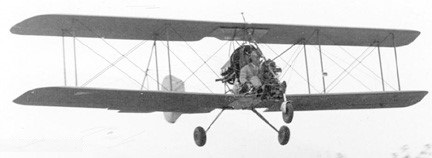
Several single place open biplane experimentals based loosely on the Curtiss design were produced by Waterman for himself and others in exhibition flying.
Individual aircraft were only lightly documented, but a particularly notable one used the wings and tail of the original Vought VE-7, which were discovered in an old hangar after WW2. Donated to the San Diego Air Museum, but perished in its 1978 fire.
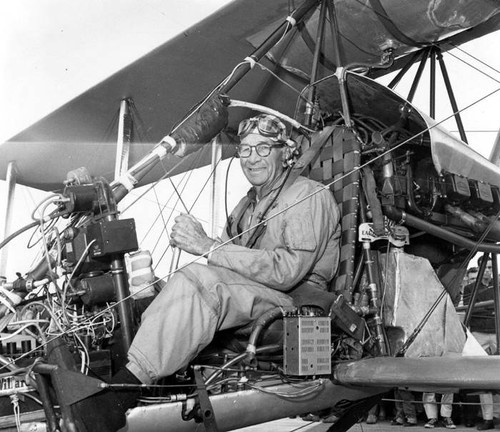
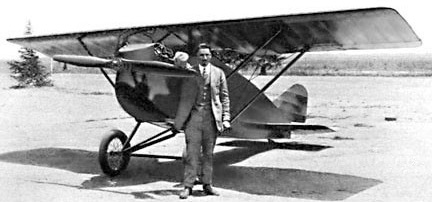
The 1921 Gosling, or Mercury Gosling, was a parasol-wing racer with bass/birch veneer fuselage, sponsored by film director and air enthusiast Cecil B de Mille for local competitions (piloted by Eldred Remelin) at his Mercury Air Service field.
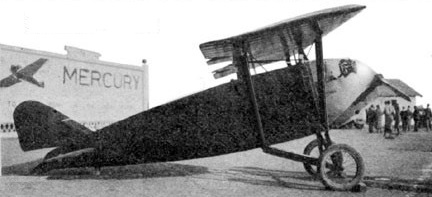
First flying on 6 June 1921, it was sold to Art Goebel for promotion of Julian Oil Co Lightning in 1925, then to a film studio, where it was deliberately destroyed in a fire scene.
Engine: Curtiss OX-5, 90hp
Wingspan: 21’9″
Length: 18’7″
Useful load: 245 lb
Max speed: 130 mph
Cruise speed: 110 mph
Stall: 60 mph
Range: 135 mi
Seats: 1
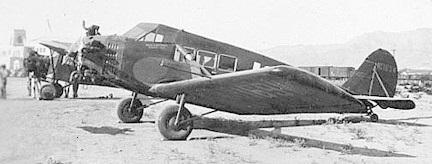
The Flex-Wing aka CLM Special and Variable Wing Monoplane of 1930 was a four place monoplane powered by a 125hp Kinner, and registered NX169W.
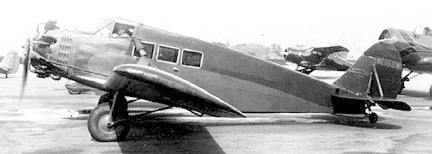
Flexible wings hinged at the fuselage allowed the pilot to vary dihedral and angle of attack for controlled performances. Struts contained shock absorbers with air pressure supplied by compressed air tanks fed by the motor. Also had a 6′ central skid acting as an arresting gear after landing.
Only the one was built, becoming the W-1.
The 1931 W-1 (NC169W) and W-1 Special (NC172M) (ATC 2-325) was a continuation of the Flex-Wing experiments; nicknamed “Rubber Duck.” The W-1s feaured ddjustable-incidence and -dihedral wings with shock-absorbing struts. Lack of funding canceled the project after the two.
Flex-Wing / CLM Special / Variable Wing Monoplane
Engine: Kinner, 125 hp
Seats: 4
W-1 / W-1 Special
Engine: Kinner C-5, 210 hp
Wingspan: 39’0″
Length: 27’2″
Useful load: 1164 lb
Max speed: 135 mph
Cruise speed: 110 mph
Stall: 48 mph
Range: 600 mi
Seats: 4
In 1920 Waldo Waterman rebuilt a war-surplus Packard-LePere LUSAC as an executive transport for L C Brand as a personal transport. Only the one was built.
Engine: Liberty 12, 400 hp
Wingspan: 43’6″
Useful load: 1335 lb
Max speed: 126 mph
Cruise speed: 105 mph
Stall: 45 mph
Range: 600
Ceiling: 25,000′
Seats: 3
 All Aero