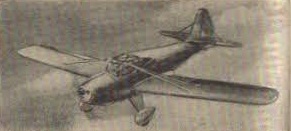
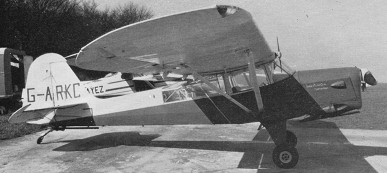
Built as a private venture, the Auster B4 was a four seat high-winged ambulance aircraft, powered by a 180 h.p. Blackburn Cirrus Bombardier 702 engine.
First flown in September 1951 as G-AMKL c/n 2983, the only example was ordered from Auster Aircraft Ltd., Rearsby, to contract 6/Acft/7708 as serial XA177.
Following initial flight trials a number of modifications were incorporated, the most noticeable being a revision of the vertical tail-surface contours.
The production model was to have the 190 hp Bombardier 203 and 7% more wing area.
Engine: Cirrus Bombardier 702, 180 hp Wingspan: 24 ft 8 in Length: 37 ft Height: 8 ft4.5 in Empty weight: 1730 lb Loaded weight: 2700 lb Max speed: 121 mph at 1000 ft Max cruise: 103 mph ROC: 670 fpm Range: 280 mi
The Auster Model S was an AOP aircraft based on the AOP.6 with an enlarged tail. Powered by a180 h.p. Blackburn Cirrus Bombardier 702 engine, one aircraft was ordered from Auster Aircraft Ltd., Rearsby. First flew August 1950 as WJ316.
The Model P Avis four seat tourer based on the J/1 with a slimmer circular section rear fuselage, new undercarriage, four doors and new wing flaps. Powered by a 145 h.p. Gipsy Major 10 engine, it was planned in two versions, the Mk 1 for civil use, and the Mk 2 for military and air ambulance duties.
Only two prototypes were built by Auster Aircraft Ltd., Rearsby, the first flying in mid-1947. The was Avis Mk.1 G-AJXW c/n 2838. The second completed was Avis Mk.2 G-AJYF c/n 2907.
Auster abandoned the project in favour of the J/5 Autocar.
The Auster A.2/45 was a British late 1940s single-engined high-wing air observation monoplane built by Auster Aircraft Limited at Rearsby, Leicestershire. It was designed and built to meet Air Ministry Specification A.2/45 for an “Air Observation Post” (AOP) for the British Army, the requirement was withdrawn and only two prototypes were built.
The Auster Model N normally known by the specification number as the A.2/45 was a strut-braced high-wing monoplane with a single DH Gipsy Queen engine, the enclosed cabin had room for a pilot and observer seated in tandem. It had a conventional landing gear with a tail wheel.
The British Air Ministry Specification A.2/45 was issued on 20 July 1945 for an Air Observation Aircraft to meet Operational Requirement OR.176 in particularly for operation from unprepared landing grounds. Contracts for four prototypes from both Auster and the Heston Aircraft Company were placed on 21 August 1945, this was later reduced to just two aircraft from each company. The Heston competitor for the specification was the Heston JC.6.
The first prototype Auster A.2/45 VL522 flew on 27 April 1948. The Air Ministry requirement was cancelled on the 20 March 1950 and only the two prototypes were built.
Powerplant: 1 × de Havilland Gipsy Queen 34, 250 hp (190 kW) Propeller: 2-blade Wingspan: 43 ft 6 in (13.26 m) Wing area: 278 sq ft (25.8 m2) Length: 30 ft 1 in (9.17 m) Height: 8 ft 4 in (2.54 m) Gross weight: 3,365 lb (1,526 kg) Fuel capacity: 24 imp gal (29 US gal; 110 L) in a port wing root fuel tank, opt/identical 24 imp gal starboard wing root Maximum speed: 130 mph (210 km/h, 110 kn) Cruise speed: 122 mph (196 km/h, 106 kn) Economical cruise speed: 105 mph (91 kn; 169 km/h) Range: 600 mi (970 km, 520 nmi) Ferry range: 1,100 mi (1,800 km, 960 nmi) with optional second tank Service ceiling: 15,500 ft (4,700 m) service ceiling Rate of climb: 740 ft/min (3.8 m/s) initial rate of climb Take off run to clear 50 m (160 ft): 330 yd (300 m) Landing distance from 50 m (160 ft): 220 yd (200 m) Crew: 2 (pilot, observer)
The Model L was the first low-wing design by the company. Responsible for its development was Mr.A.L.Wykes, and it owed much to the Auster, being little more than an Auster airframe with the wings mounted on the bottom of the fuselage.
Construction apparently started in 1944 as a 2/3 seat lightplane powered by a 130 h.p. Lycoming O-290-3 engine.
The prototype was almost completed but was abandoned after the death of Mr. A.L.Wykes in May 1944.
Engine: Lycoming O-290-3, 130 h.p. Span: 28.0 ft Length: 22 ft 5 in Seat: 2-3
In 1948 the RCAF first obtained the Auster Mk VI, an improved, post-war model with a DeHavilland Gypsy Major engine, more fuel capacity and a longer undercarriage. The first of the Auster VI’s served with 444 (AOP) Squadron at the Joint Training School (JTS), Rivers, Manitoba. The RCAF retired the last of their Austers in 1958.
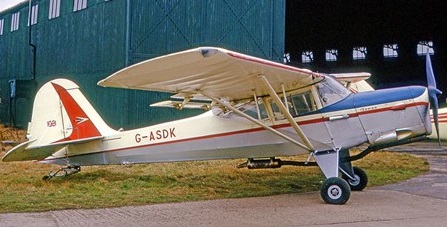
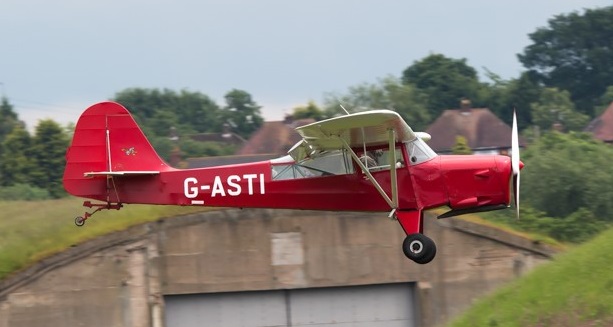
After taking the Auster AOP 6 and 7 from service, Beagle did buy them and refurbished them to civil use. They were sold to private customers as the A.61 Terrier.
A.61 Terrier
The Beagle Terrier was the name given to the modified Auster AOP (Air Observation Post) 6, after the Auster Aircraft Company was sold. The Auster Aircraft Company purchased a large number of former British Army Auster aircraft during the late 1950s. These were Auster AOP.6, T.7 and T.10 aircraft which were updated and modified with a de Havilland Gipsy Major 10-1-1 engine.
The AOP.6 and AOP.6A were modified AOP.5 with a strengthened rear fuselage, external flaps, increased MTOW, and 145 hp Gipsy Major 7. The prototype AOP.6 appeared in 1945 and 296 were supplied to the RAF, some of these being transferred to the Belgian Air Force. Others were supplied to the RCAF and SAAF, and a two-seat trainer version, the Auster T.7, was converted to full AOP standards in 1947. Initial production of the AOP.6 was completed in 1949, but further production was undertaken in 1952.
AOP.6
Initially two versions were offered for sale in the civilian market from 1960:
Auster 6A Tugmaster – a utility and glider towing aircraft
Auster 6B – a three-seat luxury version. When the company became part of Beagle Aircraft in 1960, the Auster 6B was renamed the Beagle A.61 Terrier 1.
Eighteen Terrier 1s conversions were built. The first conversion flew 13 April 1961 from Rearsby.
In 1962 the Beagle A.61 Terrier 2 was introduced with a greater span tailplane, wheel spats and a metal propeller. First flight of a Terrier Series 2 was made on 25 April 1962. The type is a three-seat touring and training monoplane. Sixty of these were sold by the beginning of March 1964. The conversions includes the complete overhaul of the airframe and engine, the provision of new tail surfaces and ailerons, and a sound-proofed three-seat cabin trimmed and upholstered. As a glider tug, the Terrier can tow an average two-seater to 2000 ft in 6 min 30 sec.
Forty-Five Terrier 2s conversions were completed at Rearsby. A small number of airframes were converted subsequently to this standard by other companies.
One Terrier 3 powered by a 160 hp Lycoming O-320-B2B engine was essentially complete at Rearsby when Terrier production was stopped in 1966. In 1967, an incomplete Terrier 2 was modified to this standard by British European Airways engineering apprentices and registered G-AVYK.
The Terrier was not an economic success for the manufacturer as it was found that more man-hours were spent on rebuilding each aircraft after its military use than were spent in building the new aircraft for the Army. Examples of the type were purchased by owners in the United Kingdom, Eire, Germany, Netherlands, New Zealand and Sweden. 23 Terriers were registered in the UK in 2013.
Of a total of 380 of AOP6 built, less that 100 were converted to Terriers between 1946 and 1953.
Auster 6A Tugmaster
The 6A Tugmaster and Terrier 1 were also rebuilt Auster Mk 6, but to lower standards.
Later adopted as the Auster T.7
The AOP.6 was developed from the Mk 5 with a modified fuselage and increased all-up weight and powered by a Gipsy Major 7 engine. Equipped with all-metal auxiliary aerofoil flaps below and behind trailing edge, and wings strengthened to take two 52.25 litre fuel tanks, the pilot and observer seated in tandem. Lengthened landing gear struts allowed a larger airscrew. Production completed in 1949. The T.7 was a two-seat trainer which could be quickly converted to full AOP standard. Equipped with side-by-side seating with dual controls, a third seat could be fitted.
AOP.6 Engine: de Havilland Gipsy Major VII, 145 hp Wingspan: 36 ft 0 in Wing area: 184 sq.ft Length: 23 ft 9 in Height: 8 ft 4.5 in Empty weight: 1413 lb Loaded weight: 2160 lb Max speed: 124 mph at 1000 ft Cruise: 108 mph ROC: 810 fpm Service ceiling: 14,000 ft Range: 315 mi
T.7 Engine: de Havilland Gipsy Major 130hp. Cruise speed: 114 mph.
T.7c Engine: de Havilland Gipsy Major VII, 145 hp.
Auster 6A Tugmaster
A.61 Terrier 60 converted from military AOP.6
A.61 Terrier 2 Engine: 1 x DH Gypsy Major 10, 145 hp / 107kW Take-off weight: 1090 kg / 2400 lb Empty weight: 727 kg / 1600 lb Wingspan: 11.0 m / 36 ft 1 in Length: 7.1 m / 23 ft 4 in Height: 2.7 m / 8 ft 10 in Wing area: 17.1 sq.m / 184.06 sq ft Max. speed: 191 km/h / 119 mph Cruise speed: 172 km/h / 107 mph Ceiling: 3500 m / 11500 ft Rate of climb: 530 ft/min (2.7 m/s) Range: 450 km / 280 miles Seats: 3
The Auster AOP.11 three-seat AOP machine with a 260 hp Continental IO-470-D 6-cylinder horizontally opposed engine raised the maximum speed to 142 mph (228 km/h) and the empty weight to 1,806 lb (816 kg). Apart from the engine, the AOP.11 was almost identical to the AOP.9. Early in its career the undercarriage had spats, though these were later removed.
Only one, a converted AOP.9 was produced, making its first flight on 18 August 1961 with serial XP254. The Auster AOP.11 was exhibited at the Farnborough Air Show in September 1961. A year later it was registered to Beagle aircraft, that had taken over Auster in 1960, as G-ASCC where it was known as the Beagle Mk 11, the E.3 or as the A.115. It was sold into private hands in 1971.
AOP. 11
The sole Beagle E3/Auster AOP.11 G-ASCC was flying until an accident in 2007.
Auster AOP11 / Beagle E-3 Engine: 1 x RR/Cont. IO-470D, 190kW Wingspan: 11.1 m / 36 ft 5 in Length: 7.2 m / 23 ft 7 in Height: 2.7 m / 8 ft 10 in Wing area: 18.4 sq.m / 198.06 sq.ft Take-off weight: 1160 kg / 2557 lb Empty weight: 750 kg / 1653 lb Max. speed: 240 km/h / 149 mph Cruise speed: 128 mph Ceiling: 6100 m / 20000 ft ROC: 1300 fpm Crew: 3
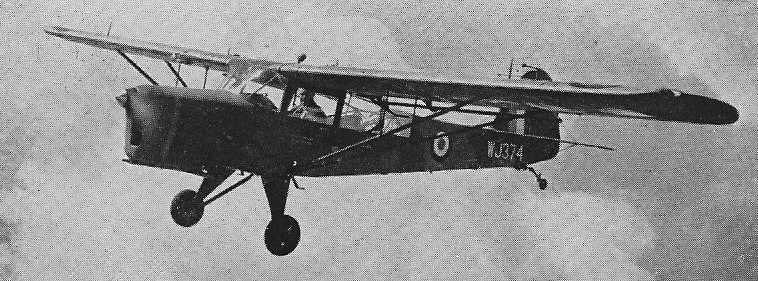
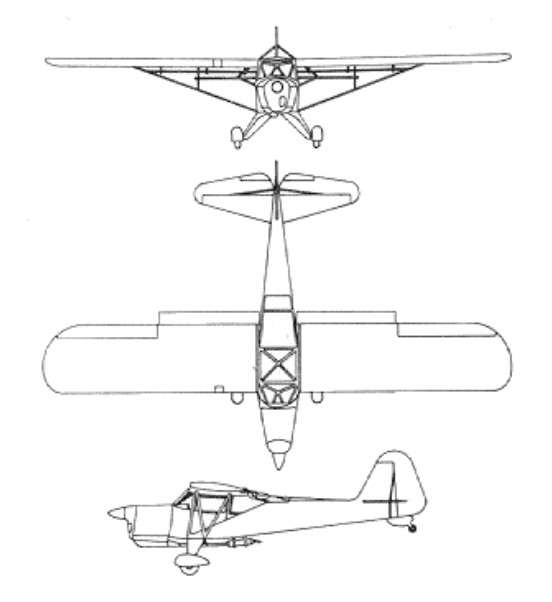
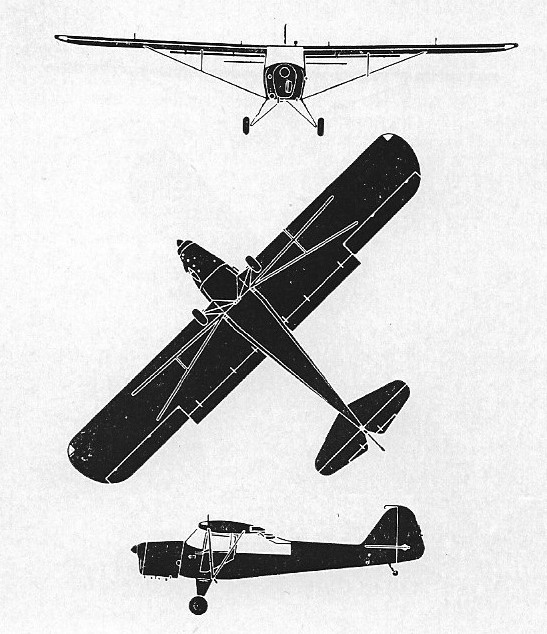
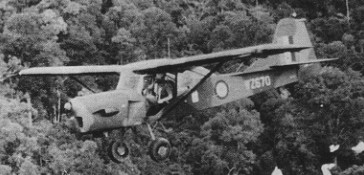
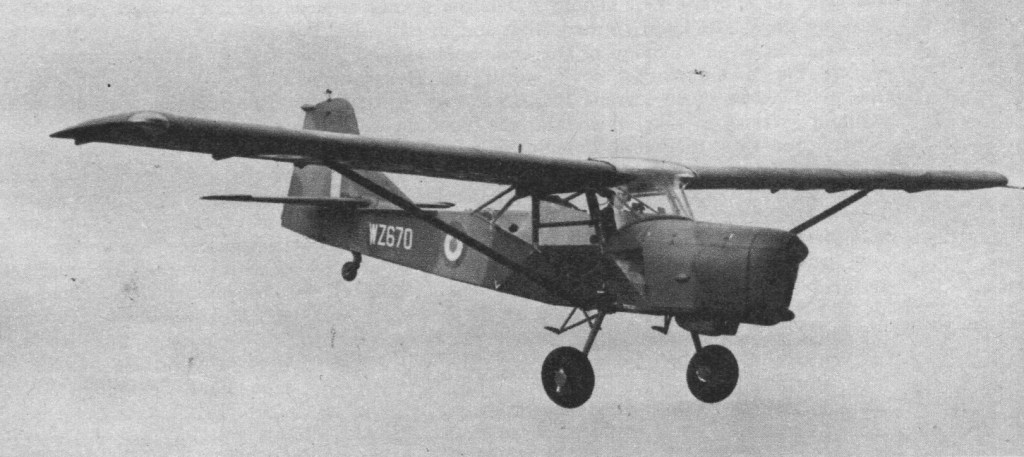
The Auster AOP.9 was designed as a successor to the Auster AOP.6. The AOP.9 was a completely new aircraft and not a development of a civil type. Apart from plastic tips and a fabric covering aft of the main spar, the wings are all-metal and are built round a stiff leading-edge torsion box. The split flaps have a hydraulic assist. Drooping ailerons assist with short landings and take-offs. One of its main features is the Dowty liquid spring undercarriage with large diameter tyres, capable of withstanding a vertical rate of descent of 9 ft/sec and allowing operation from virtually any type of landing surface.
It was a braced high-wing single engined monoplane with a fixed tailwheel undercarriage. The AOP.9 was a new design, the wing and tail metal-skinned, but the fuselage and ailerons were fabric-covered. The fin and rudder assembly were more angular in the new aircraft with a noticeable dorsal fillet. A combination of the 180 hp (134 kW) Blackburn Cirrus Bombardier engine, larger wings and large flaps gave it an improved take-off and landing performance compared with the AOP.6. It could operate from ploughed fields and muddy surfaces using low pressure tyres and strengthened undercarriage.
On the insistence of the British Army the fuselage is welded steel and fabric covered. A third seat can be fitted. A unique feature is the rear cockpit floor, designed to allow a complete and rapid change of role. With the removal of six bolts the floor may be lowered out of the aircraft and a new floor, complete with equipment, can be substituted in a few minutes.
The cabin held three seats, pilot and passenger side-by-side and the observer behind, facing either forwards or rearwards. The aircraft was also designed to be convertible into a two-seat light transport with an interchangeable rear floor. In this configuration the observer sat alongside the pilot.
The prototype WZ662, which was also the first production machine, first flew 19 March 1954 with a 180 hp / 134kW Blackburn Cirrus Bombardier 203 (military version of 702) engine. Auster Aircraft allotted its model designation B5 to the AOP.9 design.
Deliveries started to the Royal Air Force in February 1955, replacing AOP.6s in the regular AOP squadrons, the auxiliary squadrons disbanding in March 1957 before receiving AOP.9s. Until the formation of the Army Air Corps (AAC) in September 1957, Army personnel flew RAF aircraft based in RAF squadrons.
The aircraft were in action with No. 656 Squadron from September 1955, flying an average of 1,200 sorties per month. By the end of Operation Firedog in Malaya on 31 July 1960, 656 Squadron’s AOP.6 and AOP.9s had carried out 143,000 sorties.
Over 6 million leaflets were dropped by Austers of no.656 Sqn RAF dring the Malayan conflict.
The AOP.9s were involved in several of Britain’s other end of Empire conflicts; 653 Squadron AAC used them in Aden in the early 1960s, flying from Falaise, Little Aden. They stayed in service until 1966 and were the last fixed wing AOP aircraft used by the AAC, though their light transport role was taken over by Beavers.
AOP.9s were supplied to the Indian Air Force and the South African Air Force operated its AOP.9s from 1957 to 1967.
The Army Historic Aircraft Flight maintain an AOP.9 in flying condition at Middle Wallop.
A total of 182 were built and in the 1970s, 19 AOP.9s joined the UK civil register, and in 2008 14 remained, though only about three of these had a current certificate of airworthiness.
A number of army surplus aircraft were bought by Captain Mike Somerton-Rayner in 1967. One was converted as an Auster 9M with a 180 hp (134 kW) Avco Lycoming O-360-A1D piston engine. The 9M first flew on 4 January 1968, and gained a Certificate of Airworthiness on 30 April 1968. The aircraft was still airworthy in 2009.
Operators Military operators
Hong Kong Royal Hong Kong Auxiliary Air Force about 4 ex-British AAC aircraft various ACC AOP and Independent Flights stationed in Hong Kong in the 1950s and 1960s
India – About 35 aircraft Indian Air Force Indian Army
South African Air Force about 2 aircraft
United Kingdom – about 145 aircraft
Army Air Corps 653 Squadron 656 Squadron Advanced Fixed Wing Flight Army Flights: 2, 3, 5, 6, 7, 8, 10, 11, 12, 13, 14, 16, 18, 20, 21. Various Army Regiments
Royal Air Force 651 Squadron 652 Squadron (1956–1957) 656 Squadron (1955–1957) 657 Squadron Light Liaison Flight, South Korea Christmas Island Flight, 160 Wing 1900 Flight (Hong Kong) 38 Group Communications Flight Upavon Light Aircraft School Middle Wallop
AOP 9 Engine: Blackburn Bombardier 203, 173 hp (129 kw) Span: 36 ft 5 in / 11.10 m Wing area: 197.6 ft² / 18.36 m² Length: 23 ft 8.5 in / 7.24 m Height: 8 ft 11 in / 2.72 m Empty weight: 1,460 lb / 663 kg Max. takeoff weight: 2,330 lb / 1,057 kg Max speed: 127 mph / 204 km/h Cruise speed: 110 mph / 178 km/h Range: 242 miles / 389 km Service ceiling: 18,500 ft (5640 m) Rate of climb: 920 ft/min / 280 m/min Crew: 2/3
The J5 was a development of the J1 and it differed in having a sloping firewall to accommodate the larger and heavier engine. This reduced the fuel capacity of the main tank though this is overcome by the addition of a 13.75 Imp.G belly tank. It also retained the smaller vertical tail surfaces of the J1. Introduced in 1947, the J/5 range included the Autocar with its distinctive hump-backed fuselage aft of the trailing edge. This proved popular albeit briefly with clubs until the advent of modern US types. The J/5F is the only Auster rated for aerobatics.
The Adventurer four-seat model of the J/5 was built for the Australian market. Most were shipped to Kingsford Smith Aviation Services of Bankstown, Sydney, for assembly. Six were purchased by the RNZAF (NZ1701-NZ1706) for army and forestry patrol work.
The four-seat J/5 Autocrat was developed into the J/5B Autocrat with the prototype flying in August 1949. Also powered by a 130 hp Gipsy Major I engine, it featured a domed cabin roof, wing fuel tanks and an enlarged horn-balanced rudder.
J/5B Autocar
In 1951 the two-seat J/5F Aiglet Trainer was introduced. It was basically a J/1B converted to a dual control aerobatic trainer with a widened 4in and strengthened fuselage. Horn-balanced rudder and elevator are fitted and wingspan reduced from 36 ft to 32 ft. Approximately 70 of this type were built, including several with a 155 hp Gipsy Major engine, as the J/5K, with a 155 hp Cirrus Major, the J/5L, with a 155 hp Gipsy Major, and the J/5R which combined the Aiglet Trainer fuselage and tail with Autocrat wings.
J/5F Aiglet Trainer
The J.5F Aiglet Trainer was approved by the Air Ministry for A.T.C. flying training. The company stated that the Aiglet is the only aircraft other than ex-military types to obtain this approval.
Aiglet Trainer
The direct-reading fuel gauge on the 14gal front tank was very accurate and they could fly until only two gallons remained, allowing nearly two-hour work stints.
Taylorcraft J Auster 5
Developed from the three-seat J/5 Autocrat, the J/5B Autocar added a 155 hp Cirrus Major III engine and first flew in August 1949. Approximately 100 were built, most being exported. The J/5G Cirrus Autocar, first flown in July 1951, which was designed with tropical conditions in mind. Around 80 were built. A usual load for the J/5Gs was 7cwt (350kg).
The engine was changed to a 145 hp Cirrus Major II to create the J/5H Autocar.
A 145 hp de Havilland Gipsy Major 10 engine was added, producing the J/5P Autocar 145 in 1955. Approximately 20 were built. The Autocar differed from the Autocrat with raised rear fuselage decking and enlarge fin and rudder assembly.
The J/5Q Alpine incorporated the long-span wings of the J/5B Autocar and the wide fuselage of the J/5F and was powered by a 130 hp Gipsy Major I engine.
The J/5R Alpine was powered by a 145 hp de Havilland Gipsy Major 10 engine.
In 1955 Harry Wigley devised retractable skis and installed them on an Aiglet, ZK-BDX. Trials took place on the Tasman Glacier with commercial operations beginning the following year.
In 1955 Saunders-Roe conducted trials of its hydroski concept using an Auster J/5G Autocar. The skis were fitted to a standard aeroplane and were demonstrated successfully. They supported the aircraft down to a fast taxying speed so it could land on water and roll up onto a beach, and start its takeoff from a very short stretch of land or a ramp.
The sole Auster J8L Aiglet Trainer was a J/5K re-engined with a de Havilland Gipsy Major 1 engine.
Auster J8L Aiglet Trainer
The 1954 Auster J8 L Aglet Trainer was located in Queensland, Australia, registered VH-RIE, when it sold for $38,000 on 14 June 2018. It was noted as: Serial Number 3151 Total Time Airframe 1870 hrs One of a kind factory modified for the RAF, and never put into service. 145HP, 1/2″ valve stems, dual fuel pumps, and electric stater. Automotive spark plugs and leads conversion. New gaskets and engine mount rubbers. In very good condition, aerobatic seats and 4 point seat belts, centre flap leaver and 2+2 seating 33′ wingspan (short wing version), larger rudder to aid better spin recovery, as this is an aerobatic approved aircraft
Auster J8 L Aglet Trainer 2018
Auster J.5G Cirrus Autocar which Saunders Roe used for hydro-ski research in 1955
Model J Auster 5 790 built Version with rear fuselage of Autocrat known as Alpha 5
J/5 Engine: de Havilland Gipsy Major I, 130 hp Wingspan: 36 ft / 11 m Length: 23 ft / 7 m Height: 8 ft 8 in / 2.6 m Empty weight: 1162 lb / 527 kg Loaded weight: 2100 lb / 952.6 kg Max speed: 114 mph / 183.4 kph Max range: 375 mi / 603.55 km Service ceiling: 12,500 ft / 3810 m 50 built
J/5 Adventurer
J/5B Autocar Engine: 130 hp Gipsy Major I Span: 36 ft Wing area: 185 sq,ft Length: 23 ft 2 in Height: 7 ft 6 in Empty weight: 1413 lb Loaded wight: 2400 lb Max speed: 116 mph Cruise: 100 mph Service ceiling: 11,000 ft ROC: 525 fpm Range: 500 mi Approx. 100 built
J/5F Aiglet Trainer Engine: Gipsy Major 1, 130 hp. Wingspan: 32 ft Wing area: 164 sq.ft Length: 23 ft 2 in Height: 6 ft 6 in Empty weight: 1323 lb Aerobatic loaded weight: 1950 lb Max speed: 125 mph Cruise: 107 mph ROC: 650 fpm Service ceiling: 12,500 ft Cruise range: 500 mi
J5F Aiglet Trainer / J/5K / J/5L Engine: DH Gipsy Major 10, 145 hp Span: 32 ft Length: 23 ft 2.5 in Mauw: 1950 lb Max speed: 127 mph Seats: 2 Approx. 70 built
J/5G Autocar Engine: 155 hp Cirrus Major 3 Span: 36 ft Wing area: 185 sq,ft Length: 23 ft 2 in Height: 7 ft 6 in Empty weight: 1367 lb Loaded wight: 2450 lb Max speed: 127 mph Cruise: 110 mph Service ceiling: 14,000 ft ROC: 710 fpm Range: 485 mi Approx. 80 built
J/5H Autocar Engine: 150 hp Cirrus Major 2 Span: 36 ft Wing area: 185 sq,ft Length: 23 ft 2 in Height: 7 ft 6 in Empty weight: 1367 lb Loaded wight: 2450 lb Max speed: 127 mph Cruise: 110 mph Service ceiling: 14,000 ft ROC: 710 fpm Range: 485 mi
J/5P Autocar Engine: Gipsy Major 10/2. Span: 36 ft Length: 23 ft 2 in Mauw: 2400 lb Max speed: 117 mph Approx. 20 built