AVIC Special Vehicle Research Institute A2C

AC2-L

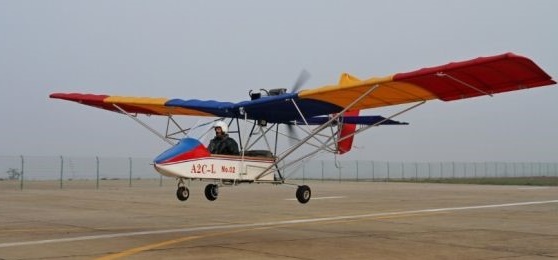
The A2C-L ultra-light aircraft was developed by the AVIC Special Vehicle Research Institute after the A2C seaplane achieved commercial success. The aircraft is transformed and updated from the seaplane and finished its test flight in 2012.

The A2C seaplane is the first ultra-light aircraft that obtained a certificate of model design approval and a production permit issued by the Civil Aviation Administration of China.

An ultra-light aircraft independently developed by China, it got the special flight permit and completed its delivery test flight on 11 March 2016. Nearly 100 A2C planes have been sold to regions including Sichuan, Hubei, Anhui, Inner Mongolia and Xinjiang.

Aviation Products Star Trike

Star Trike ES

Circa 1998, the solo Star Trike ES is a traditional double pole design.

The two seat Star Trike merely has a larger seat and power unit.

Star Trike

The Star Trike Rescue carrys a stretcher on the side, becoming a three seater.

Star Trike Rescue

Star Trike ES
Empty weight: 112 kg
Wing span: 10.4 m
Wing area: 14 sq.m
Fuel capacity: 30-50 lt
Certification: Vz
Engine: Rotax, 40 hp
MAUW: 325 kg
Seats: 1
Max speed: 100 kph
Cruise speed: 85 kph
Minimum speed: 45 kph
Climb rate: 1.5 m/s
Fuel consumption: 6 lt/hr

Star Trike
Empty weight: 115 kg
Wing span: 10.5 m
Wing area: 15 sq.m
Fuel capacity: 30-50 lt
Certification: Vz
Engine: Rotax, 40 hp
MAUW: 350 kg
Seats: 2
Max speed: 135 kph
Cruise speed: 100 kph
Minimum speed: 48 kph
Climb rate: 2 m/s
Fuel consumption: 7.5 lt/hr
Price (1998): 32 500 DM

Star Trike Rescue
Empty weight: 135 kg
Wing area: 15-16 sq.m
Fuel capacity: 50 lt
Engine: 40-90 hp
MAUW: 450 kg
Seats: 3
Max speed: 100 kph
Cruise speed: 85 kph
Minimum speed: 48 kph
Climb rate: 2.25-3 m/s
Fuel consumption: 6-12 lt/hr

AVIAD Zigolo MG12

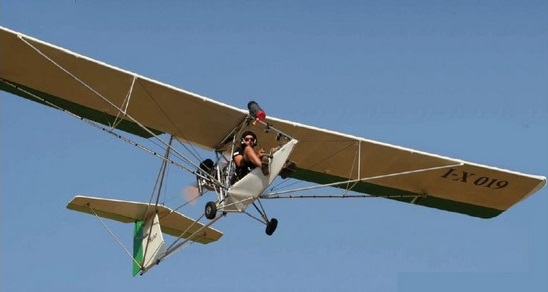
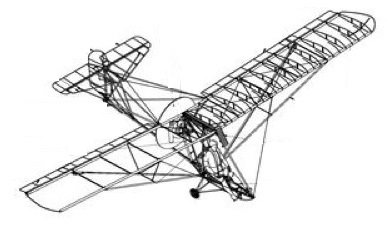
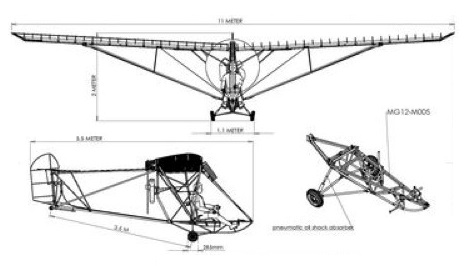
The AVIAD Zigolo MG12 is a SSDR (Single Seat De-Regulated) ultralight motor glider. This aircraft meets the USA FAA FAR Part 103 rules for UL (SSDR) aircraft in USA, China, and other countries. It is a conventional full 3-axis aircraft.

The AVIAD Zigolo MG12 is specifically designed for simple construction and low cost of ownership, it has a traditional tubular frame structure and simple bonded fabric covering. It has excellent slow flight characteristics and a short landing and take off distance of 130 feet.

The rear mounted pusher engine with propeller and the fuel tank are also contained within the airframe. The joy stick mounted engine throttle control further simplifies the aircraft’s three axis flight controls. It incorporates a forward pilot cockpit protected by the fuselage frame work and providing a wide field of view.

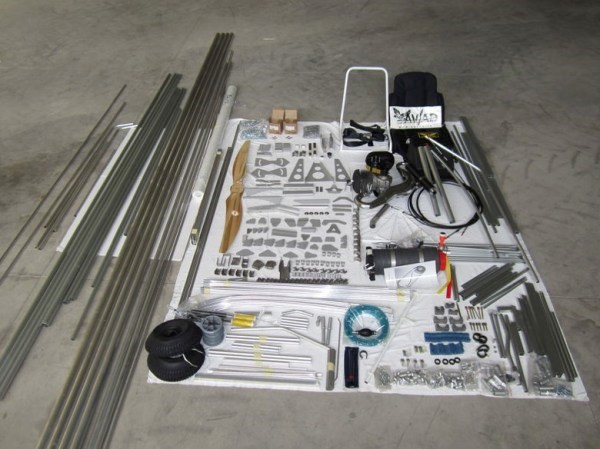
The Zigolo MG12 Kit does not require specialist knowledge or equipment for assembly. The drawings are very detailed and provide a step by step guide for assembly. The individual drawings contain a parts list of required components, which are easily identified by the initials engraved on them.

The Design Drawings are shared online and are made easily accessible for kit builders. All parts are accurately cut, perforated and folded. The assembly process only requires the correct part selection and correct positioning prior to fixing with either bolt or rivet to complete each sub-assembly / module. The complete aircraft’s final assembly can be undertaken either within the workshop or in the hangar and does not require any excessive space for construction.

The Zigolo MG12 kit requires less than 100 hours for assembly. The aircraft modules once completed can be rigged and ready to fly in 1 hour and offer easy transportation by truck, pick-up or trailer. The new wing remove system means the wings can be removed in just a couple minutes each.

It is a motor-glider. The glide ratio (L/D) is nowhere near that of a glider but due to its’ large wing and therefore very low wing loading the sink rate is reasonably low. The turn radius is so tight and slow it is easy for novice glider pilots to stay in thermals.

The Zigolo is available as a finished aircraft. Ultralights do not have any 51% build rule like the experimental class but can be offered ready to fly. Should a builder choose to fly outside the Part 103 rules the Zigolo has been inspected and approved as an E-AB kit and can be found on the FAA list of approved kits.

Base price was $12,000 (2017) and that includes EVERYTHING but finish paint. Engine & prop as well.

Engine: Vittorazi Moster 185, 25 hp at 7800 rpm
Wingspan: 11.1m / 36.4 ft
Wingarea: 15.8 sq.m / 170 sq.ft
Length: 5.5 m / 18 ft
Aspect ratio: 7.9
Dihedral: 3 deg
Empty weight: 102 kg / 225 lb
Max weight: 220 kg / 485 lb
Fuel burn: 6 lt/hr / 1.6 GPH
Fuel burn 30kg thrust: 3.5 lt/hr / 0.92 GPH
Stall: 35 kph / 22 mph
Cruise 6800 rpm: 68 kph / 42 mph
Vne: 95 kph / 58 mph
ROC: 2 m/s / 394 fpm
Sink rate: 1.4 m/s / 276 fpm
Glide ratio: 11-1
Manoeuvring speed: 65 kph / 40 mph
Range: 95 km / 59 miles
Load factor: +4 / -2 G
Safety factor: 1.5 G
Tailplan span: 3 m / 9.8 ft
Height at rudder: 1.3 m / 4.3 ft
Power loading: 7 kg/hp 15.4 lb/hp
Wing loading: 11 kg/sq.m / 2.23 lb/sq.ft
TO dist: 40m / 131 ft
TO dist to 50ft: 180m / 590 ft

A.V.I.A. 1909 Monoplane

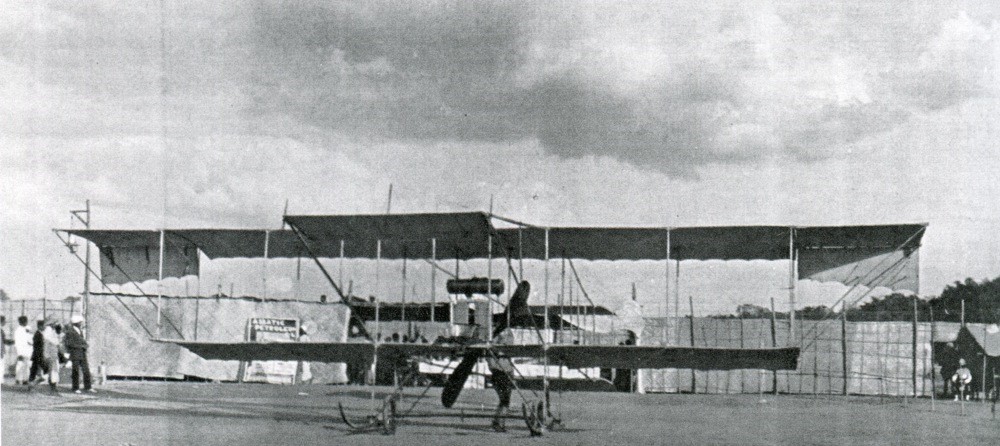
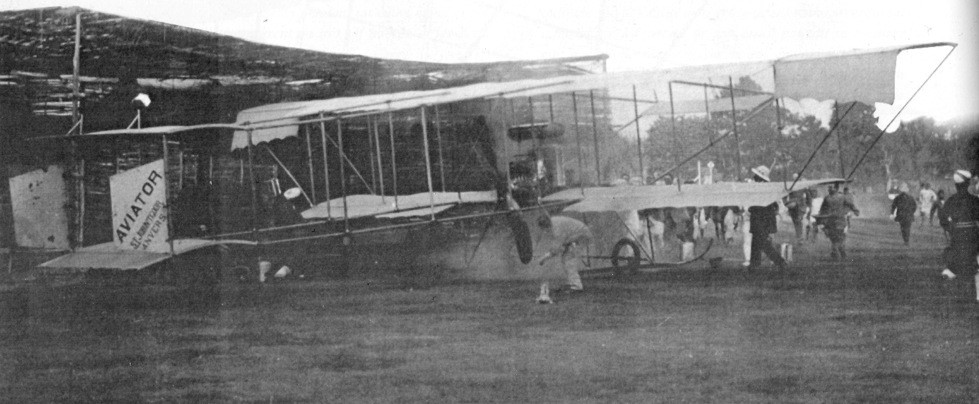
This machine, the first monoplane of the “Ateliers Vosgiens d’Industrie Aéronautique”, was built in 1909, at Saint-Dié (Vosges). It was designed by Charles Roux and was displayed at the Exposition de la Locomotion Aérienne de Paris between 25 September and 17 October 1909. The engine was a 20 hp Dutheil & Chalmers.

Engine: Dutheil & Chalmers, 20 hp
Span: 23′
Length: 25’5″

Aveko VL3 / JMB Aircraft VL3

Designed by Vanessa Air and produced in the past by Aveko, the VL3 airframe is completely made of composite material. The entire aircraft can be broken down into individual units for ease of transport.

The cabin area features clean lines and a minimalist, contemporary design. The combination of carbon and kevlar fibers, which are extremely tough, provide safety to the crew in case of an emergency landing.
The aircraft is equipped with a heating and ventilation system.

The VL3 is available with two different engines: the Rotax 912 and the Rotax 914. Fixed or variable pitch propeller options were available.

The VL3 was successfully tested to ultimate loads up to +15G’s and -8G’s and flutter tested up to 460 km/h. A parachute rescue system limits VNE to 305 km/h. An airframe parachute is installed for emergency decent.

The base VL-3 includes: retractable gear, rotax 912ULS2 100 HP, rescue system, 3-blade propeller, cabin ventilation, canopy lock, 4-points safety belts, certified canopy, Beringer Brakes, 120L fuel tanks, airspeed indicator, hobbs, slip indicator, air fuel selector, Acryl paint, AOA. Base price is €123,500 Euros in 2020.

The VL3 has type certificates in The Czech Republic, Germany, Belgium, France, Norway, Portugal, Poland, The Baltic States, South Africa, USA, Italy, Slovakia, Turkey, Hungary and Romania. VL3 is eligible to be registered in Canada.

JMB Aircraft later became the production company of the VL3.

Gallery

VL3 RG
Engine: Rotax 915is Turbo, 141 hp
Vne: 340 kph
Cruise: 205 kt / 379 kph
Stall: 34 kt
Fuel consumption: 32 lt/hr
TO distance: 175 m
Landing dist: 175 m
ROC: 2000 fpm / 695 m/min
Max op alt: 5486 m
Range: 2100 km at 270 kph

AVE Mizar

The Flight Module approach was revived by two Californians, Henry Smolinski and Harold Blake, founded Advanced Vehicle Engineers Inc in 1971 to design and build a flying car. AVE combined a standard US production automobile, a Ford Pinto, with the wings, tail and rear engine of Cessna’s push pull Skymaster aircraft as the Mizar.

The Pinto was extensively modified, so that its steering wheel not only steered on the ground, but operated the ailerons and elevators. A pair of retractable rudder pedals fitted beneath the fur trimmed dash¬board, which had a full panel of flight instruments and avionics alongside the usual Detroit fittings.

Self locking high strength steel pins and tracking attached the flying surfaces to the car. Buyers were to be offered a choice of three modules with 235 , 260- or 300 hp engines, ranging in price from $12,319 to $22,974, Plus $5974 for the Pinto, whitewall tires included. And if you were not a Ford fan, you could have a modified Chevrolet or Pontiac.

AVE’s Mizar was surely the easiest aircraft ever to manoeuvre on the ground: you just shifted the automatic transmission to ‘Drive’ and away you went. For take off, the road drive and propeller could be used together for a swift departure, or so went the theory. In practice the Mizar performed miserably with a 210 hp engine. The powerplant failed on its first flight and Smolinski and Blake had to drive back to their airfield.

Towards the end of 1973 car and aircraft went their separate ways just after take off, killing the two inventors and their project.

Gallery

Australian Aviation Works Spacewalker

Spacewalker I
Spacewalker II

Spacewalker I
Engine: 105 hp.
HP range: 65-105.
Speed max: 140 mph.
Cruise: 120 mph.
Range: 300 sm.
Stall: 38 mph.
ROC: 950 fpm.
Take-off dist: 300 ft.
Landing dist: 250 ft.
Service ceiling: 10,000 ft.
Fuel cap: 10 USG.
Weight empty: 540 lbs.
Gross: 850 lbs.
Height: 5.41 ft.
Length: 17.25 ft.
Wing span: 26 ft.
Wing area: 117 sq.ft.
Seats: 1.
Landing gear: tail wheel.

Spacewalker II
Engine: 108 hp.
HP range: 85-125.
Speed max: 125 mph.
Cruise: 115 mph.
Range: 350 sm.
Stall: 42 mph.
ROC: 950 fpm.
Take-off dist: 300 ft.
Landing dist: 250 ft.
Service ceiling: 10,000 ft.
Fuel cap: 18 USG.
Weight empty: 700 lbs.
Gross: 1200 lbs.
Height: 5.41 ft.
Length: 19.75 ft.
Wing span: 28 ft.
Wing area: 126 sq.ft.
Seats: 2.
Landing gear: tail wheel.