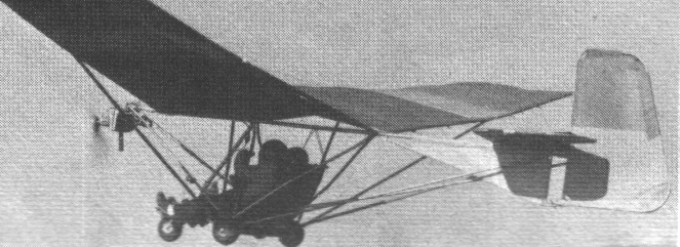
Weil Ornithopter / Bicycle Bird

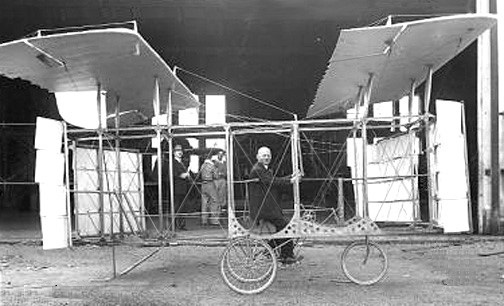
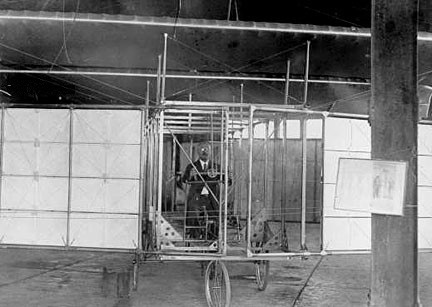
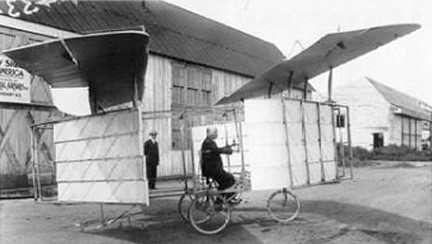
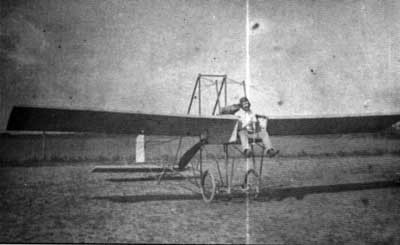
The Ornithopter, or Bicycle Bird, was built by Lehman Weil in 1927. Inventor Wilde insisted “This Bicycle Bird will fly”.

Weighing 275 pounds, there was a sprocket-and-gear arrangement that flapped the wings while a pilot treadles and iron pipes for struts.

During tests at Curtiss Field on Long Island the airplane was not successful. There were stories of chasing the thing across Staten Island as the wings flexed and its engine strained.

Weidmann Flying Tank

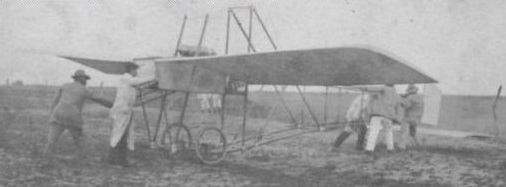
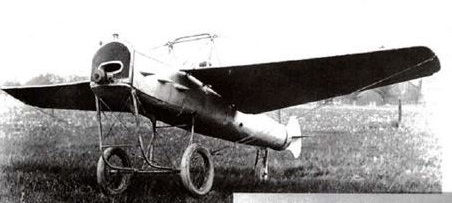
In 1910 brothers George and Edward Wiedman of the (George) Weidmann Body & Trailer Co built a single place, open cockpit, mid-wing monoplane.

Powered by an automobile engine, it was all-steel, including rolled-steel wing covering with folding wings and cruciform tail surfaces supported by a big ball-shaped universal joint.

It was probably built in 1918, even though Aerofiles and a magazine article give the date as 1910, which might be explained by a statement that the brothers had spent ten years developing the plane.

It was reportedly flown in April 1918 by a pilot by the name of “Dare Devil” Mills.

Weick A-1

Weick W-1 NS67

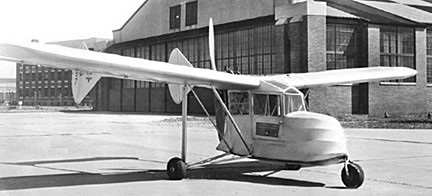
As the assistant chief of the aerodynamics division at Langley Field, in Virginia, Fred Weick was the guiding force behind development of the W 1, a pusher with an unorthodox wing configuration and decidedly unusual performance. The wing had an open slot behind the main spar controlled by a small aileron on the top surface and trailing-edge ailerons.

Although Weick’s research director at Langley wanted to have the aircraft built as a NACA project, Weick preferred to keep it free of smothering bureaucratic supervision. So, with the help of a handful of enthusiastic engineers, he built it in his garage, thereby early betraying an independent spirit.

Weick W-1-A Wind tunnel test NX67

The W 1 indeed turned out to have good stability and control and, according to Weick, was “automatically nonspinning.” It also would get in and out of unusually small spaces, off in 200 feet with no wind to an altitude of 50 feet. It landed in 100 ft, was spin- and stall-proof.

The W 1 also possessed a mildly revolu¬tionary device called a tricycle landing gear, which is what Weick says he first called it in his SAE report on the aircraft. The Weick W 1 team adopted the tricycle gear as a way to reduce ground-looping as well as a means of simplifying the entire land¬ing and takeoff process. Other noteworthy features were flaps, slot-lip ailerons, a pusher engine and twin fins.

With twin-boom, twin-tail; tricycle gear, the wing had an open slot behind the main spar controlled by a small aileron on the top surface and trailing-edge ailerons. Took off in 120′, landed in 100′, was spin- and stall-proof.

Purchased in 1934 by DoC for $5,000, plane was handed to Fairchild (Kreider-Reisner) to produce a modified W-1-A, with flaps in place of slots (NX213Y, NS67, NX67. It was Corp transferred to the NACA, it was damaged in testing and scrapped in 1938.

Engine: 85hp Pobjoy
Cruising Speed: 80 mph
Stall: 35 mph
Span: 30’0″
TO ground roll: 120 ft
Seats: 1

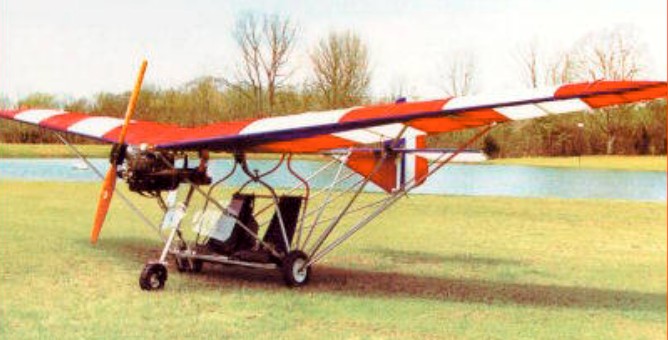
Weedhopper JC-35 Rocket

On 27 October 1981, John was killed in one of his own prototypes, the JC 35 Rocket, and on 30 December the following year the company filed bankruptcy papers. However, this does not necessarily signify the end of the company as John’s widow, Susan Boman, continued as company president, following a reorganisation which has cut the range to just one model, the JC 24C.

Weedhopper Nova

Super Nova 2000

The Nova Standard is a high-wing sturt-braced monoplane, Dacron covered aluminum framework. LANDING GEAR: Tricycle. PRICE 1984: $3,895. The Nova is similar to Nova Standard. LANDING GEAR: Tricycle. PRICE 1984: $4,695. The Super Nova 1000 is similar to Weedhopper Nova Standard. LANDING GEAR: Tricycle. PRICE 1984: $5,695. The Super Nova 2000 is similar to Weedhopper Nova Standard. LANDING GEAR: Tricycle. PRICE: 1984 $5,995.

Nova
Engine: Rotax 277, 27 hp
Prop: birch laminate 50”
Wingspan 28’
Wing area 169 sq.ft
Empty weight 198 lbs
Gross weight 398 lbs
Cruise speed 35 mph
Stall speed 22 mph
Vmax 55 mph
Climb 750 fpm
Takeoff run 50’
Landing roll 25’

Nova Standard
Engine: Rotax 277, 27 hp
Prop: wood laminate 50”
Wingspan: 28’
Wing area 168 sq.ft
Empty weight 178 lbs
Gross weight 378 lbs
Cruise speed 35 mph
Stall speed 22 mph
Vmax 55 mph
Climb 750 fpm
Takeoff run 50’
Landing roll 25’

Super Nova 1000
Engine: Rotax 503, 48 hp
Prop: birch laminate 60”
Wingspan 28’
Wing area 168 sq.ft
Empty weight 280 lbs
Gross weight 580 lbs
Cruise speed 45 mph
Stall speed 26 mph
Vmax 65 mph
Climb 1000 fpm
Takeoff run 125’
Landing roll 30’

Super Nova 2000
Engine: Rotax 503, 48 hp, or Rotax 462, 62 hp
Wingspan 28’
Wing area 168 sq.ft
Empty weight 312 lbs
Gross weight 812 lbs
Cruise speed 45 mph
Stall speed 27mph
Vmax 65 mph
Climb 750 fpm
Takeoff run 200’
Landing roll 75’

Weedhopper JC-31 Weedhopper II

JC-31A Weedhopper II

The company’s two seater, which took over the ‘Two’ part of the JC 24BL’s title and was dubbed JC 31A Weedhopper Two. At first reserved for dealers, it was later sold openly but without great success.

Weedhopper 2 place Standard Features
Full front windshield
Cushioned durable twin seating
Steerable Nosewheel- (From either seat.)
Center Stick Console
(Can be flown from either seat.)
Composite Ground Ajustable Prop -By Powerfin
Instrument Package
Tachometer
Exhaust Gas Temperature Gauge
Cylinder Head Temperature Gauge
Airspeed Indicator
Construction Type
Aluminum tube airframe with
Polyester-Dacron sailcloth wing coverings.

VNE: 75 mph.
Cruise: 55 mph
Stall: 28 mph
Range: 100 sm
Rate of climb: 400 fpm
Takeoff dist: 200 ft
Landing dist: 200 ft
Engine: Rotax 503, 50 hp
Fuel capacity: 2 x 5 USG
Empty weight: 340 lb
Gross weight: 840 lb
Length: 18 ft 6 in
Wing span: 28 ft
Wing area: 168 sq.ft
Height: 7 ft 1 in.
Seats: 2
Landing gear: nosewheel
Assembly time: 30 to 50 hours.
LSA: yes

Weedhopper JC-26-A Gypsy

When John Chotia revealed his new Gypsy at Oshkosh ’80, it was to provide an easy-to-fly, simple-to-maintain, efficient airplane.

It’s an ultralight aircraft that weighs. only 165 pounds, and because it can be footlaunched and recovered, it’s in that special -unrecognized” category that the FAA has turned its back on, meaning it can be flown without an airworthiness certificate or a pilot’s license.

The Gypsy is a very conventiowl taildragger, with responsive three-axis controls (the aileron, rudder and elevator surfaces are enormous),

Nevertheless, the Gypsy emerged full blown as a pilot’s airplane and is intended to be used as a motorized glidder. its huge, high-lift wing gives it liftdrag ratio of 16:1 and a minimum sink rate of 165 fpm. The Chotia 460 engine, which weighs only 32 pounds and develops 25 hp, is ample to get any soaring pilot high into the thermals. Once there, it doesn’t take much heat to keep the lightly loaded Gypsy going on up. Ridge soaring offers another good opportunity to lean into the wind for some free flying time. If you like cruising with the engine on, you’ll find it takes a mere 2.5 hp to maintain the 35-40 mph cruise.

A high-wing, wire-braced monoplane with “bathtub” type fuselage/cockpit and conventional tail sur¬faces. A discreet three-axis control system is operated by stick and rudder pedals. Aluminum tubing and wooden dowels are used in combination with styrofoam for ribs and fuselage pod structure. Wing and tail surfaces are covered with doped fabric. Openings in the floor of the cockpit allow for foot-launching. The engine and tail structure are at¬tached to opposite ends of a single aluminum-tube boom. POWERPLANT: Chotia 460 mounted in tractor position ahead of the main wing. The Weedhopper two-blade, wooden propeller is turned by direct drive. Fuel is carried in a polyethylene tank inside the fuselage. The single-cylinder engine is hand-propped for starting and has a compression ratio of 10:1. LANDING GEAR: Conventional taildragger type with a steerable tailwheel attached to the rudder. Main wheels are 20-inch and the tailwheel is 6-inch. There are no brakes, and the main gear are solid mounted.
In 1980 the full kit price was US$2995.

Cockpit space in the Gypsy is generous enough to accommodate a 6-foot-6-inch man with a portly frame. Visibility is incredible. While you’re offered good protection from cold winds, the sides of the fuselage hold a low profile. There’s also a large hole in the floor (for foot launching) that offers an

The aileron horn is activated by a pushrod that’s linked to a bellcrank which is hooked to cables. One cable runs down to the control stick, the other goes across to the other aileron.

The Gypsy, created and sold in kit form by Weedhopper of Ogden, Utah, represents a new, significant break-through in ultralight aircraft design. it utilizes an aluminum frame, styrofoam ribs and fuselage, and the new Chotia 460 engine which develops 25 horsepower and weighs only 32 pounds.
Weedhopper offers the Gypsy as a kit that’s complete with everything except glue and dope. It was created for easy construction: all components requiring bending, machining or sewing are treated at the factory. A drill guide is furnished to permit hand drills instead of a drill press.

Seamless, drawn 6061 T-6 aluminum tubing is used to form the basic structure of the Gypsy. Wooden dowels are’ set inside the tubes at the attach points, and aircraft bolts are used in the joints. In some cases, premachined brackets, tabs or gussets are attached to accommodate struts, spans, cables, pushrods, etc., Ruggedness has been built into the design.

Making the wings is an agreeable matter of laying out the tubes in a rectangular shape, drilling holes for some pop rivets and bolts, fitting on the precut, extruded styrene foam ribs, and gluing on the capstrips. Then the 1.5 ounce Dacron sailplane cloth is glued on. Butyrate, dope gives color and a smoothness to the flying surfaces. Detailed, large-scale drawings and full instructions reduce the entire process to simply “counting numbers.” For the rudder and elevator, you just sand to shape and glue on fiberglass cloth.

The control system follows the tradition for separate aileron, rudder and elevator linkage, Cables run from the control stick and rudder pedals to their respective horns and bell cranks. Everything in the control system is exposed, so you can easily see and closely inspect it. Any wear on the cables or attach points will show up immediately.

Because of the slow stall speed (22 mph), takeoffs and landings in a Gypsy are easy, even for a relatively inexperienced pilot.

Wingspan, 32 ft
Wing area, 144 sq.ft
Aspect ratio, 7.1
Overall length, 18.5 ft
Empty weight, 165 lb
Usable payload (include fuel), 250 lb
Wing loading, 2.31 lbs/sq.ft
L/D power-off glide ratio: 16.1
VNE: 65 kt / 75 mph / 120 kmh
Cruise speed (85% power), 60 mph (redline)
Stall: 22 kt / 25 mph / 41 kmh
Ap¬proach speed, 30mph
Flair speed, 22 mph
Liftoff speed, 25 mph
Take-off distance (50ft obstacle): 100 ft / 30 m
Landing distance (50ft obstacle): 35 ft / 11 m
Rate of climb, 400-600 fpm
Fuel capacity, 2.5 Usgal
Range at cruise, 60 mi
Engine displacement, 456cc
Rated HP, 30 hp
Static thrust 140-150 lb
Cockpit width, 24 in
LSA: yes