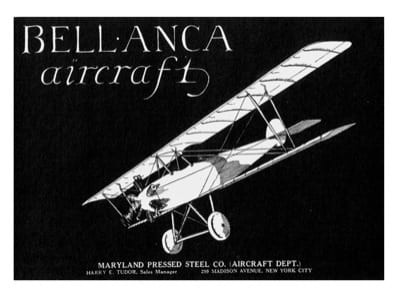
The CE biplane, designed by Guiseppi Bellanca in 1919, was powered by a 35-hp Anzani engine. Two were built, including one by Clarence Chamberlin, who would fly the Atlantic after Lindberg in a later model Bellanca airplane.
Engine: 35-hp Anzani Span: 28 ft Length: 18 ft Empty weight: 470 lb Load: 250 lb Speed: 102 mph.
The 31-55A Senior Skyrocket is generally similar to the Pacemaker but carries a crew of two and six passengers. The Skyrocket was first produced in 1930, and was built with a variety of radial engines in the 450-500 hp range prior to World War 2.
They were built post-war under licence in 1946-7 by North-West Industries Ltd in Canada. Powered by a 500 hp Pratt & Whitney Wasp S3H1, it is otherwise identical to the Model 31-42 Skyrocket of 1935.
31-55A Senior Skyrocket Wingspan: 50 ft 6 in Length: 27 ft 11 in Empty weight: 3760 lb Loaded weight: 6450 lb Max speed: 180 mph Cruise: 160 mph
The Bellanca 19-25 Skyrocket II is a prototype light plane built in 1975 by Payne Engineering Company. The aircraft design was the result of Giuseppe Bellanca’s son, August attempting to revive the original Bellanca company with an all-new design to prove that proper composite design could take advantage of a 1940’s NACA laminar flow airfoil. Designed over a sixteen year period and design and constructed over two and a half years, the project was begun on Long Island, New York and later transferred to Huntington, West Virginia.
The Skyrocket II is a six-seat, low-wing cantilever monoplane of conventional configuration with retractable tricycle undercarriage. The SkyRocket has an aluminum honeycomb, molded into a half inch thick skin. The Bellanca uses pre impregnated glass cloth kept frozen in a freezer until ready for use and then laid in the mold, where it softens. When sandwiched in honeycomb, it is cured in an oven for an hour and a half at 250 deg F. There are left and right molds for the fuselage and for the vertical tail, and top and bottom molds for the wings and horizontal tail. The wing is buttressed by a pair of glass spars fastened in the fuselage floor by metal bolts.
Skyrocket III
The inside of the fuselage shell discloses three bulkheads of plastic, and an inte¬gral part of the monocoque structure, once the fuselage halves are joined.
Wet wings hold 180 US gallons of 100 octane for a planned max fuel range of 1,485 nm at a 75¬% cruise. The expected stall speed, with gear and flaps down, is 56 knots.
$340,000 was raised from 20 friends of the Payne’s to construct this plane from August Bellanca’s design drawings in the 1974-1976 time span.
August Bellanca was the designer. John P Harris was the construction engineer and the test pilot for all flights through 1978, including the 5 FIA world record runs. Henry E Payne was the chief director and facility provider for the project. These three were the key group that produced this prototype. They are all deceased within five years before 2007.
The test pilot for this new prototype was John P. Harris. Within months of its first flight, the prototype claimed five FAI world airspeed records for an aircraft in its class, all of which still stand in 2007. The aircraft attracted the attention of NASA, which conducted an aerodynamic analysis of the design, in order to investigate natural laminar flow as a factor of its high performance.
The six place SkyRocket II is envisioned by its builders as the fastest piston single in commercial general aviation. They attempted to raise three to five million dollars to get the plane certificated. There were plans also for a twin-engine version of the Skyrocket. The plan was to build 100 units per year and sell each for $200,000 including the estimated $100,000 product liability insurance premium. The time frame for raising money, 1976-1979, included 15% to 20% interest rates. The money could not be raised so the project was discontinued. August Bellanca took the plane to Delaware and tried the kit plane concept and other attempts to manufacture the plane. Despite its advanced design and exceptionally good performance, it never achieved certification or entered production.
AviaBellanca Aircraft Corp announced in 1998 an advanced derivative of the SkyRocket, the AviaBellanca 19-25 Skyrocket III. Incorporating carbon fibre/Nomex foam structure and a 435 hp Continental GTSIO-520, the Skyrocket III has a 0.0155 drag coefficient.They claim a kit could be assembled in 3500 hours and take from 325 to 500 hp.
Skyrocket III
SkyRocket II Engine: Continental GTSIO-¬520 F, 435 hp. Gross weight; 3775 lb Cruise speed: 220 kt at 16,000 ft Fuel capacity: 180 USG Seats: 6
SkyRocket II Engine: One Continental GTS520-520D, 375 hp Oil capacity 15 qts. Wing span: 35ft Length overall: 27ft Height overall: 9ft Wing area: s: 182.6 ft² Weight empty: 2450 lb (kg) Max T/O weight: 4100 lb (kg) Total fuel usable capacity 2 wing tanks: 150 US gallons / 568 lt Max never-exceed speed: 280 knots IAS Max cruising speed (75% power): 210 knots Cruising speed (65% power): 200 knots Stalling speed, wheels and flaps down: 56 knots Vx (best angle of climb): 80 knots Vy (Best rate of climb): 90 knots Max demonstrated crosswind component: 18 knots Max rate of climb at S/L: 1900ft/min Service ceiling: 36,000ft T/O to 50 ft (15 m):1790ft Landing from 50 ft (15 m):1665ft Range, 75% power: 1056nm Range, 65% power: 1273nm Seats: 6 Systems: 12V electrical
AviaBellanca 19-25 Skyrocket III Engine: Continental GTSIO-520F, 435 hp Power Loading: 9.7 lb/hp Wing Loading: 23.0 lb/sq.ft / 112.3 kg/sq.m Length: 27.0 ft / 8.23 Wing Span: 35.0 ft / 10.67 Height: 9.0 ft / 2.74 Wing Area: 182.6 sq.ft / 16.96 sq.m Maximum Gross Weight: 4200 lb / 1905 kg Empty Weight: 2490 lb / 1129 kg Useful Load: 1710 lb / 776 kg Maximum Baggage: 200 lb / 91 kg Cabin Length: 155 in / 395 cm Cabin Width: 45 in / 114 cm Cabin Height: 48 in / 122 cm Crew: 1 Passengers: 5 Integral Wing Tanks: 176 USG / 666 lt Alternative Engines: Teledyne Continental TSIO-550, 350 hp Teledyne Continental GTSIO-520-L, 375 hp Maximum speed, @20,000ft: 340 mph / 296 kts / 547 kph Cruise @5000ft (1521m), 75% pwr: 270 mph / 235 kts / 435 kph Cruise @10,000ft (3041m), 75% pwr: 282 mph / 245 kts / 454 kph Cruise @26,000ft (7925m), 75% pwr: 327 mph / 284 kts / 526 kph Cruise @26,000ft (7925m), 65% pwr: 314 mph / 273 kts / 505 kph Stall, landing configuration: 68 mph / 59 kts / 109 kph Range (w/45 min res) (@10,000ft / 3041m; 75%pwr) Full Fuel: 1800 sm / 1565 nm / 2897 km Range (w/45 min res) (@26,000ft / 7925m; 65%pwr) Full Fuel: 2300 sm / 2000 nm / 3701 km Landing Dist 50ft (15m): 1786 ft / 544.4 m Landing Grd Run, S.L.@ISA: 922 ft / 281.0 m Ground Run, S.L.@ISA: 680 ft / 207.3m Total to clear 50ft (15m): 1128 ft /344.8m Max ROC S.L.@ISA: 2080 fpm
Skyrocket III Empty weight: 1129 kg Wing span: 10.67 m Wing area: 14.96 sq.m Fuel capacity: 666 lt Engine: Continental GTISO-520F, 435 hp MAUW: 1905 kg Seats: 6 Max speed: 547 kph Cruise speed: 526 kph Minimum speed: 109 kph Climb rate: 10 m/s Fuel consumption: 90 lt/hr Kit price (1998): US$85,000
Ben Anderson, Marvin Greenwood and their associates conceived a sophisticated airplane, and in 1971, the preliminary design of the four place AG 51 was completed.
One AG-51 prototype was built in 1973, N51AG c/n 0001, later redesignated as the first Bellanca T-250 Aries It received Approved Type Certificate A11SW. That aircraft (which the FAA claims was built in 1976) was apparently re-registered as N251AG. The design won full FAA certification on July 8, 1976.
Two more examples built as Bellanca T-250 Aries types, under the same Approved Type Certificate. C/n 0003-80 is N250DJ and c/n 0004-80 is N77CT.
C/n 0002 has never been mentioned and c/ns 0005 to 0007 were reserved but not built.
Anderson, Greenwood’s AG 51 may be transformed into the Bellanca Aries T 250 at the stroke of a pen. The two companies had reached an agreement in principle, subject to negotiations as well as other conditions including outside financing. Under the agreement, Bellanca would manufacture the airplane at its Alexandria, Minnesota facility and would handle marketing as well. Bellanca would have a new mod¬el and the Aries T 250 a home in which to be built and someone to market it.
The Aries T¬250 is a metal airplane, powered by a 250 horsepower carbureted Lycoming, designed for the best combination of production efficiency, performance and good handling qualities.
The main landing gear tread is narrow. With a T tail, the wings are constant chord with a low aspect ratio. A T 250s can lift a gross of 3,150 pounds, and the prototype would fly with full tanks (76 gallons), four 170 pound people and 99 pounds of luggage.
An agreement giving Bellanca Aircraft exclusive production rights to the Aries T-250 single engine retractable expired at the end of 1977. According to Bellanca President James Callier, Anderson, Green-wood Aviation Corporation which controls the rights to the airplane and has pumped $2.4 million into Bellanca since 1976 – found it unwise to continue an agreement when there were no immediate prospects that would allow Bellanca to begin production.
Engine: Avco Lycoming O-540-A4D5, 247 hp Length: 26.181 ft / 7.98 m Height: 8.596 ft / 2.62 m Wingspan: 31.332 ft / 9.550 m Wing area: 170.071 sqft / 15.8 sqm Max take off weight: 3153.2 lb / 1430.0 kg Weight empty: 1852.2 lb / 840.0 kg Max. speed: 187 kts / 346 km/h Cruising speed : 181 kts / 335 km/h Service ceiling: 18045 ft / 5500 m Wing load: 18.66 lb/sq.ft / 91.00 kg/sq.m Range: 1017 nm / 1883 km Crew: 1 Payload: 3 Pax
A prototype Bellanca two place, side by side, tri-gear training plane flown in late 1973, but shelved in 1974, was an outgrowth of the pre-war Aeronea Chief
A development of the Cruisemaster, the Viking wing is made of Sitka spruce and mahogany, crafted in a separate wing plant. The fuselage is welded steel tubing covered with Dacron. It is all as durable as aluminum, and Bellanca feels that this unique method of construction is one of their major assets.
Bellanca 260
The Bellanca 260 was introduced in 1964 and produced through 1967. Built of wood and fabric, only 105 were built before production switched entirely to the Viking 300.
In 1967, a 300 hp Continental IO 520 D installation transformed the Bellanca Model 14 design into a Viking. Somewhere along the way, Vikings become Models 17 30A, but the overall aerodynamic design is true to the genius of Giuseppe Bellanca.
Viking 300
There are three 300 hp engine options for the Viking: a Continental IO 520 K, a Lycoming IO 540 K1E5 and the Ra¬jay turbocharged version of the Lycoming. The Viking is 3,325 pounds at gross, with an empty weight of 2,225 pounds. When a Viking is topped with 450 pounds of fuel, 75 pounds of options and 340 pounds of people, it’s easy to see how most of the 1,100 pound useful load can quickly disappear. The baggage compartment capacity is billed as 186 pounds, although it looks too small for what that weight of luggage would amount to. There is also a tube-like container running back from the baggage area toward the tail that is designed to hold 20 pounds of long equipment, such as skis or fishing poles.
17-31
Variants:
260B Developed from the Model 14-19 Cruisemaster, with single sweptback fin and rudder replacing original tail unit.
260C Improved version of 260B with 260hp Continental IO-470-F
Standard Viking 300 Airframe as 260C with 300 hp Continental IO-520-D or 300 hp Lycoming IO-540.
Super Viking 300 As Continental-engined Standard 300 but increased fuel and more luxurious appointments.
Super Viking 300 As Lycoming-engined Standard 300 but increased fuel and more luxurious appointments.
Standard Turbo Viking 300 / Turbo Viking As Standard Viking but 310 hp Lycoming TIO-540 turbocharged engine.
Bellanca 14-19-3 Cruisemaster
Super Viking Model 17 30A Engine: Continental IO 520 D. TBO: 1,500 hrs. Propeller: McCauley two or three blade. Length: 26 ft. 4 in. Height: 7 ft. 4 in. Wingspan: 34 ft. 2 in. Airfoil: Bellanca B. Aspect ratio: 7.2. Wing area: 161.5 sq. ft. Wing loading: 20.59 lb/sq.ft. Seats: 4. Empty wt: 2,303 lbs. Useful load: 1,022 lbs. Payload with full fuel: 572 lbs. Gross weight: 3,325 lbs. Power loading: 11.8 lb/hp. Fuel capacity (standard): 60 USG/360 lb lbs. Fuel capacity (option): 75 USG/450 lb. Baggage capacity: 186 lbs. Baggage area: 12.08 cu. ft. Minimum runway requirement: 1,420 ft. Rate of climb: 1,085 fpm. Service ceiling: 17,000 ft. Maximum speed: 191 mph/166 knots. Cruise, 75% power @ 7,500 ft: 187 mph/162 knots. Economy cruise, 65% power 9,000 ft: 160 mph/139 knots. Range @ max cruise (45 min res): 593 sm/516 nm. Range @ economy cruise (45 min res): 715 sm/622 nm. Duration @ max cruise (no res): 3.9 hrs. Stall speed (clean): 74 mph/64 knots. Stall speed (gear, flaps down): 70 mph/61 knots
Super Viking 17 31A Engine: Lycoming IO 540 K1 E5, 300 hp. TBO: 1,800 hrs. Prop: Hartzell, 3 blade, constant speed, 80 inch dia. Length: 26 ft. 4 in. Height: 7 ft. 4 in. Wingspan: 34 ft. 2 in. Aspect ratio: 7.2. Wing area: 161.5 sq.ft. Airfoil: Bellanca B. Wing loading: 20.6 lb/sq.ft. Power loading: 11.1 lb/hp. Seats: 4. Empty wt: 2,303 lbs. Useful load: 1,033 lbs. Payload with full fuel: 583 lbs. Gross weight: 3,325 lb. Fuel capacity (standard): 60 USG/360 lb lbs. Fuel capacity (option): 75 USG/450 lb. Max rate of climb: 1,170 fpm. Service ceiling: 18,200 ft. Max speed: 196 kts. Max cruise, 75 % power (2,400 rpm) at 15,000 ft: 165 kts. Econ cruise, 55 % power at 15,000 ft: 150 kts. Duration at max cruise: 4.8 hrs. Duration at econ cruise: 6 hrs Stalling speed, clean: 69 kts. Stall speed, full flap: 61 kt. Baggage capacity: 186 lbs. Baggage area: 12.08 cu. ft. Minimum runway requirement: 1,420 ft.
Bellanca Turbo Viking 17-31ATC Engine: 1 x Lycoming IO-540-K1E5, 300 hp. Seats: 4. Wing loading: 20.6 lb/sq.ft. Pwr loading: 11.08 lb/hp. Gross wt: 3325 lb. Empty wt: 2372 lb. Equipped useful load: 886 lb. Payload max fuel: 436 lb. Range max fuel/75% pwr: 799 nm/4 hr. Range max fuel / 55% pwr: 814 nm/ 5.7 hr. Service ceiling: 24,000 ft. 75% cruise: 193 kt. 55% cruise: 144 kt. Stall: 56-63 kt. 1.3 Vso: 73 kt. ROC: 1170 fpm. Min field length: 1420 ft. Fuel cap: 360/450 lb. Undercarriage: retractable.
Viking 300A Engine: Continental IO-520K, 300 hp TBO: 2000 hr Fuel type: 100/100LL Propeller: Hartzell CS Wingspan: 34 ft. 2 in. Overall length: 25 ft. 4 in. Height: 7 ft. 4 in. Wing area: 161.6 sq. ft Wing loading: 20.6 lbs./sq. ft Power loading: 11.1 lbs./hp Wheel base: 6 ft. 8 in. Wheel track: 9 ft. Wheel size: 6.00 x 6 in Max ramp weight: 3325lb Gross weight: 3325 lb Landing weight: 3325lb Empty weight, std: 2185lb Useful load, std: 1140 lb Payload, full std. fuel: 690 lb Usable fuel, std: US 75 gals Equipped payload (750 miles fuel, 75 % power): 867 lb. Cruise speed (75% power): 186mph. Maximum range (75% power): 910mi. Stall speed (Vso): 72mph. Cabin width (elbow to elbow): 40.5in. Landing gear type: Tri/Retr. Seating capacity: 4 Cabin doors: 1 Cabin width: 41 in Cabin height: 45 in Baggage capacity: 186 lb Cruise speed 75% power: 174kt Vs: 66 kt Vso: 61 kt Best rate of climb (SL): 1210 fpm Service ceiling: 20,000 ft Takeoff ground roll: 980 ft Takeoff over 50-ft. obstacle: 1200 ft Landing ground roll: 835 ft Landing over 50-ft. obstacle: 1500 ft
Turbo Viking 300 Engine: Continental IO-520-D or Lycoming IO-540, 300 hp at 2700 rpm. Gross Weight; 3325 lbs. Std Empty Wt; 2372 lbs. Useful Load; 953 lbs. Wing Area; 161.5 sq.ft. Wing Span; 34.2 ft. Length; 26.3 ft. Height; 7.3 ft. Power Loading; 11.8 lbs/hp. Wing Loading; 20.6 lbs/sq.ft. Fuel Capacity; 75 US Gal. Wheelbase; 7.3 ft. Wheel Tread; 9.0 ft. Top Speed; 200 kts. Optimum Cruise, 75% power, best power; 193 kts. Stall Speed, full flaps 40 deg; 57 kts. Take-off Run (23 deg flaps); 980 ft. Take-off 50 ft; 1420 ft. Landing Roll; 835 ft. Landing Roll 50 ft; 1340 ft. Best Rate of Climb; 94 kts. Rate of Climb; 1170 fpm. Service ceiling; 24,000 ft. Fuel Consumption, 75% power, best econ; 15.7 US gph Range 75% – 1080 sm (894 nm) Range 65% – 1130 sm Range 55% – 1110 sm
The original Model 14 9 Bellanca Junior, later renamed the Cruisair, started life with a 90 hp LeBlond radial engine and 140 square feet of wing area. Later versions, such as the Models 14 13 and 14 14 developed in the early ’40s, had Franklin powerplants and a healthy 161 square feet of the famous Bel-lanca B airfoil. In 1952, a 190 hp Lycoming was mated to the Cruisair’s tubular steel fuselage and the Model 14 19 Cruisemaster was born. Seven years and a new manufacturer later, the design was resurrected, modified to accommodate the 260 hp Continental IO 470 and designated the Model 14 19 3. Although a tri gear and a swept vertical stabilizer characterized subsequent Bellanca evolutions, the wing, with its Sitka spruce spar, mahogany skin and 161 square feet, remained basically unchanged except for some strengthening to accommodate the higher gross weights of the updated aircraft. In 1967, a 300 hp Continental IO 520 D installation transformed the Bellanca design into a Viking.
14-19-3 Cruisair
14 Cruisemaster A low-wing, retractable four-seat monoplane with a good reputation for speed and lifting ability. The wooden wing tended to keep sales down and only 700 or so were built before the Cruisemaster design was updated with tricycle gear, swept fin, and a new name the Bellanca Viking. Northern Aircraft Inc purchased from Bellanca all rights, jigs and tooling for the Bellanca 14-19 Cruisemaster four-seat lightplane. The Bellanca Model 14 was one of the classic lightplane designs, since built by several manufacturers. First production of the Northern Cruisemaster started in October 1956. Northern also supplied spares, support and modification kits for Republic Seabee amphibians after a merger with the American Aviation Corporation.
14-13-2 Cruisair
Four-seater first flown November 1945
14-30-2
Circa 1947. Fabric fuselage, controls and wings. Engine: 150 hp.
14-19 Cruisair Engine: 190 hp Lycoming O-435A Span: 34 ft 2 in Length: 23 ft Height: 6 ft 2 in Empty weight: 1525 lb Loaded weight: 2600 lb Cruise: 180 mph at 6000 ft ROC: 1400 fpm Range: 680 mi
Col James Fitzmaurice, a colonel in the Irish Air Force entered a Bellanca 28-70 “one off’ named Irish Sweep, in the London Mebourne Centenary Air race in 1934. The aircraft was built to his order and designed by Al Mooney of Mooney aircraft fame, who worked for Guiseppe Bellanca in the Delaware factory at the time. This was M8 in Mooney’s personal model numbering and a P&W Wasp radial of 825 hp was fitted, giving the Bellanca the best power/weight factor of all entries. The com¬mittee refused to allow Col Fitzmaurice to compete with the aircraft’s ‘all-up’ weight of 8,000 lbs.” The full weight had a restricted certificate issued by the US Government which, at the time, did not belong to the ICAN, the interna¬tional controlling body. The Irish entry was withdrawn at the last minute.
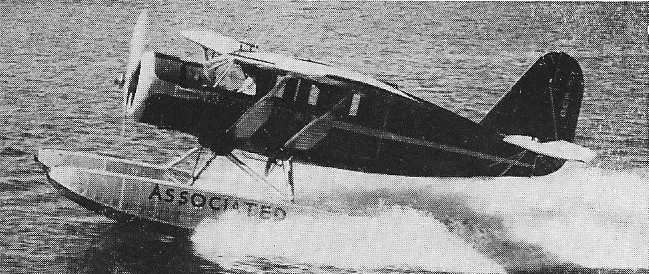
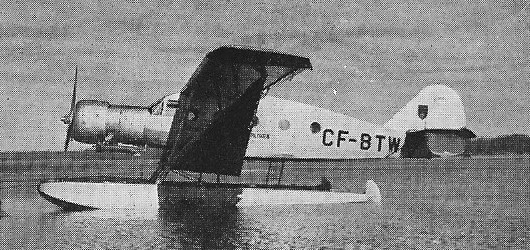
The Bellanca Aircruiser and Airbus were high-wing, single-engine aircraft built by Bellanca Aircraft Corporation of New Castle, Delaware. The aircraft was built as a “workhorse” intended for use as a passenger or cargo aircraft. It was available with wheels, floats or skis. The aircraft was powered by either a Wright Cyclone or Pratt and Whitney Hornet engine.
Bellanca P-100 Airbus
The first Bellanca Airbus was built in 1930 as the P-100. An efficient design, it was capable of carrying 12 to 14 passengers depending on the cabin interior configuration, with later versions carrying up to 15. In 1931, test pilot George Haldeman flew the P-100 a distance of 4,400 miles in a time aloft of 35 hours. Although efficient, with a cost per mile figure of eight cents per mile calculated for that flight, the first Airbus did not sell due to its water-cooled engine.
The next model, the P-200 Airbus, was powered by a larger, more reliable air-cooled engine. One version (P-200-A) came with floats and operated as a ferry service in New York City, flying between Wall Street and the East River. Other versions included a P-200 Deluxe model, with custom interiors and seating for nine. The P-300 was designed to carry 15 passengers.
The final model, the “Aircruiser,” was the most efficient aircraft of its day, and would rank high amongst all aircraft designs. With a Wright Cyclone air-cooled supercharged radial engine rated at 715 hp, the Aircruiser could carry a useful load greater than its empty weight. In the mid-1930s, the Aircruiser could carry 4,000 lb payloads at a speed of between 145 and 155 mph, a performance that multi-engine Fokkers and Ford Trimotors could not come close to matching.
C-27A C/N 721
The Airbus and Aircruiser served as both commercial and military transports and in total 23 were built.
Bellanca Aircruiser CF-AWR under restoration at the Western Canada Aviation Museum, Winnipeg, 2006
In 1934, United States federal regulations prohibited single-engine transports on United States airlines, virtually eliminating future markets for the Aircruiser. Where the workhorse capabilities of the Aircruiser stood out was in Canada. Several of “The Flying Ws”, as it was commonly dubbed in Canada, were used in northern mining operations, ferrying ore, supplies and the occasional passenger, into the 1970s.
Variants:
Bellanca P Airbus Commercial version of Bellanca K, powered by a 500 hp (370 kW) Pratt & Whitney R-1860 Hornet.
P-100 Airbus 14-passenger monoplane powered by a 600 hp (450 kW) Curtiss Conqueror engine, one built, later converted into a P-200.
P-200 Airbus 12-passenger monoplane, nine built and one converted from P-100.
P-300 Airbus 15-seater monoplane powered by a Wright R-1820 Cyclone engine.
Y1C-27 United States Army Air Corps designation for four P-200 Airbuses powered by 550 hp (410 kW) Pratt & Whitney R-1860 Hornet B engine. All later converted to C-27C.
C-27A Airbus Production version of the Y1C-27 powered by a 650 hp (480 kW) Pratt & Whitney R-1860 Hornet B engine, ten built. One converted to a C-27B the rest converted to C-27Cs.
C-27B Airbus One C-27A re-engined with a 675 hp (503 kW) Wright R-1820-17 Cyclone engine.
C-27C Airbus Four Y1C-27s and nine of the C-27A re-engined with a 750 hp (560 kW) Wright R-1820-25 Cyclone engine.
Aircruiser 66-67 Improved structure modified from a P-200 with a 675 hp (503 kW) Wright SR-1820 Cyclone engine
Aircruiser 66-70 An Aircruiser with a 710 hp (530 kW) Wright SGR-1820 Cyclone engine, five built – exported to Canada. Wingspan: 65 ft 0 in (19.82 m) Wing area: 520 sq ft (48.3 m2) Length: 43 ft 4 in (13.21 m) Height: 11 ft 6 in (3.51 m) Empty weight: 6,072 lb (2,754 kg) Gross weight: 10,000 lb (4,536 kg) Maximum speed: 144 kn (165 mph, 266 km/h) Range: 608 nmi (700 mi, 1,130 km) Service ceiling: 22,000 ft (6,700 m) Crew: one, pilot Capacity: 16 passengers
Aircruiser 66-75 An Aircruiser with a 730 hp (540 kW) Wright Cyclone engine, three built. Wingspan: 65 ft Length: 43 ft 4 in Height: 12 ft Empty weight: 6300 lb Loaded weight: 11,400 lb Max speed: 165 mph Cruise: 137 mph
Aircruiser 66-76 A cargo-version of the Aircruiser with a 760 hp (570 kW) Wright Cyclone.
Aircruiser 66-80 An Aircruiser with an 850 hp (630 kW) Wright Cyclone engine.