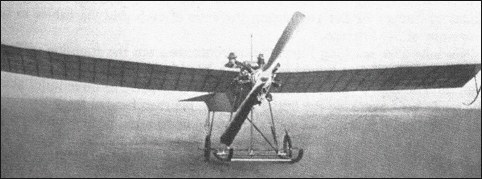
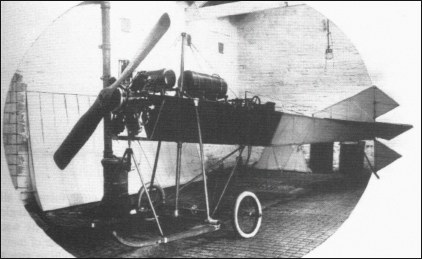
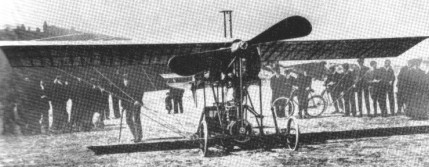
The Blackburn Second Monoplane (sometimes described as The Light Type Monoplane) of 1910 used the then new and untried Isaacson 40-hp radial engine. It first flew from Filey Sands in Yorkshire on 8 March 1911. Surviving damage on that occasion, it subsequently went on to achieve a number of successful flights (and landings).
This aircraft marked the acceptance of Robert Blackburn as a leading British aircraft designer.
Engine: Isaacson 40-hp radial Wingspan: 30 ft Length: 32 ft Max speed: 60 mph Number built: 1
With tail dragger or tricycle gear configuration, the BK1 is a design to carry up to 6 ft 4 in 250lb pilot, 30 lbs of baggage, at 130 mph for 400 miles with an hour reserve. At the time it could be built from scratch for under $10K. In 2005 a BK-1 was flown 1200 miles to Oshkosh in 10 flight hours, with 2 fuel stops. The BK-1 also appeared at Sun-N-Fun 2006 and Oshkosh 2006.
Engine: Great Plains 1835 Volkswagen, 60 hp Wing Span: 19 feet 4 inches Length: 15 feet 4 inches Cockpit Width: 24 inches Cockpit Height: 40 inches (curved canopy) Leg Room: 50 inches (firewall to seat back bulkhead) Fuel Capacity: 15 USgallons Empty Weight: 430 pounds Gross Weight: 800 pounds Fuel: 90 Pounds (15 USGallons) Pilot Size: Up to 250 lb – 6 foot 4 inches tall Baggage: up to 30 lb Takeoff Distance: 700 feet Landing Distance: 700 feet Rate of Climb: 750 fpm @ 65 mph IAS (initial) Max Continuous Cruise: 130 mph Fuel burn max cruise :3.5 USgallons per hour. Range 400 miles with reserves. Economy Cruise: 100 mph Economy fuel burn: 2.5 USgallons per hour. Economy range: 500 miles with reserves. Top Speed: 145 mph
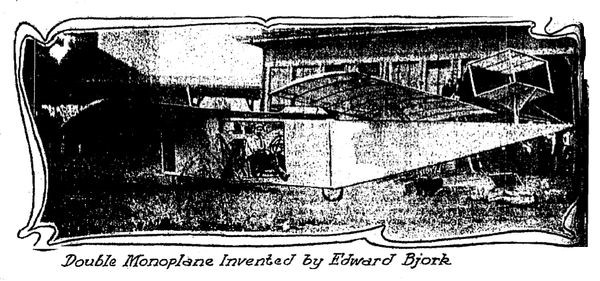
Constructed in September 1910 by Edward Bjork, a Chicago building contractor residing at 934 Fletcher Street. His machine was forty feet in length by twenty in width. He constructed it in a shed at Evanston Avenue and Byron Place.
Bjork was a member of the Swedish-American Aerial Club of Chicago – a manufacturer of aerial machines that failed to conduct the business for which it was created.
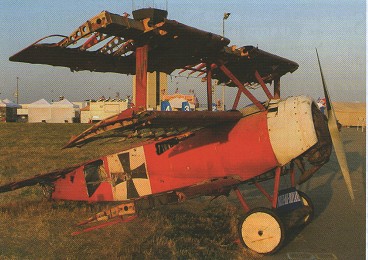
Bitz Flugzeubau in Germany built two Fokker Dr.1 triplanes in 1964 for the film industry. They featured in such films as ‘Blue Max’ and ‘Von Richthofen and Brown’.
After filming, one triplane, owned by ex-RCAF pilot Lynn Garrisin’s Blue Max Aviation, was stolen from storage Leixlip, Ireland. It resurfaced in a ‘Wing and Wheels’ auction in Florida years later however title was regained through the Courts and it was moved to Chino for restoration. From here it was stolen again. It was then abandoned at a Los Angeles A&P technician’s shop and following closure of the business, stored in the ‘owners’ back yard. After being overgrown in shrubbery, new owners of the house discovered it many years later. The legal process began again and the aircraft returned to the Garrison family.
The two were: c/n 001 G-ATIY, became EI-APW c/n 002 G-ATJM, EI-APY, N78001
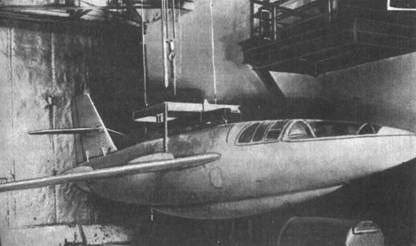
Bisnovat “5” in the TsAGI before the modifications.
The Bisnovat 5 experimental aircraft was developed in 1948 with the aim of testing the influence of the 45º swept wing on the range of supersonic flight speeds. Two prototypes were built and tested in a glider configuration due to difficulties in setting up the selected power plant.
Based on the concept of the DFS 346, the Bisnovat “5” featured an overall configuration similar to that of the Bell X-1, which would be the first manned aircraft to break the sonic barrier.
The effectiveness of wing sweep in achieving high flight speeds was demonstrated at the end of the 1940s. The 35º swept wing did not allow to overcome the sonic barrier, as it generated too much resistance. The calculations showed the need to test a new wing with 45º sweep and increase the engine power.
In the TsAGI they developed a wing with these characteristics, but the T-106 wind tunnel did not allow it to be tested at speeds above Mach 0.9. This required the construction of experimental aircraft.
This happened at the end of 1946, when in the former premises of the main constructor Boljovitinov, in the Factory No. 293 of the MAP a new OKB was created at the head of which was MR Bisnovat located. This new OKB was tasked with developing a supersonic experimental aircraft in order to test characteristics in flight and piloting conditions at speeds of Mach 1.1.
The aircraft received the designation “5” and had to be built according to an aerodynamic composition based on the 45º swept wing and TsAGI 12045bis and P2 (2M) profiles. Its development was carried out in parallel with the tests by OKB-2 of the captured German DFS 346 aircraft. The powerplant selected was the Dushkin RD-2MZVF liquid reactive engine capable of developing 2000 kg of thrust and was conditional on the fact that a higher power engine did not exist in the USSR.
Due to the low capacity of the engine, the ascent to a height of 10,000 meters had to be done by a mother plane. Once this height was reached, the plane released and the rocket engine was started. The calculations showed that, in addition to a speed of Mach 1.1, the “5” would reach 15,000 meters (from 10,000 m) in just 68 seconds. The duration of the flight with full power would be only 2.5 minutes.
The development task was officially approved in a new experimental construction plan that was signed on March 11, 1947.
The “5” was conceived as an all-metal monoplane with a double spar mid-set wing and 45º taper along the 25% chord line. The wing profiles were suggested by TsAGI : TsAGI 12045bis in the wing root and P2 (2M) in the extremities. The wingspan reached 6.4 m. Two aerodynamic fins were installed on each console on the upper wing surface to break the flow. In order to study the pressure distribution throughout the wing at high speeds, drains were made in three sections in the right wing.
The monocoque-type fuselage had an oval section and a length of 9.92 meters. The front part consisted of a sealed cabin. Flying in an airplane at high speed implied a high risk, so the cabin was designed in such a way that in emergencies it was separated from the rest of the plane. The transparent cover was aerodynamically inserted into the fuselage. Behind the wing, on both sides of the fuselage, aerodynamic brakes were added.
In the tail section was located a reactive double chamber RD-2M-3F engine, designed by LS Dushkin with a power of 2000 kg at 8000 meters and 1610 kg of thrust at sea level. The chemicals (kerosene and nitric acid) and hydrogen peroxide (for turbocharger feed) were calculated for a flight time of about two minutes at full power.
As the “5” aircraft was designed to be launched from a mother plane, the landing gear consisted of a ski located in the lower part of the fuselage, two stabilization supports on the wings and a small skid on the tail section.
The high tail had sweep. The stabilizer had a span of 2.4 meters. The aircraft could be controlled using the stabilizers, which were connected to the flight stick. Boosters could be connected to reduce the pressure on the stick.
In order to guarantee the necessary safety, it was decided to first carry out the tests using a scale model that was called “6” and designed with full flight capacity. The “6” was built in factory 293, in conjunction with the OEZ TsAGI led by Kuznietsov. This model was built at 1: 2.75 scale, and equipped with a liquid reactive U-400-10 engine with 400 kg of thrust manufactured by Isayev and had an AP-14 autopilot system.
The “6” model had to be towed by a Tupolev Tu-2 bomber up to a height of 9000 meters and after detaching it had to connect the reactive engine to reach a supersonic speed of Mach 1,225 in straight flight. To record the flight data the “6” was included in the model a data recording system.
The recovery of the “6” was carried out by means of parachutes operated in sequence. Initially, the braking parachutes located on the wings were opened, with an area of 1 sq.m. Later the main braking parachute located in the tail area and with an area of 100 sq.m was opened.
In total, 4 examples of the Model “6” were built and tested in September – November 1947, at Gumpak airfield, near Stalingrad.
The first model (No.61) after the detachment quickly moved away from the Túpolev Tu-2, reaching great speed. The following La-7 soon lost sight of the model and it was never found.
The second model (No.62) after detaching began to present large oscillations around the axles and this resulted in the engine turning off with only 8 seconds of work. The model opened its parachutes and could be recovered without problems. The recorded speed was only 230 – 240 meters per second.
The third model (No.63) worked without problems, but after 44 – 45 seconds of flight, it plummeted and the brake parachutes were pulled away. The model was launched towards the ground, burying itself at a depth greater than 3 meters. During the impact the search equipment was badly damaged and some could not even be found in the metal mass. According to the measurements obtained from an MS-7 team and assuming that they were taken during the flight in a straight line at 8,300 meters, a speed of 1405 km / h (Mach 1.28) could be calculated.
The fourth model (No.64) flew without problems for 51 – 52 seconds, presenting only some oscillations in relation to the transverse axis. After the engine finished working, the main parachute did not open, so that only with braking the model began to descend, burying itself about 80 centimeters into the ground. In this case it was possible to recover the result of the measurements of the recording equipment, which yielded a model speed of 1230 km / h (Mach 1.11)
The figures obtained allowed the MAP to consider that the speed of the models corresponded to that calculated and to consider the tests as successful, but the direction of the VVS disagreed. Bershinin wrote in January 1948 to the Minister of the Armed Forces NA Bulganin:
“ In relation to the tests with the help of the Bisnovat manufacturer’s models, we can deduce that as a result of their lack of completion as aerodynamic models and the lack of objectivity of the flight data, objective conclusions cannot be made and they can only be considered as a first step in the use of flying models in the investigation of high flight speeds. “
The need to develop a dozen “6” models and repeat the tests ensuring the preservation of the recordings of the measuring instruments was strongly discussed. This never took place because very soon the first prototype of the plane “5 ” was ready which was known as “5-1”.
The first prototype “5-1” during testing.
The first prototype with full flight capacity was named ” 5-1 “. The towing system was replaced by the under-wing attachment of a mother aircraft, in this case a Petlyakov Pe-8 (No. 4291) with Ash-82FN engines, which was specially prepared for this task. Under the right wing, between the fuselage and the inner engine console and installed a special bracket from which the ” 5 ” was hung. The launch was carried out at heights of 7000 – 7500 meters. The weight of the plane in glider configuration reached 1565 kg.
The delivery of the engine suffered delays, reason why the first ” 5-1 ” sample began to be tested in July 1948 in a glider configuration, in order to check the behavior of the aircraft at low speeds. The “5” plane was flown by Colonel Pajomov and the Pe-8 mother plane by test pilot MA Samusiev and Ziemskov.
The flight plan included a dive after detachment, with departure to horizontal flight with an overload of 2 -3g, increase in speed until the plane reached 1500 – 2000 meters in height, when the tasks stopped and the plane was preparing for landing. During the landing, the behaviour of the plane at low speeds was studied.
In the first flight the 14 of July of 1948, there was a rending of the alar coating at the time of the release of the mother aircraft, affecting directional stability. The pilot managed to control and land the plane, but off the runway. The ” 5-1 ” was damaged and was sent to the factory for repair.
During this process some modifications were made. To prevent the plane from hitting the mother plane again at the time of detachment, the fixation system was modified. The flight control system was modified.
Rear view of the Bisnovat “5-1”.
The second flight on September 3 was quite positive, but it showed a lack of transverse stability and the lack of effectiveness of the ailerons to correct it. It was decided to study this phenomenon in depth on the third flight on September 5, but another accident occurred during the landing. Upon landing the plane hit the ground with one wing, then the other. The pilot was unable to control the landing and ended up burying his nose, which caused the destruction of the plane. The pilot was unhurt but the plane could not be rebuilt.
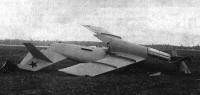
Prototype “5-1” destroyed after its third flight.
The commission created to analyze the accident was headed by the replacement of the head of the TsAGI laboratory, VN Matvieyev. It was found that the cause of the accident was the lack of lateral stability of the plane at low speeds after extending the landing pad and the increase in resistance in the aileron control system; as well as the incorrect ground connection and the deterioration of visibility due to the condensation of water vapor that appeared on the cabin cover. It was recommended to build a second specimen taking into account the recommendations recorded and to modify and test the landing system at TsAGI.
These accidents delayed the obtaining of the expected results in “5”. In 1947 at the request of the VVS and with the support of the Moscow committee of the CPSU, the MAP was directed to carry out the necessary actions to equip the TsAGI with wind tunnels capable of testing the new speed environments. In the second half of that year, the new T-112 tunnel began to operate at TsAGI .
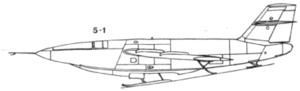
Drawing of the prototype “5-1”
The dimensions of the work area of this tunnel was not large, measuring only 0.7×0.6 meters, but the flow velocity reached Mach 2. This tunnel still lacked the necessary instrumentation to carry out the measurements, but it was considered that it was enough to determine the effectiveness of the wing at 45º.
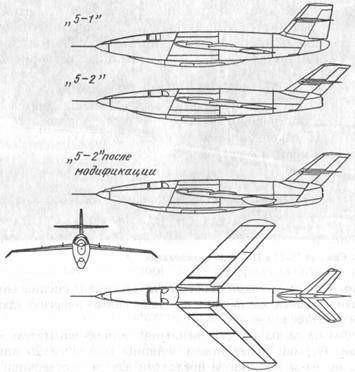
A second ” 5-2 ” prototype was built and ready by January 1949. It was practically no different from the first prototype, but to improve directional stability it was lengthened and increased the sweep of the vertical fin, which led to an increase in the length of the aircraft to 11.2 meters. The stabilization wing supports for landing were replaced by amortized skids capable of absorbing energy during impact with the ground.
Drawing of the prototype “5-2”
It was first decided to continue the tests in a glider configuration. The LII test pilot G. M. Shiyanov was selected as the pilot. The Pe-8 mothership was piloted by Gintsie and Chistyakov.
Between 26 January and 9 of June of 1949 the ” 5-2 ” carried out a total of nine glider flights, in October-November four, none with engine, even though it had been installed on the model and tested on the ground.
During the tests the weight of the aircraft reached 1710 kg, the maximum speed obtained in the dive flights reached Mach 0.775. The plane showed good behaviour and the flight control with the help of hydraulic boosters was practically no different from the conventional one.
Despite the promising results, everyone understood that the ” 5 ” had lost its “moment”. Reactive engines, characterized by their dangerousness, short working time and capricious behavior, now gave way to the increasingly capable turbojets, which had already demonstrated their ability to reach sonic speeds. The MAP leadership, in this situation, decided to turn its back on the project and, without much explanation, stopped financing it.
During the tests of the “5” for the first time in the USSR , the launching test system for rocket aircraft from the wing of a mother aircraft was tested and the accumulated experience was of great use for the development of new types of aircraft and missiles.
On the basis of the aircraft “5” Bisnovat and Isayev developed the air-surface missile R-1.
Drawing of the Bisnovat “5”
“5” Powerplant: 1 RD-2M-3VF liquid reactive, 1610 kg thrust Wingspan: 6.40 m Length: 9.92 m Wing area: 11.18 m² Empty weight: 883 kg Maximum takeoff weight: 3184 kg Wing loading: 95.6 kg / m² Maximum speed: 1200 km / h Accommodation: 1
Views of the different variants of the Bisnovat “5”.
The “302” reactive interceptor fighter was designed in 1940. It was the world’s first fighter with combined reactive powerplant.
This fighter appears interchangeably in the specialized literature as a product of MK Tijonrarov (head of the project design brigade and specialist of aerodynamic calculations during the construction of the prototype), AG Kostikov (main engineer of the RNII (NII-3) during the design of the project and main constructor of the OKB-55 during the construction process or MR Bisnovat (head of the OKB-55 designated for the development and construction of the model. In some literature it has also been called Kostikov KB-3 and Tijonrarov I-302.
Between 1939 and 1940 in the USSR began to develop a design process for aircraft powered by reactive engines. Due to the short working time of these engines, their use was conceived in the form of interceptors of very high speed and short radius of action. The three most prominent developments in this line were the Tijonrarov “302”, the “Malyutka” and the Bereznyak / Isayev BI. The three projects were conceived to use liquid reactive engines using kerosene as fuel and nitric acid as oxidizing agent, with powers between 1,100 and 1,200 kg. Of these three projects, only the BI was further developed. The projects “302” and Malyutka were kept as Secret for many years and information about them is scarce and little known.
The “302” appeared in 1940 as a project for the world’s first fighter with a combined reactive powerplant. The project was developed by a group of specialists led by MK Tijonrarov under the general direction of AG Kostikov, who at that time was serving as the chief engineer of the RNII (NII-3). In the spring of 1941 the project was presented to the technical council of the institute, being approved. After the defense of the project before the commission of the VVS, AG Kostikov directed the request for approval to the NKAP, where between June 17 and 18, 1942 it was approved by a commission made up of SA Jristianovich, AV Chesalov, SN Shishkin, VI Polikovski.
In the second half of 1942 the project was presented to Kliment Efremovich Voroshilov and that same day, during a reception with Stalin, the “302” was approved and Kostikov was appointed principal constructor of the OKB-55 and director of the experimental factory of the same name. As head of the OKB was appointed MR Bisnovat and as his replacement AA Andreyev. VD Yarovitsky was selected for the resistance calculations and the aerodynamic calculations were carried out by MK Tijonrarov.
Structurally the “302” was conceived as a low-wing cantilever monoplane. The construction was of wood. The wing had a RAF-34 profile with 15% at the root and NACA-230 with 8% at the wingtips. The tail was made of wood with a plywood coating. The fuselage was designed with a monocoque structure.
Structure of the “302”
The landing gear was designed as a traditional type with single wheels on all units. The retraction system was hydraulic.
The “302” was conceived as a fighter with a liquid reactive engine (ZhRD) RD-1400 produced by LS Dushkin and with 1400 kg of thrust located under the tail and two ramjets (PVRD according to its acronym in Russian and also known as Ramjets in English) designed by V.S. Zuyev, located under the wings.
The interceptor was armed with two ShVAK 20mm cannons located in the nose and two similar ones below the cockpit, all with 400 rounds. Under the wing were detachable mounts for unguided rockets (RS-82 and RS-132) or two FAB-125 bombs.
The “302P” during testing.
By the summer of 1943 it was found that the development schedule for Zuyev’s ramjet was seriously overdue. Only a 1: 2 scale model had been completed and the tests could not be executed. Dushkin’s 1100kg D-1 Liquid Reactive Engine, with an additional 450kg chamber, was not yet ready as testing had just begun. For this reason it was decided to equip the “302” with a RD-2M double chamber liquid reactive motor, which also presented problems.
Given the lack of availability of the engines, it was decided to finish the cell and test it in the form of a glider, which received the name ” 302P “. All the weapons and some of the equipment were removed from the plane in order to lighten it. In the tail section a model of a reactive single chamber engine was located, which was exposed, without the fairing.
Glider “302P”, rear view showing the reactive engine model
At the end of August 1943 in this configuration the ” 302P ” was delivered to the LII. The tests showed excellent stability characteristics and the “302P” was sent to the TsAGI, where it was tested in the wind tunnel. During the “blows” in the T-104 tunnel of the TsAGI, it was possible to obtain an aerodynamic quality K = 15, which promised excellent results. Several dozen flights were carried out towed by a Tupolev Tu-2 and a North American B-25 Mitchell. The evaluation given by the USSR honorary test pilot S. N. Anojin on the “302P” was highly positive. Positive evaluations were also received from other experienced test pilots such as ML Galai, BN Kudrin and VN Yelagin. In the tests it was possible to calculate a landing speed of 115 – 120 km / h. The powered flights were not carried out due to the lack of completion of the reactive engines.
The first motorization variant with one ZhRD and two PVRDs yielded a possible speed of 900 km / h, a ceiling of 9000 meters and a time to reach this ceiling of 2 minutes.
The calculations obtained with the “302P” yielded a speed of 800 km / h, a ceiling of 18000 m and a reach time of a height of 5000 meters of 2.1 minutes and 2.8 minutes for the 9000 meters. The calculated range was 100 km. The only real data obtained were the take-off with a run of 16 – 18 seconds and a speed of 200 km / h. The empty weight of the plane was 1502 kg and with a military load of projectiles for the 4 guns, 505 kg of fuel and 1230 kg of oxidant, the takeoff weight reached 3358 kg.
In 1944 a government commission led by AS Yakovlev made the decision to stop all work related to “302”. The results obtained during development were not lost and many of the constructive decisions employed during the construction of the “302P” were later employed by SM Alexeyev during the construction of the I-211 and I-215 fighters.
Model 302 Powerplant: 1 x ZHRD RD-1400 with 1,400 kg thrust + 2 x PVRD Wingspan: 11.4 m Length: 8.708 m Wing area: 17.8 m² Takeoff weight: 3800 kg Empty weight: 1856 kg Maximum speed at height: 900 km / h Time at 9000 m: 2 min. Service ceiling: 9000 m Armament: 4 x ShVAK 20 mm cannons Bombload: unguided rockets (RS-82 and RS-132) or two FAB-125 bombs Seats: 1
Model 302P Wingspan: 9.55 m Length: 8.708 m Wing area: 14.8 m² Takeoff weight: 3358 kg Empty weight: 1856 kg Total load weight: 1502 kg Weight of fuel and oil: 1735 kg Wing loading: 227 kg / m² Reactive fuel weight: 505 kg Oxidizer weight: 1230 kg Speed at sea level: 800 km / h Speed at altitude: 900 km / h Take-off speed: 200 km / h Time to 5000 m: 2.1 min Time at 9000 m: 2.8 min Service ceiling: 18,000 m Range: 100 km Armament: 4 x ShVAK 20 mm cannons Bombload: unguided rockets (RS-82 and RS-132) or two FAB-125 bombs Seats: 1
302 with dotted lines the initial version with combined reactive plant.
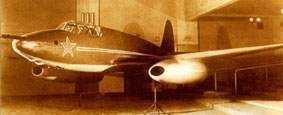
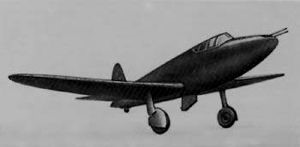
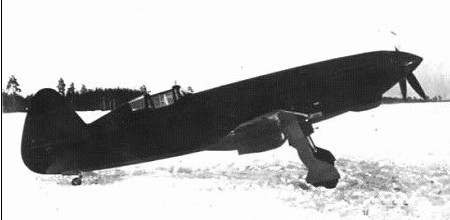
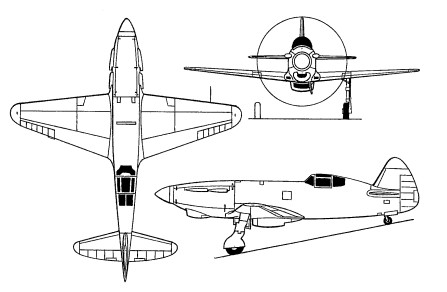
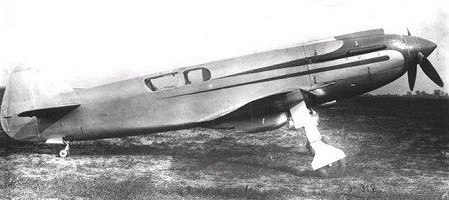
The SK-2 single-seat fighter was evolved from the SK-1 (skorostnoye krylo, or high-speed wing) aircraft tested during the winter of 1939-40 as a direct result of high-speed wing research conducted at the TsAGI (Central Aerodynamics and Hydrodynamics Institute) by a team headed by Matus Bisnovat. The SK was the smallest possible airframe capable of accepting a 12-cylinder Vee engine, with every effort made to reduce drag (eg, a flush-fitting cockpit canopy which could be raised, together with the pilot’s seat, for takeoff or landing). The SK-2, flown in October 1940, had a similar small-area wing and 1050hp Klimov M-105 12-cylinder liquid-cooled Vee engine, but with an orthodox cockpit, conventional carburettor and oil cooler air intakes, revised vertical tail surfaces and an armament of one 7.62mm and two 12.7mm machine guns. The SK-2 was of all-metal construction with dural pressed sheet stressed wing skinning and a semi-monocoque fuselage. Flight test results were allegedly promising, but not enough to warrant replacing established fighter types in production.
SK-2 Engine: 1 x 1050hp Êëèìîâ Ì-105 Take-off weight: 2300 kg / 5071 lb Empty weight: 1850 kg / 4079 lb Wingspan: 7.30 m / 24 ft 11 in Length: 8.28 m / 27 ft 2 in Height: 2.60 m / 9 ft 6 in Wing area: 9.57 sq.m / 103.01 sq ft Cruise speed: 530 km/h / 329 mph Ceiling: 10500 m / 34450 ft Range: 620 km / 385 miles Crew: 1 Armament: 1 x 7.62 mm, 2 x 12.7mm mg
SK-1 Engine: 1 x 1050hp Klimov Ì-105 Take-off weight: 2300 kg / 5071 lb Empty weight: 1505 kg / 3318 lb Wingspan: 7.30 m / 24 ft 11 in Length: 8.00 m / 26 ft 3 in Wing area: 9.57 sq.m / 103.01 sq ft Cruise speed: 524 km/h / 326 mph Ceiling: 10300 m / 33800 ft Range: 1000 km / 621 miles Crew: 1
A 1928 three seat commercial biplane. Powered by a 90 hp Curtiss engine, the Imperial had a maximum speed of 90mph (145 kmh).
The first Bird Wing took McCrum and his assistants 63 days to build at a cost of US$12.000. The prototype flew over 5000 passengers over a period of 15 months.
Among the many pilots who flew the birds wing was Hap Arnold and Charles Lindbergh. McCrum suggested a comprehensive program of courses of flight training, which included training flight in a Bird Wing, and build the aircraft from scratch. The Bird Wing Imperial was tested to meet the requirement of 1931 and 50 were ordered, then cancelled at the beginning of the great Depression.
McCrum revised the plans for the Bird Wing again in the 1950s to install a 450 hp 336 kW Pratt & Whitney R-985 Wasp Junior radial engine and a 3 inch fuselage widening to convert the design into an agricultural aircraft which never went into production.
Bird Wing Model 1 Engine: 1 × Curtiss OX-5, 90 hp / 67 kW Propeller: 2-bladed wooden fixed pitch Wingspan: 31 ft 4 in / 9.55 m Wing area: 303.5 sq ft / 28.20 sq.m Airfoil: Aeromarine 2 Length: 23 ft 6 in / 7.16 m Height: 8 ft 7 in / 2.62 m Empty weight: 1.236 lb / 561 kg Gross weight: 2.255 lb / 1023 kg Fuel capacity: 34.5 US gal / 28.7 imp gal / 131 l Maximum speed: 90 mph / 140 km / h / 78 kn Rate of climb: 460 ft / min / 2.3 m / s Service ceiling: 10.000 ft / 3.000 m Cruise speed: 75 mph 121 km / h, 65 kn Landing speed: 30 mph / 26 kn / 48 km / h Wing loading: 6.95 lb / sq ft / 33.9 kg / sq.m Power / mass: 0.04 hp / lb 0.066 kW / kg Crew: Capacity: 2 pax
Bird Wing No. 2 Upper and lower ailerons
Bird Wing No. 4 Engine: Hisso, 180 hp / 134 kW
Bird Wing Imperial 1930 Engine: Wright Whirlwind R-540, 165 hp / 123 kW Max speed: 118 mph / 190 km / h