The Bleriot X was another of Louis Bleriot’s concept attempts and followed more the design path of the American Wright brothers featuring a “pusher” type propeller/engine arrangement and biplane wings. Construction of this design was never completed.
1 engine
Bleriot IX
The Bleriot IX was an experimental monoplane design fitting an Antoinette engine of 100 horsepower and an off-shoot of the VII but with tandem horizontal tail surfaces. The much-improved Blériot IX was built with paper-covered wings and a fuselage largely made of fabric. The aircraft used wing-warping to turn and, in order to descend or reduce the airspeed, the engine had to be switched off and then on again as there was no throttle.
This design succeeded in making a few short “hops” about the ground though never achieving sustained flight.
Bleriot Racer / XXVII
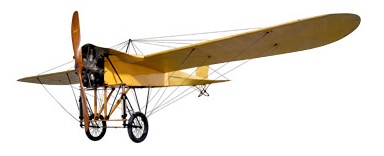
The Type XXVI was built by Louis Bleriot in 1910 for the Gordon Bennett Cup Race in the USA. It was first flown at Hardelot, France, by Monsieur Alfred Leblanc, Bleriot’s test pilot, in May 1910. Subsequently it was flown by him in the American race but crashed just when it appeared to be winning. Originally built as a single-seat racing aircraft, it was unofficially timed at 130kph (81mph) and could be the Bleriot shown at the Paris Aero Show in December 1911.
It was powered by a 50hp Gnome giving it a top speed of 78 mph and later had a twin Gnome fitted for a while and a top speed of 120 mph was claimed. Added streamlining features included a cloth covered fuselage and a top cowl for the engine. By 1914 the Bleriot racer had been put in storage.
In 1936 it was acquired from crated storage at Le Havre in France for preservation by vintage vehicle and aircraft collector Richard Nash for his International Horseless Carriage Corporation. When discovered, the oil tank was still half-full. Nash, quickly restored it, only to crash it at Brooklands in June 1936, having flown to 30 ft.
He rebuilt the aircraft (cn 433) again between 1938 and 1939 and then, in 1953, sold it to the Royal Aeronautical Society in 1953, along with other aircraft now in the RAF Museum collection, such as the Caudron G3, Fokker DVII, Sopwith Camel and Bleriot XI. All these aircraft were formally purchased by the Ministry of Defence from the Royal Aeronautical Society in 1992 following many years on loan and are now on display at Hendon.
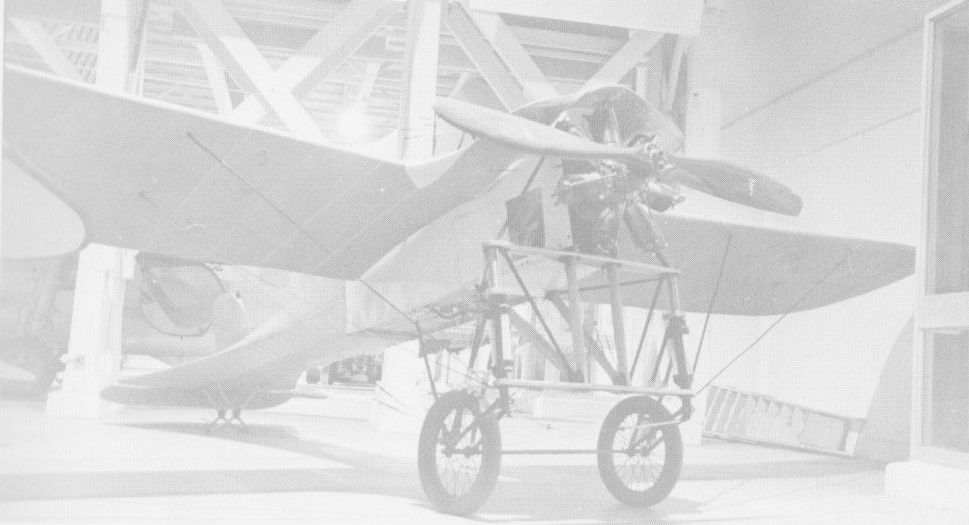
The aircraft underwent further restoration by the Royal Air Force in 1963, and again by the RAF Museum at Henlow in 1967 and at Cardington circa 1974, to be put on display at the Hendon RAF Museum in October 1978.
Type XXVII
Engine: Gnome, 50 hp
Wingspan: 29 ft 6 in
Wing area: 14.5 sq. yds
Length: 21 ft 4 in
All up weight: 705 lb
Max speed: 78 mph
1911 Bleriot XXVII monoplane
Span: 29’2″
Length: 24’7″
Weight: 950 lb
Speed: 78 mph
Bleriot VII
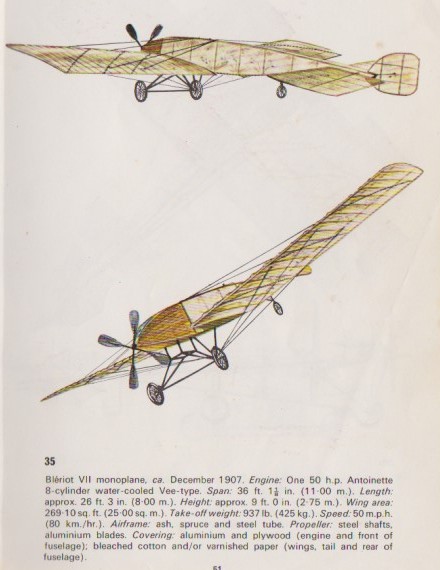
The VII, complete with its covered-over fuselage, proved more in line with front mounted engines designs to come. The fuselage was a near-perfect rectangular shape while the main wings were low-mounted with noticeable dihedral (upward angle from root to tip). The engine powered a four-blade paddle-type propeller. Power was a single Antoinette 50-horsepower 8-cylinder water-cooled piston engine. Cruising speed was listed at 50 miles per hour. Bleriot and his VII made a total of six flights before the machine was lost to accident in December of 1907.
Span: 36′
Length: 29’6″
Weight: 940 lb
Bleriot V

The Blériot V was a canard configuration pusher monoplane with a braced wooden box-girder fuselage covered with varnished silk, at the rear of which was the 24 hp (18 kW) Antoinette water-cooled V-8 engine.
The wings, which could be folded upwards for transport and had no wire bracing, were made of wood covered with varnished paper and were of a complex design probably inspired by the seeds of the Zanonia tree. Remarkably for the time, the high-set wings were cantilever structures. Though the 1907 plan view much exaggerates the curvature, the wing leading edges did form a quarter of a circle, with constant chord out to large, curved edged tips with increased chord and dihedral. The wings could be folded to save space.
There was a small elevator mounted at the front of the fuselage as well as a rectangular rudder mounted underneath, which also served as a nose skid. The main undercarriage consisted of a pair of bicycle wheels on a short single axle mounted on struts from the fuselage under the wing.
It was first tried on 21 March 1907, when Blériot made a single taxiing trial which ended in the aircraft slewing round, causing the undercarriage to collapse and damaging the rudder and elevator. Two further ground trials were made, one on 26 March, causing similar damage, and another on 2 April, when the propeller was damaged. After this trial Blériot replaced the frontal rudder with a large, semi-circular one mounted on a frame reaching behind the propeller, and added a fin to the underside of the fuselage in front of the wing. He also added a third wheel, placed centrally and under the engine. On 5 April a further trial was made, and after a 100 m (305 ft) run the machine briefly left the ground. Concerned about his ability to control the aircraft in the stiff breeze that was blowing, Blériot cut the engine and landed, yet again damaging the undercarriage slightly. He had only flown around 6 m (20 ft), but nevertheless this was the first time one of his aircraft had successfully flown. More trials followed, the last on 19 April when, traveling at a speed of around 50 km/h (30 mph), the aircraft left the ground. Blériot over-responded when the nose began to rise and the machine hit the ground nose–first and somersaulted. It was largely destroyed and Blériot was fortunate to emerge unhurt. The Bleriot V was wrecked on the very same site across which Santos Dumont’s No. 14bis had lurched the previous year.
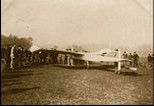
Span: 25’7″
Length: 27’11”
Weight: 570 lbs
Bleriot Aerobus
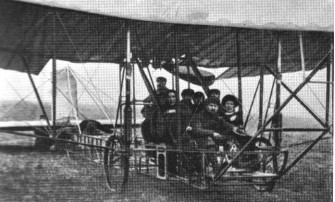
Bleriot carried six passengers in his Aerobus in 1911.
Bleriot VI Libellule
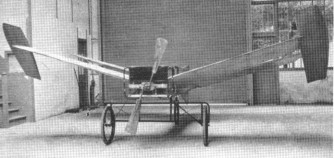
Bleriot’s first completely successful aeroplane was this tandem-wing, Antoinette-powered Libellule, in which he flew 25 m on 11 July 1907, and 184 m, before crashing, on 17 September. It had rotating wingtip controls.
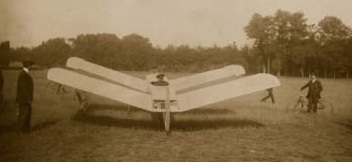
Built in 1907 and powered by a 24 hp Antoinette engine.
Blavier GB.8C2

The GB.8C2 is an all-wood design, covered in plywood, designed over a five year period.
Lavier first flew the one off aircraft in September 1996 at Toussus-le-Noble, near Versailles in Paris.
The design features a fixed maingear and retractable nose wheel.
Engine: Lycoming O-320, 160 hp
Prop: Constant speed
Max speed: 172 mph
Cruise: 160 mph
Stall: 63 mph
Endurance w/res: 3.5 hr
MTOW: 1760 lb
Seats: 2
Blanton V-6 STOL

The prototype was built from a salvaged PA-22.
Top speed: 135 mph
Cruise: 120 mph
Stall: 48 mph
Range: 600 nm
Rate of climb: 1700 fpm
Takeoff dist: 500 ft
Landing dist: 500 ft
Service ceiling: 18,000 ft
Engine: Ford V-6, 230 hp
HP range: 230-300 hp
Fuel capacity: 36 USG
Empty weight: 1250 lb
Gross weight: 2200 lb
Height: 7.2 ft
Length: 22.3 ft
Wing span: 32 ft
Wing area: 168 sq.ft
Seats: 4
Undercarriage: tailwheel
Blanton Sport Racer

The Blanton Sport Racer N87SR first flew on 23 April 1988.
Top speed: 200 mph
Cruise: 175 mph
Stall: 62 mph
Range: 525 nm
Rate of climb: 900 fpm
Takeoff dist: 1600 ft
Landing dist: 1800 ft
Service ceiling: 18,000 ft
Engine: Ford Javelin , 230 hp
HP range: 150-260 hp
Fuel capacity: 30 USG
Empty weight: 1175 lb
Gross weight: 1825 lb
Height: 5.7 ft
Length: 21 ft
Wing span: 22 ft
Wing area: 81 sq.ft
Seats: 2

