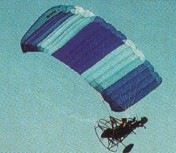
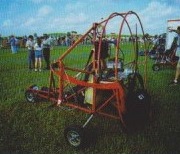
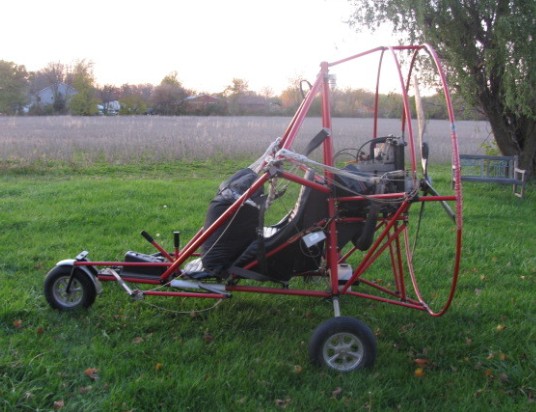
Manufactured in the US, the Dream Machine first flew in 1991. Options included the Rotax 503, instruments and instrument pod. The parachute is 1.1 oz ripstop nylon. The 1998 kit included the engine and propeller for US$8741.50.
Eagle 447 Engine: Rotax 447, 40 hp. Speed max: 26 mph. Cruise: 26 mph. Range: 50 sm. ROC: 500 fpm. Take-off dist: 150 ft. Landing dist: 100 ft. Service ceiling: 9500 ft. Fuel cap: 5 USG. Weight empty: 220 lbs. Gross: 500 lbs. Height: 6 ft. Length: 8.75 ft. Wing span: 35.5 ft. Wing area: 450 sq.ft. Seats: 1. Landing gear: nose wheel.
Eagle 503 Speed max: 26 mph. Cruise: 26 mph. Range: 50 sm. ROC: 650 fpm. Take-off dist: 150 ft. Landing dist: 100 ft. Service ceiling: 10,500 ft. Engine: Rotax 503, 46 hp. Fuel cap: 5 USG. Weight empty: 230 lbs. Gross: 540 lbs. Height: 6 ft. Length: 8.35 ft. Wing span: 35.5 ft. Wing area: 450 sq.ft. Seats: 1. Landing gear: nose wheel.
Manufactured in the US, the Dream Machine first flew in 1991. Options included the Rotax 503, instruments and instrument pod. The parachute is 1.1 oz ripstop nylon. Designed by Jack McCormack, the Buckeye is built from dural tubes bolted together.
It was offered as a single or two seater with various Rotax engines.
Dream Machine 503
The 1998 kit included the engine and propeller for US$13,429.08.
Dream Machine 582
Dream Machine 582 Engine: Rotax 582, 66 hp. Speed max: 30 mph. Cruise: 30 mph. Range: 60 sm. ROC: 700 fpm. Take-off dist: 150 ft. Landing dist: 100 ft. Service ceiling: 10,500 ft. Fuel cap: 6 USG. Weight empty: 300 lbs. Gross: 700 lbs. Height: 8 ft. Length: 9.43 ft. Wing span: 36.5 ft. Wing area: 500 sq.ft. Seats: 2. Landing gear: nose wheel.
Dream Machine 503 Empty weight: 123 kg Wingspan: 11.60 m Wing area: 46.5 sq.m Fuel capacity: 35 lt Engine: Rotax 503 DCDI, 52 hp Seats: 2 Max speed: 52 kph Cruise speed: 44 kph Min speed: 23 kph ROC: 2.5 m/sec Fuel burn: 16 lt/hr Kit price (1998): US$10,881
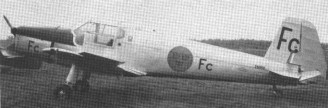
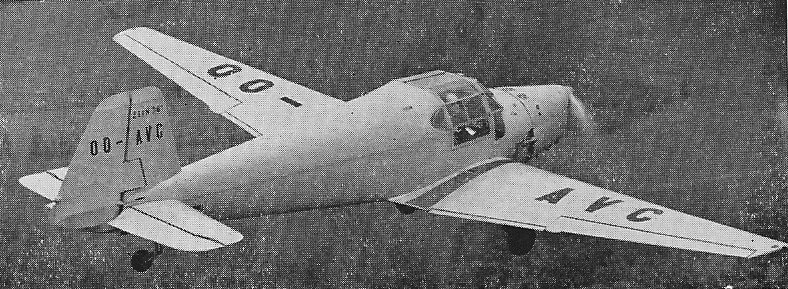
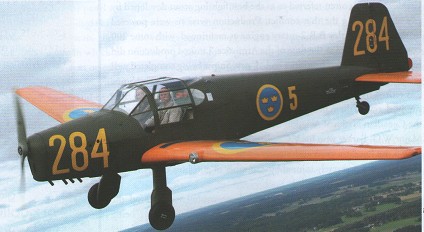
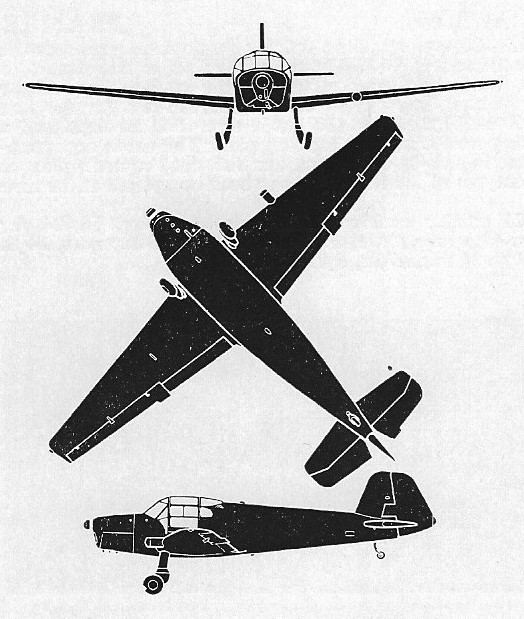
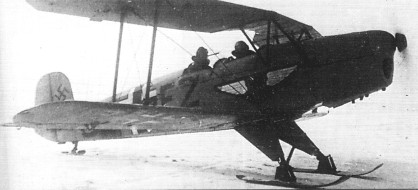
The Bu 181 low-wing monoplane trainer was a development of the Bu 180 Student with enclosed side-by-side accommodation for the crew of two and typical mixed construction (ply/fabric-covered wooden flying surfaces, aluminium alloy covered steel tube forward fuselage and wooden monocoque rear fuselage) with fixed tailwheel landing gear.
The production version for the Luftwaffe was the Bu 181A of which several thousand were built in Germany. Production was transferred to Fokker in Holland (who produced nearly 1000) and Zlin in Czechoslovakia. More production was undertaken in Holland (708) and Sweden by Hägglunds & Söner (125 Sk 25s) during 1944-46 for the Flygvapnet.
Post-war production was launched in Czechoslovakia as the C.6 and CC.106 (105 hp Minor 4-III) and, in civil form as the Zlin 381.
Zlin 381
Under Czech license, the Bu 181 was built Egypt as the ‘Republic of Egypt’, and one civil machine was designated Gomhouria Mk.2.
The final war-time development was the Bu 181D with a number of detail improvements over the Bu 181A. In addition to its designed role, the Bu 181 was used as a communications aeroplane and, in small numbers, as a tug for light training gliders.
Heliopolis Air Works in Egypt was formed 1950 to manufacture a local version of the German Bücker Bu 181D Bestmann as the Gomhouria trainer for Egypt, Jordan, Libya, Saudi Arabia, Somalia and the Sudan.
The success of the Jungmann led Bucker to open a second factory where a single-seat derivative could be produced in parallel with the original two-seater. The single-seater was the Jungmeister (young champion) advanced trainer, essentially a scaled-down Jungmann. First introduced in 1935, quickly developed an international reputation for its outstanding aerobatic capabilities.
The initial Bu 133A had the 101-kW (135-hp) Hirth HM 6 inline but better performance than the higher-powered Bu 131. Quantity production was undertaken for the Luftwaffe, though precise details are lacking. The Bu 133B export version was produced to the extent of some 100 aircraft by Dornier in Switzerland and CASA in Spain with the 119-kW (160-hp) Hirth HM 506 inline. The definitive version, however, was the Bu 133C with a radial engine: this had excellent agility and performance, and was used as a fighter lead-in trainer as well as for advanced flying training. This model too was built in Switzerland and Spain.
Bu 133C Jungmeister
The Bu 133 was built be Construcciones Aeronauticas S.A. in Spain for the Spanish Air Force under the designation ES-1, and 47 were built in Switzerland by the former Dornier-Werke for the Swiss Air Force.
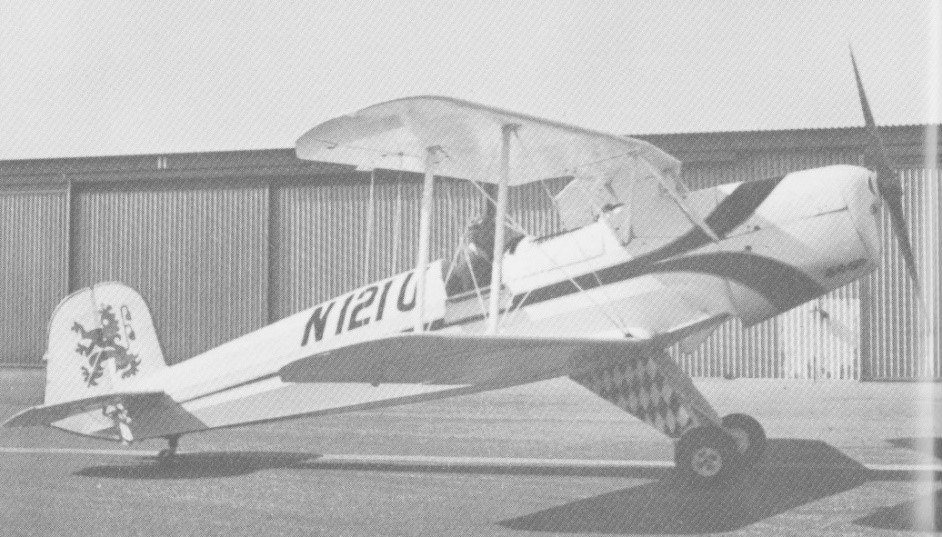
In 1968, the Aero Technik Canary in Munich, Germany, began production of the BU-133 D-1, also called the Jungmeister. Its engine is a remanufactured Siemens-Halske Sh-14A4; however, due to this engine’s limited availability and demand for more power, a new version, the BU-133F, was built by Wolf Hirth GmbH with a 220 hp Franklin engine.
The Bu-133D-1 is basically as the Bu-133C but engine, optimised for constant inverted flight, Goodyear tyres, wheels and brakes, and US instruments.
Bucker Prado Sl offered kits to build the former German Jungmann two-seat aerobatic biplane using original Bucker/CASA Bu 131 jigs, plus Jungmeister single-seat aerobatic biplane.
Bu 133A Engine: Hirth HM 6 inline, 101-kW (135-hp)
Bu 133B Engine: Hirth HM 506 inline, 119-kW (160-hp)
Bu 133C Jungmeister Engine: l x Siemens Sh 14A-4, 119kW (160hp) Span: 6.6m (21 ft 7.75in) Length: 6m (l9ft 8.25 in) Empty weight: 420 kg / 925 lb Max T/O weight: 585 kg (1,290 lb) Max speed: 134 mph / 116 kt / 215 kph at sea level Max cruise: 108 kt / 124 mph / 200 kph Climb to 3300 ft / 1000m: 2 min 50 sec Service ceiling: 19,685 ft / 6000 m Operational range: 311 mi / 269 nm / 500 km Optional fuel: 8.6 ImpGal / 39 lt
Bu 133 D-1 Engine: Siemens Sh-14A-4 Bramo, 158 hp Length: 19.751 ft / 6.02 m Height: 7.71 ft / 2.35 m Wingspan: 21.654 ft / 6.6 m Wing area: 129.168 sq.ft / 12.0 sq.m Max take off weight: 1411.2 lb / 640.0 kg Weight empty: 992.3 lb / 450.0 kg Max. weight carried: 419.0 lb / 190.0 kg Max. speed: 113 kts / 210 km/h Initial climb rate: 1082.68 ft/min / 5.5 m/s Service ceiling: 12467 ft / 3800 m Wing load: 10.87 lb/sq.ft / 53.00 kg/sq.m Range: 205 nm / 380 km Endurance: 2 h Crew: 1
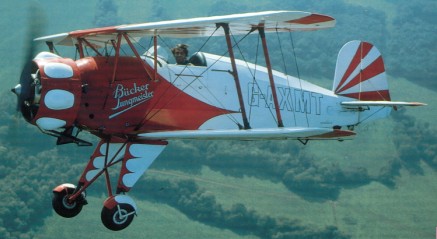
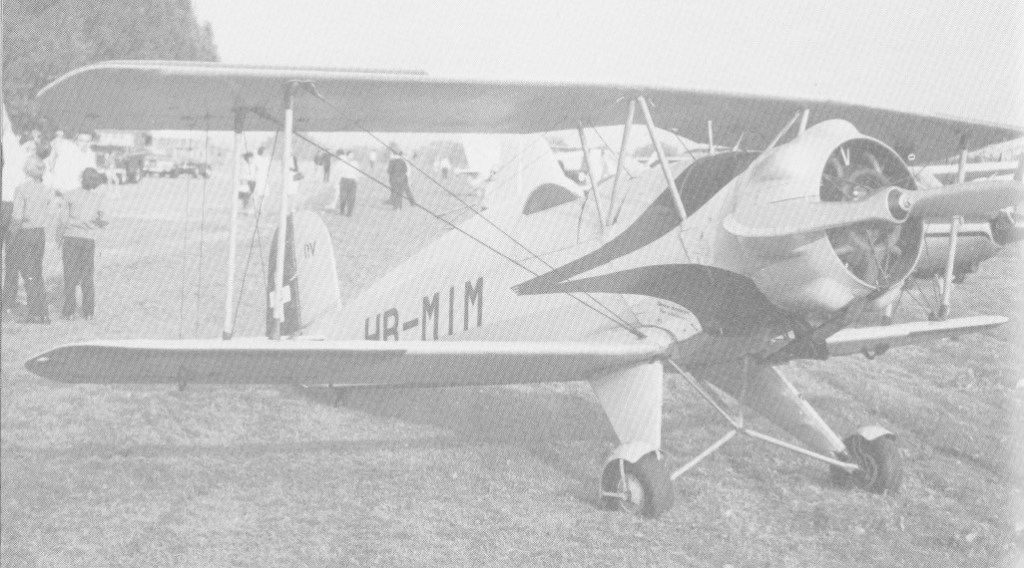
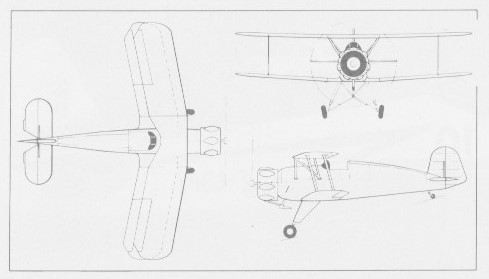
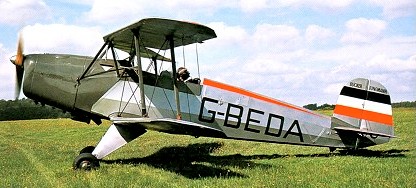
Bücker Flugzeugbau first design, designed by Anders Andersson, was the Bü.131A Jungmann powered by a 4 cylinder Hirth in line engine. A light two-seat biplane trainer specially developed for school and other training purposes, the prototype “D-3150” flew first 27 April 1934 with a 60-kW (80-hp) Hirth HM 6CR inline engine. The Jungmann was ordered by the Deutsche Luftsport Verband (The German Air-Sports Association). In 1936, the Luftwaffe adopted the Jungmann as one of its primary trainers.
Power was provided by a 60kW Hirth H.M.60R engine in the Bü.131A and a 78kW Hirth H.M.504A inverted engine in the Bü.131B.
Bu.131B
Before the outbreak of World War II the trainer was being used in 21 countries and licence-built in Holland, Czechoslovakia, Spain and Switzerland.
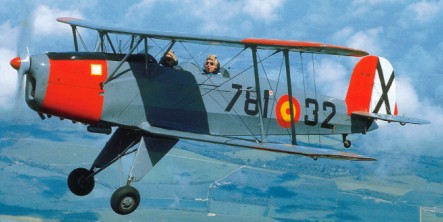
Spain was one of the earliest customers. Over a hundred German-built Jungmanns were delivered to the Spanish Nationalist side in the civil war. A total of 500 Jungmanns were built by the Construcciones Aeronauticas S.A. (CASA) in Spain. The first 200 had German Hirth HM504 engines but the remainder were powered by versions of the Spanish ENMA Tigre G-IV. In Spain production started 1938 and the CASA I-131 remained in production until the end of the fifties. The CASA E3B is a licence-built example.
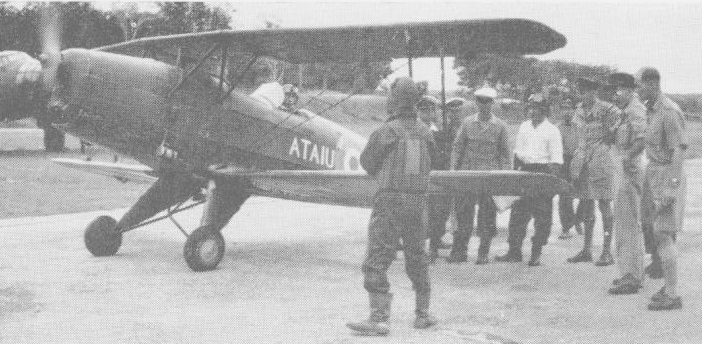
Some 1,254+ were built in Japan by Watanabe and Kyushu as the army’s Kokusai Ki-86A (1,037) and the navy’s K9W1 Momiji (Maple) (217+). Later models had 110 hp Hitahi Ha.47 engines. The code name was Cypress, applied to both the Navy Type 2 Momiji and Army Type 4.
The prototype was originally delivered to Japan in 1939, and Navy production began in August 1941.
K9W1 Cypress
Production figures have not survived, but some indication of scale is provided by the fact that Hungary took 100 and Romania 150, while Switzerland built 75. The Bucker Bü.131B Jungmann was also built under license pre-war in Switzerland by Dornier, and Czechoslovakia as the Tatra T.131. In Czechoslovakia the post-war version of the Bu.131B was the C.4. The C.104 was as the C.4 but with a 105 hp Walter Minor 4-III engine.
CASA 1-131E
Bucker Prado Sl offered kits to build the former German Jungmann two-seat aerobatic biplane using original Bucker/CASA Bu 131 jigs, plus Jungmeister single-seat aerobatic biplane.
Bu 131A Engine: 1 x Hirth HM60R, 59kW / 80 hp Max Take-off weight: 630 kg / 1389 lb Empty weight: 280 kg / 617 lb Wingspan: 7.4 m / 24 ft 3 in Length: 6.7 m / 21 ft 12 in Height: 2.3 m / 7 ft 7 in Wing area: 13.5 sq.m / 145.31 sq ft Max. speed: 170 km/h / 106 mph Cruise speed: 150 km/h / 93 mph Ceiling: 3500 m / 11500 ft Range w/max.fuel: 680 km / 423 miles Crew: 2
Bu 131B Engine: Hirth HM 504 A-2, 104 hp, 78kW Wingspan: 24 ft 3.25 in / 7.4 m Wing area: 145.314 sq.ft / 13.5 sq.m Length: 21 ft 8in / 6.62 m Height: 7.776 ft / 2.37 m Max take-off weight: 1477.4 lb / 670.0 kg Weight empty: 882.0 lb / 400.0 kg Max. weight carried: 595.4 lb / 270.0 kg Max. speed: 93 kts / 173 km/h / 114mph at sea level Initial climb rate: 748.03 ft/min / 3.8 m/s Service ceiling: 11483 ft / 3500 m Wing load: 10.25 lb/sq.ft / 50.0kg/sq.m Range: 216 nm / 400 km Endurance: 3 h Crew: 2
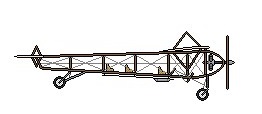
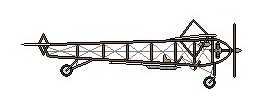
Brothers Wincent and Rudolf Schindler, wealthy millers from Kraków, built in 1908 a working model airplane and in 1910 they commissioned a talented engineer Henryk Brzeski to build a plane to their ideas, named Aquila (Latin for “eagle”). In August 1910 it was demonstrated on the ground to emperor Franz-Josef I, and several days later a test-flight attempt was made, during which it crashed into a fence at the outskirst of the airfield.
Initial configuration
Final configuration
Span: 32’10” Length: 32’10” Weight empty: 660 lb pilot and 2 passengers
The Hybrid is a fully enclosed, modified RAF 2000 using a Subaru fuel injected 120 hp EJ-20 SOHC engine with a Sub4 gearbox. Built as a one-off, it is fitted with a Motec ECU, 87 litre seat tank, two blade wooden prop, 30 foot Patroney rotors. The hub bar and windscreen are new. A Rosco rotor head has an RAF rotor brake and electric pre-rotator with soft start. It is fitted with carpet, heater, pitch and roll trims. It was registered in Australia with the ASRA registration of G-400.