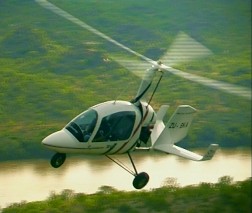
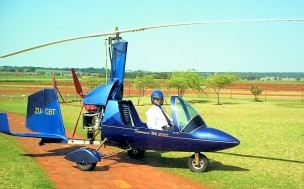
Chayair Sycamore Mk.2000

At 17 ft., 9 in., the tandem Sycamore is one of the longer gyroplanes, using a 115-hp engines and reaching speeds up to 106 mph. The Mk2000 is partially enclosed.
Square and round-tube aluminum airframe with composite semi-enclosure. Instrument panel.
Available: Production built, licensed in the LSI amateur-built class.

Two-seat tandem, semi-enclosed gyroplane
Engine: 115 hp Rotax 914, turbo charged four-stroke
Propeller: 68″ ARPLAST 3-blade
Rotor Blades: Chayair composite
Specifications:
Min Speed 35 mph
Cruise 80 mph
Top Speed 110 mph
Empty Weight 365 kg
Useful Load 225 kg
Gross Weight 590 kg
Width 5’11”
Height 8’6″
Length 17’9″

Chayair Sycamore Mk.I

At 17 ft., 9 in., the tandem Sycamore is one of the longer gyroplanes, using a 115-hp engines and reaching speeds up to 106 mph. The Mk1 is fully enclosed.
Square and round-tube aluminum airframe with composite enclosure, removable doors. Instrument panel.
Available: Production-built, licensed in the LS1 amateur-built class.

Two-seat tandem fully enclosed gyroplane
Engine: 115 hp Rotax 914 turbocharged four-stroke
Propeller: 68″ ARPLAST 3-blade
Rotor Blades: Chayair composite
Min Speed 35mph
Cruise 80 mph
Top Speed 110 mph
Empty Weight 380 kg
Useful Load 210 kg
Gross Weight 590 kg
Width 5 ft 11 in
Height 8 ft 6 in
Length 17 ft 9 in

Chauviere Gyroptere

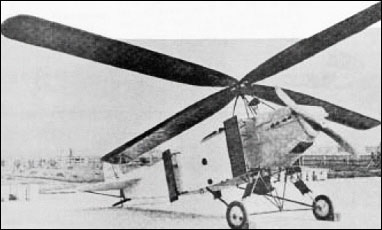
Lucien Chauviere, a propeller designer, built a machine dubbed the Gyroptere in 1927, based on the principles of a patent he had filed ten years earlier. It used a 170kW Renault engine to drive a four-blade rotor with flapping hinges and clutched to power a tractor propeller at the nose. To counter torque while the rotor was powered, control flaps mounted vertically on the fuselage sides vectored the slipstream. Testing of the 1,372kg aircraft did not progress very far before his available finances were expended.

Châtelain AC-5 Bijou

F-PHQO c/n 01

The AC-5 Bijou was one of several original homebuilt aircraft designed and built by Armand Châtelain in the 1950s and 1960s.

The sole AC-5 was initially powered by a 75 hp Minié 4DC-32 Horus engine, and was registered F-PHQO. It first flew on September 10, 1956. Later it was re-engined with one 65 hp Continental A65, the aircraft was still active in 2012.

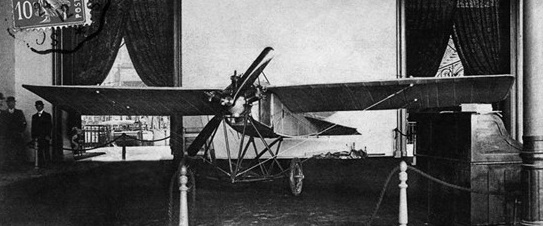
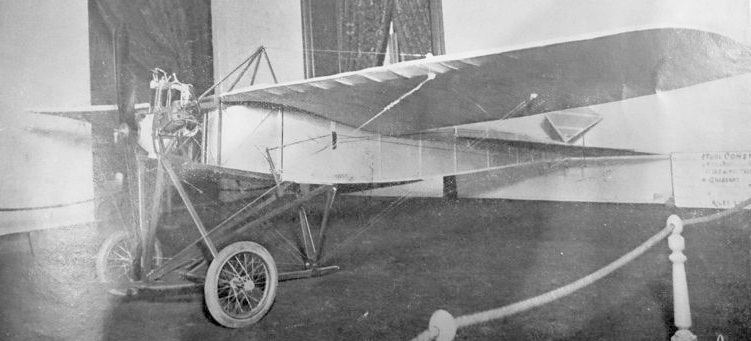
Chassany Monoplane

Chassany built his Monoplane in France in 1910.

This Nieuport-like monoplane was displayed at 1910 Paris “Exposition de la Locomotion Aérienne”. It’s recognisable by the three-cylinder Viale engine and the arrangement of landing gear struts.

It was claimed to be the lightest plane at the show, having reached 90 km/h with only a 32 hp engine. It was also the cheapest, costing only 7,000 francs without engine.

Chase-Gouverneur 1911 Wrightsville Beach / Gouverneur

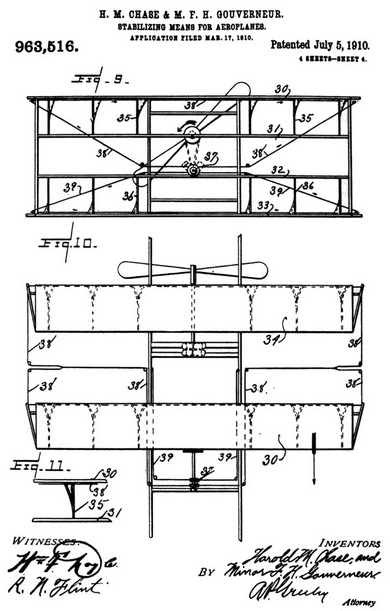
In July 1910 Harold M. Chase and Minor F.H. Gouverneur received a patent for a mechanism to stabilise and control aeroplanes. Their invention was a manually operated lever described as capable of being swung in any direction to transmit motion to other elements of the plane, apparently including on the wings. Three weeks later they won a second patent for rear wing panels (ailerons) that were controllable in flight by a cable or flexible cord, a device different enough from the 1906 Wright wing-warping patent.

On November 14, 1910, M. F. H. Gouverneur, vice-president of the Tide Water Power Company, and H. M. Chase, manager of the American Chemical and Textile Coloring Company, made the only public test flight of the airplane they built on Shell Island, sometimes called Moore’s Beach. More than 5,000 visitors crowded Wrightsville Beach four months earlier, when, on July 4, the pair had planned to attempt the first flight of their self-designed aircraft. Newspaper reports described the November flight, piloted by Mr. Chase, as having attained an altitude of about five feet, sustained for some distance, just long enough to demonstrate the plane’s ability to fly. The event carries the distinction of being the first airplane constructed in North Carolina and owned and flown by North Carolinians.

Designed and built by H. M. Chase and M. F. H. Gouverneur, Wilmington NC, USA, the 1911 Chase-Gouverneur “Wrightsville Beach” multiplane was similar to a Wright aircraft but built from aluminum.

It flew short hops at about five feet altitude on 10 November 1911, at Wrightsville Beach, Chase flew in a series of unannounced hops along the Shell Island beach at low tide.

In 1911 Gouverneur won a lawsuit for $380, with interest, against Boston’s Harriman Motor Works, apparently because its motor was unreliable.

In 1912 Gouverneur informed London’s Jane’s All the World’s Aircraft that he was now using the Gouverneur IV, a 25ft long monoplane with a 31 ft span, with pilot, it weighed 840 lb. According to Chase, his former patner hired an experienced pilot to fly one of his planes, apparently the Gouverneur IV, but the aviator crashed and “Gouverneur went no further”.

Engine: Harriman, 40hp
Wingspan: 16’0″
Length: 30’0″
Weight gross: 1200 lb
Seats: 1

Gouverneur IV
Wingspan: 31 ft
Length: 25ft long
Loaded weight: 840 lb
Chasle YC-12 Tourbillion

The Tourbillion (Whirlwind) is a single seat, amateur-built, light low-wing plane that comes from France.

Prototype Chasle YC-12 Tourbillion F-PMXQ nearing completion at Beynes 1965

Designed by Yves Chasle in 1964, the wooden prototype F-PMXQ first flew on 9 October 1965.

It is available in several models that differ only in their engine size. Most common is the 65-hp Continental. Airframe construction includes wood and fabric wings and a plywood-covered fuselage structure.

Plans no longer available.

Variants:
YC-12
prototype with Continental A65 engine
YC-121
similar to prototype with enlarged tailfin for limited certification
YC-122
similar to YC-121 but with Continental C90 engine
YC-123
similar to YC-121 but with Potez 4E-20b engine

YC-121
Powerplant: 1 × Continental A65, 48 kW (65 hp)
Propeller: 2-bladed EVRA fixed pitch wooden propeller, 1.75 m (5 ft 9 in) diameter
Wingspan: 6.7 m (22 ft 0 in)
Aspect ratio: 6
Airfoil: NACA Srs.7
Length: 5.95 m (19 ft 6 in)
Empty weight: 285 kg (628 lb)
Max takeoff weight: 432 kg (952 lb)
Fuel capacity: 60.5 l (16.0 US gal; 13.3 imp gal)
Maximum speed: 235 km/h (146 mph, 127 kn) at sea level
Cruise speed: 205 km/h (127 mph, 111 kn) at 70% power
Stall speed: 75 km/h (47 mph, 40 kn)
Range: 800 km (500 mi, 430 nmi)
Rate of climb: 4.6 m/s (910 ft/min)
Wing loading: 57.5 kg/sq.m (11.8 lb/sq ft)
Power/mass: 0.112 kW/kg (0.068 hp/lb
Takeoff run 855 ft
Landing roll 900 ft
Range 500 miles
Crew: 1