The IAR 813 is a two-seater light sports and training aircraft developed from the earlier IAR 811. The IAR 813 is a low-wing cantilever monoplane of wooden and composite construction powered by a Walter Minor 6-III six-cylinder in-line inverted air-cooled engine providing a top speed of 185km/h and a range of 500km.
Engine: 1 x Walter Minor 4-III, 77kW Take-off weight: 760 kg / 1676 lb Empty weight: 520 kg / 1146 lb Wingspan: 10.1 m / 33 ft 2 in Length: 8.4 m / 27 ft 7 in Height: 2.3 m / 7 ft 7 in Max. speed: 190 km/h / 118 mph Cruise speed: 175 km/h / 109 mph Ceiling: 5500 m / 18050 ft
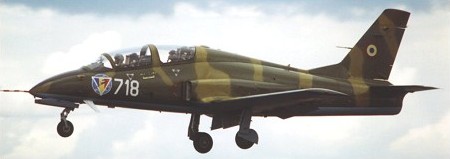
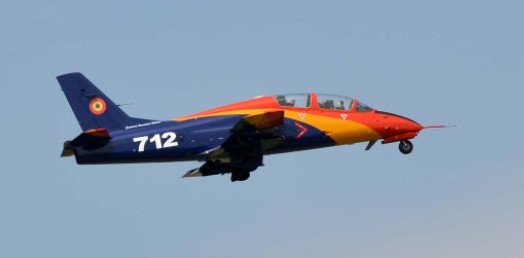
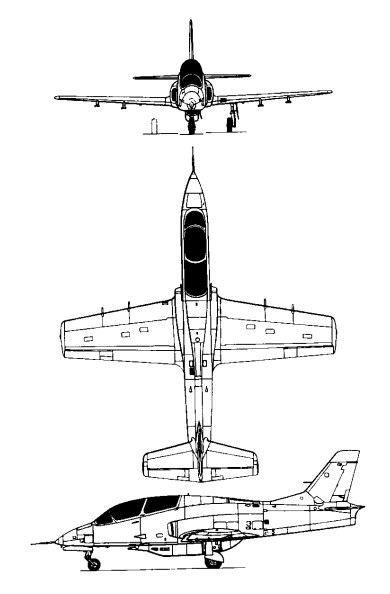
Making its first flight in December 1985, the IAR-99 Soim (Falcon) is designed as a basic jet trainer/light ground attack aircraft, the Soim has lateral intakes for the single 4,000 lb st (17,8 kN) R-R Viper Mk 632-41 turbojet. The wings are unswept, with provision for up to four attachment points, as well as a gun pod on the fuselage centreline. Maximum take-off weight is in the 5,500kg class, with a maximum level speed of 865km/hr (467kt) and a service ceiling of 13,900m (46,000ft).
The first prototype flew on December 21, 1985. The aircraft was in production for the Romanian Air Force to replace the L-29 Delfin in Romanian Air Force service.
IAR 99 Soim Engine: 1 x Rolls-Royce “Viper” Mk.632-41M, 1820kg Take-Off Weight: 4400-5560 kg / 9700 – 12258 lb Empty Weight: 3200 kg / 7055 lb Wingspan: 9.85 m / 32 ft 4 in Length: 11.01 m / 36 ft 1 in Height: 3.90 m / 12 ft 10 in Wing Area: 18.71 sq.m / 201.39 sq ft Max. Speed: 865 km/h / 538 mph Ceiling: 12900 m / 42300 ft Initial ROC: 2190 m / min. T/O run: 790 m. Ldg run: 750 m. Hardpoints: 4. Range: 970-1100 km / 603 – 684 miles Crew: 2 Armament: 1 x 23mm cannon, up to 800kg of weapons
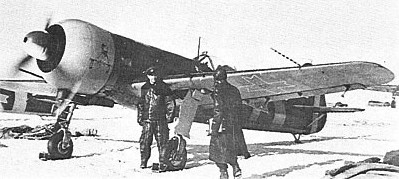
Expansion of the operational versatility of the basic IAR.80 design to embrace the fighter-bomber and dive bomber tasks resulted in the I.A.R.81, which was to fly its first operational sorties in the Ukraine on 15 October 1941. The 25th production I. A.R.80A was taken from the line to serve as a prototype, fitted with two wing racks for 50kg bombs and a ventral crutch for a 225kg bomb. Introduction of the crutch dictated modifications to the main undercarriage members and an automatic flap actuating device was introduced. The dual fighter-bomber and dive bomber version became known as the BoPi, an acronym for Bombardier in Picaj, or dive bomber. The I.A.R.81 retained the six 7.92mm FN-Browning guns and could carry three 100kg bombs, or one 225kg and two 50kg bombs. Fifty I.A.R.81s were followed by a batch of 10 I.A.R.81As, which, like the final 10 I.A.R.81s, were armed with two 13.2mm and four 7.92mm guns, and these proved to be the last of the BoPi aircraft. The next production version, the I.A.R.81C, was a pure fighter and was to be built in larger numbers than any I.A.R. 80 variant. Essentially similar to the I.A.R.80C apart from having the Ikaria cannon replaced by the Mauser MG 151 and retaining only two 7.92mm guns, the I.A.R.81C was, like other versions of the I.A.R.81, powered by the I.A.R.-K 14-1000A engine. A total of 161 I.A.R.81Cs was built by late 1943 when licence manufacture of the Bf 109G-6 took over. The maiden flight of the first IAR 81C, No 301, was performed on April 6, 1943. Until June 1, 26 sub versions of the IAR.80/81 had already been finished and test flown.
IAR-81 fighter-bomber equiv. to IAR-80A Wingspan: 10m Armament: 6 x FN-Browning 7.92mm mg initial production: belly-rack (1 x 225kg bomb), 40 built late production: belly-rack + 2 x wing rack (50kg bomb), 10 built
IAR-81A BoPi equiv. to IAR-80B Wingspan: 10m Armament: 4 x 7.92mm mg + 2 x 13.2mm mg 10 built Orig. 20 IAR-81s ordered deliv. w/o bomb racks as IAR-80B fighters
IAR-81B Project Range: 695 km Ikaria cannon-armed vers., deliv. as IAR-80C fighters
IAR-81C as ’81B Wingspan: 11m Range: 730 km Armament: 4 x 7.92mm mg + 2 x 20mm MG151 150 built (up to 165)
IAR-81M 1944-45 conv. program to uprate earlier IAR-81 models to IAR-81C Wingspan: 11m Armament: 4 x 7.92mm mg + 2 x MG151/20
Take-off weight: 3070 kg / 6768 lb Empty weight: 2125 kg / 4685 lb Wingspan: 10.52 m / 34 ft 6 in Length: 8.97 m / 29 ft 5 in Height: 3.60 m / 11 ft 10 in Wing area: 16.00 sq.m / 172.22 sq ft Max. speed: 542 km/h / 337 mph Range: 1030 km / 640 miles
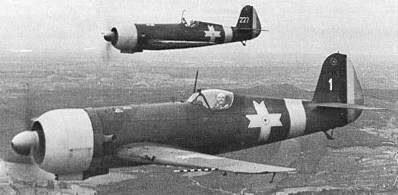
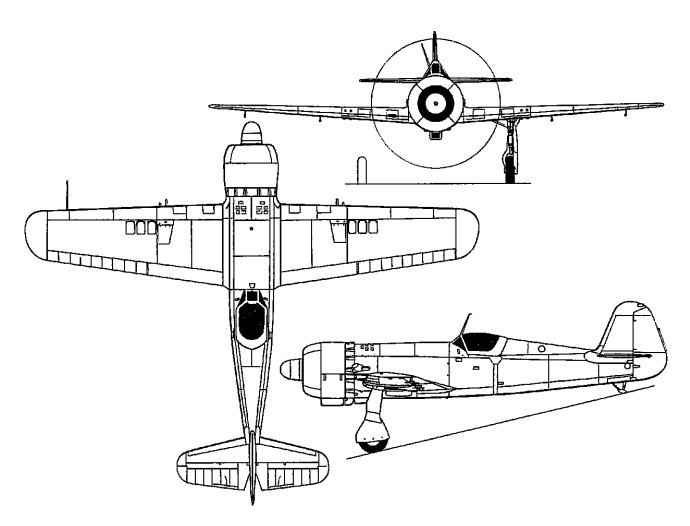
Provisional design work on a monoplane fighter with retractable landing gears was privately started by a small JAR team in early 1936, to be abandoned at the end of the year due to lack of interest shown by authorities. Corrupt members of the Romanian government had already influenced the military to place a substantial order for the ill fated PZL P.11. However, the design was secretly warmed up in mid 1937 and eventually lead the prototype of an aircraft comparable to the main fighter designs of those pre war years. Designed as a successor to the licence-built P.Z.L. P.24E by a team comprising Ion Grosu, Ion Cosereanu, Gheorghe Zotta and Gheorghe Vallner, the I.A.R.80 single-seat fighter was flown on 20 April 1939 in the hands of Capitan Aviator Constantin Pufi Popeseu, IAR’s chief test pilot. The prototype was powered by a 900hp I.A.R.-K 14-II C32 14- cylinder air-cooled radial based on the Gnome-Rhone 14K Mistral-Major and its armament consisted of two wing-mounted 7.92mm FN-Browning guns. The series-production I.A.R.80 appeared in the spring of 1940, and featured a 52cm increase in wing span, a 74cm increase in fuselage length, greater fuel capacity, an aft-sliding cockpit canopy, an armament of four 7.92mm guns and a 930hp I.A.R.-K 14-III C36 engine. The series model also discarded the tailplane bracing struts featured by the prototype. The first flight of an initial series production dive bomber, the IAR 81, No 81, happened on August 16,1941. The I.A.R.80 achieved operational capability on 14 January 1941 with Flotilla 2 Vinatoare of the Royal Air Forces of Romania (Fortelor Aeriene Regal ale Romania), or FARR. The 50th and last of the initial series (No 175) left the production line in April 1942, and was fitted with an extra pair of guns, this six-gun armament being standardised for subsequent aircraft, which were designated I.A.R.80As, these also having racks for two 50kg bombs and being powered by the 1,025hp I.A.R.-K 14-1000A engine. Ninety I.A.R.80As were followed by 50 I.A.R.80Bs, with an armament of four 7.92mm and two 13.2mm guns, the 21st and subsequent aircraft of this batch having a further increase in wing span of 48cm and provision for underwing drop tanks. Manufacture of the pure fighter version of the basic design was completed with 50 I.A.R.80Cs – originally laid down as I.A.R.81Bs, which see – with 20mm Ikaria cannon replacing the 13.2mm weapons and reintroducing the tailplane bracing struts. A small number of I.A.R.80s remained in Romanian service until late 1949, after which survivors with the lowest hours were rebuilt as I.A.R.80DC tandem-seat dual-control advanced trainers. The Junkers Jumo 211Da was not the only in line engine to be experimentally fitted to an IAR 80 airframe. At the end of June 1943, several test flights were performed with an IAR 80 fitted with a Daimler Benz DB 601Aa from a Messerschmitt Bf 109E.
IAR-80 prototype 1939 Engine: 870hp IAR K14-III C32 Wingspan: 10m open cockpit Armament: 2 [or 4?] x FN-Browning 7.92mm
IAR-80 initial production 1941 Engine: 930hp K14-III C36 Wingspan: 10.52m Armament: 4 x 7.92mm 20 built
IAR-80 (No.13) April 1941 Engine: 1100hp DB 601Aa (from Bf-109E) Wingspan: 10.52m
IAR-80 late production 1941 Engine: 960 hp IAR K14-IV C32 Armament: 4 x 7.92mm 30 built
IAR-80A Engine: 1025hp IAR K14-1000A Armament: 6 x FN-Browning 7.92mm reinforced rear fuselage, additional armour protection
IAR-80B Wingspan: 11.00 m / 36 ft 1 in Length: 8.97 m/ 29 ft 5 in Height: 3.52 m / 11 ft 7 in Wing area: 16.50 sq.m / 177.60 sq ft Take-off weight: 2980 kg / 6570 lb Loaded weight: 2200 kg / 4850 lb Max. speed: 550 km/h / 342 mph Range: 730km, drop tank 1030km Armament: 4 x FN-Browning 7.92mm mg + 2 x FN-Browning 13.2mm mg 50 built
IAR-80B (No.326) June 1943 Engine: 1475hp DB-605A for trials
I.A.R.80C Wingspan: 11.00 m / 36 ft 1 in Length: 8.97 m/ 29 ft 5 in Height: 3.52 m / 11 ft 7 in Wing area: 16.50 sq.m / 177.60 sq ft Take-off weight: 2980 kg / 6570 lb Loaded weight: 2200 kg / 4850 lb Max. speed: 550 km/h / 342 mph Armament: 4 x FN-Browning 7.92mm + 2 x 20mm Ikarus 50 built
IAR-80DC Postwar conv. to 2-seat trainer (fuselage fuel tank removed)
IAR-80M 1944-45 conv. to uprate IAR-80 gun armament to IAR-81C standards
IAR-80 one conv. Engine: 1600hp engine [Gnome-Rhône 14R?]
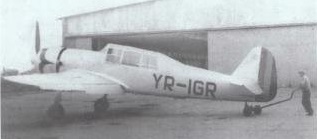
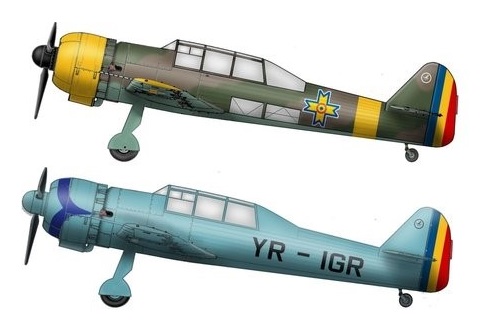
In 1940 three I.A.R.47 prototypes were under construction, intended to replace the I.A.R.39 in production. A low-wing monoplane recce bomber, the first was for static tests. The other two were of different design. They were a combination of the IAR 39’s fuselage with the IAR 80’s wings.
None of them were destroyed during US bombings, and at least one (YR-IGR) was still flying in 1956.
IAR-47 Engine: IAR K14 1000A, 960hp Max Speeds: at sea level: 396km/h at 1000m: 406km/h at 2000m: 419km/h at 3000m: 435km/h at 4000m: 456km/h at 4300m: 464km/h at 5000m: 460km/h / 304mph Armament: 3 x 7.92mm Rheinmetall mg (2 fixed, 1 flex) Bombload: 6 x 50kg
The IAR-46 is a very light two-seater airplane for flight school, training and tourism, developed from the ICA IS-28. Construction is conventional riveted joints. Seats are arranged side by side, the left seat as the main, low trepezoidal wing, empennage in “T” semi-retractable landing gear, with skid wheel connected with the rudder.
Definition phase and marketing studies started early 1991 and detail design began late 1991.
DESIGN FEATURES: Low-wing monoplane; GA(W)-1 aerofoil section) with high aspect ratio; raked tips; T tail. Dihedral 2° from centre-section; incidence 4° at root; no twist. Foldable horizontal tail surfaces.
FLYING CONTROLS: Conventional and manual. Actuation by pushrods and cables; trim tab in each elevator. Manually operated plain trailing-edge flaps.
STRUCTURE: All-metal except fabric covering on elevators and rudder and GFRP for non-stressed fairings. Wing has main and auxiliary spars. Fluted aluminium skins on ailerons and flaps.
LANDING GEAR: Retractable (manual/mechanical) single mainwheels with hydraulic shock-absorbers and hydraulic, toe-operated disc brakes; steerable, non-retractable tailwheel rubber-in-compression shock-absorption. Rearward-retracting 5.00×5 Matco or Cleveland mainwheels, with 360×110 tyres, pressure 3.00 bar (43.5 lb/sq in). Tost 210×65 tailwheel and tyre, pressure 2.50 bar (36 lb/sq in).
POWER PLANT: One 59.6 kW (79.9 hp) Rotax 912 F3 (IAR-46) or 73.5 kW (98.6 hp) Rotax 912 S3 (IAR-46S) flat-four engine, with 2.43:1 reduction gearing to a Hoffmann HO-V352F/170FQ two-blade variable-pitch propeller (‘170FQ+6 in IAR-46S). Fuel in single tank in fuselage, capacity 70 litres (18.5 US gallons; 15.4 Imp gallons).
ACCOMMODATION: Two adjustable backrest seats side by side; dual controls standard; adjustable rudder pedals. Fixed windscreen and rearward-sliding jettisonable canopy. Baggage compartment aft of seats. Cockpit heated and ventilated.
SYSTEMS: Electrical power supplied by 250 W 14 V DC alternator and 12 V 25 Ah battery. Hydraulic system for mainwheel brakes only, with parking brake valve.
AVIONICS: Instrumentation: Standard VFR instrumentation to JAR 22.1303 and JAR 22.1305. Options include horizon and directional gyros, turn co-ordinator and Becker nav/com and transponder avionics package.
EQUIPMENT: Anti-collision and position lights standard; ground power receptacle optional.
A development phase was initiated mid-1992 with the first of two prototypes (YR-1037) shown at the Paris Air Show June 1993 and made first flight November that year.
Following flight test evaluation, static test and ground testing for JAR-VLA compliance, development of 02 second prototype began at end of 1995. This aircraft (YR-BVC) made first flight in April 1997.
The manufacturer’s preliminary flight test programme was completed in August 1999 and JAR-VLA certification (Utility category) by Romanian CAA, began mid-1998, was received November 1999, with YR-BVC registered to Airclub Romania in August 2000.
FAA certification was expected in September 2000 but apparently still awaited in mid-2003. Three further production aircraft were built and stored by late 1998, eventually registered in April 2001. The first three (c/n 03 to 05) were registered to Airclub of Romania in April 2001.
IAR-46 Engine: Rotax 912 F3/A3, 58 kW (78 hp) Propeller: 2-bladed Hoffmann HO-V352F/170FQ, 1.7 m (5 ft 7 in) diameter Wingspan: 11.42 m (37 ft 6 in) Wing area: 13.87 sq.m (149.3 sq ft) Aspect ratio: 9.403:1 Airfoil: GA(W)-1 Height: 2.15 m (7 ft 1 in) Length: 7.85 m (25 ft 9 in) Empty weight: 530 kg (1,168 lb) Max takeoff weight: 750 kg (1,653 lb) Fuel capacity: 78 L (21 US gal; 17 imp gal) G limits: +4.4, -2.2 Cruise speed: 150 km/h (93 mph, 81 kn) (econ cruise) Stall speed: 78 km/h (48 mph, 42 kn) Never exceed speed: 270 km/h (170 mph, 150 kn) Range: 800 km (500 mi, 430 nmi) (no reserve) Service ceiling: 5,000 m (16,000 ft) Rate of climb: 4.30 m/s (846 ft/min) Wing loading: 54.1 kg/m2 (11.1 lb/sq ft) Power/mass: 12.58 kg/kW (20.67 lb/hp) Rate of climb: 4.30 m/s (846 ft/min) Crew: 2
IAR-46S Engine: Rotax 912 S3, 73.5 kW (98.6 hp) Wingspan: 11.42 m (37 ft 6 in) Wing area: 13.87 sq.m (149.3 sq ft) Aspect ratio: 9.403:1 Airfoil: GA(W)-1 Height: 2.15 m (7 ft 1 in) Length: 7.85 m (25 ft 9 in) Empty weight: 530 kg (1,168 lb) Max takeoff weight: 750 kg (1,653 lb) Fuel capacity: 78 L Maximum speed: 215 km/h (134 mph; 116 kn) Cruising speed: 170 km/h (110 mph; 92 kn) (econ cruise) Stall speed: 78 km/h (48 mph; 42 kn) Never exceed speed: 280 km/h (170 mph; 150 kn) Range: 800 km (497 mi; 432 nmi) (no reserve) Service ceiling: 5,000 m (16,404 ft) Crew: 2
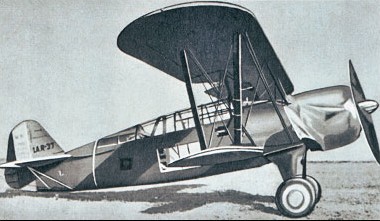
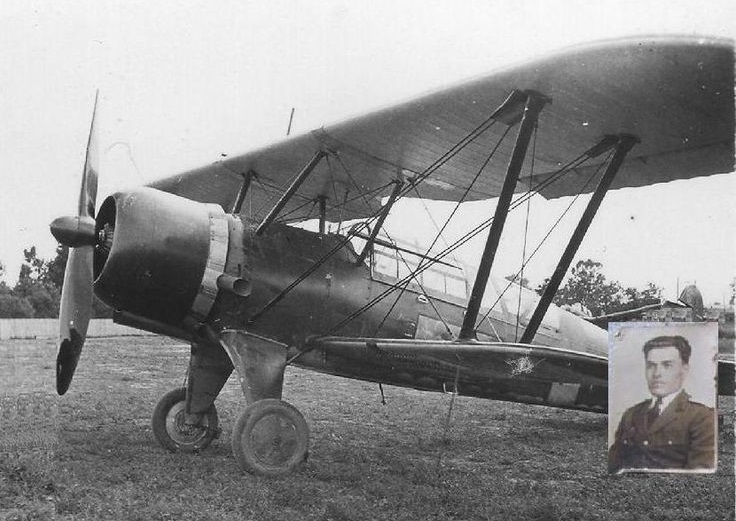
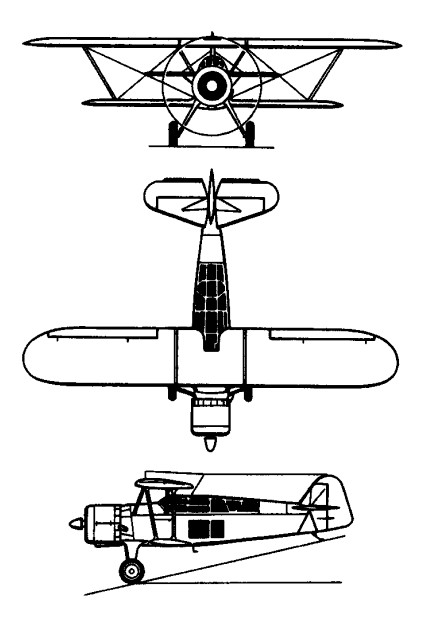
The I.A.R.37 prototype was built to the design of engineers Grossu-Vizuru and Carp. Flown for the first time in 1937 by company pilot Max Manolescu, it was intended to meet an official requirement for a tactical bombing and reconnaissance aircraft. An unequal-span biplane, the I.A.R.37 had fixed main landing gear and was powered by an I.A.R. K.14 radial engine. Its three-man crew was accommodated beneath a continuous glazed canopy, the observer seated between pilot and gunner and provided with full dual controls, a Romanian-designed Estopey bomb-sight, radio and a camera. Defensive armament comprised four machine-guns and the offensive load 12 50kg bombs or six 100kg bombs on underwing racks. The I.A.R.37 entered production.in late 1938 and was built in small numbers before being succeeded in 1939 by the interim I.A.R.38, which differed mainly in its powerplant. An attempt to modify an IAR 37 into a dive bomber was made in the summer of 1940. No 5, redesignated IAR 371, performed the Romanian dive bombing premiere on July 16 with a test diving from 4,000ft (1,200m), piloted by Emil Droc, test pilot of the IAR factory. Several modifications (including the cockpit canopy and fuselage side glazing) were made to the IAR 37 design before it was fitted with a German BMW 132A radial engine, giving birth to the more reliable IAR 38. In January 1939, even before all 50 examples of the –37 had been completed production was shifted in favour of the IAR 38. The last IAR 37, No 47 was first flown on June 16, l939. The final number of IAR 38s actually manufactured is still unclear, the existence of a photograph depicting ‘Red’ 89 suggests that possibly 90, even up to 120, such aircraft could have been finally produced at Brasov. The -38 was soon displaced on the production line by the I.A.R.39. The increased fuel consumption of the more powerful IAR K1 4 engine installed in the IAR 39s decreased the aircraft’s range to 350nm (650km), equal to the similarly equipped IAR 37. Of the total production of 325 I.A.R.37, 38 and 39 aircraft, over 200 were I.A.R.39s, 96 built under sub-contract by the S.E.T. company and over 100 by I.A.R.
IAR 39
By the end of 1940 the I.A.R. biplanes were in large-scale service with Fortelor Aeriene Regal ale Romania (Royal Romanian Air Force) or FARR. They equipped a number of squadrons attached to the various army corps and by June 1941, when Romania supported the German offensive against the Soviet Union, the three reconnaissance flotile of the FARR had 18 eskadrile, 15 of which were equipped with I.A.R. biplanes. In July 1942 the air expeditionary force in the Soviet Union had been re-formed as Corpul I Aerian and had several groups equipped with the I.A.R.39. Eleven reconnaissance eskadrile were operating with the army co-operation flotile during the 1944 offensive in the Ukraine, most of them with I.A.R.39s on strength. Post-war the new Communist republic was declared at the end of 1947, and the reorganised air arm, known as the FR-RPR (Fortele Aeriene ale Republicii Populare Romania) had a small number of I.A.R.39s for training and liaison duties for several years. The last member of the IAR 37/38/39 family was withdrawn from service in mid 1960s.
IAR-38 Engine: BMW 132A, 522 kW (700 hp) Empty weight: 5,070 lb (2,300kg) Taller tail. 75 built (IAR).
IAR-39 Engine: 1 x IAR K.14-IV C32, 16 kW (960 hp) Wingspan: 13.10 m / 42 ft 11.75 in Length: 9.60 m / 31 ft 6 in Height: 3.99 m / 13 ft 1 in Wing Area: 40.30 sq.m / 433.79 sq ft Take-Off Weight: 3085 kg / 6801 lb Loaded Weight: 2177 kg / 4799 lb Max. Speed: 336 km/h / 209 mph / 182 kn Service Ceiling: 8000 m / 26245 ft Range: 1050 km / 652 miles / 567 nmi Armament: 3 x FN (Browning) 7.92mm machine-guns Bombload: 288kg (635lb) or 144 air-grenades Crew: 3 255 built (95 at IAR and 160 at SET).
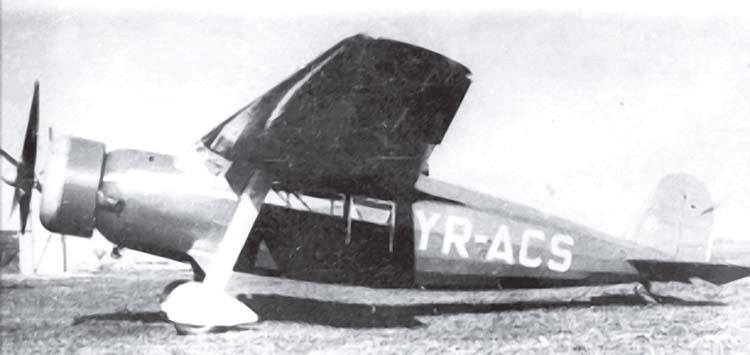
BFW negotiations with the Romanian company ICAR (Intrepindere Pentru Constructii Aeronautice) led to a contract for the development by ICAR of an M-36 transport aircraft for 6 passengers. ICAR designated it the ICAR 36; Messerschmitt, working at BFW referred to it as the M 36. According to the project, the Messerschmitt designed aircraft was to be equipped with a French Gnome et Rhone 14 K engine with 450 hp. However, in order to save money, the Romanians chose a less powerful Armstrong Siddeley Serval (350 hp).
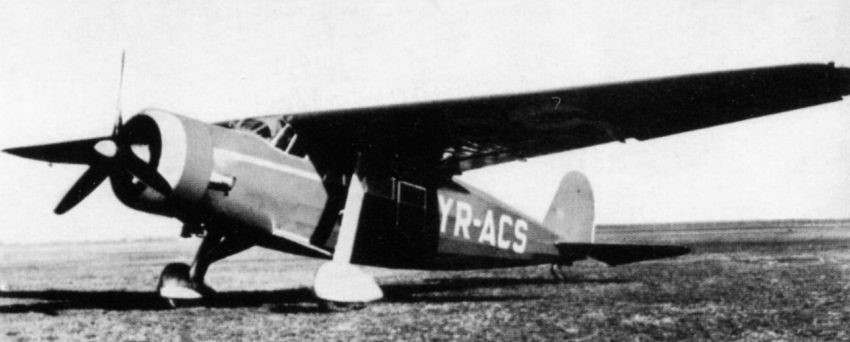
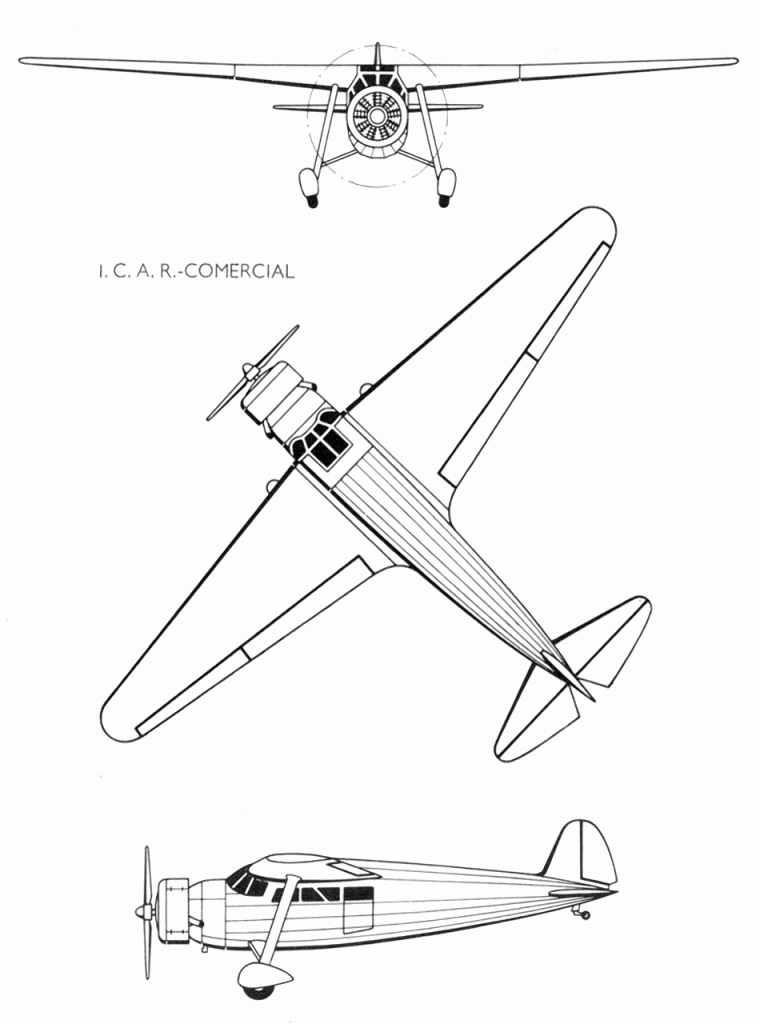
The ICAR 36 was a high-wing cantilever monoplane of mixed construction, with a closed cockpit, single engine, and fixed landing gear. It had a welded steel tube fuselage, covered with plywood, and tapered single-spar, plywood-covered wings. The crew of two sat in the cockpit, forward of the wing, which was equipped with a radio and could be fitted with twin controls. The cabin for six passengers, with wide rectangular windows and access doors at the rear, was aft and below the cockpit / wings. There were also two baggage compartments.
The aircraft successfully completed tests at the end of 1934 after some modifications. Possibly six aircraft were built.
One example was built for the LARES airline on the domestic routes of Romania including the Bucharest to Cernauti. The aircraft (YR-ACS) was built, later modified with a cabin for five passengers and two luggage compartments. Initially fitted with a 280 kW (380 hp) Armstrong Siddeley Serval I ten-cylinder radial engine in a NACA cowling, which was, in turn, replaced with a 220 kW (300 hp) Lorraine 7M Mizar 47, driving a three-bladed propeller. The fixed landing gear was supported by long faired vertical struts to the wings, with teardrop spats over the mainwheels and a tailwheel at the end of the fuselage.
I.C.A.R. 36 Comercial Engine: 1 × Armstrong Siddeley Serval I, 250 kW (340 hp) Wingspan: 15.4 m (50 ft 6 in) Wing area: 30.50 m2 Length: 9.8 m (32 ft 2 in) Height: 2.8 m (9 ft 2 in) Empty weight: 1,320 kg (2,910 lb) Gross weight: 2,250 kg (4,960 lb) Maximum speed: 235 km/h (146 mph, 127 kn) Cruise speed: 220 km/h (140 mph, 120 kn) Stall speed: 89 km/h (55 mph, 48 kn) Range: 700 km (430 mi, 380 nmi) Service ceiling: 4,500 m (14,800 ft) Crew: two Capacity: six / 960 kg (2,120 lb) payload
The unnumbered prototype of the IAR 27 trainer made its debut on June 8, 1937. A two-seat basic trainer, low-wing monoplane, metal construction, power was a 180 hp IAR 6 GI (licenced DH Gipsy 6), and a 9.10 m span.
Series production totalled 80 aircraft, 30 built by SET in 1941. The wheel covers were not employed on series production airframes.
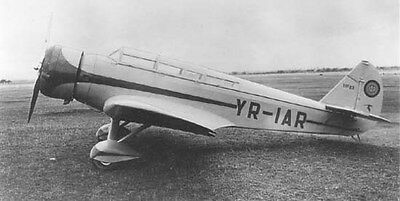
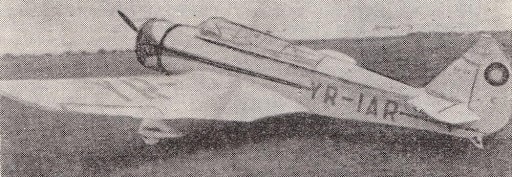
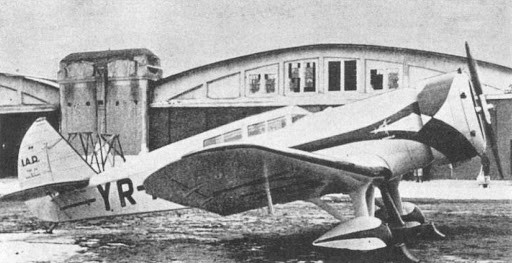
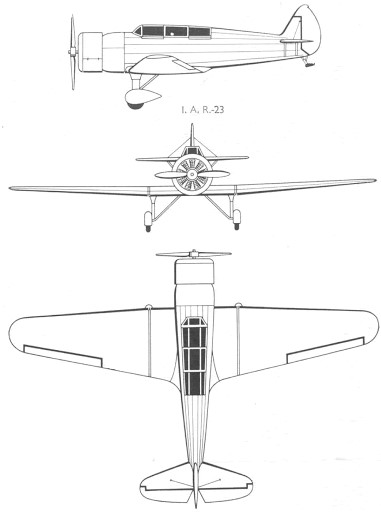
The IAR-23 was created in 1934 by the Romanian company Industria Aeronautică Română (IAR) as an attempt to design a next-generation fighter for the Royal Romanian Air Force, but because its low power, it was classified only as a civilian touring aircraft. However, it contained many advanced features for its time, including uniquely designed wings. After the installation of additional fuel tanks, it turned into a long-haul touring plane, with a maximum range of 2300 km.
IAR-23
The sole IAR-23 built was registered YR-IAR. and delivered to Major G. Bănciulescu in September 1934, who undertook several cross-country flights with the aircraft through Europe (from Bucharest to Warsaw, Prague and Vienna). The next year, the IAR-23 was flown to Tel-Aviv and back.
An improved version, the IAR-24 YR-ACI, was created in 1935. It used the same airframe, but had a modernized cockpit and a slightly more powerful engine that yielded a higher cruising speed.
IAR-24
IAR-23 Powerplant: 1 × Hispano-Suiza 9Qa, 253 kW (340 hp) Wingspan: 12.00 m (39 ft 4 in) Wing area: 22.30 m2 (240.00 sq ft) Length: 8.35 m (27 ft 5 in) Height: 2.70 m (8 ft 10 in) Empty weight: 980 kg (2,156 lb) Gross weight: 1,920 kg (4,224 lb) Maximum speed: 245 km/h (153 mph, 133 kn) Cruise speed: 215 km/h (134 mph, 116 kn) Range: 2,300 km (1,437 mi, 1,249 nmi) Service ceiling: 4,100 m (13,670 ft) Crew: 2 pilots Capacity: 4 passengers
IAR-24 Engine: Gnome-Rhone 7 Kd, 350 hp Wingspan: 12.00 m Length: 8.35 m Height: 2.70 m Wing area: 22.30 sq.m Empty weight: 1180 kg Normal takeoff weight: 2030 kg Maximum speed: 280 km / h Cruising speed: 230 km / h Practical range: 2300 km Rate of climb: 200 m / min Service ceiling: 4500 m Crew: 2