da Silva I

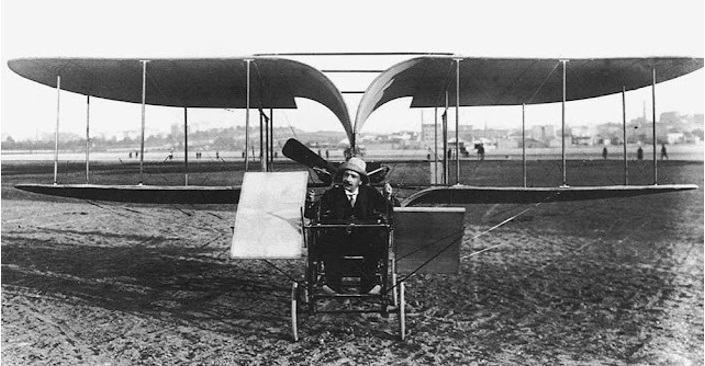
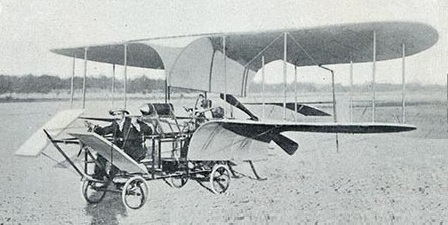
In 1909, Abeillard Gomes da Silva, was in Beira in the then Portuguese colony of Mozambique. Working there, at customs, was Abeillard Gomes da Silva, who that year had the opportunity to visit Europe during a holiday. At his own expense, he set off for France with an interest in heavier-than-air flight.

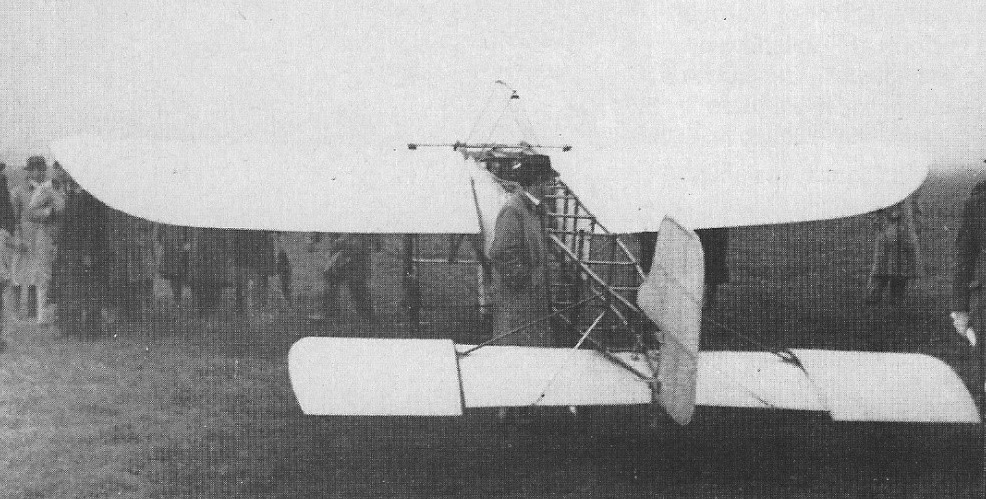
Upon arriving in France, he promptly spent 23,000 francs to build an airplane of his own invention: the Gomes da Silva I. A biplane configuration with its engine – a 25 to 28 hp Anzani – placed behind the pilot, it had a three-lever control system: a central lever for the rear directional rudders, and the other two for the altitude rudders, placed on either side of the pilot and which could either function together or separately. Enrolled in the Juvisy Aviation Fortnight (Grande Quinzaine d’Aviation), organised by the Société d’Encouragement à l’Aviation, it seems that Gomes da Silva was eventually disqualified due to a “21-day delay in the delivery of the engine”. The craft had been tested at the Issy-les-Moulineaux airfield and was not able to take off.

Gomes da Silva I
Wingspan: 7 m
Length: 6.5 m
Weight: 250 kg

D’Ascanio Helicopter

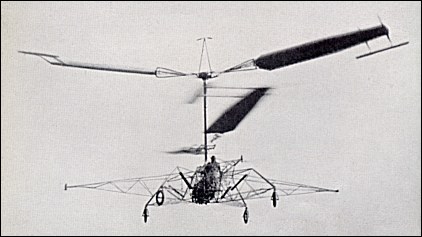
In 1928 in Italy, Corradino D’Ascanio built a helicopter with two 13m counter-rotating coaxial rotors, each with a trailing elevator which could be used to vary the rotor blade angle of attack. Two small propellers at the ends of extra arms were used for additional control. Powered by a 95hp Fiat engine, the craft set three Federation Aeronautique Internationale (FAI) world records on October 8, 1930: an altitude of 18m, a distance of 1078m, and endurance of 8 minutes and 45 seconds.
D’Ascanio worked for the Piaggio company, and designed also the Vespa scooter.

Engine: 1 x Fiat A-505, 95-100hp
Rotor diameter: 13-15m
Take-off weight: 800kg
Achieved height: 18m
Achieved endurance: 8min 45s

Dart Manufacturing Dart / Lambert Aircraft Corporation Monoprep G / Monosport G / Mono Aircraft Corp Monoprep G / Monosport G

Dart GK

Dart Manufacturing Co was formed 1937 at Columbus, Ohio, to manufacture Dart G two-seat light aircraft. This was a version of the aircraft known originally as the Monosport, designed and built by the Mono Aircraft Corporation. Taken over by Culver Aircraft Company of Columbus in 1939.

Mooney, while working for Monocoupe, designed the Monoprep G which was a low wing monoplane with an open cockpit, seating two side by side. Given a cabin enclosure it became the Monosport G and was to have gone into production in October 1935, but financial problems prevented this.

One was built in 1935, registered NX11791. Power was a 90 Lambert.

Al Mooney left Monocoupe and bought the design and production rights from Lambert Aircraft. He teamed up with K K Culver and they formed the Dart Aircraft Co at Port Columbus, Ohio, in 1939. Several uncompleted airframes were modified to produce an improved version to be known as the Dart. This was certificated in April 1938 as ATC 674.

About fifty Dart Aircraft Co Darts were produced before the war, using one of three engines, the 90hp Lambert R 266 in the model G, the 90hp Ken Royce in the model GK and the 90hp Warner Scarab Junior in the model GW.

Model G

Production of the Model G commenced in 1938 powered by a 90 hp Lambert R-266 radial, and the Model GC was produced in 1939 by a 100 hp Continental engine.

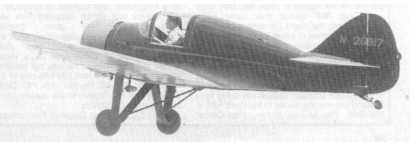
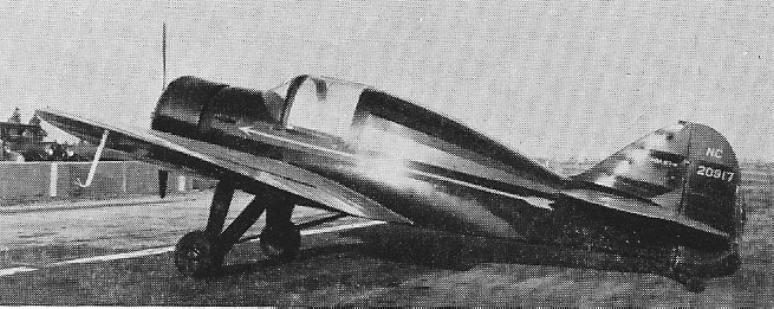
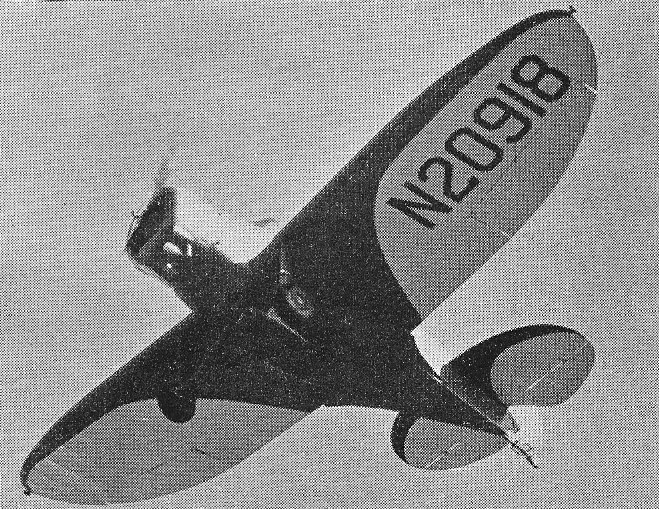
Dart GW N20918

In 1939 the company became the Culver Aircraft Co, and produced the new Culver Cadet. The Dart was not finished, however as rights were acquired by Applegate & Weyant in 1946 and the Dart DC with a 100hp Continental was built. Competition from newer models was too great and only about twelve were sold.

Model G
Engine: 90 hp Lambert R-266
Wing span: 29 ft 6 in
Length: 18 ft 6 in
Height: 7 ft 9 in
Empty weight: 922 lb
Loaded weight: 1550 lb
Max speed: 130 mph
Cruise: 115 mph
ROC: 900 fpm
Range: 500 mi

Model GC
Engine: 100 hp Continental

Model GK
Engine: 90hp Ken Royce

Model GW
Engine: 90hp Warner Scarab Junior

Dart Kitten

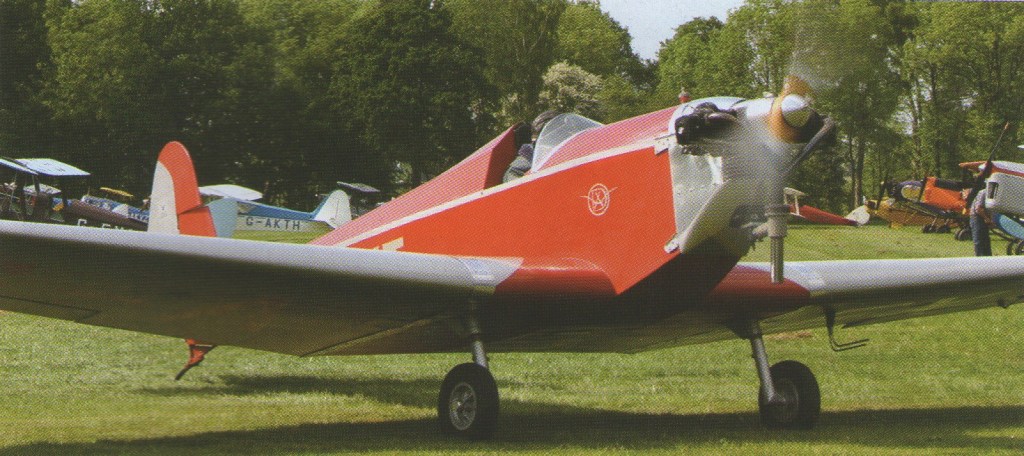
The Dart Kitten Mk.I was a low wing, single seater, powered by a 27 hp Ava 4a-00 engine.

Dart Kitten Article

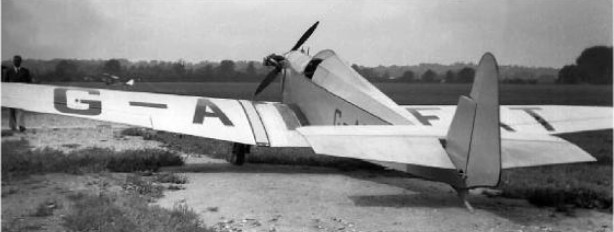
An improved Mk.II version, G-AEXT, was powered by a 36 hp Aeronca JAP J-99. Awarded an Authorisation to Fly in April 1937. The Kitten II passed through many owners and survived the war. G-AEXT crashed at Willindale in November 1964, killing the pilot. It was rebuilt and restored to the register in 1976.

Kitten II G-AEXT – 27 August 1939

Darmstadt University Aviation Soc D-22

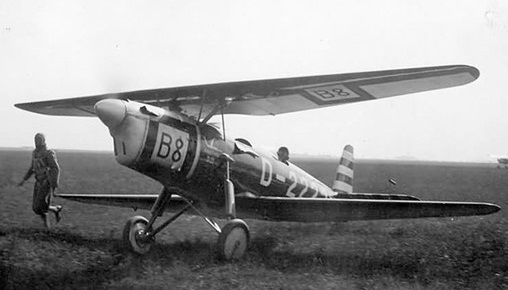
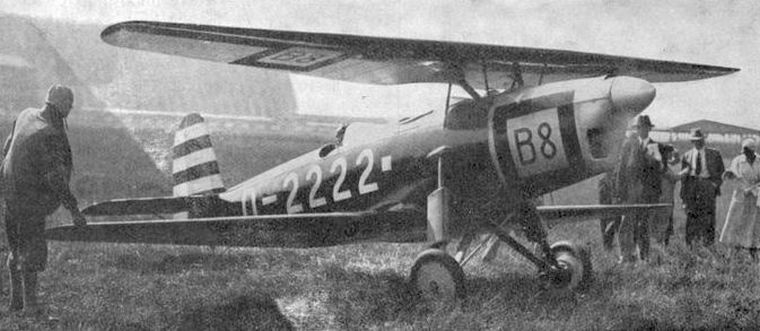
The Darmstadt D-22 was an all-wood sport biplane designed and built in Germany in 1931 by the Akademische Fliegergruppe of Darmstadt University of Technology, a group of aerodynamical engineering students. A development of the Darmstadt D-18 designed by F. Fecher, the D-22 was a slightly enlarged, more streamlined and more powerful German sports-plane built to compete in the 1932 Coupe Deutsch de la Meurthe.

The D-22 had an unorthodox configuration, being a cantilever biplane, with an upper wing placed low, just above the fuselage and ahead of its lower wing. The design emphasized aerodynamics and lightness and the aircraft was small with a streamlined silhouette.

The D-22 boasted an oval cross-section fuselage skinned with plywood and fabric on parts of the single-spar wings. This could, as was required by the rules of the competition, be dismounted and folded rearwards. The crew of two sat in tandem in open cockpits each with its own with windshield. The landing gear was fixed with a tail skid. The engine was mounted in the fuselage nose and drove a two-bladed fixed-pitch propeller.

Propulsion was from a 75.7 kW (101.5 hp) Argus As 8 4-cylinder inverted air-cooled, in-line piston engine driving a 2-bladed fixed-pitch propeller which powered the D-22 to a top speed of 230 km/h (140 mph, 120 kts).

Two were constructed. One was allocated G-ABPX and was known to have a Gipsy III engine.

One was allocated D-2222.

The trial was to be run in two 1,000 km stages separated by a 90-minute refuelling stop and was limited to aircraft with an engine capacity not exceeding eight litres. The starting point of the race was still at Étampes. Suzanne Deutsch de la Meurthe offered one million Francs in prize money while Ministère de l’Air (Air Ministry) offered another three million.

Only one, a D-22A flew in the cup. Not having flaps or slats, she was severely handicapped in the landing trials, eventually finishing 35th out of 43 contestants. However, after this she improved her score after a rally around Europe, where she took the 4th place with a cruise speed of 205 km/h (127 mph; 111 kts). In the maximum speed trial, the D-22A was beaten only by the five Heinkel He 64s, reaching 230.7 km/h (143.4 mph; 124.6 kts). As a result, she eventually finished 17th overall.

Sold in 1933, she competed for several more years in various events.

Wingspan: 24 ft
Length: 21 ft 6 in
DAR DAR-10F

The DAR 10F was the only Bulgarian designed military aircraft to have seen service. It was a trim but conservative light bomber with an 840/960 hp Fiat A74RC38 radial, and with spatted wheels and a crew of two under a glasshouse canopy.
The gun armament was heavy: two 20 mm (0.79 in) MG FF cannon in the wings and two 7.92 mm (0.312 in) MG 17 in the top decking, all firing ahead, and an MG 15 in the rear cockpit. In spite of this the 10F could still carry up to 500 kg (1102 lb) of bombs. Darjaviia Aeroplanna Rabotilnitza flew the prototype in 1941 and a small but unknown number entered Bulgarian service.

Span: 12.65 m (41 ft 6 in)
Length: 9.83 m (32 ft 3 in)
Gross weight: 3420 kg (7540 lb)
Maximum speed: 454 km/h (282 mph)