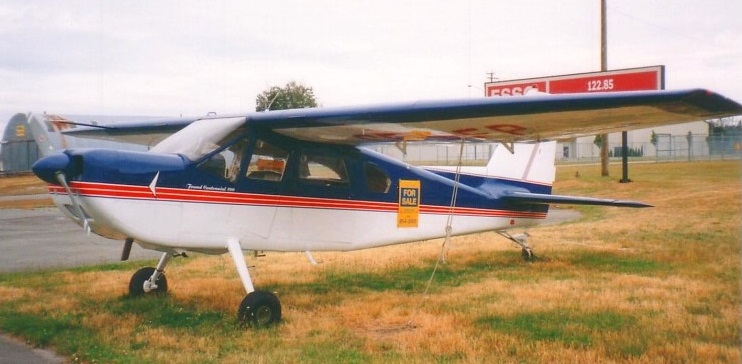
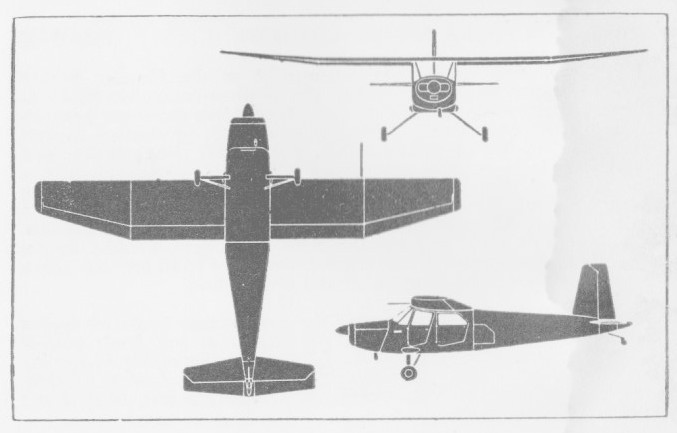
The Centennial 100 was developed as an improved version of the Found FBA-2. Design work started in October 1966 and the prototype first flew on 7 April 1967.
The aircraft is powered by a 290 hp (216 kW) Avco Lycoming IO-540-G1D5 engine.
Three prototypes and two production aircraft were built and were used to gain certification for the type in July 1968. No further aircraft were built as the company went out of business.
Engine: 1 × Avco Lycoming IO-540-G1D5, 290 hp (220 kW) Propeller: 2-bladed Hatzell metal constant speed propeller, 7 ft 4 in (2.24 m) diameter Wingspan: 39 ft 0 in (11.89 m) Wing area: 196.6 sq ft (18.26 sq.m) Aspect ratio: 7.2:1 Airfoil: NACA 23016 at root, NACA 23012 at tip Length: 26 ft 6 in (8.08 m) Height: 8 ft 4 in (2.54 m) Empty weight: 2,000 lb (907 kg) Max takeoff weight: 3,500 lb (1,588 kg) Fuel capacity: 50.5 imp gal (60.6 US gal; 230 L) Maximum speed: 162 mph (261 km/h, 141 kn) at sea level Cruise speed: 140 mph (230 km/h, 120 kn) (Econ. cruise, 65% power) Stall speed: 55 mph (89 km/h, 48 kn) (flaps down) Range: 700 mi (1,100 km, 610 nmi) Service ceiling: 18,000 ft (5,500 m) Rate of climb: 1,250 ft/min (6.4 m/s) Takeoff run to 50 ft (15 m): 1,020 ft (310 m) Landing run from 50 ft (15 m): 950 ft (290 m) Crew: 1 Capacity: 5 passengers
Found Brothers Aviation was formed in 1946 to produce a new design by Captain S.R. Found, the Found FBA-1A. The FBA was a four-seat cabin monoplane designed by Captain S. R. Found. The FBA-1 was a high-wing monoplane powered by a 140 hp (104 kW) de Havilland Gipsy Major engine, designed from its inception to be operated on wheels, tundra tires, skis and on floats. The prototype first flown 13 July 1949. Only one was built and it was developed into an all-metal four/five seater, the Found FBA-2.
Developed version designated FBA-2A flown August 11, 1960. It is a high-wing monoplane with a fixed tricycle undercarriage. The production version was to be the Found FBA-2B but the aircraft was produced with a conventional tail-wheel landing gear as the Found FBA-2C.
The first production FBA-2C was a five-seater flown on 9 May 1962. It is powered by an Avco Lycoming O-540-A1D engine and had a slightly longer cabin and enlarged cabin doors than the prototype. Originally, float or ski landing gear was available through third parties, and later became a factory option. Production ended in 1965 to concentrate on building the newer and larger Centennial 100. Thirty-four had been built.
In 1996 the design was acquired by Found Aircraft Development who developed an improved model the FBA-2C2 Bush Hawk-XP. This model was certified by Transport Canada in March, 1999 and by the Federal Aviation Administration in March, 2000. This version was manufactured between 2000-2007, after which it was replaced by a new version of the same basic airframe, designated the Expedition E350 and the Expedition E350XC.
Expedition E350
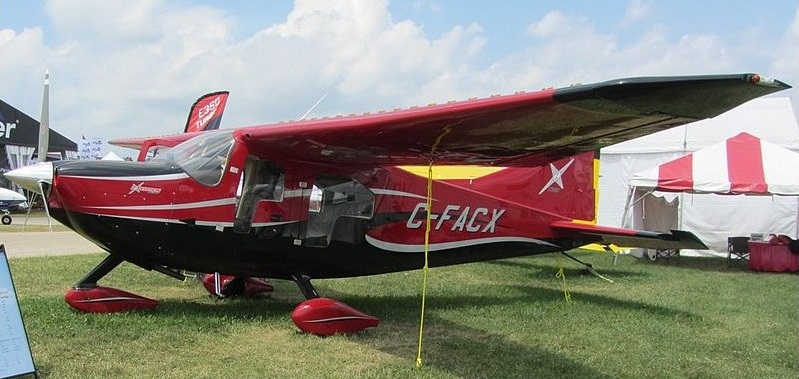
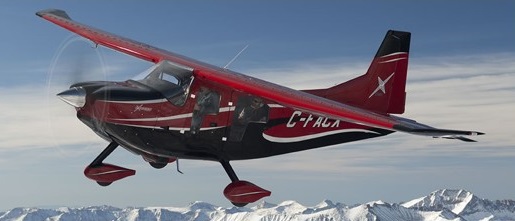
The E350 was a development of the basic FBA-2 aimed at the personal use market. The Expedition E350 was FAA type certified in December 2008. The aircraft can be equipped with four or five seats and has a full fuel payload in excess of 900 pounds. It is powered by a Lycoming IO-580 powerplant producing 315 hp (235 kW). The E350 was designed with rugged landing gear for operating from unprepared surfaces and has STOL performance.
Found Aircraft went into receivership in 2013 and production ended after 68 were built.
New Zealand aircraft manufacturer Pacific Aerospace Limited (PAL) acquired the ownership and manufacturing rights of the E-350 Expedition from Found Aircraft after it went into receivership.
Already FAA-certified, the E-350 was to be manufactured at Pacific Aerospace’s headquarters in Hamilton, New Zealand, from the second quarter of 2017.
PAL launched a joint venture company, Beijing Pan-Pacific Aerospace Technology (BPAT), in Changzhou, China, which will manufacture the P-750 SETP and, in the future, the E-350. Once the E-350 is established in China, there is the option of assembling the aircraft in a brand new facility at Changzhou
The E-350 is powered by a 325-hp Lycoming IO-580 with a turbo-charged engine option. It can carry a full load of passengers, baggage, and fuel for 750 nautical miles.
E-350 Expedition
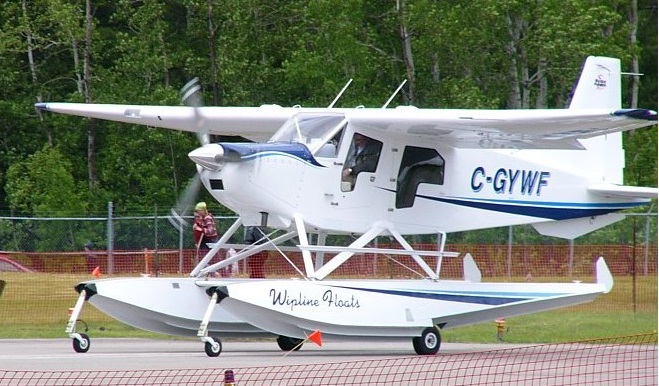
The E-350 Expedition is a five seat design coupled with a four door design, including two large rear cabin doors, allows for easy loading/unloading of people and cargo.
The Expedition cabin is 53 inches and each individual rear seat can be removed quickly and stored easily. Every Expedition comes standard with float attachment kits, so the E-350 can easily be turned into a big payload, high-performance floatplane.
In September 2016, the E-350 Expedition tooling was shipped to its Hamilton, New Zealand plant. Pacific Aerospace planned to relaunch production of the five-seat type in the first half of 2017, but this date was not achieved. It is also planned to produce the E-350 in its joint venture plant in China with Beijing General Aviation Company. The joint venture will be known as Beijing Pan-Pacific Aerospace Technology.
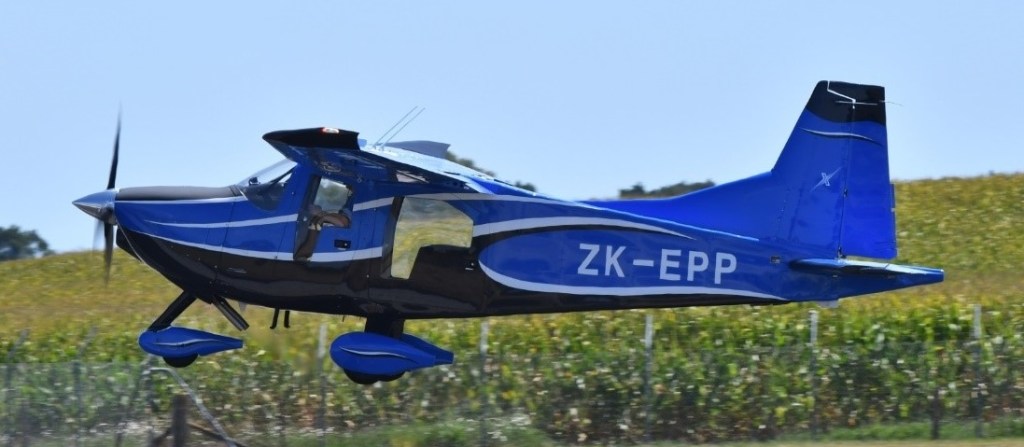
On 3 February 2021, E-350 Expedition #315 made its first production flight, at Hamilton, New Zealand. Piloted by PAL company pilot Ray Long the aircraft was to receive a CoA then be on its way to PAL’s North American dealer Northwest Back Country Aircraft in Boise, Idaho.
E-350 Expedition #315 ZK-EPP
Variants
FBA-1A Engine: 1 × de Havilland Gipsy Major, 140 hp (100 kW) Wingspan: 30 ft (9.1 m) Wing area: 165 sq ft (15.3 m2) Length: 25 ft 4 in (7.72 m) Height: 9 ft (2.7 m) Crew: 1 Capacity: 3 passengers
FBA-2 Prototype, one built.
FBA-2C Initial production variant, 26 built. Engine: 1 × Avco Lycoming O-540-A1D, 250 hp (190 kW) Propeller: 2-bladed Hartzell constant-speed, 7 ft 4 in (2.24 m) diameter Wingspan: 36 ft 0 in (10.97 m) Length: 26 ft 5 in (8.05 m) Height: 8 ft 4 in (2.54 m) Empty weight: 1,550 lb (703 kg) Max takeoff weight: 2,950 lb (1,338 kg) Fuel capacity: 56 imp gal (67 US gal; 250 L) Wing area: 180 sq ft (17 m2) Maximum speed: 147 mph (237 km/h, 128 kn) at sea level Cruise speed: 129 mph (208 km/h, 112 kn) at 5,000 ft (1,500 m) (econ cruise, 60% power) Stall speed: 48 mph (77 km/h, 42 kn) (power off, 35 degree flaps) Range: 610 mi (980 km, 530 nmi) Service ceiling: 16,000 ft (4,900 m) Rate of climb: 1,100 ft/min (5.6 m/s) Crew: 1 Capacity: 4 passengers
FBA-2C1 Bush Hawk 300 Improved variant with a 300hp Lycoming IO-540L, one built.
FBA-2C1 Bush Hawk XP Production variant of the Bush Hawk 300, 31 built.
FBA-2C2 Bush Hawk 300XP Minor changes, 6 built.
FBA-2C3 Expedition E350 Tricycle landing gear first flown in 2006, 3 built.
FBA-2C4 Expedition E350XC Tail-wheel, one built.
FBA-2D Proposed variant powered by a 290hp Lycoming engine, not built.
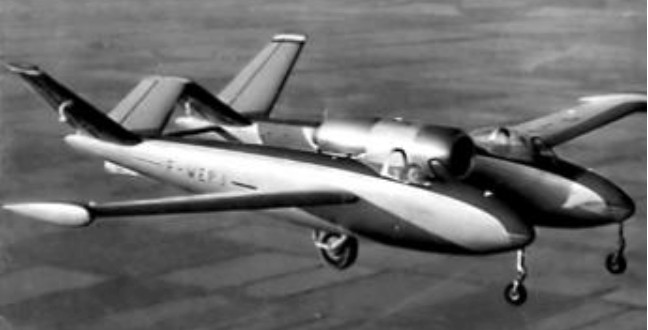
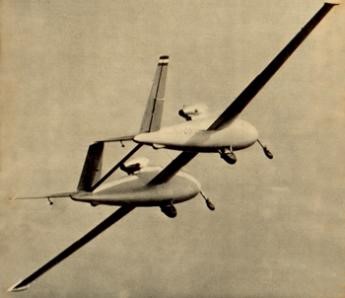
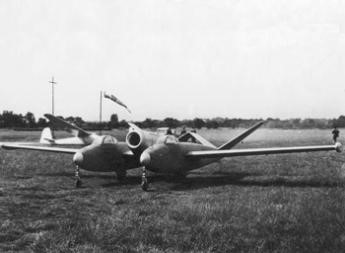
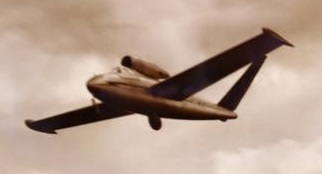
Primarily a flying test aircraft, proposed uses were numerous and made it a real aircraft laboratory. It was a two-seater with 2 Pimene 110 kgf turbojets, which could fly up to 285 km / h with a service ceiling of 7000 meters.
Gemini, as Cyclops and Sylph which it is derived, is of mixed construction, wood and metal.
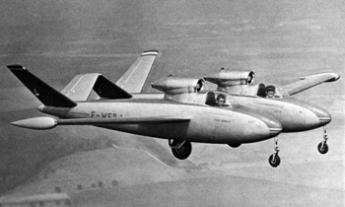
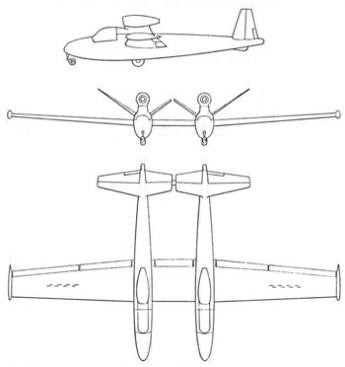
The fuselage has two hulls oval section connected by the central plane. Each body is identical to the Sylphe in its design and its dimensions. Gemini is dual – control, the control station located in the fuselage on the left.
The tail is two juxtaposed butterflies, forming a W, the V 2 not connected (the fuselages interconnected by a fixed horizontal plane).
The Gemini Mark I, F- WEPJ, CM 88 R made its first flight on March 6, 1951, at the hands of Leo Bourriau. The first prototype was named “Castor and Pollux”.
The Mark V version with a Turbomeca Aspin II of 360 pounds thrust, made its first flight, piloted by Léon Bourriau, on June 21, 1952.
Fouga CM88R – Gemini Mark V
CM.88R Gémeaux I: Mar 1951, 2 x 100 kg Piméné turbojets, aka CM.88.R I CM.88R Gémeaux II: June 1951, 2 x 300 kg Marboré I, aka CM.88.R II CM.88R Gémeaux III: Aug 1951, 2 x 380 kg Marboré I, aka CM.88.R III NB: CM.88.RIII/Gémeaux III was re-engined CM.88.R II/Gémeaux II CM.88R Gémeaux III: Jan 1952, 2 x 400 kg Marboré I, aka CM.88.R III CM.88.RIII/Gémeaux III re-engined with 400 kg Marboré II, Jan 1952 CM.88R Gémeaux IV: Nov 1951, 2 x 200 kg Turbomeca Aspin I, aka CM.88.R IV NB: CM.88.RIV/Gémeaux IV was Gémeaux I re-engined with ducted turbojet CM.88R Gémeaux IV: June 1952, 2 x 360 kg Turbomeca Aspin II, aka CM.88.R V NB: CM.88.RV/Gémeaux 5 was CM.88.RIV/Gémeaux IV re-engined with Aspin II
Engines: 2 x Turbomeca Piméné Takeoff thrust: 100 Kg to 35000 rpm Max thrust. Continue: 90 kg 34300 rpm Wingspan: 10.76 m Length: 6.66 m Height: 1.93 m Empty weight: 750 kg Weight equipped: 585 kg Engine weight: 150 kg Fuel wight: 180 kg Equipment: 166 kg Total weight: 1096 kg Fuel: Kerosene Fuel capacity: 3 x 40 lt (wings), 2 x 50 lt (fuselage) Oil capacity fuselage: 2 x 2 lt Max speed SL: 285 km / h Cruise speed (3000 m): 220 km / h ROC: 3,5 m / s Ceiling: 7,000m Endurance: 1h 30 mi
The Fouga Midget racing aircraft resulted from the adaptation to a competition Fouga Cyclops II. Eight aircraft were ordered in late 1951 by the Racing Airports Company Colonel Dhome. Production started in November 1951 and only seven months later, May 30, 1952, the first flying in the hands of Leon Bourrieau at Aire sur Adour. The other seven were completed in the five or six weeks that followed.
The Midgets were to participate in air races for Colonel Dhome.
The Fouga CM -8 R.8.3 cantilever NACA wing is relatively thin. It is single spar skin, the box edge housing fuel tanks. The fins are slotted, and the wing is equipped with shutters brakes. Wing tip have two retractable legs.
It fuselage is of shell structure with an oval section. The Turbomeca Palas is attached at three points above the fuselage. The fuel used is Regular Gasoline contained in two 64 liters tanks. Oil is contained in an annular three liter tank, located in front of the engine. Ignition is provided by a six volt battery and two coils. The starting is effected by means of compressed air.
The unsercarriage is a monotrace fixed type. The main wheel, 420 x 150, is equipped with disc brakes. The nose wheel, 220 x 60, is controlled by the steering. Both wheels have hydraulic shock absorbers.
The Midget meets the conditions imposed by the ISP to take part in international competitions class light aircraft less than 500 kg and record attempts in the category. With an equipped weight of 350 kg, the loaded weight is 900 kg. The fuel counted for 74 kg yet the Palas consumes 180-200 kg per hour.
Eight examples were built.
Engine: 1 x Turboméca Palas, 160 kgp Wingspan: 7.07 m Aspect ratio: 6 Length: 6.70 m Height: 1.85 m Wing area: 11 m² Empty weight: 350 kg Weight total: 500 kg Maximum speed: 400 km / h ROC: 10 m / sec
The CM.8 was a 1942 Castel-Mauboussin project 1-seat wooden gull-wing acrobatic glider, 13.5 m span The CM.8 Acro was a scaled-down, single-seat development of CM.7 Adour, leading to CM-8/13.
Turbomeca designed and built after the end of World War Two the Pimene turbojet which was rated at 242 lbst (110kgst). This design was successfully flown on July 14, 1949 in a Fouga Cyclone powered glider. The experience so gained enabled Turbomeca to put into production a family of small gas turbine engines which included the Palas of 160kgst (353 lbst), the Marbore of 300kgst (660 lbst) and the Marbore II of 400kgst (880 lbst).
Experience with CM.8-R.9 Cyclipe and with the Gemeaux led to development of the CM.170R Magister jet trainer, first flown 23 July 1952 and subsequently built in quantity for French Air Force and overseas customers.
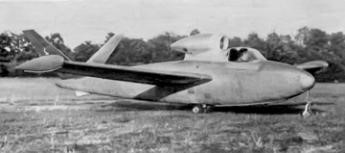
The C.M. 8R-13 Cyclone is a jet-powered version of C.M. 8-13 Sailplane. The C.M. 8R-13 had been intended to serve as a test-bed for the Turboméca Piméné light axial-flow turbo-jet engine which has a maximum static thrust of 100 kg. (220 lb.). On July. 14, 1949, Fouga chief test pilot Léon Bourriau flew the first flight of the Fouga CM8 R13, which was named Cyclone.
Fouga CM8 R13 – Cyclone [Sylphe I]
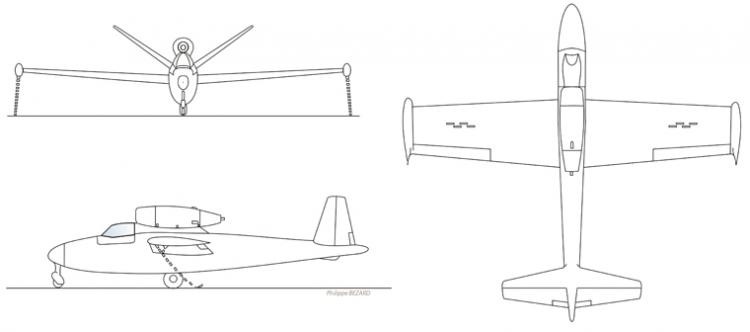
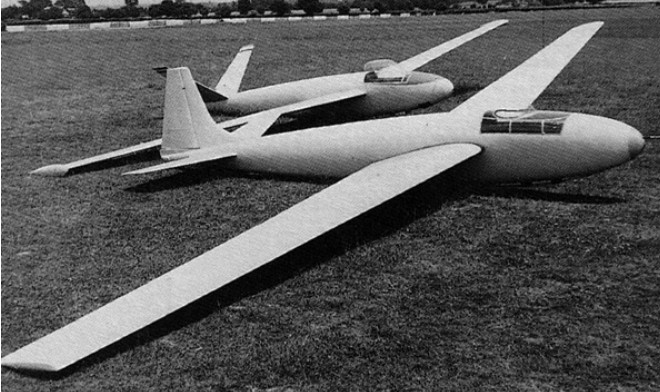
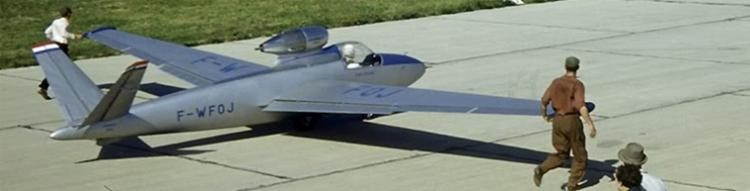
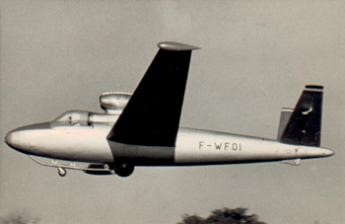
Only 2 CM8 R13 Cyclone (Sylphe I) were built. They appeared on the French civil register as : F-WFOI [later F-BFOI] and F-WFOJ [later F-BFOJ]. The Turbomeca turbojet, which weighs 64 Kg (141 lb) fully equiped, was mounted above the fuselage just after the pilot’s cockpit. Tha aircraft has the “butter-fly” tail fitted to the CM8-15 sailplane.
Fouga Cyclone N°1 (Sylphe I), F-WFOI
Fouga demonstrated the CM 8 R 13 Sylph I in France and then in Miami in January 1950, flown by Fred Nicole.
In May 1950, the piston engines manufacturer, Wright, sent a letter to Aire sur Adour requesting that the CM 8 R 13 name be changed from “Cyclone”, which was assigned to one of their world famous engines. M Mauboussin accepted and give “Sylph” in CM8 R 13.
A number of changes were implemented summers, especially the integrated front runner on No. 1 was instead attached to the front runner, and in the case of No. 2, the engine cowling was evolved.
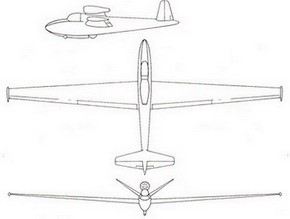
The wings were mid-wing cantilever monoplane. NACA 230 wing section. Aspect ratio 13. Single-spare all-wood stressed-skin structure. Metal framed, fabric-covered slotted flaps and slotted ailerons. Retractable air-brakes in upper and lower wing surfaces.
An oval wood monocoque fuselage structure. The tail unit was a “butterfly type”. Fixed surfaces all-wood, movable surfaces all-metal. Area fixed surface 1,35 m² (14.52 sq. ft.), Area movable surfaces 1,09 m² (11.73 sq. ft.). Landing gear was a fixed single-track type.
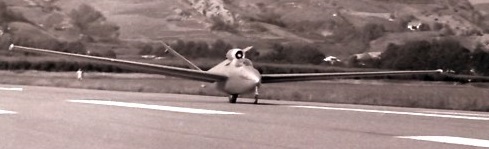
The CM8 R9,8 Cyclope I is a single-seat training and aerobatic version of the Sylphe, from which it differs by having wings of reduced span and area, a single track landing gear with twin main wheel (later replaced by a single one) and retractable wing-tip skids. The turbojet engine remain a Turbomeca Pimene. Fouga CM8 R 9.8 Cyclope was flown by Leon Bourriau 31 August 1950.
Fouga CM8 R9,8 – Cyclope I
Five month later, on 3 January 1951, The Cyclope successfuly flown with a Turbomeca Palas (160 Kp version).
The CM8 R13 – Sylphe II can be considered an evolution of the Cyclone [Sylph I] prototype [F-WFOI / F-BFOI] which has been specially modified. The little dolly always present (the nose wheel not making its appearance with the Sylph III), the cockpit with a canopy with closed side, and Pimen having a much lower position make it a very different.
The Sylph III is a direct result of an evolution of cylcone [Sylph] Sylph in II. It is, like its predecessors, a single-seater glider with auxiliary engine. The first flew on January 2, 1952.
Fouga CM8 R13 – Sylphe III
The Sylph III led to the deletion of the small wheel, a single wheel nose.
The most significant change for performance was the Turbomeca Pimene, which is more powerful than previous versions installed on the Sylph or cyclone version as delivering more than 100 kgf.
The wing is NACA 23014 to the root, at the end 23012. A mid-wing cantilever monoplane, monolongeron-skin, entirely from wood. The fins are slotted alloy and stretched canvas, and flaps trailing edge slot, alloy and stretched canvas. The V-tail is fixed plan wood, coated with plywood. Moving parts are light-alloy coated sheet. The undercarriage is a monotrack fixed type, with steerable front wheel, combined with auxiliary rudder and rear skid.
Variants: CM.8 — 1949 single-seat sailplane, aka Fouga CM.8, aka CM-8/13 CM.8 Acro: [Project] 1942 CM.8/13: 13m span prototype with conventional empennage, 1 built CM.8/15: 15m span prototype with a V-tail, 1 built
CM.8R: Turbomeca Piméné-powered vers., 13m span with V-tail, aka CM.8R13 CM.8R13: 1949 Sylph I, aka Cyclone (renamed at insistance of Wright) Cyclone/Sylph I: July 1949, 2 built, F-WFOI and F-WFOJ [F-BFOJ] CM.8R13: 1950 Sylph II, changes to Piméné jet and canopy, 1 built CM.8R13: 1952 Sylph III, 100+ kg Piméné, revised canopy and u/c Sylph III, 4 built F-BFDH, F-BFDI, F-BFDJ, and F-BFDK CM-08R9.8 Cyclope I: 1951 short-span Sylph, 1 x 110 kg Piméné, 1 built CM-08R9.8 Cyclope II: 1951 short-span Sylph, 1 x 160 kg Palas, 1 built CM.8/13 Sylphe démotorisé: CM-8R/13 with motorization option removed
Fouga CM8 R13 – Cyclone [Sylphe I] Engine: One Turbomeca Pimene turbojet: 100 kg / 220 lb. St Span: 13,00 m (42 ft.7,5 in). Gross wing area: 13 m² (140 sq. ft.) Length: 6,70 m (21 ft.11 in.) Height: 1,85 m (6 ft.1 in.) Weight empty 435 Kg (958lb.) Pilot weight: 88 Kg / 194 lb Fuel and oil: 110 Kg (242 lb.) Weight loaded: 633 Kg (1394 lb.) Max speed at sea level: 240 Km/h (149 mph) Max speed at 3500 m: 250 Km/h (155 mph) Max Speed with AB: 150 Km/h / 93 mph Max. speed at sea level: 149 mph. Max. speed at 11,500 ft: 155 mph. Initial rate of climb: 790 ft./min. Climb to 1200 ft: 1 min. 45 sec. Climb to 11,500 ft: 18 min. Climb to ceiling: 1 hr. Service ceiling: 27,225 ft. Max. range at 13,000 ft: 186 miles Take-off run to 66 ft: 460 yards
Fouga CM8 R9,8 – Cyclope I Engine: One Turbomeca Pimene turbojet: 100 kg / 220 lb. St Span: 8,76 m (28 ft.9 in.) Length: 6,66 m (21 ft.10 in.) Wing area: 9,80 m² Weight empty: 394 kg (867 lb.) Fuel and oil: 77 kg (170 lb.) Weight loaded: 554 kg (1,220 lb.) Wing loading: 56,5 Kg/m² (11.58 lb./sq.ft) Max speed at sea level): 280 km/h / 174 mph Max speed at 13120 ft: 300 km/h / 186 mph Initial rate of climb: 288 m/min / 945 ft/min Climb to 1180 ft: 1 min 30 sec Service ceiling: 8 500m / 27,880 ft Take-off distance (66 ft): 460 m / 503 yards Range at 13120 ft: 280 km / 150 miles
Fouga CM8 R13 – Sylphe III Engine: Turbomeca Pimene Wingspan: 13,00 m Length: 6.70 m Height: 1.85 m Wing area: 13,00 m² Empty weight: 435 kg MAUW: 633 kg Max cruise speed: 300 km / h Cruise speed: 100-150 km / h Fuel: Kerosene Fuel capacity: 2 x 40 lt in wing, one 50 lt central fuselage tank
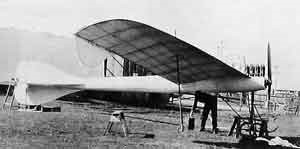
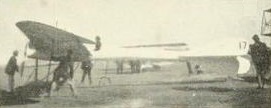
This large monoplane, Louis Fortney’s third, was powered with a 4-cylinder Knox engine of 60 hp weighing 400 lbs. Viewed from a distance the machine had a very fine appearance, but under closer inspection revealed a number of weak points in construction. After two short jumps Fortney met with the usual fate of the novices –yet deserves credit for staying in the game– as this was also his third machine to be destroyed.
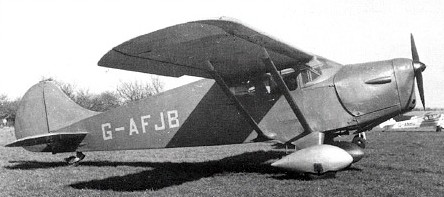
The Wicko was originally designed to use a Ford V8 car engine, and the first prototype two-seat Wicko FW1, with a modified Ford V8 engine known as the Wicko F, was completed in September 1936. This was later re-engined with a 90hp Cirrus Minor I as the FW2. A 150hp Cirrus Major installation, specifically for the 1937 King’s Cup race, resulted in the FW3, and this engine became the standard powerplant for all GMI production models.
Nine Wickos were built 1938-1939 at Southampton designated G.M.1 with the more powerful Gipsy Major engine, that being the total production.
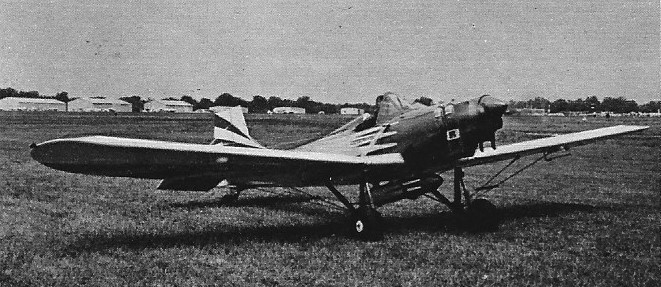
Sidney Foster, an automotive engineer, built his original design single-seater over a 22-year period. Named ‘Blood, Sweat and Tears’, N48F has an all-wood Clark Y aerofoil wing, and steel-tube fuselage and tail. The own design landing gear uses BT-13 tail wheel shock struts.
Fuel is carried in an external tank, 10 USG / 37.9 lt, and an 8 USG / 30.3 lt fuselage tank.
Engine: Lycoming. 125 hp Wingspan: 30 ft / 9.1 m Length: 21 ft / 6.4 m Empty weight: 904 lb / 410 kg MAUW: 1265 lb / 573.8 kg Cruise: 120 mph / 193 kph Landing speed: 45 mph / 72.4 kph ROC: 1500 fpm / 7.62 m/sec Endurance: 2 hr
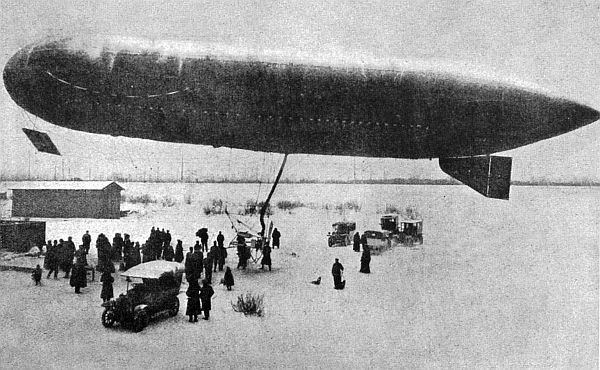
First ascent of the Forssman dirigible balloon, on January 13, 1911 at Gerstenhofen, north of Augsburg.
In 1910, Villehad Henrik Forssman (1884–1944) had graduated from the Riga Polytechnic Institute as a mechanical engineer and then moved to Germany that same year. Thereabouts, the Swede had been contracted by the Russian army to deliver a dirigible and was there to be used for intelligence services, which was constructed at “August Riedinger Ballonfabrik” in Augsburg. It is not known whether or not the Russian military ever took delivery of the airship. The dirigible was only 35 meters long with a maximum diameter of 6 meters, and held 800 cubic meters of hydrogen gas. It could be dismantled very quickly and just as fast, later be ready to fly. Because of lift-force limitations a gondola was not available, only a single bench seat with the engine, where the pilot and a mechanic had a place to sit. The 28 hp motor, which was also built by Forssman, weighed only 38 kg, and the cooling 4 1/2 kg. Reportedly the entire craft weighed 450 kg and capable of attaining a maximum speed of 43 km/h.
Built in 1931, the Omnia Dir was only completed after Forlaninis death. It used two groups of five jets of compressed air for maneuvering, one at each end.
Propulsion: One Isotta Fraschini, 150 hp Volume: 4,000 cubic metres