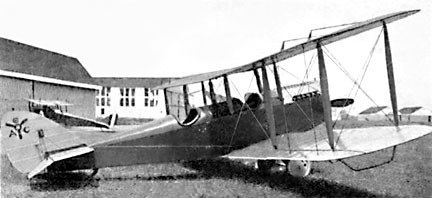
Gallaudet C-3
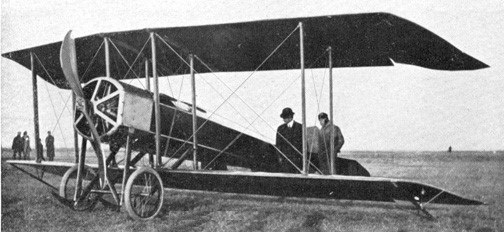
1918
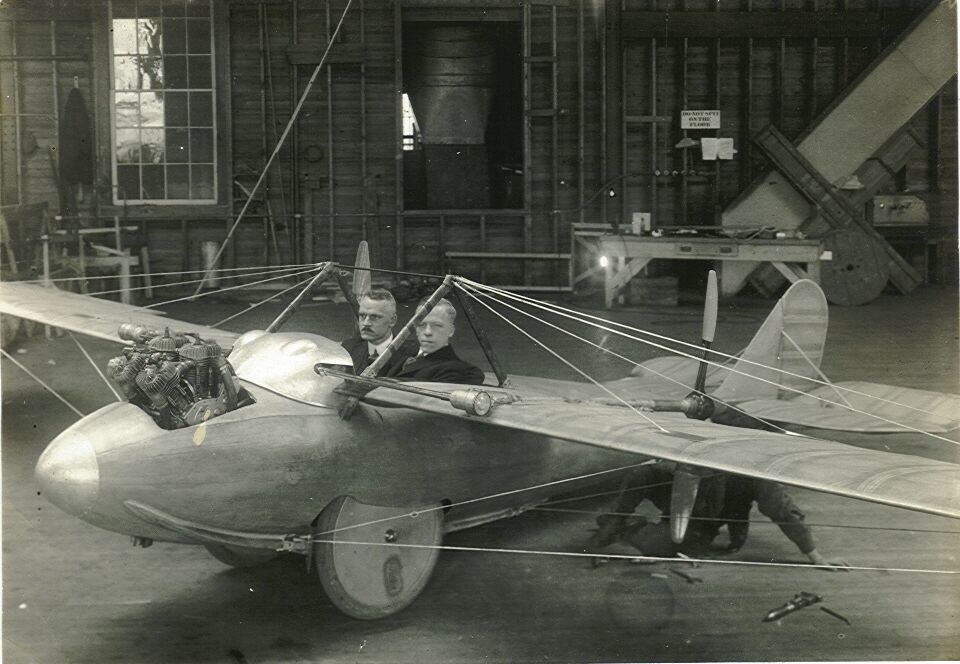
Gallaudet took advantage of the tremendous public fascination with flight and came up with an unusual twin-pusher prop sport plane with a pair of 18 horsepower engines called the Chummy Flyabout.
The little two-seater, built in the Warwick factory, was priced at $3,500, a hefty sum for the day. A 1919 glossy marketing brochure suggested the plane could “be flown to the golf or country club and landed on the fairways.” Readers were tempted with “the joy of flying is to be had for the asking” and “weekend trips to neighboring estates.” Owners could fly “around the ranch or commute to the office by air.” A newspaper advertisement offered the plane as an alternative to courting by automobile and suggested “imagine calling for your young lady in a Flyabout and soaring above the clouds.”
The Chummy was only eighteen feet, seven inches in length, with a 33-foot wingspan. The cockpit was a tight fit for two adults. The Chummy Flyabout was a two-seat biplane, powered with two 18 hp Indian motors driving pusher propellers. Either or both of the air-cooled engines could power the twin 48-inch props through complicated shaft and bevel transmissions. The whole plane weighed only 600 pounds empty (the literature does not indicate how much weight it could carry).
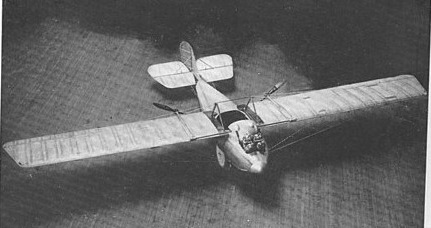
Gallaudet’s company even offered to provide plans for a complete aviation club, including flying lessons, hangars, fuelling station, tools, and a support staff. But only a handful of the little planes were ever built.
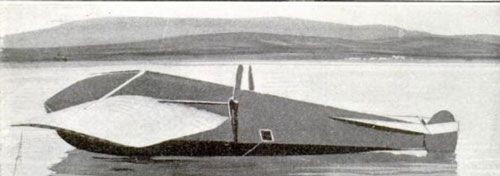
Gallaudet’s second aircraft, the Model B monoplane flying boat, continued the arrangement of an engine enclosed in the fuselage driving remote propellers, in this case a pusher propeller behind that trailing edge of each wing panel. The Model B was flown several times during 1913 and 1914 with several different engines, but does not appear to have been particularly successful.
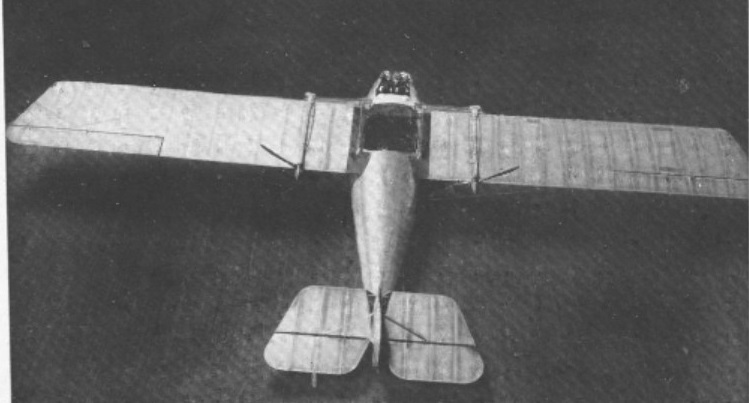
The 1912 A-2 Bullet was an evolution of the A-1 with a round, stringer-formed fuselage and variable-incidence wing with single-tube main spar and ribs made of aluminum tubing. Only one was built which crashed during a speed run of 110mph on 24 July 1912.
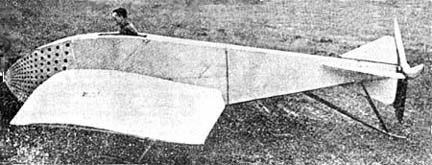
The A-1 Bullet of 1912 had a streamlined, four-sided, wood fuselage with a three-bladed prop mounted on the tail, driven by extended crankshaft from the fully-enclosed motor. It was twice as fast as biplanes of the era.
Engine: 100hp Gnôme
Wingspan: 31’11”
Length: 20’7″
Top speed: 125 mph
Seats: 1
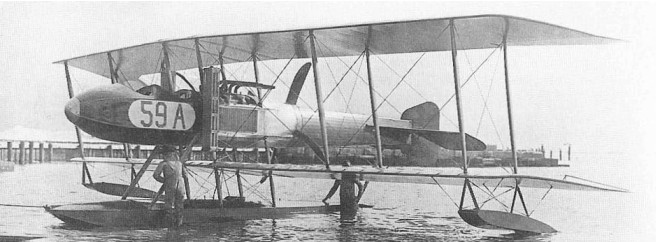
In an effort to produce an aircraft with the best possible forward visibility for the observer, Gallaudet developed the D-2 into the D-4, which placed the observer in the nose, followed by the pilot, with the propeller attached to a ring that circled the fuselage behind the wings. The four blades spun around the fuselage just behind the pilot.
Power for the D-4 was a 360-hp Liberty L-12 engine buried within the fuselage, just behind the pilot. A large pontoon was mounted below the fuselage, and small outboard floats were mounted near the tips of the swept-back wings.
Two D-4 were built for the Navy (A2653, A2654). The prototype crashed during flight testing on 19 July 1918, but the second was accepted by the U.S. Navy. No further aircraft were built, as Gallaudet turned their attention to constructing Curtiss HS-2L flying boats.
Engine: 1 × Liberty L-12, 360 hp ( kW) each
Wingspan: 46 ft 5 in ( m)
Wing area: 260 sq.ft ( sq.m)
Length: 33 ft 6 in ( m)
Height: 11 ft 8 in ( m)
Empty weight: 4,228 lb ( kg)
Gross weight: 5,440 lb ( kg)
Maximum speed: 119 mph ( km/h)
Range: 390 miles (628 km)
Endurance: 3 hr 30 min
Service ceiling: 14,000 ft
Crew: 2 (pilot, observer)
Armament: None
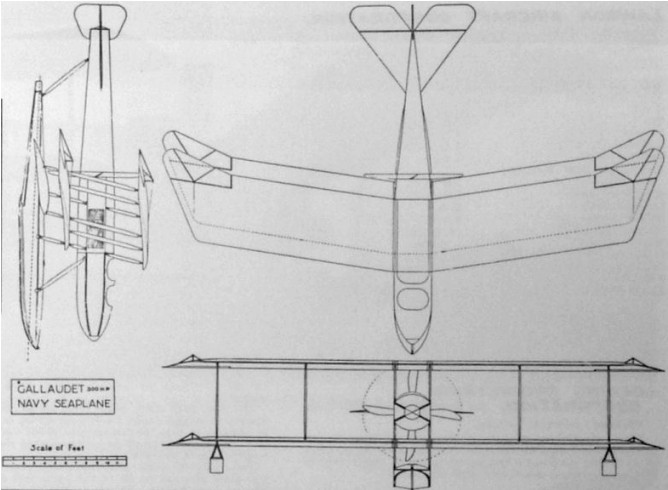
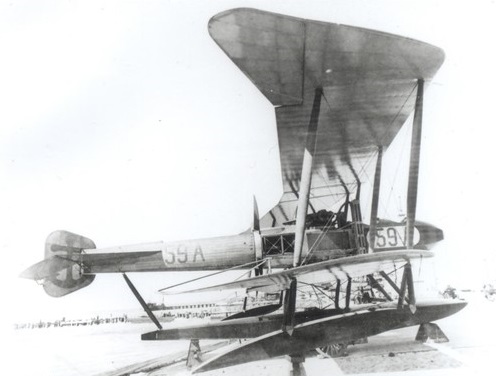
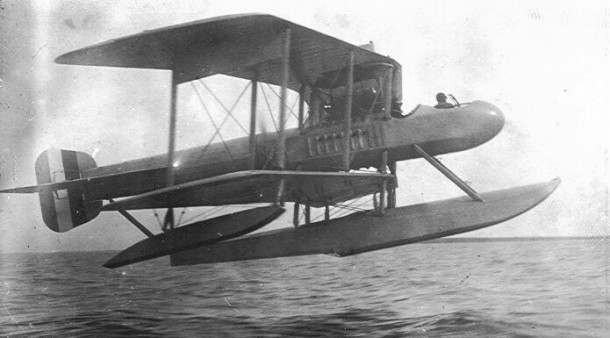
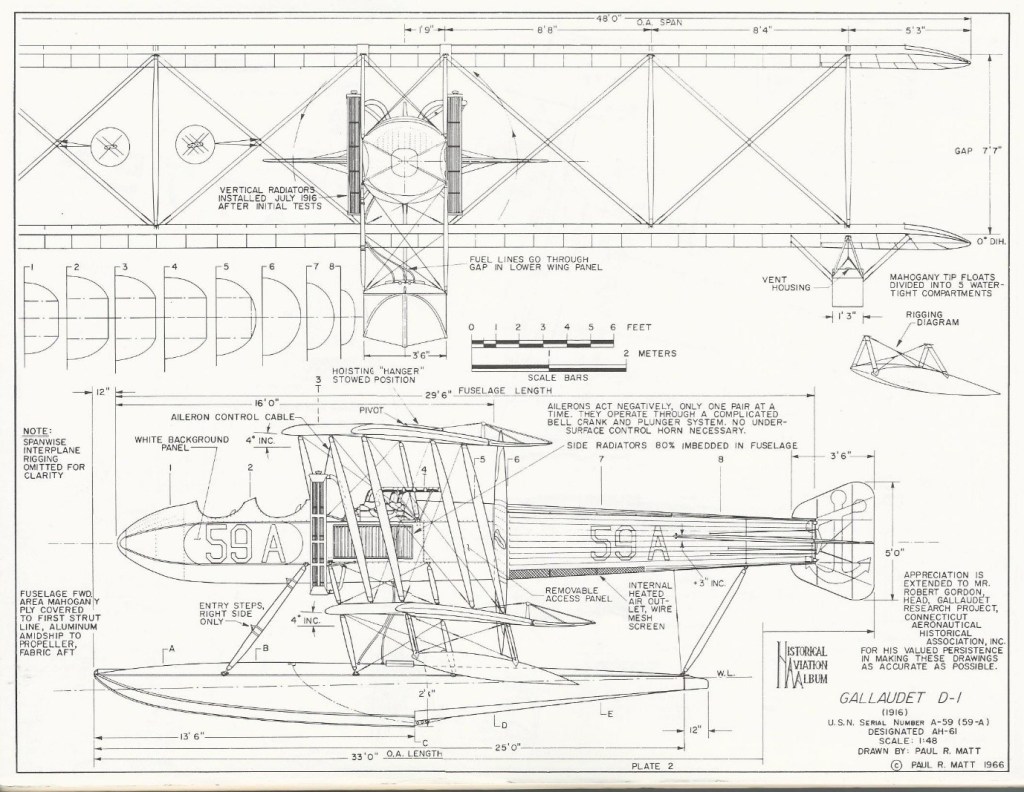
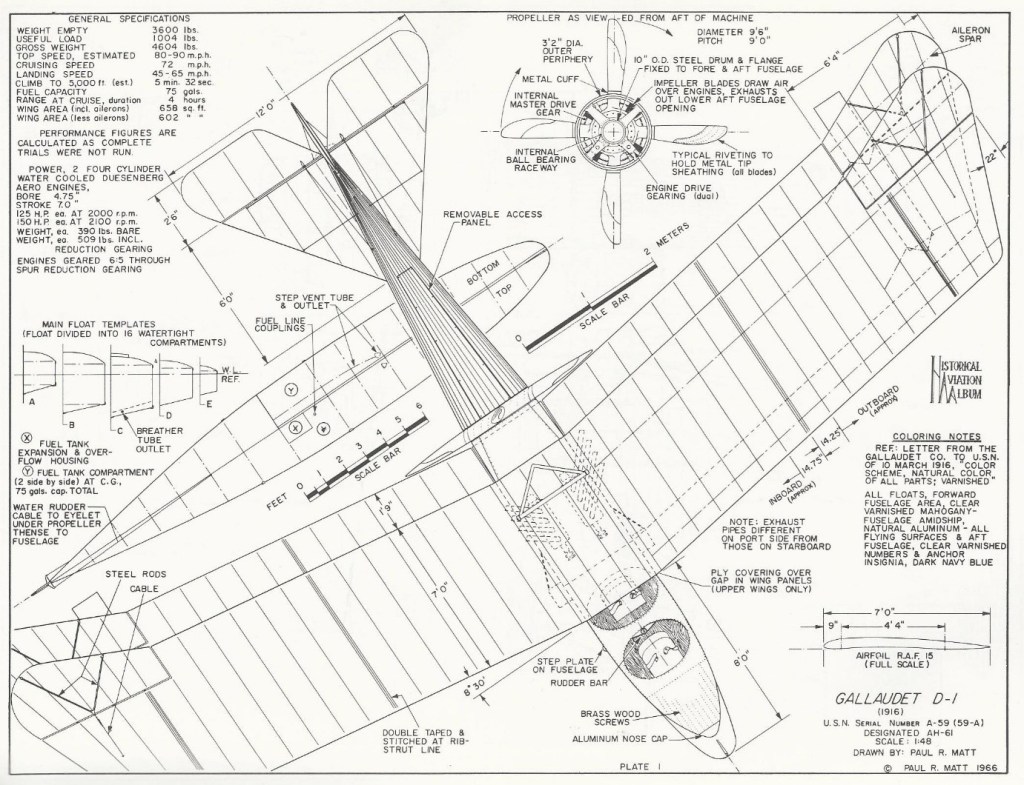
In response to a requirement by the U.S. Navy for light floatplanes capable of being launched off catapults by ships underway, the Gallaudet Aircraft company began development of the “D-4”, based on the earlier Gallaudet D-1. The D-1 (A59) was powered by two 150 hp Duesenberg engines mounted side by side, and first flown on 17 July 1916. Following delivery of the D-1 in January 1917, the firm reorganized as Gallaudet Aircraft Corporation, and moved to Greenwich, Rhode Island.
Despite numerous mechanical difficulties the Army bought four of the improved D-2 version.
In an effort to produce an aircraft with the best possible forward visibility for the observer, Gallaudet developed the D-2 into the D-4.
D-1
Wingspan: 48 ft
Length: 33 ft
Gross weight: 4,604 lb
Max speed: 90 mph
The Gallaudet #1 of 1911 was an open cockpit monoplane with a single float. The 125hp Emerson Aerial engine was mounted amidships turning two props, one at the nose and one at the tail.
Designed by Edson Gallaudet, only one was built, which made test flights only.
Engine: 125hp Emerson Aerial
Wingspan: 44’0″
Length: 56’0″
Registered NX18237, the 1938 Gallatin A was a single place, open cockpit, low wing monoplane, powered by a 37hp Aeronca E-113.
It suffered a wing failure on its second flight and crashed, killing its designer, Oscar Gallatin.
Wingspan: 22’0″
Length: 15’0″

