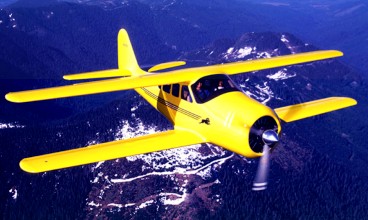
Developed for flying enthusiasts as a “kit” aircraft and designed to make the building process pleasant, fun, and memorable, the Lionheart is an elegant and spirited, 220+ mph, six place, long-distance cruiser. Its design is inspired by the classic Beech Staggerwing and features a fuel capacity of 180 gallons with a range of around 1450nm, payload around 2,000 pounds, and stall characteristics in the mid-fifty knot range. The aircraft’s primary structure consists of high-temperature glass and carbon composites molded in precision production tooling. Lionheart’s powerplant is the reliable and powerful 450HP Pratt & Whitney R-985 Wasp Jr. Radial engine.
The fuselage is about 20 feet long from firewall to rudder post making Lionheart a cabin class aircraft that can be constructed in a relatively small space. Interior cabin volume and seating is similar to the Malibu but wider at the shoulders. A small aisle exists between the first two rows of seats and cabin access/egress is via a single split door between the mid and rear seats on the left side of the fuselage (ala Malibu and Staggerwing).
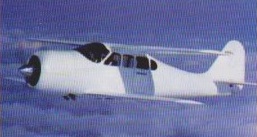
Lionheart accommodates 6 full size, FAA 170 lb passengers and is designed with a 5200 lb gross weight at +6,-3 G limit loads. Following structural testing the gross weight is increased for +4.4, -2.2 G limit loads (utility category). With an estimated empty weight of 3100 to 3300 lbs, Lionheart has a payload of about 2000 lbs. Just about right for the wife and kids… and lots of fuel.
Dual control sticks are designed for the pilot and co-pilot seats. Ailerons and elevator are pushrod actuated while the rudder is cable operated. The four ailerons and flaps of the upper and lower wings are interconnected at the wing roots via cables. With the exception of the landing gear attachment fittings, the upper and lower wings are identical.
Lionheart uses a fully retractable conventional (taildragger) landing gear. The mains use pressurized gas for spring and damping while the tailwheel is sprung via a gas charged air/oil cylinder. Retraction is accomplished using electro-hydraulics. Landing gear track and wheelbase are both wider and longer than the stock Staggerwing, so ground handling is improved.
Lionheart prototype N985L flew for the first time Sunday morning, July 27, 1997.
Chuck Cianchette of Palmyra, Maine, built the first customer-built Lionheart, first flying in 2000.
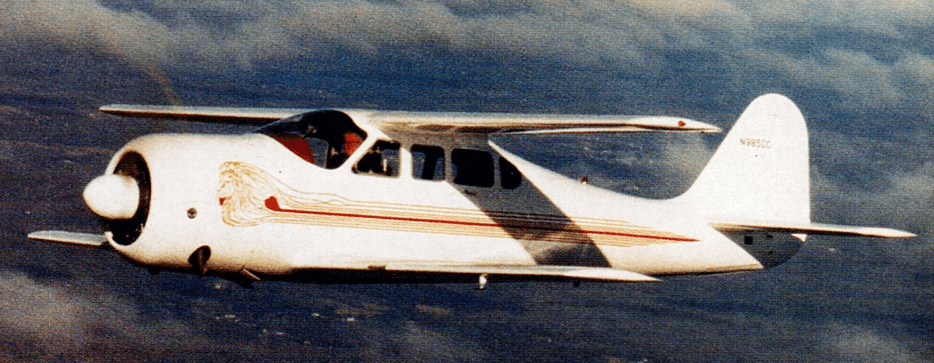
In 2009 the Lionheart was out of production.
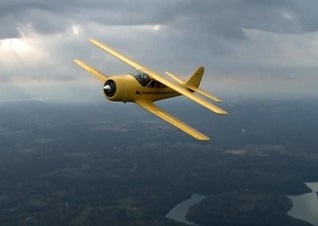
Top speed: 230 mph
Cruise: 210 mph
Stall: 56 mph
Range: 1500 sm
Rate of climb: 2500 fpm
Takeoff dist: 800 ft
Landing dist: 1400 ft
Service ceiling: 20,000 ft
Engine: Pratt & Whitney R-987, 450 hp
HP range: 350-600
Fuel capacity: 160 USG
Empty weight: 2900 lb
Gross weight: 5200 lb
Height: 8 ft
Length: 26.6 ft
Wing span: 31 ft
Wing area: 238 sq.ft
Seats: 7
Landing gear: retract/tail
Engine: Pratt & Whitney
Wing span: 9.45 m
Wing area: 21.9 sq.m
MAUW: 1905 kg
Empty weight: 1043 kg
Fuel capacity: 530 lt
Max speed: 370 kph
Cruise speed: 322 kph
Minimum speed: 98 kph
Climb rate: 15 m/s
Seats: 6
Fuel consumption: 12 lt/hr
Kit price (1998): $89,900