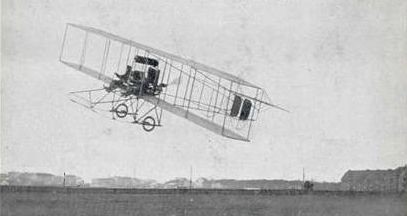
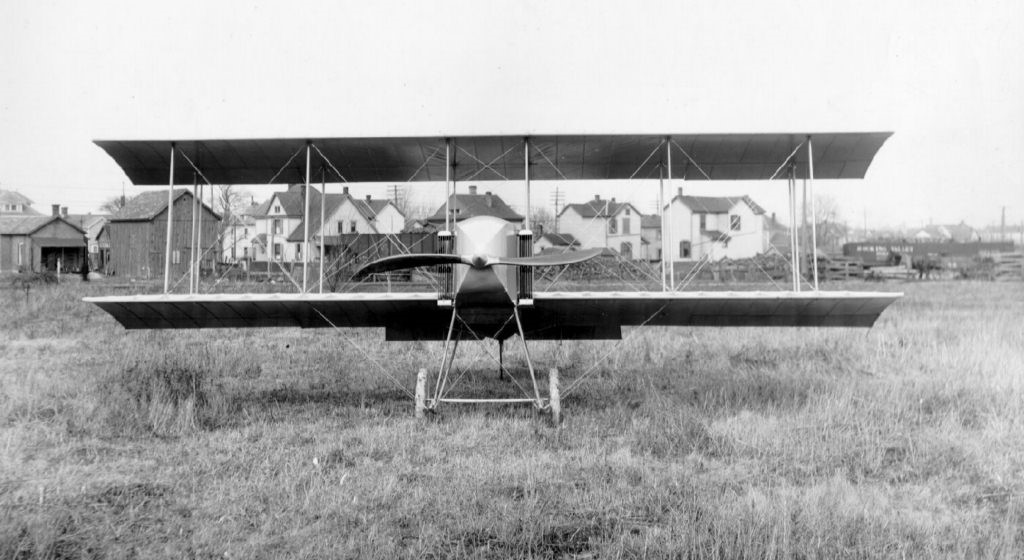
German Flugmaschine Wright-Gesellschaft (Johannisthal) Wright biplane designed by Deutsche Wright pilot Robert Thelen in 1911. It had only a single propeller, directly attached to the drive shaft of its 50 hp NAG engine. Thelen used at least one of this type with the Ad Astra Fluggesellschaft, a flight school and exhibition company that Thelen formed with Rudolf Kiepert, also a Wright pilot.
The Wright & Co Light Sport was built in 1928. An open cockpit, high-wing monoplane, the sole example was registered N7926 c/n 5. It was sold in 1930, then reported to CAA as no longer in use with engine removed. The registration was cancelled on 14 March 1930.
The sole Wright WP-1, A6748, was based on a Swiss-built Dornier Falke, imported by Wright Co. Built in 1923, it was all-metal, with an unbraced parasol wing, with a single-place open cockpit.
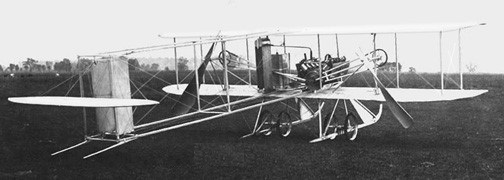
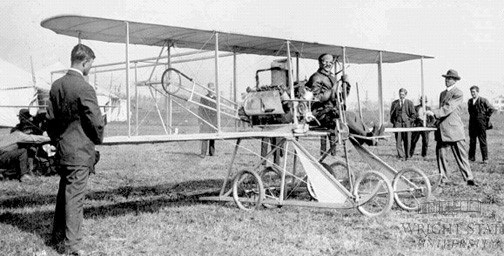
The 1910 two-place open cockpit Wright R Roadster was powered by a 30hp Wright 4 with two pusher props.
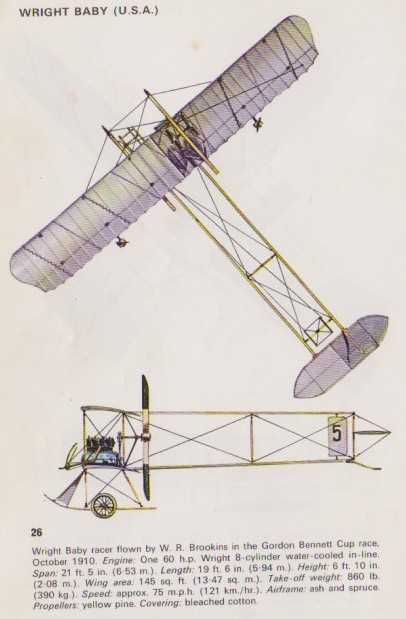
Similar 8-cylinder models were known as High Flyer and Baby Wright.
The Baby Grand, which was single place, with a 60hp Wright driving two pusher props, had no front elevator.
Wright Baby Grand 1910
Models were also displayed at the 1917 Pan-Pacific Aero Exposition (New York) with a 75hp Wright and a 150hp Hisso.
A Wright Baby flew more than 3100 miles around the United States.
One Baby Wright, constructed in France by the Society Ariel, a Wright licensee, was discovered in an old building at Villacoublay being torn down. It is now in the Musee de l’Air in Paris.
Baby Wright at Musee de l’Air in Paris
R Roadster Engine: 30hp Wright 4 Props: two pusher Wingspan: 22’0″ Length: 19’6″ Seats: 2
Baby Grand Engine: 60hp Wright Props: two pusher Wingspan: 26’6″ Length: 19’6″ Speed: 75 mph Seats: 1
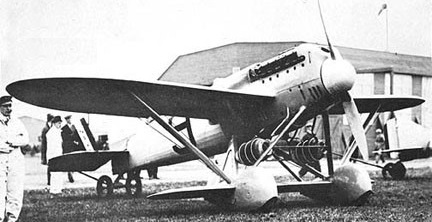
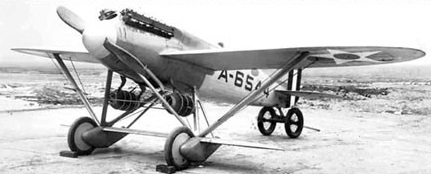
The 1922 Wright NW was a Pulitzer racer with a 650hp Packard T-2 engine. Two were built, as NW-1 sesqui-wing monoplanes, A6543 and A6544.
Wright NW-1 A6544
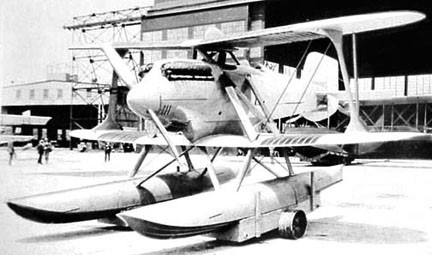
The first crash-landed in Lake St Clair and the second was only used as a test-bed for the 750hp Wright Tornado engine. It was then modified as a float equipped biplane NW-2 for the 1923 Schneider Cup race.
Wright NW-2 A6544
A6544 did not compete for the Schneider Cup after a shattered propeller blade tore its float during trail runs.
The 1915 Wright L was a two-place, open cockpit biplane primary trainer with standard control surfaces. Powered by a 100hp Hall-Scott A-7, it was similar to the Dayton-Wright FS-1 except for a longer wing.
The Model L was inferior to many other biplanes that were being produced at the time. It failed to secure any military orders and few were produced.
This was the last airplane produced by the Wright Company under that name. By this time Orville Wright no longer owned the company, but he was retained as a consultant and may have had some input on the design of the Model L.
Wright Model L Engine: 100hp Hall-Scott A-7, 75 hp at 1400 to 1560 rpm Propeller: Single direct-drive, 8 ft (244 cm) Wingspan: 29 ft (8.8 m) Wing area: 360 sq ft (33.4 sq. m) Wing chord: 6.5 ft (198 cm) Wing separation: 5.7 ft (174 cm) Camber: 1:20 Length: 24.2 ft (7.4 m) Horizontal rear elevator: 20 sq ft (1.9 sq m) Twin movable vertical rear rudders: 8.5 sq ft (0.8 sq m) Weight: 850 lbs (386 kg) Speed range: 25 to 80 mph (40 to 129 kph)
The Wright K of 1916 featured chain-driven, interwing-mounted twin props, powered by a 60-70hp Wright engine. One was built, going to the USN as AH-23 / A51.
The 1915 Wright J, or Long Bull (Burgess), was a two-place, open-cockpit, biplane floatplane similar to the Aeroboat. It was a license-built civil version of the Burgess-Wright C.




 All Aero