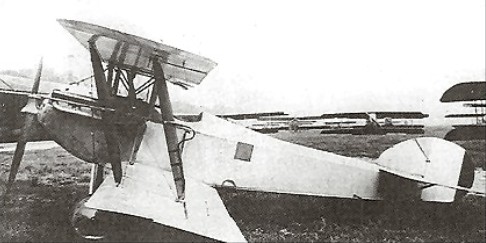
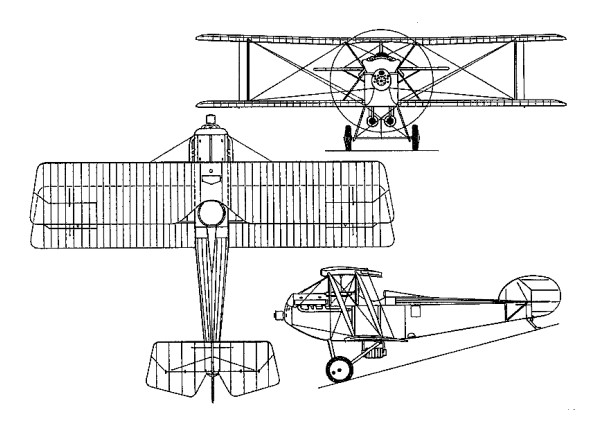
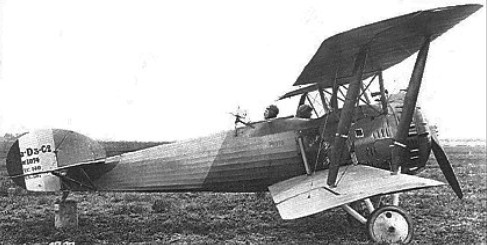
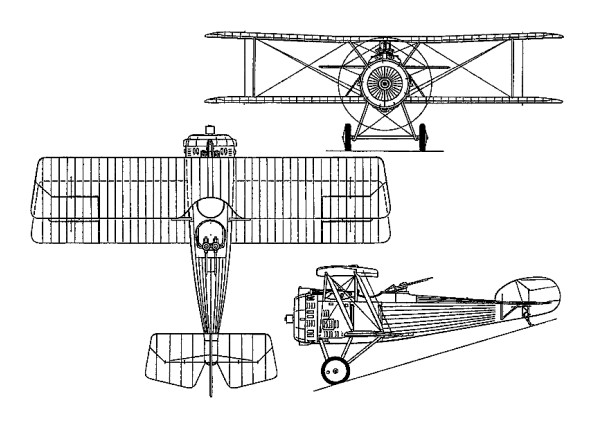
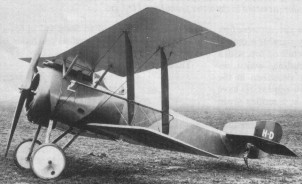
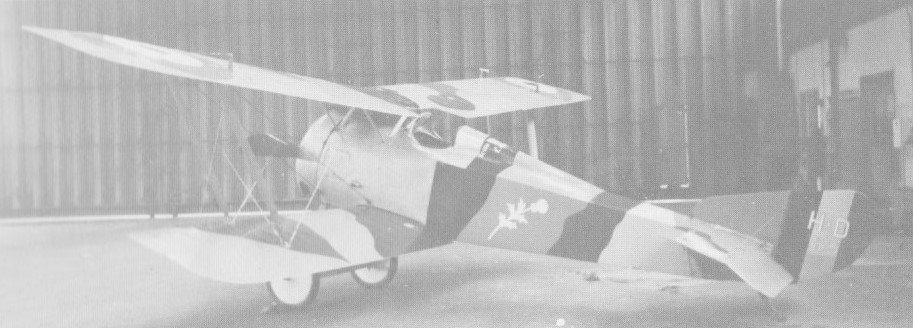
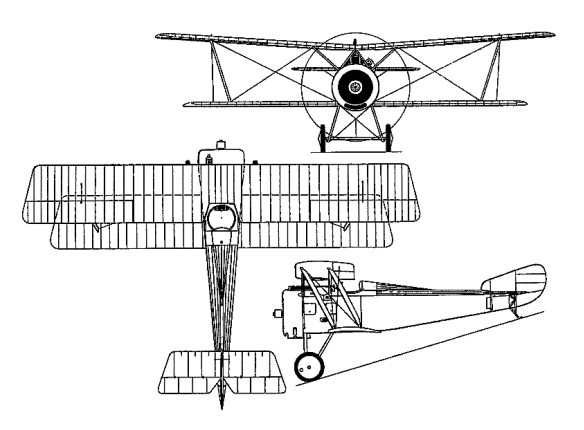
Designed as a potential successor for the SPAD S.XIII, the HD.7 single-seat fighter employed wings and tail surfaces essentially similar to those of the two-seat HD.3. Flown for the first time in the summer of 1918, the HD.7 was powered by a water-cooled Hispano-Suiza 8Fb eight-cylinder engine of 300hp and mounted an armament of two 7.7mm synchronised Vickers machine guns. The performance of the HD.7 proved good, but marginally inferior to that of its principal competitor for production orders, the Nieuport 29. With selection of the Nieuport for series manufacture, further development of the HD.7 was discontinued.
Max take-off weight: 1900 kg / 4189 lb Empty weight: 1230 kg / 2712 lb Wingspan: 9.80 m / 32 ft 2 in Length: 7.20 m / 23 ft 7 in Height: 3.00 m / 9 ft 10 in Wing area: 28.00 sq.m / 301.39 sq ft Max. speed: 218 km/h / 135 mph Range: 900 km / 559 miles
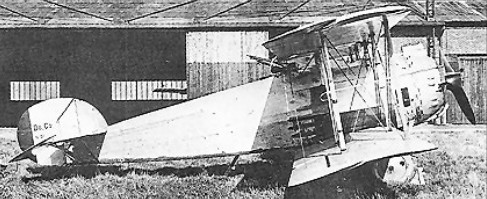
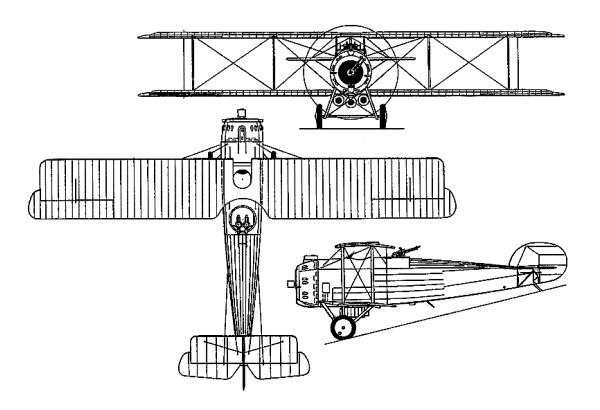
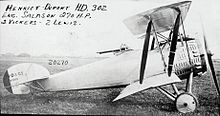
Evolved in parallel with the HD.5 and of generally similar configuration, but larger and more powerful, the HD.6 two-seat fighter was powered by a 530hp Salmson 18Z two-row radial water-cooled engine. This was essentially two Salmson 9Z engines on a common crankcase and flight testing was delayed by difficulties with this experimental power plant, eventually commencing in the spring of 1919. Armament consisted of two synchronised 7.7mm Vickers guns for the pilot and three 7.7mm Lewis guns for the gunner, two on a rotating mount and one firing through a trap in the fuselage floor. The pilot, seated beneath a cut-out in the upper wing, was offered a singularly poor field of vision. Performance did not show a significant improvement over that of the more compact and simpler HD.3, and development was discontinued by the late summer of 1919.
Max take-off weight: 1250 kg / 2756 lb Empty weight: 810 kg / 1786 lb Wingspan: 13.60 m / 44 ft 7 in Length: 8.85 m / 29 ft 0 in Height: 2.90 m / 9 ft 6 in Wing area: 47.50 sq.m / 511.29 sq ft Max. speed: 225 km/h / 140 mph Range: 600 km / 373 miles
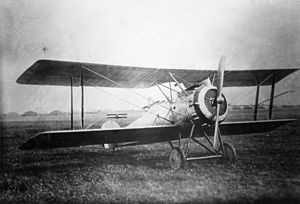
Design work on this two seat biplane was begun by Hanriot and Dupont in the autumn of 1917. The prototype had unequal span wings and was powered by a 260 hp Salmson (Canton Unnne) 9 Za radial engine and flew in June 1017. A double yoked pair of 0.303 in (7.7¬mm) Lewis guns were fitted in a ring mount¬ing in the rear cockpit.
A production order for 120 (later increased to 300 when it was also ordered for the Aviation maritime), to be desig¬nated HD.3 C2, was placed in April 1918. Main modifications included reduction of the upper wing span to that of the lower dimension, adoption of horn balanced ailerons, and improved covering for the forward top decking panels. These were faired over the ammunition feed equipment to twin and fixed and synchronized 0.303 in (7.7 mm) Vickers guns. The pilot and gunner sat in tandem, open cockpits and the main units of the fixed tailskid undercarriage were linked by a cross-axle. Short struts braced the fuselage sides to the lower wing.
First production machines appeared in September 1918, but the Armistice in November prevented comparison with the combat promise shown by the HD.3 C2. However, 75 had been built (s/n 1001 to 1075) for the Esc. HD 174 and other squadrons of the Aviation Militaire (army aviation) and at least 15 for the Aviation Maritime (naval aviation) before the Armistice halted production. HD 174 had been formed but never saw any action before the end.
A floatplane, to have been designated HD.4 in production form, was developed with varying types of floats and hydrovanes and a larger tailfin during 1918. The first really successful mode did not appear until December 4, 1918. By this time it was too late for combat service but some were used by the Aviation Maritime for a few years.
Work on a proposed night fighter variant, the HD.3bis CN2, also stop¬ped at the end of the war. This had mainplanes of thicker section, enlarged and balanced ailerons and rudder.
After the war, one of the navy’s machines was used for trials aboard the new aircraft carrier Béarn, while another was used for floatation tests at the Isle of Grain.
The 15 used by l’Aviation Maritime never entered service until 1919. They have variously been quoted as having serials starting from 2000 and up, but according to Lucien Morareau they were from the same series quoted above. The serial 2000 has also been quoted as the sole HD.4 prototype even though a photo clearly shows HD.3C2 on the tail. Few aircraft were completed in this serial range, highest number known is 2003.
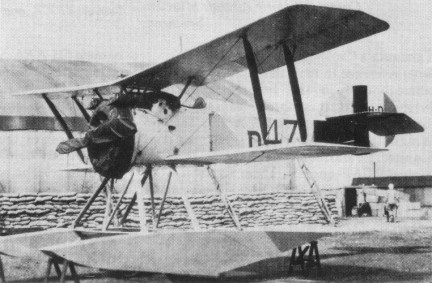
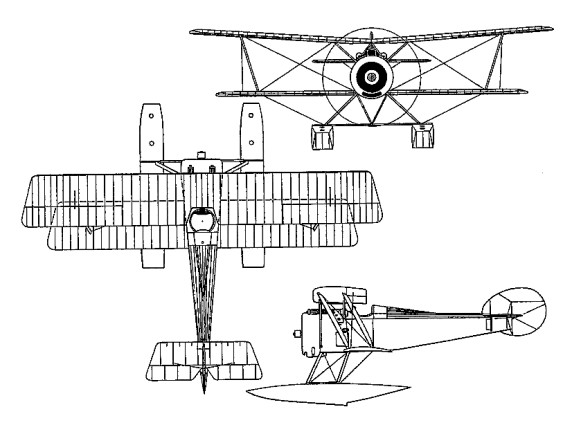
At the end of 1917, a derivative of the HD.1 intended for use by France’s Aviation maritime as a single seat fighter float plane was tested as the HD.2. Possessing an essentially similar airframe to that of the HD.1, the HD.2 was powered by a 130 hp Clerget 9B rotary engine and carried an armament of twin synchronised Vickers machine guns. Two prototypes were tested with float undercarriages of differing lengths, and several HD.2s with wheel undercarriages were delivered to the Aviation maritime at Dunkirk for trials purposes, including trial operations from a 40 ft (12 m) platform mounted above a turret of the battleship Paris in the harbour at Toulon flown by Lieutenant Georges Guierre in October 1918. Later, in August and September 1918, similar trials were conducted at Saint Raphael with one of the HD.2 prototypes converted to landplane form and re engined with a 120 hp Le Rhone. Production exam¬ples, designated HD.2C, were fitted with 130 hp Clerget 9B engines, longer main floats, and a completely revised elliptical fin and rudder assembly. Armament comprised twin 0.303 in (7.7 mm) Vickers guns. Some HD.2Cs were in service with the French navy’s Centre Maritime at Dunkerque before the end of the First World War. The US purchased 26 HD.2s and Japan also bought a number. After the war, ten of the US batch were converted back to HD.1 landplanes by the naval aircraft factory, but continued to be used as trainers aboard at Langley Field, with flotation bags and hydrovanes attached in front of the main wheels. One was employed in August 1919 for trials from a platform mounted on the battleship USS Mississippi.
HD.2 – (float equipped) Max speed, 113 mph (183 km/h). Service ceiling, 15,750 ft (4800 m). Range, 186 mls (300 km). Empty weight, 1,091 lb (495 kg). Loaded weight, 1,594 lb (723 kg). Span, 28 ft 6.5 in (8,70 m). Span upper: 8.7 m (28 ft 6.5 in) Span lower: 7.4 m (24 ft 3.25 in) Length, 22 ft 11.5 in (7,00 m). Height, 10 ft 2 in (3,10 m). Wing area, 195.9 sq ft (18,20 sq.m).
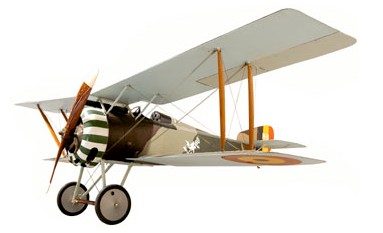
French single seat fighter biplane, prototype first flown 1916. It was designed by Pierre Dupont for the Sociote Anonyme des Appareils d’Aviation Hanriot and built by Hanriot at Billancourt, and was of sesquiplane configuration. The powerplant was a 110 hp Le Rhone 9 J rotary engine (120 hp Le Rhone 9 Jb on production aircraft) and carrying an armament of one synchronised 7,7 mm Vickers machine gun (although a few aircraft were later to be fitted with two Vickers guns). Tests proved it to be compact, manoeuvrable and with a good field of view. Although the HD.1 was accepted by the French government in early 1917, the huge contemporary production of the Spad 7 C1 precluded any production order for the French Aviation Militaire. Neither was the HD.1 considered to be a suitable replacement for the ageing Nieuport single seaters.
However, the HD.1 did impress the Italian and Belgian authorities. It was adopted by Italy as the main Nieuport replacement, and went into licence production by the Societa Nieuport Macchi at Varese. It seems that reports of 1700 being ordered from Nieuport-Macchi may have been exaggerated. Societa Nieuport Macchi delivered 125 to the Aeronautica del Regio Esercito in 1917, 706 in 1918, and a further 70 after the Armistice. 831 were received by the war’s end, the balance coming from French production.
The HD.1 entered Italian service in mid 1917, serving in the Austrian, Macedonian and Albanian theatres. During the latter stages of the war they equipped 16 of the Italian air arm’s 18 fighter squadrons, and some continued in service until 1925. Over nine-hundred were produced for the Italians and they used the type in greater numbers than any other fighter during the First World War.
The HD.1 was also adopted by Belgium to which country Hanriot supplied 79 fighters of this type from August 1917. The HD.1 continued in service in both Italy and Belgium into the mid ‘twenties, and in 1921, Switzerland purchased 16 from Italian war surplus stocks and retained these in service until 1930.
Standard armament was a single 0.303 in (7.7 mm) Vickers gun, initially offset but later moved to a central position where the firepower was more effective, although the pilot’s view was slightly impaired. Belgian orders, for French built HD.1s, totalled 125, the first being delivered in August 1917. They were not instantly successful, but later gained popularity. One Belgian HD.1 was fitted with a single 11 mm (0.433 in) gun, which proved highly successful. Belgian HD.1s also served long after the war, some until 1926.
Small numbers were used by the French Aviation Maritime (naval air arm), with 130 hp Clerget 9 B engines and, on some, fin and rudder modifications similar to those of the HD.2. Switzerland purchased 16 HD.1s in 1921, and these remained in service until 1928.
HD 1 Engine: 120 hp Le Rhone 9Jb. Max speed, 115 mph (184 km/h) at sea level, 111 mph (178 km/h) at 6,560 ft (2 000 m). Time to 3,280 ft (1000 m), 2.97 min. Ceiling, 20,670 ft (6 000 m). Range, 224 mls (360 km). Empty weight, 983 lb (446 kg). Loaded weight, 1,437 lb (652kg). ROC: 894 fpm / 272 m/min Span: 8.70 m, (28 ft 6.5 in) upper Span: 7.40 m (24 ft 3.25 in) lower Length, 19 ft 2.25 in (5,85 m) Height, 9 ft 7.5 in (2,94 m) Wing area, 195.9 sq ft (18,20 sq.m) Seats: 1
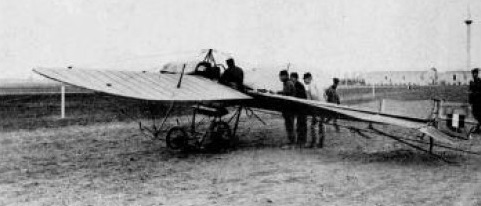
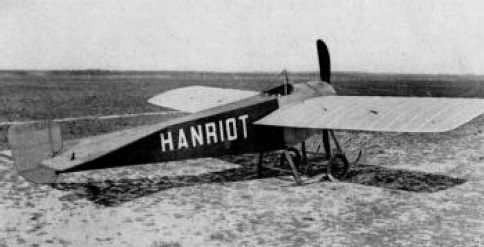
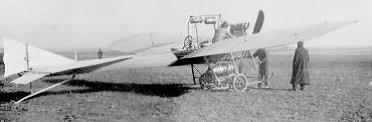
Hanriot’s entry into the 2nd Military Trials in 1912 was smaller than the X or XI. The fuselage appears to be all-wood, and the undercarriage is reduced to four legs. The pylon is a pyramid similar to a Nieuport or Morane-Borel, and a high metal cowling encloses the Gnome engine. This would seem to the last of the early-style Hanriots.
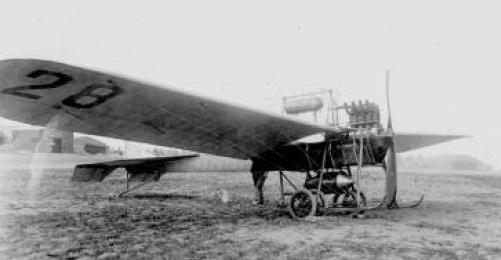
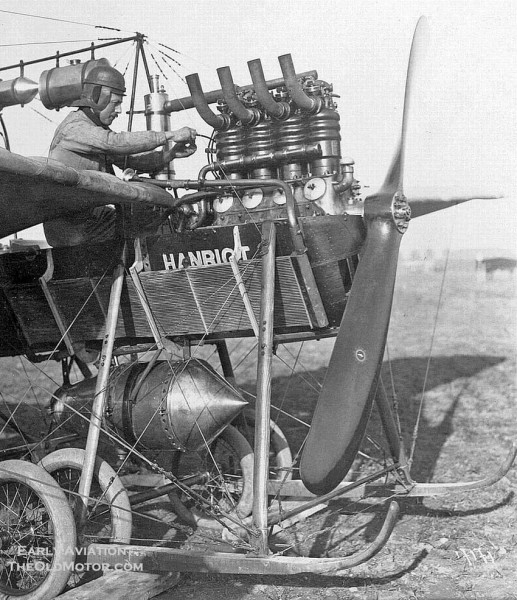
The third Hanriot entered in the 1911 Concours military trials had a 200hp Clement-Bayard. Photos show a machine similar to the IX but with an extended wingspan, single, larger tank hanging form the pylon and triangular, non-arched pylon uprights front and back. It looks to have a 100hp Clement-Bayard. This is the machine featured in the Automobiline ad.
The longer-winged 100hp machine at the 1911 Concours Militaire has a “28” on the underside of the starboard wing.
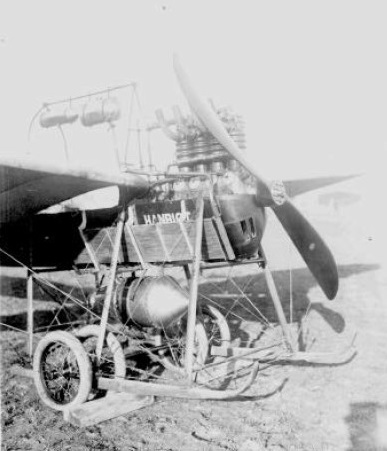
Hanriot entered three machines into the 1911 Concours military trials. A larger machine than the VIII, the 100hp Clement-Bayard powered IX had two pair of wheels, a fuel tank carried below the fuselage in the middle of the undercarriage birdcage, and two smaller tanks on the pylon. The rear pylon uprights were curved, coming to a point at the top rather like a gothic arch. Radiators are mounted on each side of the forward fuse Antoinette-style. The rear fuse is fabric-covered and the rudder is completely above the stabilizer/elevators (whereas earlier types had a “fishtail” rudder centered on the back end with small fins above and below the fuse). Curiously, there is one photo of what appears to be this machine with an early-style rudder. There is a large steering wheel in place of the trademark Hanriot dual levers. A photo of Dubreuil in the cockpit of the shorter-winged one (IX) shows a small “23” on the fusealge side, near the seat.
Marcel Hanriot in a 1911 Hanriot Militaire Triplace Type VIII
Built in cooperation with Henri-Hubert Pagny, who had previously worked with Nieuport. This 100 hp Clement Bayard powered machine, the first of the Antoinette-developments by Hanriot, was designed for the Concours Militaire de Reims in October 1911, where it was flown by Gaston Dubreuil.
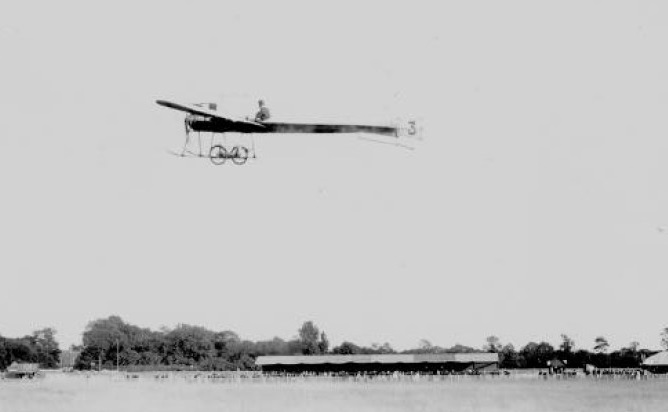
Hanriot entered three machines into the 1911 Concours military trials. The VIII looks very similar to but perhaps a little larger than the VII, except there is no tank on the pylon. Since one of the requirements of the Concours was that the aeroplane carry three people, possibly the tank was moved in the interest of headroom.
Hanriot’s craft was passed over at the trials because the fuselage was very slender and open which left the crew unprotected.
The VIII should be powered by a 40hp Clement-Bayard.
Hanriot VI 40 hp Clerget, Reims 1911
Hanriot VIII Clément-Bayard 100hp 1911
Hanriot VIII Clément-Bayard 100hp at concours militaire de Reims 1911
The Type VII appeared in 1911, after Clément-Bayard had built a 100 hp engine for. I always thought that had three sets of wires for the wings. Only I can’t prove this with photographs and I might be mistaken.
A single-seater similar to the VI, but without the extra inverted-V brace in the undercarriage or tailwheel. There’s a small fuel or oil tank suspended from the wing warping/bracing pylon. Possibly this is the machine shown at the 2nd Exposition de Locomotion Aerienne in Paris, Oct – Nov 1910, and also pictured on at least two postcards with Henri Lefargue.