Henschel Hs 126

Henschel Hs 126

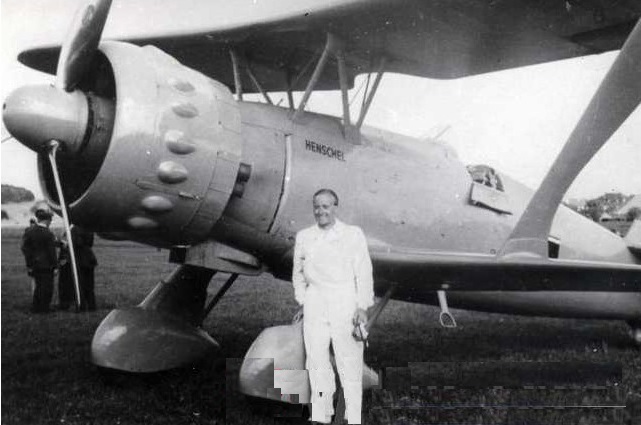
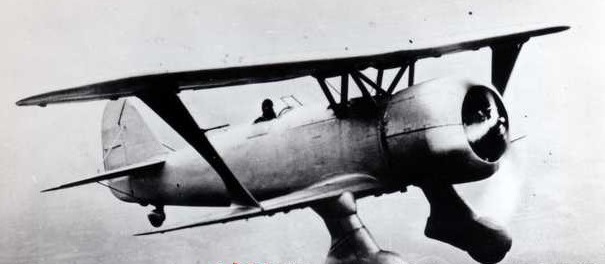
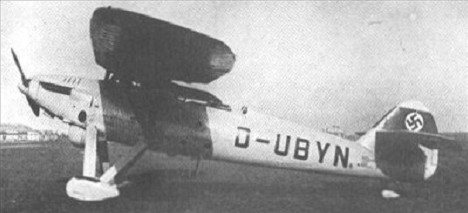
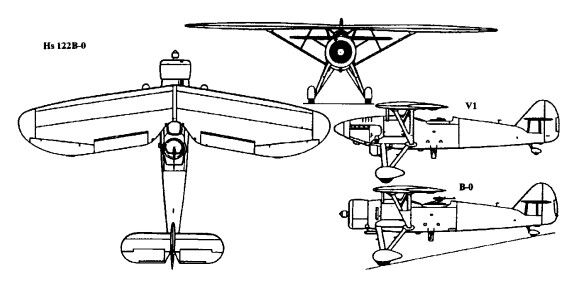
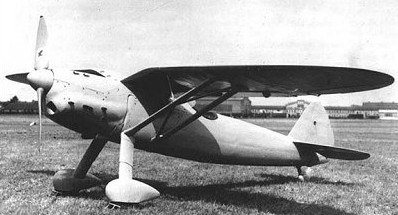
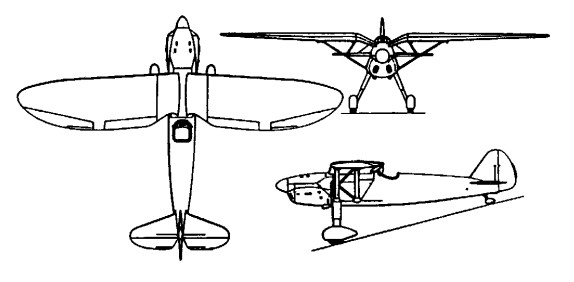
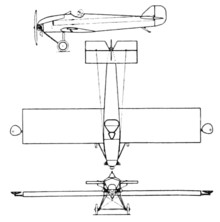
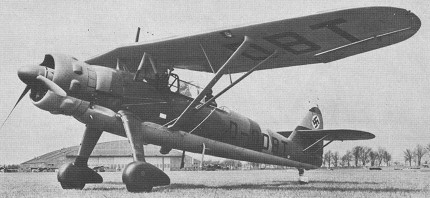
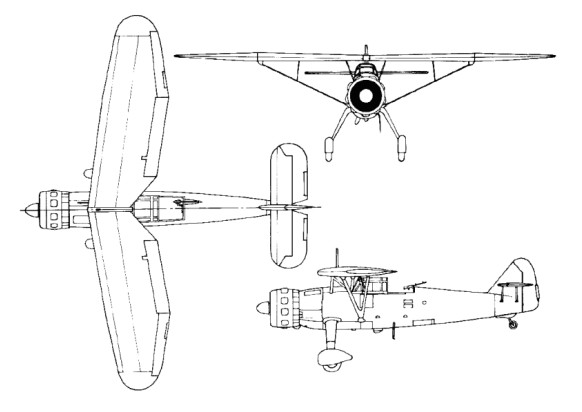
In 1935 Henschel developed the parasol-wing Henschel Hs122 short range reconnaissance aircraft as a replace¬ment for the Heinkel He 45 and He 46, but although a few of the 492-kW (660-hp) Siemens SAM 22B-engined aircraft were built, the Hs 122 was not adopted for Luftwaffe use. From it, however, Henschels chief designer Friedrich Nicolaus derived the Henschel Hs 126 which incorporated a new wing, can¬tilever main landing gear and a canopy over the pilot’s cockpit, the observers position being left open. Making its appearance in 1936 the Henschel Hs 126 V1 was a modified Hs 122A airframe powered by a Junkers Jumo 210.

The pilot was seated in a protected cockpit under the parasol wing and the gunner in an open rear cockpit. The aircraft was of all-metal construction, the wing was a high lift parasol wing was designed by Friedrich Nicolaus and this allowed the Hs 126 to use short and rough landing strips. The wheels had long struts which gave it a nose high appearance on the ground. To reduce drag, spats were sometimes fitted. It had a strut-braced tail unit and tailwheel-type landing gear. Cockpit access was via a ladder on the side and the rear of the cockpit was open to the elements. The gunner/observer had a handheld camera and also operated a Zeiss Rb topographic camera that was located in a bay behind him. The canopy had deflector panels to shield the gunner’s gun from the slipstream.

Henschel Hs 126 Article

The first prototype was not entirely up to Luftwaffe standards; it was followed by two more development planes equipped with different engines. Following the third prototype, during 1937 Henschel built 10 pre-production Hs 126A-O aircraft based on the third prototype, and some were used for operational evaluation by the Luftwaffe’s Lehrgruppe reconnaissance unit in the spring of 1938.

Initial production version was the Hs 126A-1, generally similar to the pre-production aircraft but powered by the 656-kW (880-hp) BMW 132dc radial engine. Armament comprised one forward-firing 7.92-mm (0.31-in) MG 17 machine-gun, plus one similar weapon on a trainable mounting in the rear cockpit, and five 10-kg (22-lb) bombs or a single 50-kg (110-lb) bomb could be carried on an underfuselage rack. A hand-held Rb 12.5/9x 7 camera in the rear cockpit was supplemented by a Zeiss instrument in a rear-fuselage bay.
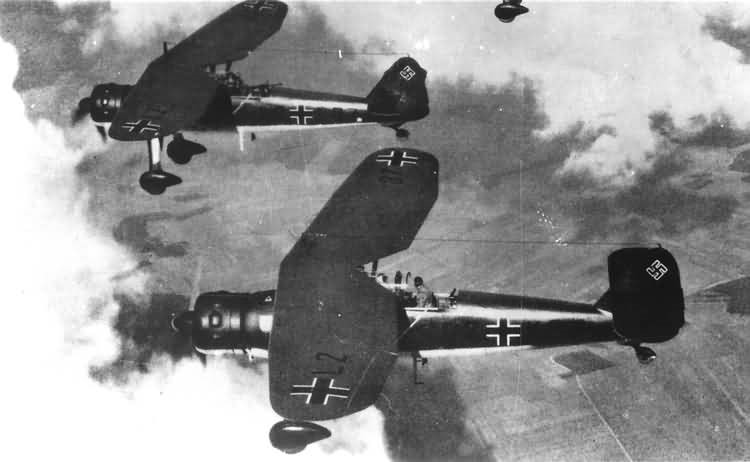
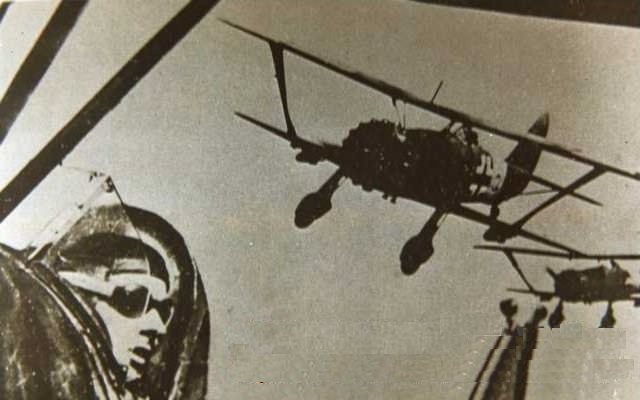
The Hs 126 entered service in 1938 after operational evaluation with the Legion Kondor contingent to the Spanish Civil War (in 1938 six were delivered to the Condor Legion and served in Aufklarungsgruppe 88. Five of these survived to be turned over to Spain at the end of the Civil War), and 16 were delivered to the Greek air force.

An improved but similar He 126B-1 was introduced during the summer of 1939, this incorporating FuG 17 radio equipment and either the Bramo 323A-1 or 671-kW (900-hp) 323A-2. The final Hs 129B- 2/R-4 version was armed with a 75 mm cannon.
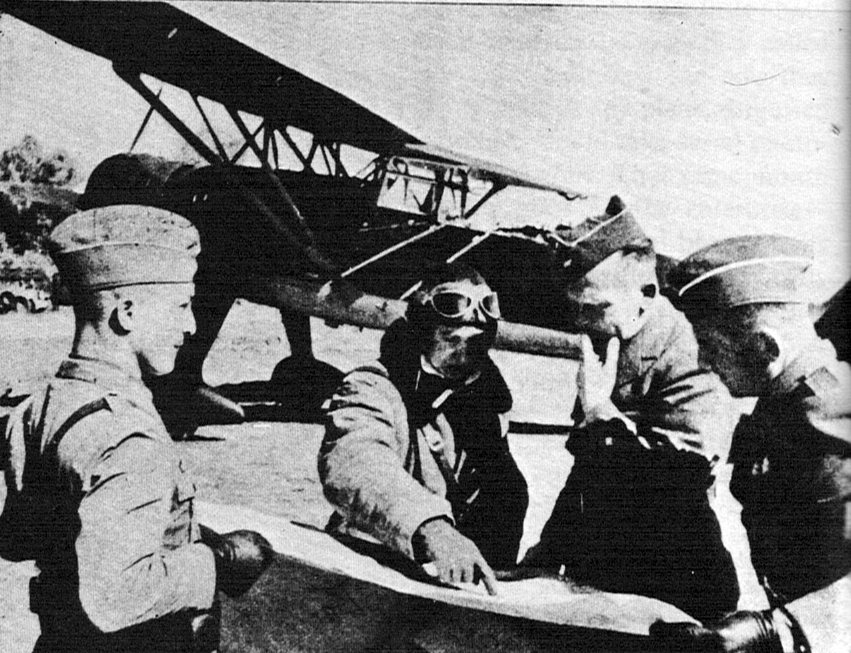
By the time the Hs 126A-1 joined the Luftwaffe, the re-equipping of reconnaissance formations was already well advanced, and by the start of World War II in September 1939, Germany already had several good short range observation and long range recon aircraft. Some 13 squadrons were equipped with the He 126 in the invasion of Poland, where it was able to operate as a bomber and ground attack aircraft, as well as in its normal army co-operation, reconnaissance and artillery spotter roles. Luftwaffe Henschels were active during the Polish campaign, the absence of any effective fighter or antiaircratt opposition enabling them to mix in a bit of bombing and strafing with their everyday reconnaissance and Army cooperation duties. RAF and Armee De l’air aircraft weren’t so obliging, being present in large numbers and motivated by hostile intent, and losses among the poorly armed Henschels began to rise alarmingly- twenty were lost between 10-21 May. By spring, when the “Sitzkrieg” ended in the invasion of the Netherlands, Belgium, and France production of the Hs 26 was being wound down following the RLM’s decision to order Focke Wulf’s Fw 189 “Fliegende Alige” into production as a replacement. One Staffel operated Hs 126s in Atrica in support of Rommel’s Afrika Korps, but the rest were transferred to the Eastern Front when Operation Barbarossa began, gradually being phased out as Fw 189s arrived from mid 1942 on. Relegated to rear area utility jobs Hs 126s re-entered combat later that same year following the establishment of Storkampfstaffeln for night time harassment, and continued flying these missions against partisans in the Balkans during 1943.

By June 1941, there were 48 squadrons of the aircraft in service – in the aftermath of the campaign in France one squadron, 2.(H)/14 took the Hs 126 to North Africa, where it remained in service until August 1942. This left forty-seven squadrons equipped with the Hs 126 for the invasion of the Soviet Unit. The aircraft was still vulnerable, and began to suffer heavy losses. In the spring of 1942 the Fw 189 began to replace it, and by the end of the year it had gone from use in the front line. From 1942 on, most of the surviving Hs 126s were used as training aircraft but some were used as a glider tug and for night-fighting units (Nachtschlachtgruppen) in specialized close-support and ground attack roles. The Hs 126 was used by NSGr 7 in the Balkans, 3./NSGr 11 in Estonia and 2./NSGr 12 in Latvia. It remained in use in the Balkans until April 1945 and the German collapse. Production of the Hs 126 ended in 1941 and the type was retired from the front line in 1942. Some 800 in total were produced.
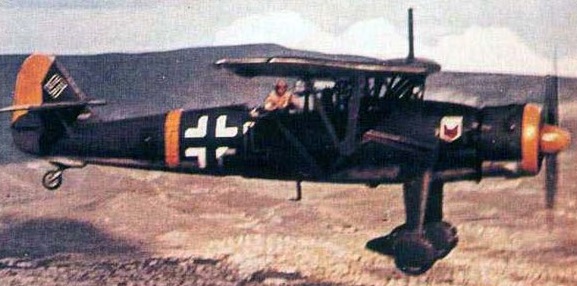
Production aircraft were built in Berlin, at Schänefeld and Johannisthal, from 1938 and entered operational service first with AufklGr. 35. By the outbreak of World War II the re-equipment of He 45- and He 46-equipped reconnaissance units with the Hs 126 was well under way. The type was withdrawn progressively from front-line service during 1942 on replacement by the Focke-Wulf Fw 189.

Gallery

Hs 126A4
Max Speed: 221mph.
Ceiling: 9840ft.
Wingspan: 47ft 6in.
Length: 35ft 7in.
Armament: MG17 and MG15 machine guns.

Hs 126B-1
Engine: 1 x Bramo 323A-1, 634kW / 850-hp
Max take-off weight: 3090 kg / 6812 lb
Empty weight: 2030 kg / 4475 lb
Wingspan: 14.5 m / 47 ft 7 in
Length: 10.85 m / 35 ft 7 in
Height: 3.75 m / 12 ft 4 in
Wing area: 31.6 sq.m / 340.14 sq ft
Service ceiling: 8300 m / 27250 ft
Range: 720 km / 447 miles
Maximum speed: 310 km/h (193 mph) at sea level
Armament: two 7.92-mm (0.31-in) MJ 17 machine-guns, plus one 50-kg (110lb) or five 10-kg (22-lb) bombs
Crew: 2
Henschel Hs 123

Spurred on by Ernst Udet’s enthusiastic reports on what he’d seen during his tour of the United States, the Luftfahrtkomissariat’s C AMT let design contracts to Fiesler and Henschel for prototypes of Sturzkampffleugzeugen, or dive bomber.

Henschel Hs 123 Article

In February 1934, a requirement was published for the aircraft and tenders were awarded to Hamburger Flugzeugbau GmbH, Fieseler Aircraft GmbH and Henschel Aircraft GmbH.

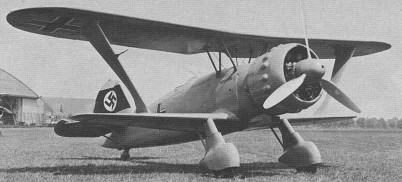
Henschel chief designer Friedrich Nicolaus developed a sesquiplane with an open cockpit and fixed landing gear of all-metal construction. The power was a BMW 132 enclosed in a NACA ring. The wings had the usual control surfaces and they were partially covered with fabric. The control surfaces were all covered with fabric.

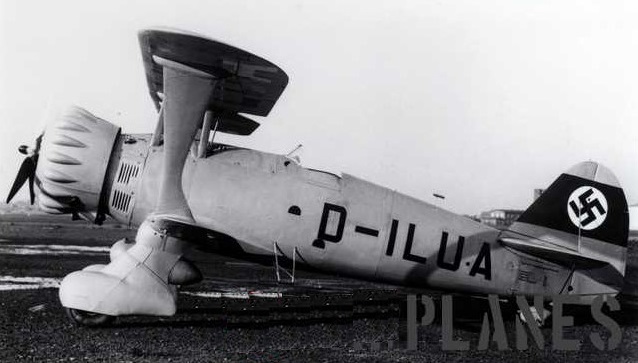
The construction of the prototype progressed rapidly and on 1 April 1935, the Hs 123 V1 was completed. Maiden flight was on April 5, 1935 and Hs 123 V1 had the registration D-ILUA. The V2 was tested with a Wright Cyclone R-1820 F52, starting with 770 hp power. This machine suffered from a landing accident and later was adapted to use the BMW 132 A and in this configuration was designated as Hs 123 V8.

The testing of the three machines from different manufacturers was held at Rechlin from June 1935 up to January 1936. Henschel’s Hs 123, flown by Udet himself, comfortably beat out its competition, the Fi 98, but two prototypes were lost in quick succession once flight testing had begun at Erprobungsstelle Rechlin. Examination of the wreckage and static testing of the surviving ariplane pointed to weakness in the top wing’s center-section, the design being modified accordingly. The Henschel Hs 123 was found as most suitable from all proposed aircraft and production began in 1936 at Kassel. The Hs 123 V5 was presented in 1937 at the International Air Meeting in Dübendorf.

The very first production block was Hs 123A-0, delivered to units in 1936 and the main purpose for these machines was operational testing by the Luftwaffe. The first series-manufacture example was the Hs 123A-1 and these had minor differences compared with the previous pre-production block. The aircraft was equipped with pilot armor. The main offensive armament was four SC50 bombs mounted on the bottom wing racks with optional SC250 bomb mounted beneath the fuselage. On the fuselage central position it was also possible to mount a droppable fuel tank. Two MG 17 machine guns, caliber 7.92 mm, were mounted in the top nose and they were synchronized to fire through the propeller arc.

Hs 123A 1s first entered service with Stukagruppe I/162 Immelmann, examples soon being sent off to Spain where they were flown by “volunteers” from the Legion Condor, proving their worth by providing close support for Nationalist ground forces. The Spanish Air Force later received the remaining Hs 123 A-1. These Hs 123 were based in Seville and during the combat evaluation Hs 123 performed at a high efficiency in the close-support missions, and at the same time performed as a safe combat platform for its pilots.

By 1939, despite its success in Spain, the Luftwaffe considered the Hs 123 obsolete and most of the Schlachtgeschwader equipped with the type had been disbanded and only II.(Schl)/LG2 remained operational with the Hs 123. Sole operational II. (Schl)/LG 2 had 39 machines which were engaged in combat missions during the Polish Campaign. This single unit proved to be particularly effective and this is greatly dedicated to the sound of the engine which had a psychological effect on ground forces. It was also true that the Hs 123 could take considerable punishment and stay flyable. One of the benefits was use from unprepared airfields.

After this good combat record, the Hs 123 was put into the combat missions over the Low Countries and France. At this time the Luftwaffe had two operational combat aircraft, the Junkers Ju 87 was a dive bomber and the only machine that could give close support was the Hs 123, previously declared by the Luftwaffe as ’obsolete’. After the campaign in France some number of machines was sent to 10.(Schl)/LG 2. and they were seriously considered to be used during Operation Barbarossa. In the begining of Operation Barbarossa, the single Gruppe of the Luftwaffe that was providing ground support was II.(Schl)/LG 2, equipped with 38 Bf 109Es and 22 Hs 123s. During the operations the Bf109 was shown vulnerable during operations with weak landing gear as well as a sensitive engine to ground fire and Hs 123 again showed some advantage as a close support aircraft. The Escuadrilla Azul, volunteers from Spain flew the type during this time. Bitter experience came in the winter 1941/42 since the open cockpit was not good accommodation for pilots in harsh winter climate. From January 1942, the unit was re-designated as SchlG 1 and Hs 123 became a part of 7./SchlG 1. SchlG 1 took part in the operations in Crimea, Battle of Kharkov and in the Battle of Stalingrad. The Hs 123 was then being replaced with modern aircraft. The remaining machines were sent to the trainer units as well as in non-operational occupied zones.

China imported 12 Hs 123 A-0 from Germany before the war, those aircraft only saw limited actions in the Chinese air force, after new aircraft from the Soviets arrived in China after 1938, those survived German war planes were transferred to reserve. Germany stopped military supply to China in May 1938 and the Hs 123s suffered from shortages of spare parts and they saw limited service. Operated by 15th Sq of the Chinese air force, the few Hs 123 were used in the dive bombing role against Japanese shipping on the Yangtze River in 1938.

Although scheduled to be phased out in favor of Junker’s Ju 87 the Hs 123 did its ground attack job so well that General Wolfram von Richthofen recommended, in 1943, that it be put back into production. Whatever the idea’s worth it could not be followed up on, since all tooling and jigs had been broken up for scrap three years earlier.

Last samples of the Henschel Hs 123 remained operational until the spring 1944 when 7./SG 1 replaced their last Hs 123s with the Ju 87. By 1945, the Hs 123s that remained serviceable were reassigned to secondary duties such as supply dropping and glider towing.

During its service the Hs 123 had just a few operational camouflage patterns. First one was splinter with RLM 61, 62 and 63 at the topside and RLM 65 at the bottom. There were two variations of this scheme used. During the later service this camouflage pattern was still used no matter that it was officially discarded and during overpainting the aircraft got single colour of RLM 71 or 70 at the topside.

Gallery

Hs 123A-1
Engine: 1 x BMW 132Dc, 656kW
Max take-off weight: 2215 kg / 4883 lb
Empty weight: 1500 kg / 3307 lb
Wingspan: 10.5/8.0 m / 34 ft 5 in / 26 ft 3 in
Length: 8.33 m / 27 ft 4 in
Height: 3.2 m / 10 ft 6 in
Wing area: 24.85 sq.m / 267.48 sq ft
Ceiling: 9000 m / 29550 ft
Range: 855 km / 531 miles
Armament: 2 x 7.92mm machine-guns, 450kg of bombs
Crew: 1

Henschel Hs 122

In 1935 Henschel developed the parasol-wing Henschel Hs122 short range reconnaissance aircraft as a replacement for the Heinkel He 45 and He 46, but although a few of the 492-kW (660-hp) Siemens SAM 22B-engined aircraft were built, the Hs 122 was not adopted for Luftwaffe use. From it, however, Henschels chief designer Friedrich Nicolaus derived the Henschel Hs 126 which incorporated a new wing, can¬tilever main landing gear and a canopy over the pilot’s cockpit, the observers position being left open.

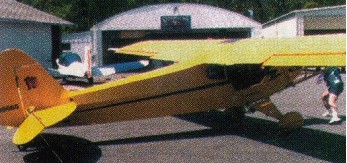
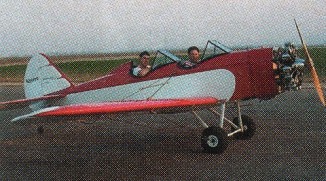
Henderson Aero Supplies Little Bear

A Super Cub replica. In 1997 the kit price was US$24,500.

Engine: Continental C-65, 65 hp.
HP range: 65-100.
Speed max: 85 mph.
Cruise: 80 mph.
Range: 340 sm.
Stall: 38 mph.
ROC: 800 fpm.
Take-off dist: 400 ft.
Landing dist: 300 ft.
Service ceiling: 11,500 ft.
Fuel cap: 20 USG.
Weight empty: 649 lbs.
Gross: 1220 lbs.
Height: 6.67 ft.
Length: 22.34 ft.
Wing span: 35.21 ft.
Wing area: 178.5 sq.ft.
Seats: 2
Landing gear: tail wheel.

Henderson-Glenny Gadfly

William A. Baker had undertaken the construction of the six seat Henderson HSF 1 (G ABVF) and all three of the Henderson Glenny Gadfly monoplanes which were also designed by K. N. Pearson, M.C., AFRAeS.

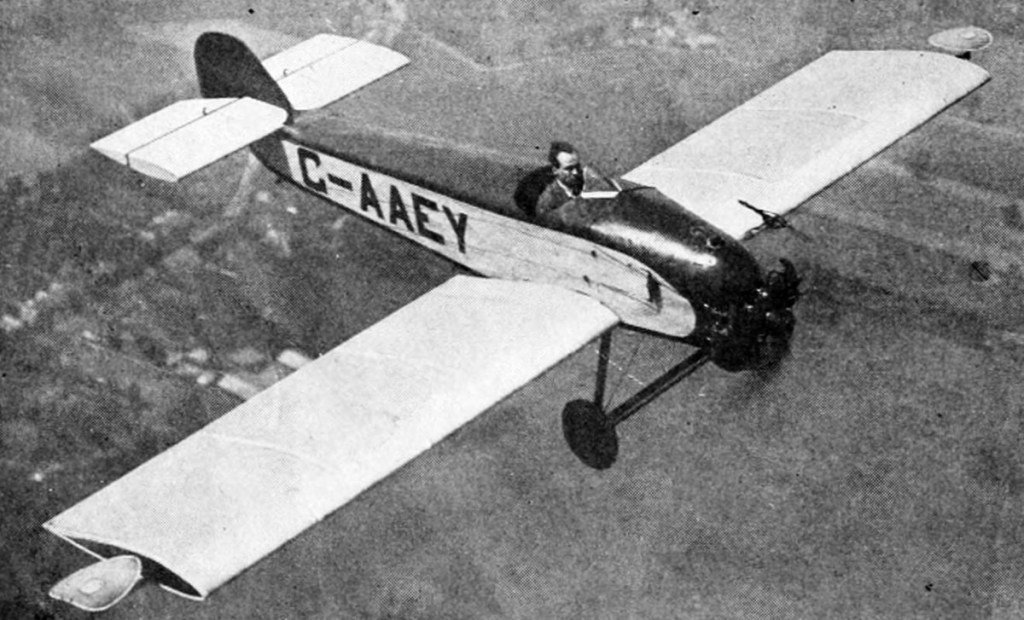
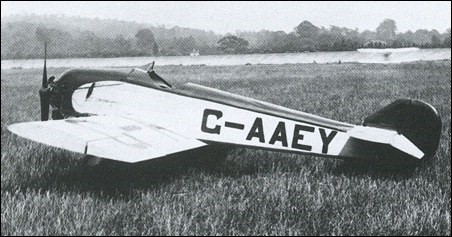
Glenny & Henderson company at Byfleet, Surrey, UK, built a Mk.I standard aircraft G-AAEY c/n 1. It was first flown in April 1929, at Brooklands. It was converted to Gadfly Mk.II statue later that year. It was scrapped in June 1934.

The second built was c/n 2 G-AARJ, built ads a Mk.II. This was as the Mk.I but fitted with Pearson rotary ailerons. It first flew in August 1929, from Brooklands. In 1930 it was sold in Canada as CF-AMG but was written off on 25 August 1931.

One aircraft was built as a Mk.III, like the Mk.II but fitted with a Salmson AD.9 radial engine. G-AARK was first flown in late 1929, at Brooklands. It was withdrawn from use in 1930 and put into storage at Brooklands until scrapped there in 1933.

Mk.I
G-AAEY c/n 1
Engine: A.B.C. Scorpion
Span: 25.10 ft
Length: 17.10 ft

Mk.II
G-AARJ c/n 2
Engine: A.B.C. Scorpion
Span: 25.10 ft
Length: 17.10 ft

Mk.III
G-AARK
Engine: Salmson AD.9

Helwan HA-300

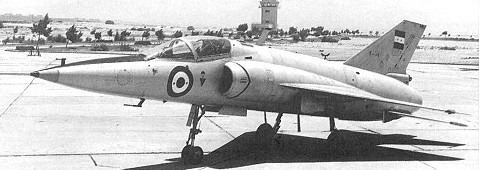
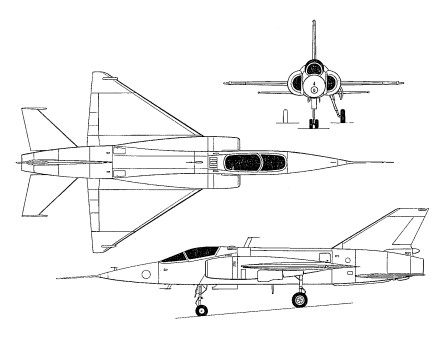
Originally conceived to meet a Spanish Ejercito del Aire requirement for a small M=1.5 interceptor and the design responsibility of a Germano-Spanish team supervised by Prof Willy Messerschmitt, the HA-300 programme was transferred to Egypt. Here development and construction was undertaken in Factory No 36 at Helwan, this being controlled by the Egyptian General Aero Organisation (EGAO). Originally designed for the proposed afterburning Orpheus BOr 12 turbojet, the HA-300 was modified for the Brandner-designed E-300 with a calculated afterburning rating of 4800kgp. The first V.1 prototype, powered by a 2200kgp Orpheus 703-S-10, was flown on 7 March 1964, a similarly-powered second V.2 prototype flying on 22 July 1965. The version flew supersonic.

The definitive third prototype with the E-300 engine commenced taxi trials in November 1969, but the HA-300 programme was then terminated without flight testing of this prototype being undertaken. It was anticipated that the E-300-powered HA-300 would be capable of attaining 12000m and M=2.0 within 2.5 min of take-off. The Orpheus-powered prototypes achieved approx M=1.13 during flight test.

Egypt’s HA-300 was test flown in the Spring of 1964 by an Indian pilot, showing no appreciable advantages over the MiG-21.

The HA-300 V.1 is displyed in the Deutsches Museum – Oberschleissheim and the Ha-300 V.2 and V.3 remained in Cairo.

Wingspan: 5.84 m / 19 ft 2 in
Length: 12.40 m / 40 ft 8 in
Height: 3.15 m / 10 ft 4 in
Wing area: 16.70 sq.m / 179.76 sq ft
Max. speed: 1490 km/h / 926 mph

Helve Classic

An LSA kit or plans built plane circa 2010. The kit, including engine, cost US$15,995.

Cruise: 105 mph
Stall: 45 mph
Range: 290 sm
Rate of climb: 1000 fpm
Takeoff dist: 400 ft
Landing dist: 500 ft
Engine: Rotec R2800, 110 hp
HP range: 85-150
Fuel capacity: 16 USG
Empty weight: 800 lb
Gross weight: 1320 lb
Length: 22 ft
Wing span: 28 ft
Wing area: 120 sq.ft
Cockpit width: 27 in
Landing gear: tailwheel

Helton Lark 95

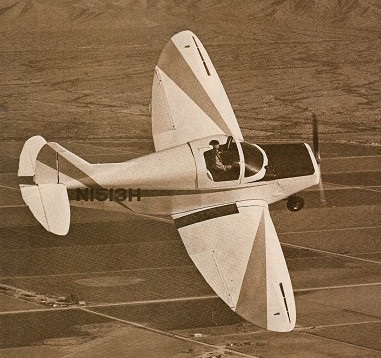
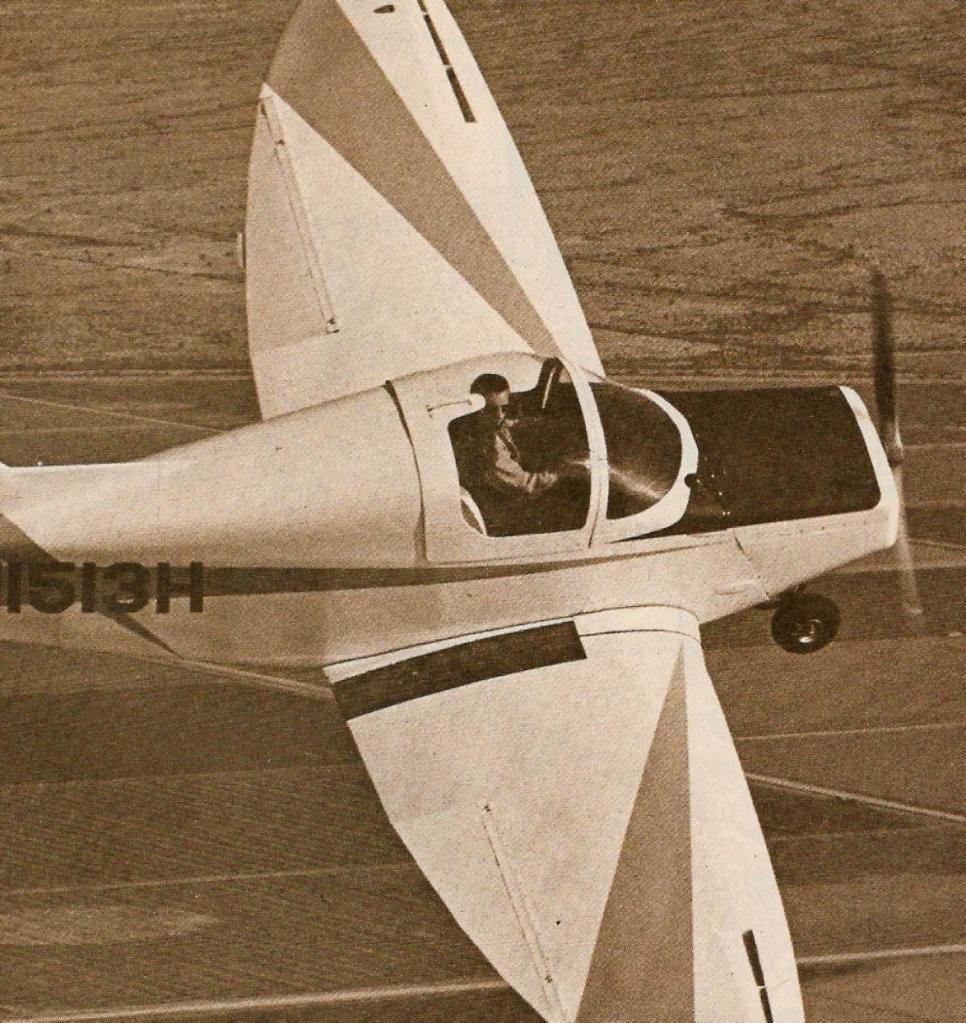
When Culver went out of business in 1946 the rights were bought by Superior Aircraft Co and then sold to California Aero Co of Tracy. They revived the model in 1966 as the Helton Lark 95 with a 90hp Continental C 90 16. Dimensions were similar to the Cadet, though the overall height was 6ft 10in due to the tricycle gear.

There is some doubt as to how many Larks were built, but seventeen constructor’s numbers were allotted and not all may have been completed. The last to be built, c/n 9517, was N5017J.

Further developments on the drone theme followed the PQ 8 and the NR D was built as the PQ 14A and PQ 14B for USAAF use and as the TD2CA for the Navy (which used a few TDCs from PQ 8 contracts). About 2,570 were built for use by the two services. Basic power was the 150hp Franklin O 300 11.

Post war limited type certificate LTC 28 was granted in December 1947 and a few were registered, there being eleven listed in the 1959 statistical survey, and one, N4744N was still in existence fairly recently There was a strong similarity with the Cadet, but the fuselage was lengthened and a larger fin and rudder fitted to counter increased power, plus tricycle undercarriage.