Y2Fly Seahawk

The Y2Fly Seahawk is an American amphibious flying boat ultralight trike that was designed and produced by Y2Fly of Point Harbor, North Carolina.

The Seahawk features a cable-braced hang glider-style high wing, weight-shift controls, a two-seats-in-tandem, open cockpit, a trimaran hull and a single engine in pusher configuration.

The aircraft hull is made from fiberglass, with stainless steel fittings. The wing and its supporting structure are made from bolted-together aluminum tubing, with the single surface wing covered in Dacron sailcloth and supported by a single tube-type kingpost. The Seahawk uses an “A” frame control bar for weight-shift control. The hull was carefully designed to account for the inherent lack of pitch control that trikes have while on the water. It was designed to reduce porpoising and water spray being thrown into the crew seats and propeller. The hull also provides lift in flight and allows flight at reduced power and fuel consumption. The retractable landing gear is of tricycle configuration and is mechanically retracted by a lever located next to the pilot. The nosewheel retracts in front of the bow of the hull, while the main landing gear retracts beside the tri-hull. The standard powerplant supplied was the twin cylinder, two-stroke, liquid-cooled 64 hp (48 kW) Rotax 582 aircraft engine.

A clutch system is standard on the 582 Rotax using an E box. This allows pilots to safely taxi in the water, without having the prop pushing the craft along. Another feature is a full time water rudder located at the rear and center of the craft. The unit is equipped with all three wheels retractable, actuated by one manual lever.

The “trimaran float design” uses spray rails, and splash pans. “Dive planes” help bring the nose of the craft up in case of slight nose down landing, or taxing in rough water. The use of fiberglass and stainless steel components allow the Sea Hawk to be used in salt water.

The Sea Hawk uses a 16.8 meter, certified Wizard wing to give the best performance for take-off and cruise. With two on board the craft stalls at 30 mph and cruises along at 55 mph.

The empty weight of this amphibious trike without wing is 341-363 lbs. depending on what engine is chosen. The aircraft was supplied as a completed aircraft but production has ended.

XtremeAir XA 42 / Sbach 342

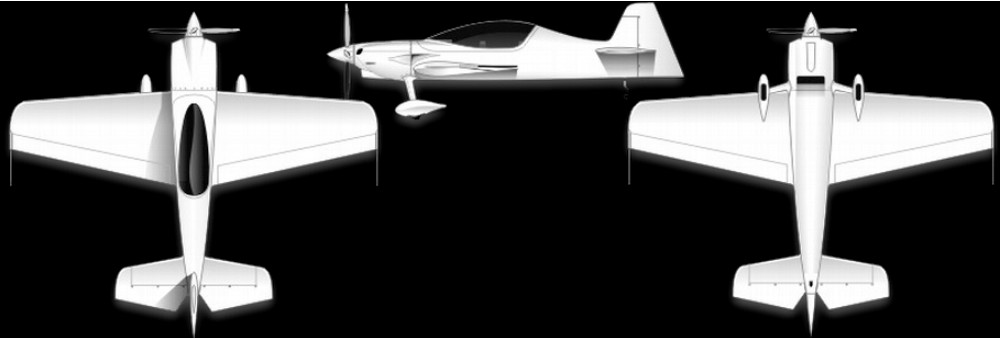
The XtremeAir Sbach 342 is a German high performance two-seat aerobatic and touring monoplane designed by Philipp Steinbach with Albert Mylius and built by XtremeAir GmbH of Hecklingen.
The Sbach 342 (a marketing name for the XA42) is a composite structure low-wing monoplane with a fixed conventional landing gear with a tailwheel. It is powered by a 315 hp (235 kW) Lycoming AEIO-580-B1A piston engine driving a three-bladed propeller. It is the tandem version of the single-seater XA 41 (XtremeAir Sbach 300) which was designed by the same team in Speyer in 2004. The XA42 received a type certificate from the European Aviation Safety Agency in March 2011. On 5 November 2012 it received its type certification through the FAA.
At least 37 have been produced.

Engine: 1 × Lycoming AEIO-580-B1A, 245 kW (315 hp)
Length: 6.67 m (21 ft 11 in)
Wingspan: 7.5 m (24 ft 7 in)
Height: 2.54 m (8 ft 4 in)
Overall height, ground attitude: 2.3 m / 7.5 ft
Wing area: 11.25 sq.m (121 sq.ft)
Aspect ratio: 5
Stabilizer / Elevator span: 3.20 m / 10.5 ft
Stabilizer / Elevator area: 2.98 sq.m / 32.1 sq.ft
Empty weight: 610 kg / 1344 lb
Max. Take off weight Aerobatic: 850 kg / 1875 lbs
Max. Take off weight Utility: 999 kg / 2200 lbs
Wing loading Aerobatic: 75.5 kg/sq.m / 15.4 lb/sq.ft
Wing loading Utility: 84.4 kg/sq.m / 17.3 lb/sq.ft
Maximum speed @ 3000 ft: 416 km/h (256 mph)
Cruise 75%: 185 kts
Stall speed: 53 kts
Rate of climb: 3200 ft/min
Service ceiling: 4572 m (15000 ft)
Range @ 75% 205kts TAS @ 10,000ft: 800 nm
VA: 174 kts / 322 km/h
VC: 185 kts / 345 km/h
VNE: 225 kts / 416 km/h
Load Factor Aerobatic flight: +/-10G
Load Factor Utility: +4,4G / -2G
Roll rate: 450°/sec
Take off over 50 ft obstacle: 260 m / 853 ft
Landing over 50 ft obstacle: 400 m / 1312 ft
Seats: 2

XtremeAir XA41 / Sbach 300

The XtremeAir Sbach 300 is a German aerobatic aircraft, designed by Philippe Steinbach and produced by XtremeAir, of Cochstedt. The aircraft was supplied in 2012 as a complete ready-to-fly-aircraft. The aircraft bears the company designation XA41, but is marketed under the name Sbach 300.
The Sbach 300 is an all-composite design, predominately constructed of carbon fibre. It features a cantilever low-wing, a single-seat enclosed cockpit under a bubble canopy, fixed conventional landing gear and a single engine in tractor configuration.
The aircraft’s wing mounts full-span ailerons with spades to lighten control forces, which give a roll rate of 450° per second. The standard engine employed is the 324 hp (242 kW) Lycoming IO-580 four-stroke powerplant.

The Sbach 300 was flown to a German national aerobatic championship in the unlimited class.
The 300 was later developed into a two-seat version, the XtremeAir Sbach 342, which was introduced in 2007.

XtremeAir XA-41 (Sbach 300)
Engine: 1 × Lycoming IO-580 B1A, 242 kW (324 hp)
Propeller: 3-bladed constant speed
Length: 6.30 m (20 ft 8 in)
Wingspan: 7.50 m (24 ft 7 in)
Height: 2.3 m (7 ft 7 in) in three-point attitude
Wing area: 11.25 sq.m (121.1 sq ft)
Aspect ratio: 5:1
Stabilizer / Elevator span: 3.20 m / 10.5 ft
Stabilizer / Elevator area: 2.98 sq.m / 32.1 sq.ft
Empty weight: 570 kg (1,257 lb)
Gross weight: 850 kg (1,874 lb) for aerobatics
Gross weight: 999 kg (2,200 lb) for non-aerobatic flight
Fuel capacity: 245 litres (54 imp gal; 65 US gal)
Maximum speed: 389 km/h; 242 mph (210 kt) @ 3000 ft
Cruising speed 75%: 345 km/h (214 mph; 186 kn)
Stall speed: 94 km/h (58 mph; 51 kt)
Never exceed speed: 417 km/h; 259 mph (225 kn)
VA: 174 kts / 322 km/h
VC: 185 kts / 345 km/h
Range 75% pwr: 1,482 km; 921 mi (800 nmi)
Load Factors Aerobatic: +/-10G
Load Factors Utility: +4,4G / -2G
Rate of climb: 3500 ft/min
Roll rate: 450°/second
Wing loading Aerobatic: 57,8 kg/sq.m / 11.8 lb/sq.ft
Wing loading Utility: 66,7 kg/sq.m / 13.7 lb/sq.ft
Take off over 50 ft obstacle: 230 m / 750 ft
Landing over 50 ft obstacle: 380 m / 1250 ft
Crew: one

Xian J-7 / JJ-7 / F-7 Airguard / Skybolt / Chengdu J-7

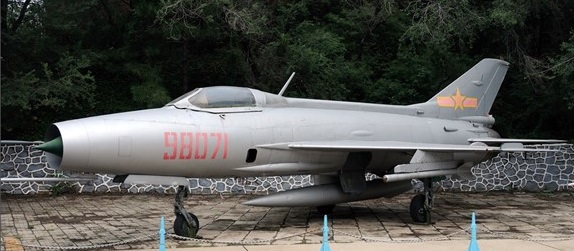
The Xian factory reverse-engineered the MiG-21 and the resulting J-7 made its first flight in December 1964. Two years later, manufacture halted because of unexplained technical problems after only 70 had been built.

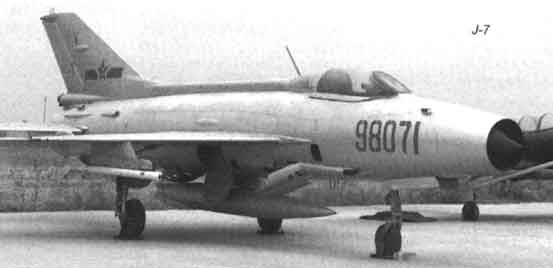
The early model J7I can be seen as the first variant of the type of full production standard. One difference with the MiG-21F-13 is the drag chute housing at the base of the tail.

J7I 98071

Meanwhile, in the common cause of communism, China was allowing Soviet supplies to pass through its territory bound for Vietnam, where the USA was embroiled in conflict. One day, several railway wagons containing dismantled MiG-21s went astray, and subsequently the J-7 re-entered production in modified form at Chengdu. The new J-7 II, a considerably upgraded Chinese development, entered production in the early 1980s, and by 1982 was being exported as the F-7B. China (Giuzhou) also produces the JJ-7 two-seat operational trainer, designated FT-7 for export (first flown in 1981). The JJ-7 dual seat version was originally built by Guizhou Aviation Industry Group (GAIG).

Despite Chinese denials, a number of F-7s have been confirmed in Iranian service, while Iraq has also received the type via assembly (by Chinese technicians) in Egypt.

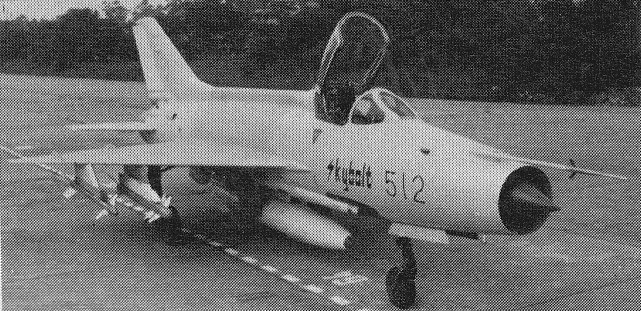
Details of the latest export version of the Chinese-built MiG-21 were released in 1984. Known as the F-7M Airguard and (as offered to Pakistan) F-7P Skybolt, this variant of the earlier F-7B is extensively modernised with Western avionics including ranging radar, a weapons aiming computer, a headup display, multimode radios, and IFF. Two additional wing hardpoints are fitted, and two fuselage cannon are carried, rather than the one carried by earlier models. Other changes include a revised canopy, an updated ejection seat, and a relocated brake-parachute housing.

With development of a successor to the J-7 (MiG-21) that formed the backbone of the PLAAF taking far longer than hoped, Chengdu began efforts to modernize the design. Work began in 1987, resulting in a major design overhaul. The wings were redesigned to have a double-delta planform, and the engine was replaced with a WP-13F engine. The primitive radar of the J-7 was replaced with the British Super Skyranger radar, and fuel capacity was increased. The modifications improved turn performance, and the takeoff roll was reduced from 1km to 600m. Upgrades to the cockpit included HOTAS controls, as well as the later addition of a helmet-mounted sight. Development proceeded quickly, with the first J-7E, as the new model was known, flying in 1990.

By the time the J-7E came about, most J-7 operators had since moved on to more capable designs. However, Pakistan, the largest non-Chinese J-7 operator, ordered significant numbers of the type. A special variant was developed to meet Pakistani requirements, integrating new western radars and the capability to mount AIM-9 AAMs.

Ever eager to develop anti-shipping platforms, the PLANAF also ordered a special J-7 variant with the ability to deploy AShMs (J-7EH). The J-7EH features the ability to carry antiship missiles, but, due to limitations with the radar, must receive targeting data from other aircraft.

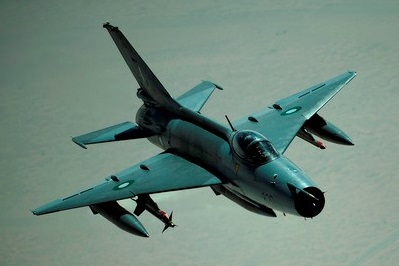
The derivative of the F-7M supplied to Pakistan as the F-7P Skybolt featured 20 PAF specified changes, including for four, rather than two, PL-5B or AKM-9 Sidewinders on pylons outboard of the main undercarriage attachment points. The Skybolt retains the two wing root-mounted Type 30-1 cannon ND MOST OF TE Western systems of the basic F-7M, although some equipment (eg. IFF) is installed in Pakistan.

F-7P Skybolt

The initial Pakistan Air Force order for 20 F-7P was fulfilled in August 1988 when the aircraft were ferried from Chengdu, but the Chengdu Aircraft Corporation was by then responsible for F-7 production.

After the final deliveries to Bangladesh, Chengdu shut down J-7 production in May 2013, marking the end of a 2,400 aircraft production run.

F-7M Airguard
Engine: 1 x Wopen-7B (BM)
Installed thrust (dry / reheat): 43 / 60 kN
Span: 7.2 m
Length: 13.9 m
Wing area: 23 sq.m
Empty wt: 5275 kg
MTOW: 7531 kg
Warload: 1800 kg
Max speed: 2.05 Mach
Initial ROC: 9000 m / min
Ceiling: 18,700 m
TO run: 700-950 m
Ldg run: 600-900 m
Combat radius lo-lo-lo: 370 km
Air refuel: No
Armament: 2 x 30 mm, 2 x AAM
Hard points: 5

Xenon Gyroplanes Xenon / ABS Aerolight Xenon / Future Flight Xenon / Celier Xenon

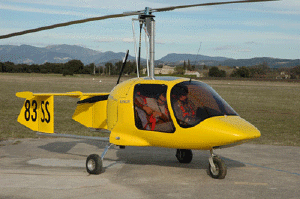
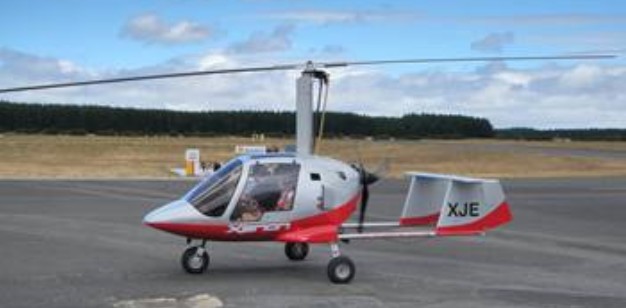
Xenon was designed by French aircraft designer Raphael Celier and was manufactured in Poland to the French Ultralight category standards.

Celier Aviation established its reputation with the two-seat side-by-side configuration Celier Xenon 2 series of autogyros. By 2011 over 100 of these were flying.

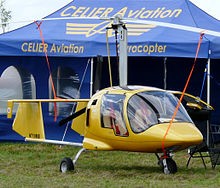
A Celier Xenon 2 on display at Sun ‘n Fun in Lakeland, Florida, United States, 2008.

This high performance ultralight autogyro was available as a kit or ready to fly. Registered as an LSA.
Delivered fully factory built starting at $61,000 in 2009.
The composite structure is the airframe, providing lightness and incorporating a full roll cage to protect the occupants. The cabin is 10″ wider than a Cessna 172 and the two pilots are separated by a 10″ console and arm rest. Behind the seats is a very large luggage compartment. The Aircopter rotor blades are aluminum yet use titanium for strength and tip weighting for higher inertia. The DUC R propeller features a spoon blade with a wider tip and built in feathering. It is carbon forged under high pressure and a carbon fiber spinner is fitted.
The box tail section is directly in the propeller slipstream and is on a long lever arm for effectiveness with or without engine power. The 28″ high cabin is soundproofed, with interior carpeting and heated leather bucket seats, and the Xenon meets European noise standards.
The Xenon is available with a choice of 3 different engines. The standard model comes with a Rotax 912S Engine that delivers 100 horsepower. The 914 Model features a Rotax turbo that delivers 115 horsepower for up to 5 minutes after which the engine delivers a continuous 100 horsepower. The high altitude or extra climb ability model is the 912 RST version which has a Rotax 912 sporting a custom designed Mitsubishi turbo delivering 122 horsepower for take-off followed by a continuous 110 horsepower with full time turbo boost.
The doors are removable for flight, leaving a full wrap around optical windshield with overhead windows and foot well windows, allowing near unobstructed viewing. The instrument panel is shock mounted to be vibration free and includes full instrumentation for flight performance and engine monitoring. Flight instruments include: altimeter, airspeed indicator and vertical speed indicator. Rotor tach and fuel are separate gauges while graphic digital engine monitor uses colored LEDs to keep track of engine tach, CHT and EGT gauges, volt/amp meter, oil pressure and temperature, fuel flow, turbine temperature and manifold pressure. There is a 12 volt power plug for the portable GPS or MP3 player. Options include intercoms, VHF radio and transponder with altitude encoder.
The console arm rest puts the throttle and 280 rpm pre-rotator under one hand. Circuit breakers control the panel and landing lights and overhead heat vents are fitted.
Options vary depending on the model but your Xenon is available with propeller spinner, special metallic paint, cabin and blade covers, larger rotors, removable joystick, adjustable pedals, heated leather seats or a ballistic parachute.

Engine: Rotax 912S, 100 hp
Propeller: 3 Blade DUC Windspoon 68.5 in
Max TO weight: 1,155 lbs.
Empty Weight: 583 lbs
Payload: 462 lbs
Rotor blades: Type 8H12 Aircopter Extruded Aluminum
Rotor Diameter: 27.55 ft
Dics Area: 596.1 sq. ft
Total Width: 86.6 in
Total Length: 192.9 in
Total Height: 110.23 in
Cabin Width: 49.2 in
Pre-rotator: Mechanical 280 RRPM
Wheel Diameter: 400×4
Vne: 108 kt / 124 mph / 200 kph
Minimum Speed: 19 mph
Cruise 75%: 75 mph
Max speed: 105 mph
Climb Rate: 600-1200 fpm
Glide Ratio: 3:1
Service Ceiling: 15,000 ft
Endurance: 4 hr + res
Take off Dist: 100-300 ft
Landing Dist: 15 ft
Fuel Capacity: 22 USG
Fuel Burn @ 65% pwr: 4.8 USGPH
Endurance: 4 hrs + res

Engine: Rotax 914, 115 hp
Empty Weight: 616 lbs
Propeller: 3 Blade DUC Windspoon 68.5 in
Max TO weight: 1,155 lbs.
Rotor blades: Type 8H12 Aircopter Extruded Aluminum
Payload: 484 lbs
Rotor Diameter: 27.55 ft
Dics Area: 596.1 sq. ft
Total Width: 86.6 in
Total Length: 192.9 in
Total Height: 110.23 in
Cabin Width: 49.2 in
Pre-rotator: Mechanical 280
Wheel Diameter: 400×4
Vne: 108 kt / 124 mph / 200 kph
Minimum Speed: 19 mph
Cruise 75%: 87 mph
Max speed: 115 mph
Climb Rate: 600-1200 fpm
Glide Ratio: 3:1
Service Ceiling: 15,000 ft
Endurance: 4 hr + res
Take off Dist: 100-300 ft
Landing Dist: 15 ft
Fuel Capacity: 22 USG
Fuel Burn @ 65% pwr: 4.8 USGPH
Endurance: 4 hrs + res

Engine: Rotax 912 RST, 122 hp
Empty Weight: 605 lbs
Propeller: 3 Blade DUC Windspoon 68.5 in
Max TO weight: 1,155 lbs.
Rotor blades: Type 8H12 Aircopter Extruded Aluminum
Payload: 550 lbs
Rotor Diameter: 27.55 ft
Dics Area: 596.1 sq. ft
Total Width: 86.6 in
Total Length: 192.9 in
Total Height: 110.23 in
Cabin Width: 49.2 in
Pre-rotator: Mechanical 280 RRPM
Wheel Diameter: 400×4
Vne: 108 kt / 124 mph / 200 kph
Minimum Speed: 19 mph
Cruise 75%: 99 mph
Max speed: 121 mph
Climb Rate: 600-1200 fpm
Glide Ratio: 3:1
Service Ceiling: 15,000 ft
Endurance: 4 hr + res
Take off Dist: 100-300 ft
Landing Dist: 15 ft
Fuel Capacity: 22 USG
Fuel Burn @ 65% pwr: 4.8 USGPH
Endurance: 4 hrs + res

Xenon Gyrocopter
Engine: Rotax 912RST (turbo)
Height: 2.8m
Fuselage width: 2.2m
Length: L4.9m
Empty weight: 294kg
Max take off weight: 544kgs
Payload: 240kgs
Fuel capacity: 87 litres
VNE: 113 knots
Cruise speed: 86 knots
Min speed: 16 knots
Rate of climb: 800-1200 fpm
Take off Distance: 35-100 meters
Landing distance: 0-5 metres
Range: 4hours plus
Seats: 2

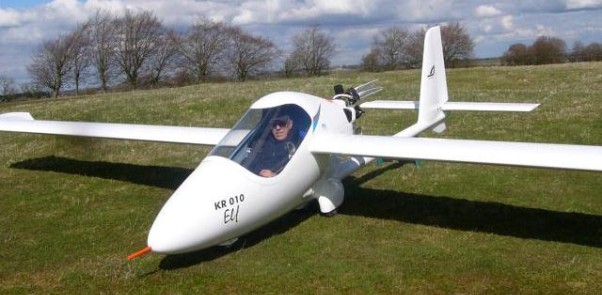
XC Aviation KR 010 Elf

Elf self launch Ultralight sailplane.

Jerzy Krawczyk, in addition to Ekolot’s Junior and Topaz, has several light aircraft, crop sprayer, and sailplane designs to his credit. In creating the self launching Elf sailplane, he employed composite sandwich and carbon structures to achieve the exceptional strength and durability required to pass UK BCAR Section ‘S’ airworthiness certification.

The Elf prototype used the JPX 330 engine which, unfortunately, was withdrawn from production in 2006 after over 20 years in the market. Fortunately, Compact Radial Engines in Canada has produced a very similar unit. This is 20% more powerful than the JPX and also employs a clutch which eliminates folding prop ‘chatter’ on start-up and allows the prop to fold whilst the engine is on idle. This engine has displayed instant re-start capability.

The Elf employs full span flapperons, and airbrakes, and has excellent rudder/stick co-ordination. The NN17-18 aerofoil possesses mild stall characteristics and overall, the handling conveys a strong sense of stability and security to the pilot.

Production aircraft will have the more powerful Compact Radial engine and a 126cms prop with a projected climb rate of 500 ft/min.

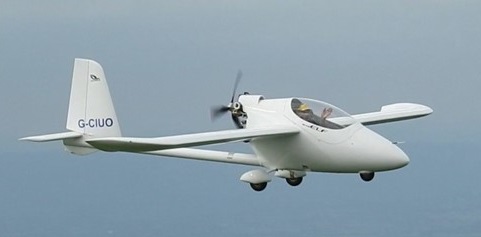
KR-010 “Elf” G-CIUO over Scotland

Engine off, the Elf with it’s 120 ft/min sink rate is capable of slowing down to exploit the slightest lift and core the smallest thermal. This is where the fun and skill challenge begins and where, if the pilot falls out of lift into sink, he can be confident of a quick engine restart and climb back to the area of lift.

Prototype
Engine: JPX 330, 24 hp
Prop dia: 116cms , folding
Weight: 145 kg (with BRS)
Gross Weight: 260 kg
Area: 10.8 sq/m
Span: 11.2 m
Length: 5.7m
Aerofoil: NN18-17
Fuel Capacity: 15 litres (3 hours + reserve)
Proof Load: +6 / -3
Max Pilot Height: 1.9m (6’3”)
Max Pilot Weight: 100kg (220lbs)
Cruise: 50 mph at 5,100rpm
Max Climb: 400ft/min at 30mph
Stall: 27mph
Best L/D: 26.4:1, 150ft/min at 45mph
Min Sink: 120ft/min at 39 mph
Airbrake: 300ft/min at 45mph (13:1)
Fuel burn: 4.5 litres/hour

X-Air Falcon / X-Air F

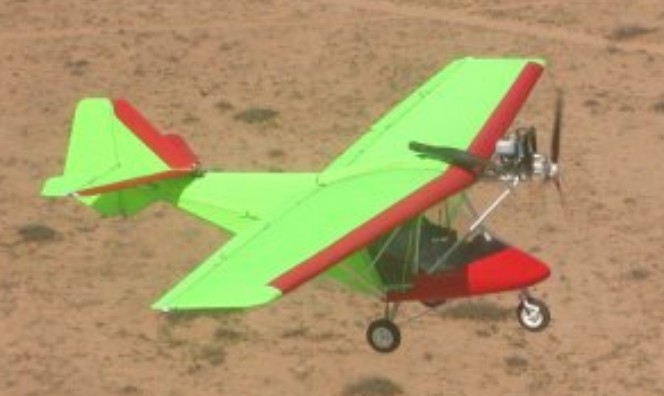
The “F” model or “FLAP” model is an evolution of the standard X-Air; it has three stage flaps to slow the aircraft down for landing and more streamlined fuselage section. The wing and tail on the Flap model also differs from the Standard X-Air, the flap model flies faster than the standard X-Air because of the different profile wing.

The kit is essentially the same.

The upgraded design gives an improved cruise speed, and makes handling in rough weather even better.

The X-air Falcon also known as the Xair-F in some countries, has the same configuration as the standard Xair, high wing, 2 side by side seats, dual controls, the pilot has toe brakes, elevator trim etc. as the Xair, with the addition of a 3 stage flap. The X-AIR can also be fitted with an emergency brake operated by the instructor. The X-Air also has a solid wooden floor in the cockpit.

The maximum all up weight of 450kg is the same, but has an improved wing profile which is shorter in span and cord. The wing section is now also fully double surfaced to the root and the fuselage tail section extends to the rudder post.

The Falcon is manufactured in India, and is supplied in kit form, which comes very complete. Only the choice of Engine/Prop & Instruments are required to finish it, ready for flight.

The X-Air can be pulled down in about 15 minutes. Firstly, the Velcro attached wing nappy is removed, the wing skin tensioning belts are released, the aileron cable is detached and with the assistance of a helper the wing struts are removed and finally, the wings are detached from the main fuse tube. All the wing removal can be done without tools. The wing can be reattached in about 25 minutes.

Nearly all of the exposed tubing, comes White Epoxy painted for long life. Some components come pre-assembled, e.g. Tailplanes & Elevators, and all the required nuts & bolts are in their relevant place’s, to speed up assembly.

The Falcon like the X-air is fitted with full Dual controls, i.e. two sticks, two throttles. The advantage of being in the left seat is to use of the independent toe brakes, fitted to the top of the Rudder pedals.

The seating is fitted with headrests. The cockpit floor is solid, and there is an optional door kit. Each wheel has its own shock absorbing system. The suspension design is similar to shock absorbers on a motorcycle and can handle all the bumps and potholes on grass and bush strips with ease. The front wheel has dual shock suspension with trailing link design steering; the trailing link design straightens up immediately on touch down, so even landing in cross wind is relatively easy in the X-Air. The shock absorber design used on the X-Air offers rebound dampening. The undercarriage is rated to 9 g’s.

Structurally the Falcon has been tested, at it’s all up weight of 450kg, to 6 Gs positive and 3 Gs negative.

The flap model X-AIR were available with three engines from Rotax-Bombardier of Austria, the Australian produced Jabiru engine and the HKS from Japan. Available Rotax options being the 52 HP “503” or the 65 HP “582” and the 80HP “912”. All Rotax engines feature carbon fiber Brolga ground adjustable props.

The fuel tank capacity of just over 59 liters gives a comfortable endurance of at least 3 hours at normal cruise with a 1/2 hour reserve and the optional 80 L fuel tank was available.

The Jabiru engine produces 80 horsepower and consumes approximately 15 liters of fuel per hour and the HKS engine has been successfully fitted to several aircraft.

The recommended engine selection is the Rotax 582. The 582 engine bolts to the X-Air without modification, it provides up to 1200 ft/min climb one up, 900 to 1000 ft/min climb two up). The Rotax 503 climb performance is about 600 ft/min.

General Configuration
Two seater, side by side
3 Axis; Ailerons, elevator and rudder
Full dual control – two sticks, two throttles
High wing, high mounted engine
Tricycle Gear, with independent hydraulic shock absorbers
Steerable nose wheel, linked to rudder pedals
Toe operated differential brakes
Enclosed cockpit, lexan windscreen
Enclosed fuselage
Elevator trim
3 stage Flaps
Two 27L Tanks
Polyester Sail Cloth
G loading +6 -3
6061 T6 Alluminium
Tubing epoxy/polyurethane painted

X-Air F
Engine: Rotax 503
Length: 5.70 m / 18 ft 8 ins
Wing span: 9.45 m / 31 ft
Max height: 2.55 m / 8 ft 4 ins
Wheel track: 1.60 m / 63 ins
Wing area: 14.28 sq.mWheel track: 1.60m
Wheel base: 1.45m
Wheel size: 500 mm / 16 ins
Wheel base: 1.45 m / 57 ins
Empty weight: 230-251 kg
Empty weight w/opts: 242-279 kg

Engine: Rotax 582 ‘C’ Box engine fitted with two blade DUC Prop
Length: 5.70 m / 18 ft 8 ins
Wing span: 9.45 m / 31 ft
Max height: 2.55 m / 8 ft 4 ins
Wheel track: 1.60 m / 63 ins
Wing area: 14.28 sq.m
Wing loading: 31.50 Kg/sq.m
Wheel size: 500 mm / 16 ins
Wheel base: 1.45 m / 57 ins
Empty weight: 237-270 kg
MTOW (Australia): 490 kg

582DCDI
Stall Speed: 28 mph
Vne: 98 mph
Cruise Speed: 70 mph
Climb Speed: 40 mph
Rate of Climb: 700 ft/min
Glide Ratio: 7@40 mph
Fuel Consumption: 16 Ltr/hr
Empty weight: 237-270 kg
MTOW (Australia): 490 kg

X-Air F
Engine: Rotax 618
Length: 5.70 m / 18 ft 8 ins
Wing span: 9.45 m / 31 ft
Max height: 2.55 m / 8 ft 4 ins
Wheel track: 1.60 m / 63 ins
Wing area: 14.28 sq.mWheel track: 1.60m
Wheel base: 1.45m
Wheel size: 500 mm / 16 ins
Wheel base: 1.45 m / 57 ins
Empty weight: 230-251 kg
Empty weight w/opts: 242-279 kg

Jabiru
Engine: Jabiru fitted with Newton 2 blade wood 60″ x 40″.
Empty weight: 263kg/580 lbs
Stall Speed: 32 mph
Vne: 98 mph
Cruise Speed: 75 mph
Climb Speed: 40 mph
Rate of Climb: 700 ft/min
Glide Ratio: 7@40 mph
Fuel Consumption: 11 ltr/hr
MTOW (Australia): 490 kg

Verner 133M
Engine: Verner 133M 2:1 box fitted with 2 blade DUC prop.
Stall Speed: 32 mph
Vne: 98 mph
Cruise Speed: 80 mph
Climb Speed: 40 mph
Rate of Climb: 800 ft/min
Glide Ratio: 7@40 mph
Fuel Consumption: 11 ltr/hr
MTOW (Australia): 490 kg
Empty weight: 263kg/580 lbs