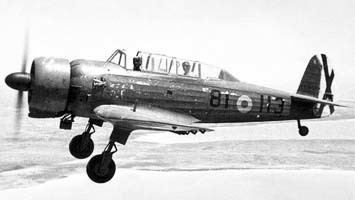
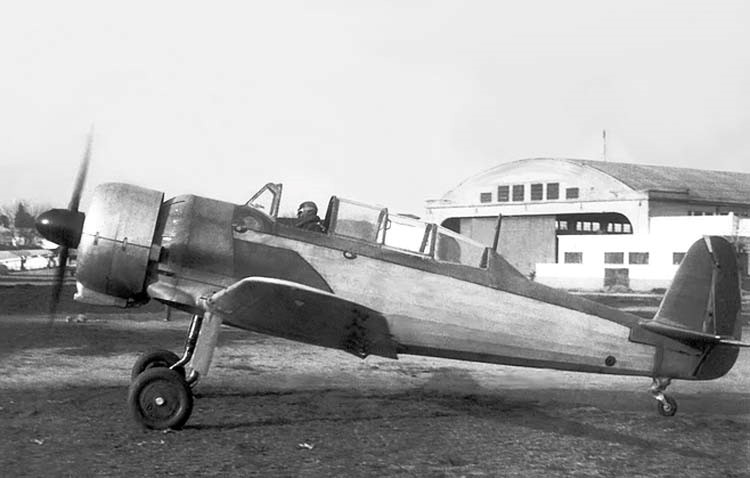
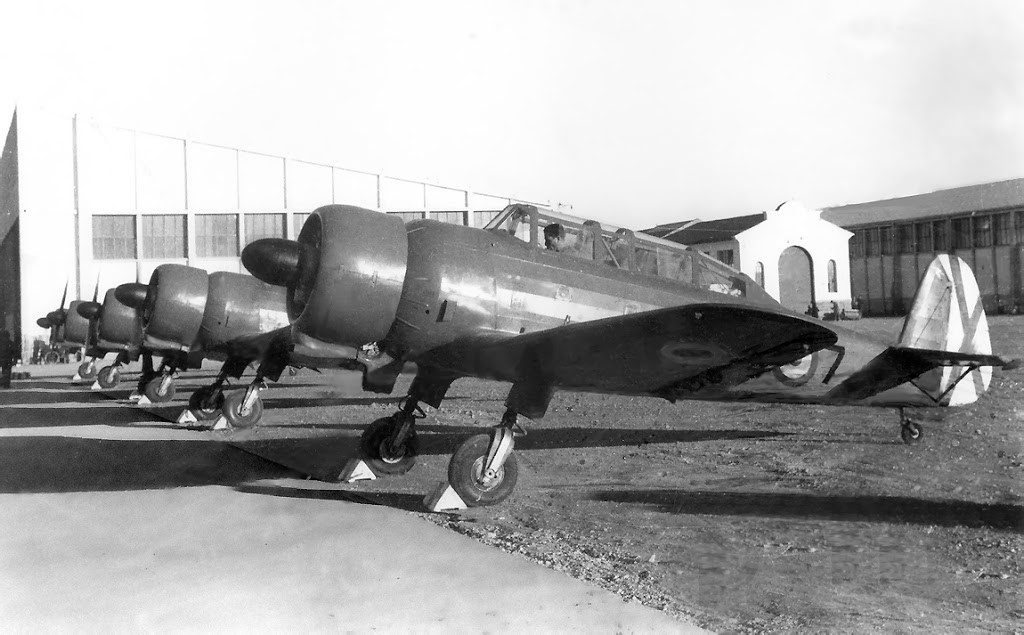
First flying in 1947, the Hispano HS-42 and its derivative, the HA-43, were advanced military trainer aircraft produced in Spain. The basic design was that of a conventional, low-wing, cantilever monoplane with seating for the pilot and instructor in tandem.
The HS-42 had fixed, tailwheel undercarriage with spatted mainwheels, while the HA-43 had retractable main units. Produced on the assembly line that had been used to build Fokker D.XXI fighters, the HS-42 shared some components with this aircraft.
HS-43 (HA-43)
The HA-43D-1 advanced two-seat military trainer went into production for the Spanish Air Force in 1947.
HS-42D
The HA-43D-1 was followed in 1953 by the HA-100 EI replacement
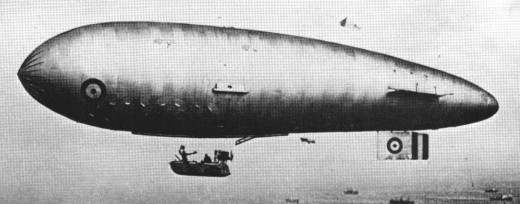
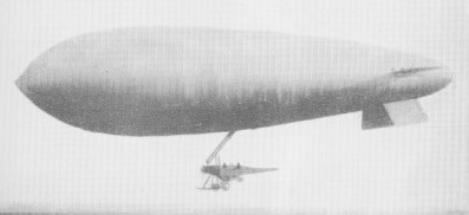
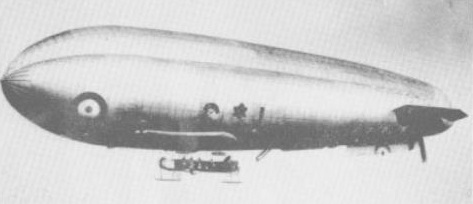
Utilised by the RNAS during WW 1 for anti-submarine patrol and convoy escort duties. Hurriedly conceived as a composite of the Willows JV (HMA No. 4) airship and a car formed from the fuselage of an RAF B. E. 2c aircraft, the resultant combination was a simple non-rigid that could be used for submarine hunting and convoy protection. It was first tested in March 1915 and given the designation ‘SS’ class, indicating ‘Sea Scout’ or ‘Submarine Scout’. Alternative cars could be fitted, and although the greater number used the B.E.2c fuselage (these being SS1 to SS3, SS8 to SS10A, SS12 to SS20, and SS23 to SS25), 11 were fitted with Armstrong Whitworth cars and 12 with Maurice Farman cars. Some are on record as going to France and Italy, while they also inspired certain US vessels of similar construction. The original ‘SS’class airships flew with a dorsal fin, while the ventral one of SS40 was extended in area. Anticipated work was agent-dropping, but it was actually used for night reconnaissance. The ‘SS’ class was used for patrols over the Dover Straits and Irish Narrows, the first base to have the type being that established at Capel near Folkestone on 8 May 1915; a second base began operations with the ‘SS’ on 6 July of the same year, this being at Polegate (Eastbourne) where there were three, compared with five at Capel. In later models the gas capacity was increased first to 1699 cu.m (60,000 cu ft) and later to 1982 cu.m (70,000 cu ft) from the original 580.5 cu.m (20,500 cu ft).
The SSO had a capacity of 70,500 cu ft., were 43.58m long and 9.14m in diameter. Useful lift was calculated to be 609.62kg. The class was powered by the 75hp Rolls Royce Hawk six cylinder engine with a maximum forward speed of 42 kts. On patrol speed was 30 kts. Other more radical variations were introduced to produce the ‘SST’ class, which had twin engines but of which only six were constructed, and the ‘SSP’ class (the last letter indicating pusher propulsion) that was even less successful, only two being built. As might be expected these airships, which gave to the English language the word ‘Blimp, had the capability to stay aloft for many hours, the normal flight duration being seven hours although records exist claiming up to twice this figure. The type served throughout the war on the same duties and certainly had a deterrent effect on submarine commanders, whose vessels it was possible to see below the surface of the water. Some, with Armstrong Whitworth F. K. 3 fuselages doing duty as their cars, were powered with 74.6-kW (100-hp) Green water-cooled motors as an alternative to the standard powerplant, the Hawk engine being particularly associated with the Maurice Farman nacelles. Production was about 150 ‘SS’ class airships. The final variant of the ‘32’ class airship was the ‘SSZ’ class (Z indicating the ultimate or zero form), of which no less than 93 were ordered although only 63 of these went to the Royal Navy: SSZ23 and SSZ24 were sent to the United States where the latter became A5472, while SSZ21 and SSZ22 went to France. The type was introduced late in 1916 and although the engine was usually the Rolls-Royce Hawk, two were fitted with the Renault V-S of similar rating, and all were used for similar work to that performed by the earlier ‘55’ type. The main visual difference between the two classes was the specially designed car that took the place of the aeroplane fuselages used formerly. In fact the SSZ was not originally intended for sea patrol, being designed to be towed by surface vessels of the Belgian coast patrol and by monitors, when their role would have been no more than aerial platforms for gunnery spotting after release and under their own power. The very first airship of this type was in fact built at Capel (Folkestone) and later flown to the Dunkirk area, where it was based at St Pol on 21 September 1916, three months after it had been constructed. Perhaps the chief claim to history enjoyed by the SSZ is the fact that, despite being of non-rigid construction and therefore capable of being flown only if the weather was suitable, they were responsible for spotting 49 submarines, of which 27 were claimed as sunk. To do this it was necessary for the airships to remain aloft for lengthy periods and the record for this goes to the crew of SSZ39, who remained in the air during the summer of 1918 for a continuous period of 50 hours. This was more than double that of the accepted ‘long patrol’, which was in the region of 24 hours, although the average was 12. A crew of three manned the airships. The crew car was designed to float like a boat and water landings were made on numerous occasions. In the front sat the wireless/telegraphist, the pilot in the centre and the engineer in the rearward position. Directional control was by rudder behind the vertical fin on the underside of the ship and elevators on the horizontal fins. To maintain envelope pressure and compensate for gas loss two ballonets were filled with air from a scoop immediately aft of the pusher propeller. The two ballonets were equivalent to about one third of the envelope volume which was a two ply rubberised fabric. Patrol duration was listed at 12 hours at full speed although at half speed patrols of 23 to 30 hours were quite common. In 1918 a flight of 50 hours 55 minutes was logged. It must be also remembered that the overhaul life of an aero engine at this time seldom exceeded 20 hours and was quite often as little as five hours. A total of seventy-one of the Submarine Scout class were built between 1916 and 1918.
‘SS’ class Powerplant: one 55.9-kW (75-hp) Renault V-S or Rolls-Royce Hawk six cylinder water-cooled piston engine, or one 74.6-kW (100-hp) Green water-cooled piston engine Maximum speed 48 kph (30 mph) with Renault or Rolls-Royce engine, or 80 km/h (50 mph) with Green engine. Useful lift 3001 kg (6,615 lb) Diameter 9.75 m (32 ft 0 in) Length 43.59 m (143 ft 0 in) Volume 1982.2 cu.m (70,000 cu ft) Armament: one 7.7-mm (0.303-in) Lewis machine-gun, plus bombs.
‘SSO’ class Engine: 1 x Rolls-Royce Hawk 6 cyl, 75 hp.
‘SSZ’ class Type: sea patrol airship. Powerplant: one 55.9-kW (75-hp) Rolls-Royce Hawk six-cylinder or Renault V-8 water-cooled piston engine. Maximum speed 77 kph (48 mph) Service ceiling 2400 m (7,875 ft) Normal endurance 12 hours Useful lift 3300 kg (7,275 lb Diameter 9.75 m (32 ft 0 in) Length 43.59 m(143 ft 0 in) Volume 1982.2 cu.m (70,000 cu ft) Armament: one 7.7-mm (0.303-in) Lewis gun for the observer, plus bombs
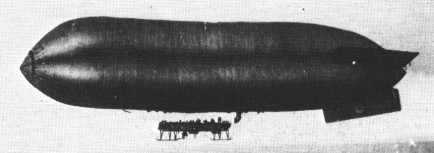
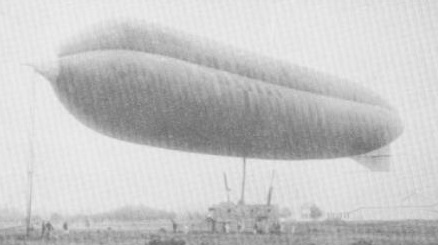
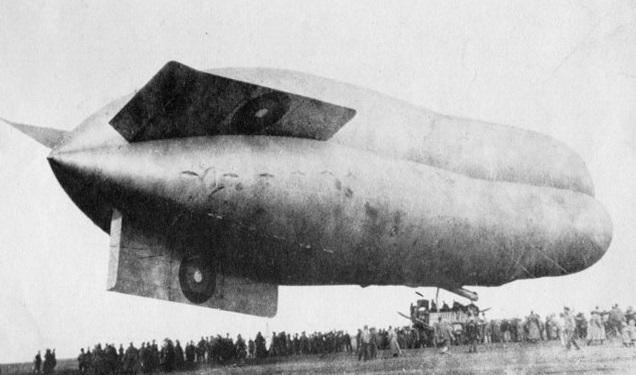
Designated the ‘C’ class from its anticipated use as a coastal type (‘Coastal’ class was an alternative name), this non-rigid type was of medium size and constructed with a trefoil envelope section, frequently known as the Astra Torrès type. The first of the pattern was ordered in June 1915 from Kingsnorth where it was assembled in the following September. The choice of envelope construction posed problems that were overcome in an interesting manner. Among these was the method of car suspension: the cables for this purpose were attached along the intersection line of the lobes and from here ran through the bottom of the covering to the car. And it is noteworthy that though the gas cells were contained in a non-rigid structure, it was possible to site one of two defensive gun positions on top.
Pembroke was the first naval air station to have the type, and the first flights took place from here in June 1916, other bases being Pulham, Howden. Mullion, East Fortune and Longside. The seas that came under the care of the ‘Coastal’ class airship patrols were those off the Norfolk coast, Lands End, the mouth of the Humber, the Firth of Forth and Aberdeen. Although the work of these vessels was largely unspectacular, one was the subject of an interesting set of experiments which were carried out on 6 September 1916. These were made with the first of the type, C1, in conjunction with the light cruiser HMS Canterbury, and were conducted offshore to look into the question of future developments, whereby an airship might be refuelled from a surface vessel.
A total of only 26 airships of this class were delivered, although these remained in service for lengthy periods. Thus they enjoyed a reputation for longevity as well as for extended flight times, the endurance of the design being as much as 12 hours. The crew of these airships consisted of five men, four of them in the car which also contained the two engines, fore and aft, driving tractor and pusher propellers respectively. The men’s accommodation was very considerably more comfortable than that of the fifth man, the upper gunner who had a special climbing tube through the envelope to reach his lofty position. ‘C’ class airships gave good and reliable service once the problems of cooling for the rear engine and blowing in of the nose cone had been solved.
When engines of differing powers were fitted in any one ship, the more powerful was normally that at the rear, while it is interesting to note that the cars were constructed from a pair of Avro 510 fuselages. Cl alone differed from the others in having a 57.9-in (190-ft) envelope with a 3964.4-cu.m (140,000-cu ft) capacity. The type had small variations of airscoop position and car details.
Naval Airship No.3
Four 1916-built Coastal airships were purchased by Russia in 1916, named Chernomor-1, 2, 3 (Name of the character of Russian fairy tale). The envelope volume was 4500 cu.m and the highest speed 80 km / h with two 173 h.p. engines.
Chernomor-1
In 1916, Chernomor-1 was at the very beginning of the next flight over the Black Sea, when engine failed. When returning to the base, the second engine failed. The situation was complicated by a decrease in the temperature of hydrogen in the envelope, which occurred as a result of the dense cloud covering the sun. The airship began to descend rapidly. The discharge of ballast and heavy equipment did not correct the situation. The gondola collided with water 10 km from the shore near the Kherson lighthouse, a boat coming to the rescue, and towed the airship to the Round Cove. When transporting the airship to the boathouse a strong wind rose, and in order to avoid the danger of damage, Chernomor-1 was dismantled. After that, it was never reassembled.
In one of the Chernomor-2 test flights, one engine failed. It was decided to land at the airfield Kachinskaya Aviation School. When landing, the second engine also failed. Despite this, the landing was done. Due to the increased wind and lack of space for safe parking, the airship “Chernomor-2” was dismantled. After that, it was never reassembled.
Chernomor -2
In the end, “Black Sea-3” was burned at the boathouse, and the “Black Sea-4” was not completed.
The C-Star class (sometimes written as C* class) of non-rigid airships or “blimps” were used by Britain’s Royal Naval Air Service for convoy escort duties during World War I. Developed from the Coastal class (often referred to as the “C class”), the Star in their designation indicated a modification of the original class which they slowly replaced in service.
C Star
The C-Star class were slightly larger than their predecessors. With an endurance of up to 30 hours, and more powerful (and reliable) Renault engines, the C*s had the same basic layout as the Coastal Class, with the same trilobe envelope. However, the envelope tapered towards the rear, as on the SSZ class, which greatly improved stability, as did the larger control surfaces.
‘C’ class Type: sea patrol airship Powerplant: two 111.9-kW (150-hp) Sunbeam six-cylinder water-cooled piston engines, or one 179-kW (240-hp) Fiat and one 82.0-kW (110-hp) Berliet water-cooled piston engines Maximum speed 80 kph (50 mph) Service ceiling 2134 m (7,000 ft) Useful lift 1608 kg (3,545 lb). Width 12.04 m (39 ft 6 in). Length 59.66 m (195 ft 9 in) Volume 4813.9 cu.m (170,000 cu ft). Armament: two 7.7-mm (0.303-in) Lewis machine-guns, plus bombs.
Chernomor Volume: 4,500 cu.m Max.speed: 80 km/h
C-Star Powerplant: 1 × tractor-mounted Berliet, 110 hp (82 kW) & 1 × pusher-mounted Fiat, 260 hp (193 kW) Volume: 210,000 cu ft (6,000 cu.m) Length: 218 ft 0 in (66.46 m) Width: 49 ft 3 in (15.01 m) Height: 57 ft 3 in (17.53 m) Useful lift: 4,030 lb (1,830 kg) Maximum speed: 58 mph (93 km/h, 50 kn) Endurance: at half speed 20 hours; at full speed 10 hours Service ceiling: 9,500 ft (2,900 m) Crew: Five
An Advisory Committee for Aeronautics was formed in 1909, and a small dirigible, the Baby, was completed and flown. At the end of the year the Balloon School was made a separate establishment with Capper at its head, and the Factory became a civilian unit, although still under War Office direction.
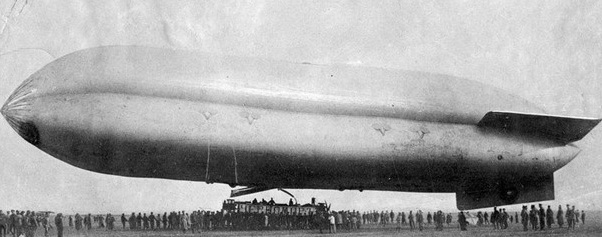
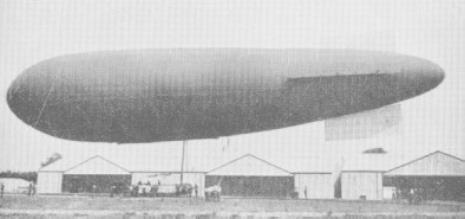
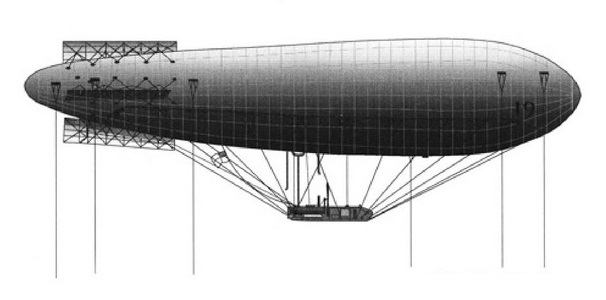
The airship Baby had been rebuilt and improved into the larger Beta, and followed by the progressively larger Gamma and Delta. The first product of the newly established Royal Aircraft Factory was the airship Delta, Naval Airship No.19, which had originally been designed in 1911 as a semi-rigid but emerged in 1912 rebuilt as a non-rigid of 175,000 cu.ft capacity. Contained in a rubberised fabric envelope and powered by two 105 hp White and Poppe engines, driving swivel propellers, it was the fastest British airship so far with a top speed of 45 mph.
A short, 28 foot long car and its crew of five were suspended 20 feet below the envelope, the suspension wires being attached to horizontal ropes sewn into the lower portion of the envelope fabric, while simple brace horizontal and vertical steering surfaces were attached at the stern.
With her increased capacity and a gross lift of 4.6 tons she was extensively used for training and wireless telegraphy experiments conducted by Captain H.Lefroy RE in 1912, during which transmissions were clearly picked up at a range of 100 miles.
Both Gamma and Delta took part in further army war games during 1912 and 1913, where they were employed both in reconnaissance and the ‘bombing’ of towns in ‘enemy’ territory providing valuable experience in the effectiveness of this new weapon for troops and general staff alike.
Engines: 1 x White & Poppe, 110 hp Capacity: 173,000 cu.ft Length: 198 ft Width: 41 ft Height: 65 ft Gross lift: 4.8 ton Disposable lift: 1.46 ton Speed: 44 mph Range: 8 hr at cruise Crew: 5
An Advisory Committee for Aeronautics was formed in 1909, and a small dirigible, the Baby, was completed and flown. At the end of the year the Balloon School was made a separate establishment with Capper at its head, and the Factory became a civilian unit, although still under War Office direction.
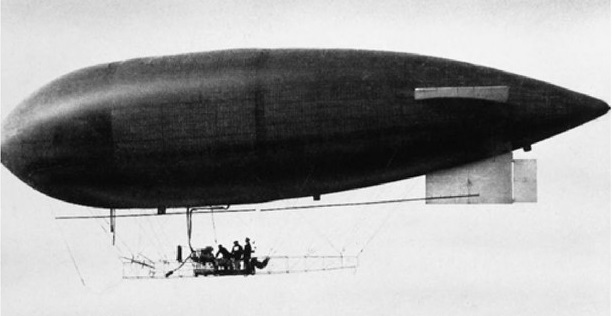
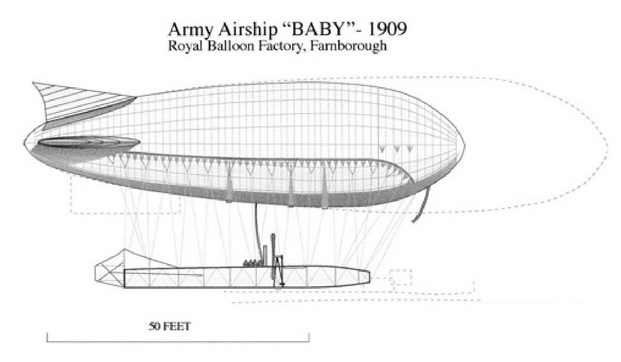
Launched in May 1909 the 22,000 cu.ft Baby was a more carefully conceived design incorporating some of the more advanced features seen in contemporary continental airships. In its original form the craft was 84 ft in length and 24 ft diameter, with bulbous air-filled fins at the stern. Unlike the earlier Gamma airship, Baby was fitted with an internal ballonet. Power initially came from to inadequate 8 hp Buchet petrol engines, these engines having previously been installed in an early version of the Dunne tail-less biplane.
After initial testing the air-filled fins were replaced with more suitable flat section steering planes, while a 25 hp REP engine was installed to provide more power. After this, and following a series of trials that highlighted poor controllability, she was further taken in hand during the winter. Emerging in the spring of 1910 in a reconstructed form and now known as Beta, her length had been increased to 116 ft with a capacity of 35,000 ft, giving her a gross lift of just over 1 ton together with a greatly improved all-round performance.
A further change of engine, a 35 hp four cylinder, water cooled Green engine, completed the conversion, giving an endurance of five hours with a crew of three.
This small craft was considered the first successful British airship, on one occasion staying aloft for eight hours. She made several flights of note, including flying over London at night in early experiments to determine the best means of defence. Beta was also the first airship to be fitted with a wireless apparatus, being used in early 1911 for experiments succeeding in sending and receiving messages at a distance of over 30 miles.
The airship Baby had been rebuilt and improved into the larger Beta, and followed by the progressively larger Gamma and Delta.
Army Airship Baby – Original configuration of 1909 Dashed outline indicates 1910 enlargement to 104 ft and capacity to 35,000 cu.ft
During the army manoeuvres of 1910 HMA Beta and recently completed Gamma were employed in evaluating their potential use to the army in warfare: in extended flights over Somerset, Dorset, Hampshire ad Wiltshire flying reconnaissance sorties; scouting for attacking and defending forces for a period of two months.
The airship was supported in the field by the old existing balloon gas train and workshop, drawn by a steam traction engine to provide a mobile base.
During the period of the manoeuvres Beta had to be deflated on only one occasion.
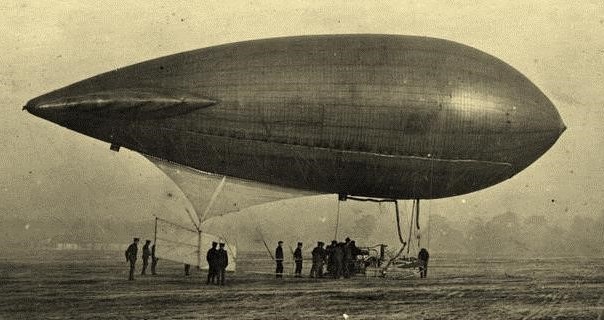
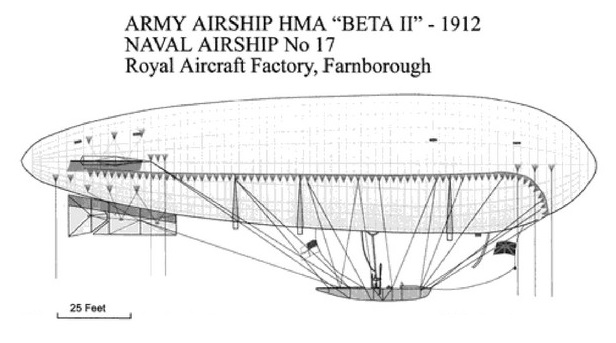
In 1912 Beta again underwent further modification, with her envelope being split lengthwise to accommodate an additional longitudinal gore. This increased her diameter to 28 ft and lengthened to 135 ft overall. The swivelling propellers were retained whereas the engine was once more changed, this time to a 45 hp Clerget, increasing the top speed to 35 mph.
Beta was also used in early mooring mast trials; using a mast designed by Commander Masterman RN at Farnborough, known as the ‘high mast’ system, whereby the airship floated free of the ground attached to the mast at the nose, using weighted rollers to keep the stern of the ship in trim as it vaned in the wind.
As Beta II she continued to give good service, taking part in the army war games on Salisbury Plain before the war and being involved in the early parachute experiments carried out from her by General E.M.Maitland. In January 1914 the navy took over the lighter-than-air operations from the army, with Beta II becoming HMA No.17 and initially used to familiarise naval personel with airship handling.
With the outbreak of war HMA No.17 was for a short time sent to France. Based near Dunkirk, she made several night flights during January 1915 over the German lines and was on artillery-spotting duties before such activities were deemed too dangerous.
Subsequently, HMA No.17 was used for training at RNAS Kingsnorth before finally being deleted in mid-1916.
The non-rigid airship “Baby” was built in 1908-1909, and subsequently enlarged and converted first to the British Army Dirigible No. 3 “Beta I” and then to Naval Airship No. 17 “Beta II”. It survived until 1916, thanks to several major rebuilds and modifications, including four different engine installations. Originally it had three inflatable fins on the tail of the envelope, which were found to be too unwieldy for practical work and were replaced by fixed fins.
1909 Baby Engine: 2 x Buchet, 8 hp Capacity: 21,000 ft Length: 84 ft Diameter: 26 ft Height: 38 ft Gross lift: 0.62 ton Useful lift: 400 lb Speed: 20 mph Endurance: 3 hr Crew: 3
1910 Baby Engine: REP, 25 hp Capacity: 35,000 ft Length: 104 ft
1910 Baby Engine: Green, 35 hp Length: 110 ft Capacity: 35,000 ft Endurance: 5 hr Crew: 3
1912 Beta II Engine: Clerget, 45 hp Capacity: 50,000 ft Length: 116 ft Width: 28 ft Height: 40 ft Gross lift: 1.22 ton Useful lift: 0.40 ton Speed: 32 mph Endurance: 8 hr Crew: 3
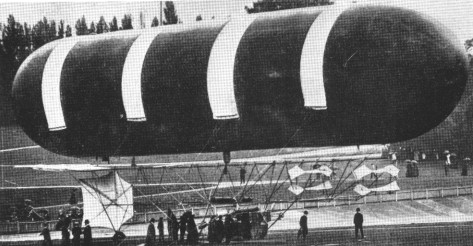
The first official government interest began in 1907 at Farnborough where, after receiving a small grant from the War Office of £2000, Colonels Capper and S.F.Cody wre able to start work on the first of the army airships, the Nulli Secundus.
The airship was designed as a semi-rigid and was to be built under conditios of the greatest secrecy. A noticeable feature of the completed craft was the long, uncovered square section metal keel suspended 12 feet below a cylindrical goldbeaters’ skin envelope of 56,000 cu.ft capacity. With a length of 120 ft, power was provided by a 50 hp Antoinette petrol motor, which doubled as the power unit for Cody’s Army Aeroplane No.1, and which drove two aluminium paddle propellers on each side of a small car suspended below the keel containing the crew of three.
An advanced feature of the propellers was that they represented the first use of a variable pitch mechanism in any aircraft, so that the blades coulb be set at an optimum angle of attack. The envelope lacked an internal balloonet compensating for the expansion of gas as the airship rose to a moderate altitude. They did include an automatic gas valve and two hand-operated manoeuvring valves.
The envelope was attached to the keel framework by four circumferential cloth bands and covered with cord netting. The netting bands being made necessary despite the extra weight due to the extreme difficulty of attaching suspension wires or other attachments to the goldbeaters’ skin fabric. Twin rudders were fitted aft, while the elevating plane was situated at the bow in the hope of providing vertical control.
On September 10th, 1907, Nulli Secundus made her maiden flight. A series of short, local flights were made at Farnborough where a speed of 16 mph was obtained.
Following these tests Nulli Secundus departed on 5 October to fly to London, landing after a three and a half hour flight at Crystal Palace. Piloted by Capper and Cody, she set up an endurance record for non rigids by staying in the air for 3.5 hours on the journey from Farnborough to London. The achievement was unfortunately crowned by anti-climax, for excessive headwinds forced the airship down at Crystal Palace on the way back. Strengthening winds threatened to damage the moored ship and the sargent in charge instead ordered the ship to be inflated and it was returned to its base by road.
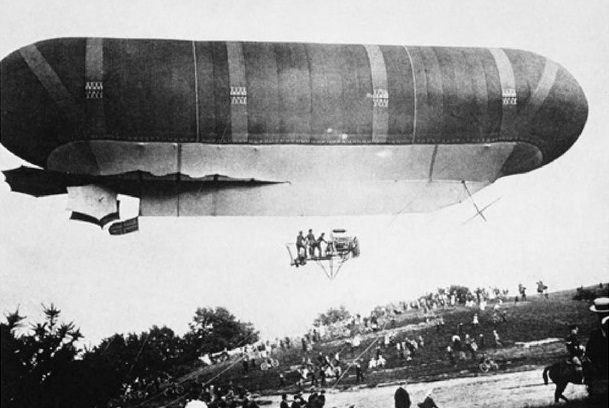
In December 1907, Cody began to build his first biplane at Farnborough, and Nulli Secundus was being rebuilt to emerge as Nulli Secundus II the following summer.
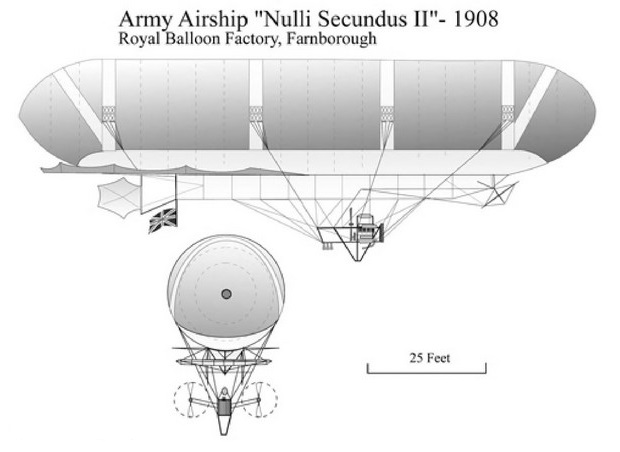
During the winter month the airship was rebuilt, emerging as Nulli Secundus II of a slightly increased capacity with a new, streamlined silk-covered deep keel that was attached directly to, and faired into, the underside of the envelope. Nulli Secundus II had made its first flight on July 24th, 1908. Several local flights were made during July and August, where a speed of 22 mph was recorded however both vertical and horizontal control was deemed to be inadequate and the airship was dismantled at the end of 1908.
In May 1909, after withdrawing its support for aeroplane experiments, the War Office reorganized the Factory for the primary task of producing airships.
Nulli Secundus II 1908 Capacity: 56,000 cu.ft Length: 120 ft Diameter: 26 ft Height: 44 ft Gross lift: 1.0 ton Disposable lift: 0.20 ton Engine: 1 x Antoinette, 50 hp Speed: 12 mph Endurance: 4 hr Crew: 3
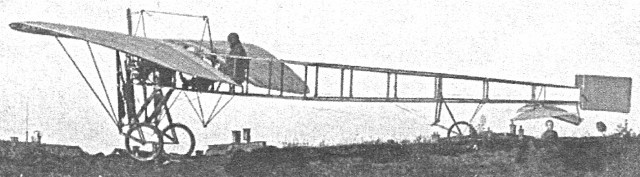
Hellmuth Hirth worked for a short time as a foreman at aviation pioneer August Euler in Darmstadt. However, since Euler had difficulties with his Voisin-type flying machine, Hirth returned to Stuttgart to build himself a Blériot machine in 1909. Because of the too weak engine, this did not go beyond small aerial jumps, causing Hirth to go to Vienna to fly the Etrich Taube together with Illner.