JAI JAI-19

The experience gained with the first devices conceived at SKB JAI showed the need not only to design them, but also to build them. In a period of three months the students under the direction of VV Reshetnikov and BL Zaslavski designed and built a second model that was named JAI-19 (Russian: ХАИ-19) in 1962.

In the design and construction of JAI-19, the students B. Zaslavski, S. Gotenkov, A. Sazonkin, V. Lyushnin and S. Reshetnikova stood out among others. Components and parts of the previous JAI-17 were used to build the aircraft.

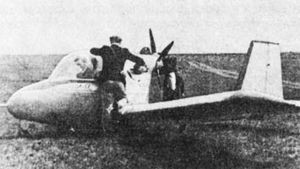
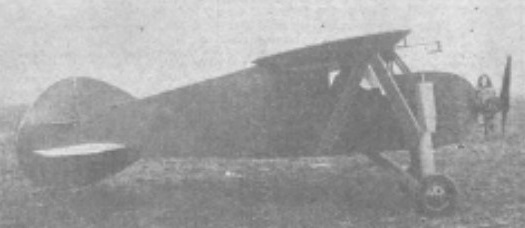
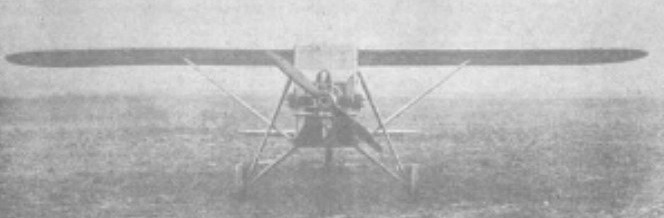
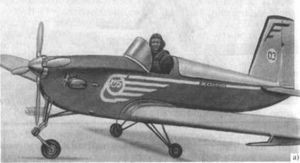
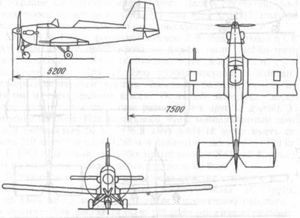
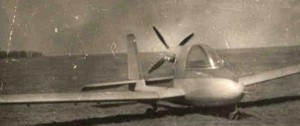
The JAI-19 was a cantilever low-wing monoplane. The entire construction was made of wood. The fuselage was made up of a wooden structure with fabric covering.

The wings were rectangular in plane. The single-stringer construction was wood with fabric covering. The wingtips were made of plywood. The trailing edge featured conventional ailerons and flaps. The tail unit was of the conventional type, with a trapezoidal tail and a rectangular stabilizer.

The landing gear was a fixed tricycle type with a 1.20m span between the main landings. The front wheel was steerable.
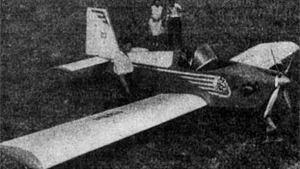
The 30.5 hp M-61K motor with a gearbox was selected as the power plant, removed from the crashed JAI-17, with a 4-blade, variable pitch propeller. The fuel was stored in two 27-liter tanks and fed to the carburetor by gravity. Behind the engine was an open cabin for the crew member, protected by a small windshield.

Construction began in 1961 and lasted for three months. The first test flight was carried out by SKB director JAI V. Reshetnikov.

Between 1962 and 1963 VV Reshetnikov carried out several successful flights on the JAI-19, but completing the tests proved impossible and only achieved flight heights of 50 – 70 meters. The JAI-19 was shown at the RS Ukraine Achievement Exhibition.

JAI-19
Engine: a 30.5 hp M-61K
Wingspan: 7.50 m
Length: 5.20 m
Wing area: 9.50 m²
Empty weight: 200 kg
Maximum takeoff weight: 312 kg
Maximum speed: 140 km / h
Cruising speed: 120 km / h
Landing speed: 60 km / h
Practical range: 600 km
Practical ceiling: 2000 m
Take-off run: 200 m
Landing run: 120 m
Accommodation: 1
JAI JAI-17

The first aircraft built at the Kharkov Aviation Institute after the war was the JAI-17 (Russian: ХАИ-17). In 1957 a group of JHA students under the leadership of VV Reshetnikov decided to test their strength in the construction of a small sports plane. A circle of interest was created under the direction of teacher LD Arson to develop this project. OK Antonov decided to support the group. In his aviation factory an area was dedicated for production and in this place the students began to work on the construction of the aircraft.

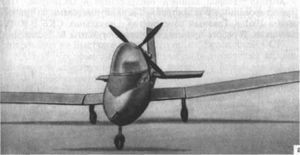
The JAI-17 was conceived as a low-wing cantilever monoplane with a driving propeller, which considerably increased the effectiveness of the empennage and stabilizers.

The wings were straight, with a rectangular shape on the plane and slightly rounded ends. The wing consoles had a slight positive dihedral.

The tail unit was of the conventional type and was located at the end of a beam connected to the fuselage.
As the power plant, a 30.5 hp M-61K motorcycle engine was selected driving a four-bladed propeller with variable pitch. The engine was located just behind the cockpit.

The landing gear selected was a tricycle, with low height landing gear and a steerable front wheel.
The pilot was located in a closed cabin forward.

On 29 April 1959 the JAI-17, with VV Reshetnikov at the controls, made the first flight.

The tests showed that with a flight weight of 352 kg the aircraft reached 148 km / h and reached a ceiling of 2300 m.

On the second flight, the plane suffered an accident due to the inexperience of the pilot. The elements of the plane were used for the construction of the improved JAI-19.

The work of the students on this plane motivated the institute council to organize a Student Construction Bureau (SKB) at the JAI . The task of its creation was assigned to the teacher PV Dybski. VV Reshetnikov, who worked on the drafting of the statutes and the structure of the organization, was selected for the leadership of the bureau. In May 1959 the first SKB of Ukraine began operations. Ten students, participants in the projection and construction of the JAI-17 plane, received the medal “For the best scientific-student work in the USSR”.

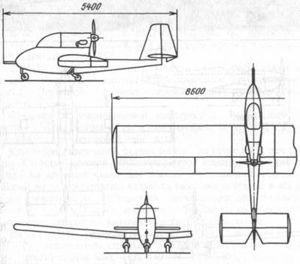
Engine: 30.5 hp M-61K engine
Wingspan: 8.60 m
Length: 5.40 m
Wing area: 10.50 m²
Maximum takeoff weight: 350 kg
Maximum speed: 148 km / h
Cruising speed: 115 km / h
Landing speed: 50 km / h
Range: 510 km
Ceiling: 2300 m
Accommodation: 1

Jacobs 1910 Multiplane

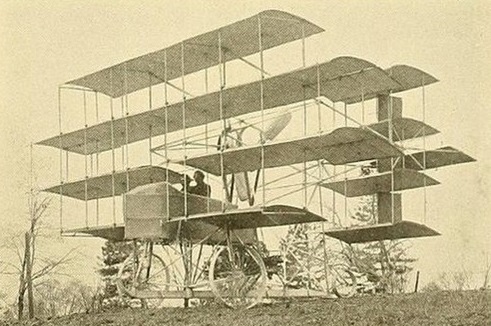
The 1910 Jacobs Multiplane [also identified as the Jacobs-Emerson multiplane] was the creation of Henry William Jacobs of Atchison, Kansas. It had quadruplane wings and tail and two engines, each driving a propeller.

Jacobs used two improved air-cooled 35hp engines he invented, to replace the two original underpowered engines [Emersons?], with which the plane flew in 1910.

It was displayed on the New York Aero Exhibition 1912. Jacobs had formed with others the firm “Multiplane Limited” in Kansas to build the machine and eventually sell it to the market and a brochure of 16 pages was produced.

Jacobs 104

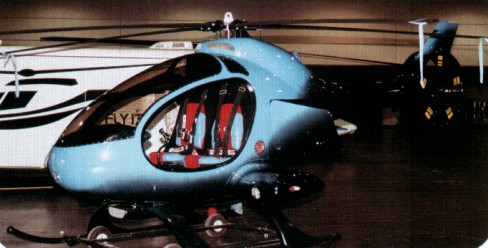
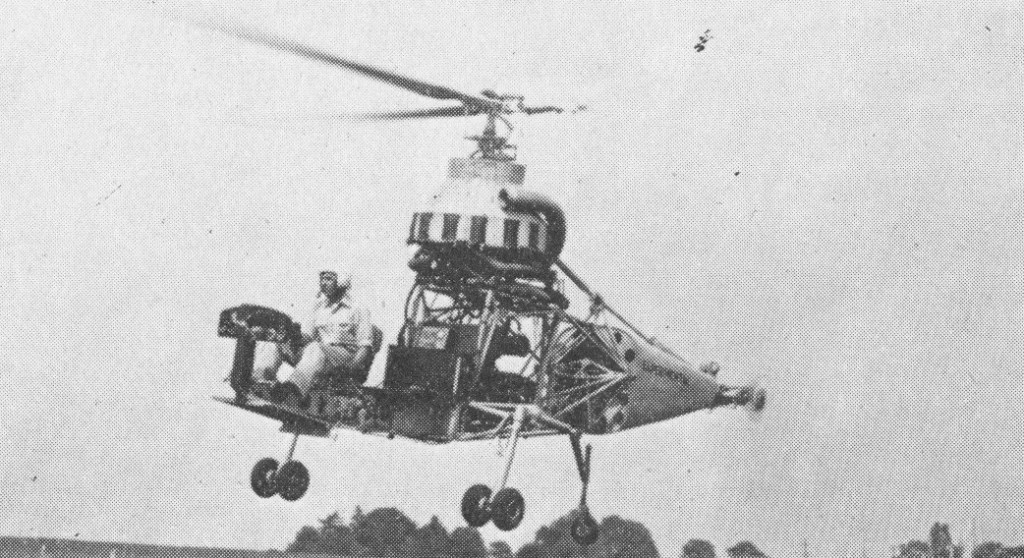
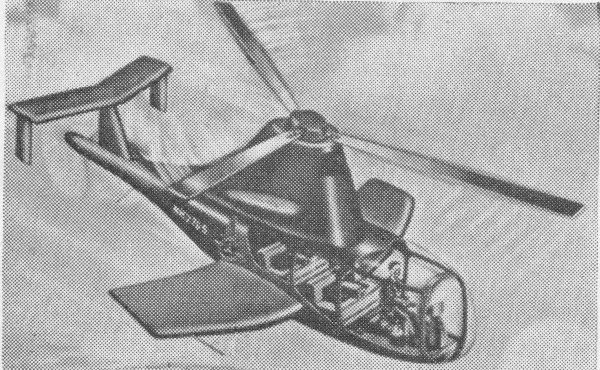
Designed circa 1958 as a high-speed short-haul aircraft, the Jacobs 104 was originally flown as a pure helicopter, as shown in the photograph above. Subsequently, a pusher propeller was fitted at the extreme tail.

It will take off as a helicopter; but in cruising flight it will be possible to transfer power to the pusher propeller, with the rotor auto-rotating and the majority of the lift coming from the fixed wings.

A feature of the Model 104 is the use of a Jacobs-designed engine “package”, consisting of the engine and complete transmission system. It is claimed to be 20 per cent lighter than conventional helicopter power plants, enabling one extra passenger to be carried. Also, by using moulded fibreglass and Plexiglass panels to cover the forward fuselage, high strength is combined with light weight, and the surface requires no painted or doped finish.

Engine: 350 h.p. Jacobs R-755EH
Rotor diameter: 36 ft.
Rotors: 3-blade main; 3-blade tail; 3-blade propeller.
Overall length: 26 ft. 4 in / 22 ft
Height: 10 ft 10 in
Empty weight: 2360 lb
Loaded weight: 3,475 lb.
Max. speed: 175 m.p.h.
Cruise: 157 mph
ROC: 1400 fpm
Typical range: 300 miles at 157 m.p.h.
Seats: 4-5.

Jackaroo Aircraft Thruxton Jackaroo

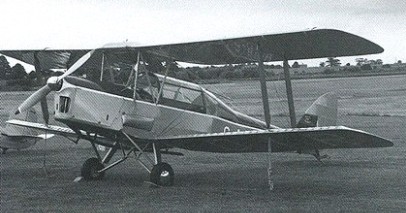
In the early 1950s Sqn Ldr J. E. Doran-Webb, managing director of the Wiltshire School of Flying at Thruxton, considered building a highwing four to five-seat touring aircraft using only Tiger Moth components. Contacts at the Royal Aero Club introduced him to Ronald Prizeman, who schemed a four-seater using the same biplane layout as a Tiger Moth but with a revised fuselage. This was accepted and formed the basis for certification as the D.H.82A (Mod) Jackaroo.
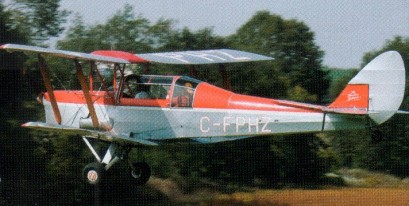
The front side frames of the Tiger Moth fuselage were moved apart by 12.5in within which four seats were installed, with the starboard pair staggered slightly forward. The basic structure and rigging of wings, tail and rear fuselage were not altered but it was necessary to increase the undercarriage track by designing a new W-shaped centre strut.
Two prototypes were built at Thruxton in 1956; G-AOEX was finished as a standard four-seater with cabin and known as a Series 1. It was test flown by Lt-Cdr Pat Shea-Simonds on March 2, 1957. The Series 2, G-AOEY, was conceived as a cargo carrier/cropduster. The cabin could be converted to carry a load of 5501b and a new low-profile superstructure neatly converted the Series 2 into a single-seater with open cockpit.

Jackaroo Aircraft Ltd was formed late 1950s at Thruxton, Hampshire, to produce the Thruxton Jackaroo widened-fuselage four-seat version of the de Havilland Tiger Moth. First “production” conversion flew on April 15, 1957, and quite a number of Tiger Moths were converted subsequently to Jackaroos. Company also designed a four-seat low-wing lightplane called the Paragon, being re-formed in early 1960s as Paragon Aircraft Ltd. to produce it under new name of Paladin.
Paragon was formed at Thruxton Aerodrome near Andover, Hampshire, from the earlier Jackaroo Aircraft Ltd., for conversion of standard two-seat Tiger Moth biplanes to four-seat configuration by inserting a new wider center fuselage and extending the top wing centre section. 18 Jackaroo conversions were carried out by the company.

By July 1957 the manufacturer was anticipating that production would reach at least six aircraft per month. An agricultural conversion kit was available at £150. Overseas owners were encouraged to convert their own Tiger Moths by purchasing a packaged kit at £600. Tiger Moths flown into Thruxton could be converted in ten days for £700.

Jackaroo Aircraft Thruxton Memories

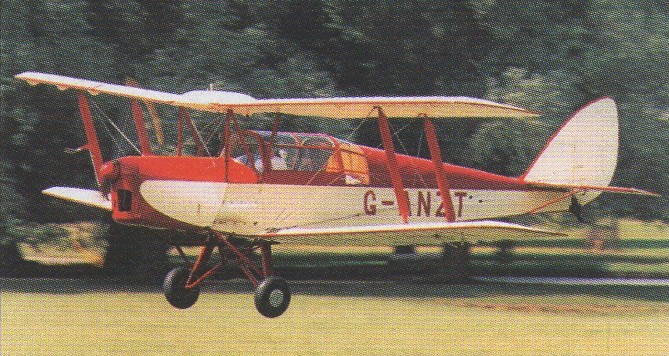
Rollason Aircraft at Croydon acquired Jackaroo G-ANZT in 1957, and incorporated a number of improvements. In April 1960 Rollason cornpleted a Jackaroo of its own, G-APOV, in which the rear fuselage faired smoothly from the wide cabin to the tail.
Although never certificated as aerobatic, the aircraft was spun on at least one occasion with all four seats occupied, an experience none of those on board ever wished to repeat.
The big prospective orders never came and import permits for five other Jackaroos already on the line at Thruxton were refused. Each was broken up for spare parts. Designer Ron Prizeman never complained however, despite never receiving his agreed royalty of £2 per aircraft

Assets acquired 1964 by Hampshire School of Flying.