Janowski J-3 Eagle

J-3 Eagle was the third, after Prząśniczka J-1 and J-2 Polonaise amateur single-seat aircraft, designed by Jaroslaw Janowski.

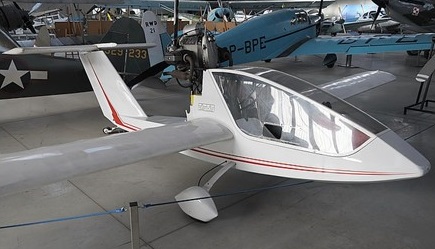
The aircraft of wooden construction featured Wortmann airfoil with flaperons all along the trailing edge, wingtip fuel tanks and composite landing gear legs. The aircraft was powered in succession by a modified Porsche car engine, a Rotax and a BMW R100 engines. The J-3 Eagle (Orzel) was produced using the pod-and-boom pusher arrangement, with a top-mounted engine and conventional landing gear similar to the J-1, and a T-tail stabilator and shoulder-mounted cantilever wings similar to the J-2. The wings used a 19% thick laminar airfoil and could be easily detached for ground transport.

A single example was built by Witold Kalita, J. Janowski and Marian Smith, for whom the aircraft was the intended. The J-3 Eagle was built from sketches, and no blueprints or plans of any sort were ever produced.

When Marian Nowak emigrated from Poland to Canada he took the J-3 with him. He flew the aircraft for 250 trouble-free hours, regularly making 375 mile commutes. However, he decided to take advantage of the detachable wings and transport it by trailer when he exhibited it at the EAA convention at Oshkosh in 1980 as the first amateur construction from the Eastern Bloc.
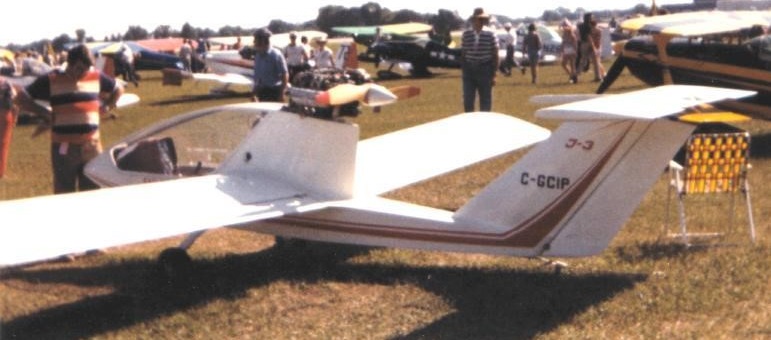
The Eagle initially flew with a 35 HP converted Porsche automobile engine, but Mr. Nowak also flew it with a Rotax 503, a Rotax 447, a 69 hp BMW motorcycle engine, and finally a water-cooled 3 cylinder Suzuki auto engine. Eventually Mr. Nowak sold the airplane, and the new owner tied it down outdoors where it unfortunately deteriorated beyond airworthy condition. The Transport Canada database listed it as last registered to Wieslaw Pawelkiewicz in April 2002, operating at Burlington, Ontario. It was donated to the Polish Aviation Museum in 2003 by the last owner, Wieslaw Pawełkiewicz of Canada.
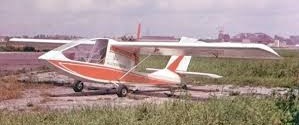
J-3 Eagle (Orzel)
Serial Number: MN-1
Registration: C-GCIP
Engine: Porsche, 35 hp
Airfoil: Wortmann NACA 23015
Wingspan: 6.7 m / 22 ft 11 in
Wing area: 6.8 sq m /73 sq ft
Length: 4.8 m (15 ft 9 in)
Gross Weight: 699-721 lb
Empty Weight: 231-320 lb
Max Speed: 155 mph
Cruise Speed: 100 mph
Landing Speed: 45 mph
Takeoff run: 328 ft
First Flight: 1976 / 1977 / 1978 / 1980
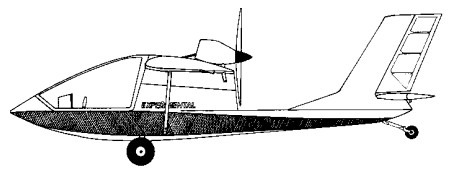
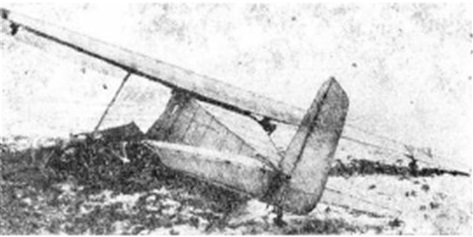
Janowski J-1 Don Quixote / Przasniczka

J-1

The prototype Don Quixote designed and built by MR. Janowski in 1974 was powered by a 23-hp two-stroke Saturn engine, also designed by Janowski. De¬veloping 23 hp from 500 cc, the J 1 features a fully enclosed cockpit with access via a lift up windscreen. The J 1’s construction uses tradi¬tional materials.
Single seat single engined high wing mono¬plane with conventional three axis control. Wing has unswept leading and trailing edges, and constant chord; conventional tail. Pitch control by elevator on tail; yaw control by fin mounted rudder; roll control by ailerons. Wing braced from below by struts; wing profile Clark Y; double¬-surface. Undercarriage has three wheels in tail dragger formation. Fuselage, totally enclosed. Engine mounted above wing driving pusher propeller.
However, several problems were inherent in the two-stroke engine, so the more readily available Volkswagen engine was settled on. The heavier engine called for strengthening the airplane’s structure. To over the widest range of homebuilders in various coun¬tries, it was decided that the Don Quixote would make use of conven¬tional wood an fabric along with more modern polyurethane foam and epoxy/fiberglass. The J-1 B can withstand loading of + 4G and – 2.3, but in the foam /fiberglass version of the plane, + 6.3 and —3.3 are possible. Construction of the plane follows conventional building rules, with spruce wood, birch plywood and flat sheets of plexiglass as basic materials.

J-1
Length overall 16.0ft, 4.88m.
Height overall 4.6ft, 1.40m.
Wing span: 24.9ft, 7.60m.
Constant chord 3.2 ft, 0.99 m.
Sweepback 0 deg.
Total wing area 81 sq.ft, 7.5 sq.m.
Wing aspect ratio 7.74.
Engine: Saturn, 25 hp.
Max take off weight 595 lb, 270 kg.
Max wing loading 7.37 lb/sq.ft, 36.0kg/sq.m.
Max power loading 23.8 lb/hp, 10.8 kg/hp.
Max level speed 81mph, 130kph.
Cruising speed 68mph, 110 kph.
Stalling speed 37 mph, 60 kph.
Max climb rate at sea level 590ft/min, 3.0m/s.
Range at average cruising speed 171 mile, 275 km.

J-1B
Engine 25-50 hp.
Wingspan: 24 ft 7.25in.
Wing Chord: 3 ft 3 in.
Length: 16 ft 4.75 in.
Height: 4 ft 5.75 in.
Empty Weight: 286 lbs.
Maximum Weight: 551 lbs.
Maximum Speed, Level Flight: 103 mph.
Cruise speed: 75 mph.
Stall speed: 41 mph.
Take-off Run: 328 ft.
Landing Roll: 164 ft.
Fuel Capacity: 4.4 Imp gal.
Nominal Range: 248 miles.

Engine: Volkswagen, 23 hp
Top speed 84 mph.
Cruise 77 mph.
Stall 39 mph.
Climb rate 244 fpm.
Ceiling 6820 ft.
Range 310 mile
Takeoff run 761 ft.
Land¬ing run (50ft) 1256 ft

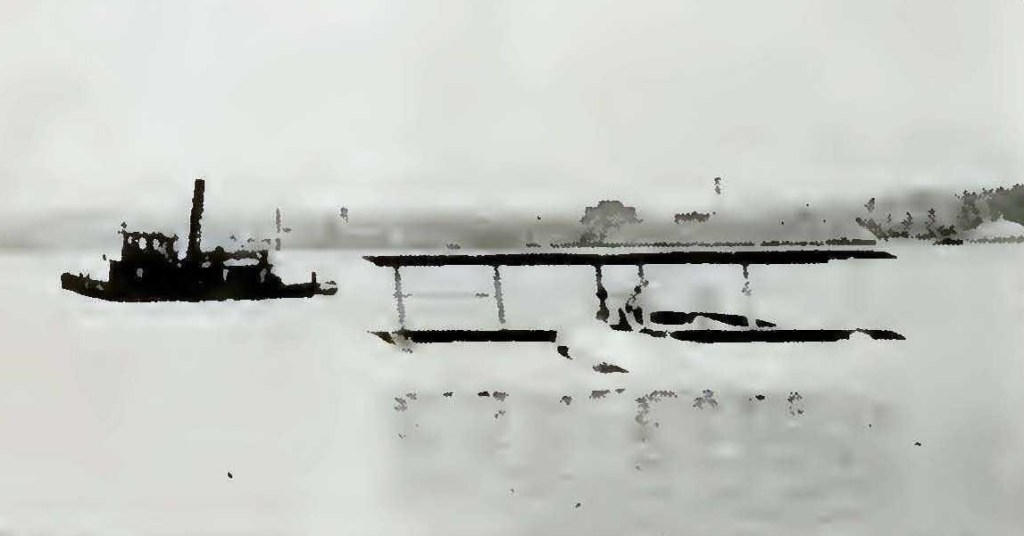
Jannus 1915 Flying Boat

A new and efficient design for rough water, ready assembly and disassembly, inherent stability, wide range of flying speed, waterproof construction of wings, enormous margin of safety, comfort for pilot and three passengers, and a dry, clean place for them to sit, this 1915 model is ideal.
The rough water ability is obtained in two principal ways: first, all the wing attachments are independent of the motor and propeller shaft; and. second, the low centre of gravity. Of special interest are the tapering end floats that never pound or jerk the wings. These taper from three inches wide across the bottom to a foot across the top. The taper has the advantage of reducing the planing surface, which at high speed would be sufficient to pound the wings badly, but when called upon as floats are quickly displacing water at an increased rate, easily combating the heaviest side lurching or listing or yawing tendency.
The removability of the tail for shipment has many advantages in construction and in simplicity of shipment for compactness. The motor remains in the front half of the hull with all controls intact. The control cables going to the tail and rudder all pass through individual leads in a conduit that is made of heavy steel as a protection against the propeller breaking or throwing anything with sufficient force to sever them.
Between the conduit and the controls the cables are supplied with the Jannus type sister hook, which locks the cables together in a permanent fashion quickly, and without additional safety wire or other auxiliary being necessary.
The wings are assembled in their entirety before being attached to the hull and, when on, cannot fail to align properly if reasonable care is taken. Where desirable they can he put on half at a time. To April 1915 the best record showed a total load of 2.200 lbs. carried in flight at 22-55 mph with an indicated 60 h.p.
Tests in the lee of large vessels, along windward shores and in other extreme conditions of gusty wind and treacherous obstacles prove that the new struts and the staggered planes are serious contenders for the inherent stability honors. The pilots reported that in no case was there any rapid inequality developed nor did the machine make any appreciable variation from its course due to these unfavourable conditions.
The tests have been conducted by Mr. Fritz G. Ericson and Mr. Antony Jannus.
The designers did not stagger the planes in this model for other than structural advantage.
The internal construction of the wing is free from ordinary glue and is amply strong without any adhesives, although liquid marine glue is used in all joints to maintain rigidity under severe stress and to prevent rotting. All bolts go on each side of the beams, through end grain blocks that are brass covered outside of the fabric.
The pilot is seated in front, leaving a seat behind for three large passengers. The ample foot space is well above the ribs of the bottom and made in the form of a grating that is removable for cleaning the bilge scuppers or any other purpose.
The motor compartment is segregated from all other parts of the boat, so that no oil or grease can be distributed.

JAI JAI-60 60 years of the JAI

The JAI-60 (Russian: ХАИ-60) all-metal trainer was designed at the SKB JAI and built at the Kharkov Aviation Factory in 1990, in commemoration of the 60 years of the JAI.

One of the last works of the SKB JAI was the JAI-60 light aircraft (also known as “60 years of the JAI”) design began in 1985, when the magazine “Krilya Rodini” (Wings of the Fatherland), together with the DOSAAF and the NII MAP, launched a competition for the development and construction of a light aircraft for primary training.

The design group was led by the head of NIL OSKB JAI Gennadi G. Jmyz. The developers, from the very beginning, decided that the new model should be useful not only for training, but also for transporting passengers and cargo. In compliance with the conditions of the contest, great attention was paid to the take-off and landing characteristics, and the ability to operate from airfields with asphalt runway, and the ability to tow gliders.

The JAI-60 was designed as a high-wing, braced monoplane with a conventional type tail unit. In its construction, the wing has negative sagging (-7º).

The landing gear features fixed main titanium legs. The enclosed cabin easily accommodates the pilot and two passengers, also featuring a luggage compartment.

This model originally featured an MZ three-cylinder engine capable of 110 hp, but due to strong vibrations it was soon replaced by a 140 hp Czechoslovak M-332 engine.

The fuel system featured tanks located on the wing leading edge for a range of 700 km and capacity for a suspended auxiliary tank.

The JAI-60 prototype flew in 1990. Only the one was built.

Engine: MZ, 115 hp
Wingspan: 10.0 m
Wing area: 12.0 m²
Length: 6.2 m
Empty weight: 406 kg
Maximum takeoff weight: 680 kg
Maximum speed at sea level: 240 km / h
Landing speed: 70 km / h
Range: 670 km
Take-off run: 100 m
Landing run: 80 m
Accommodation: 1

JAI JAI-48

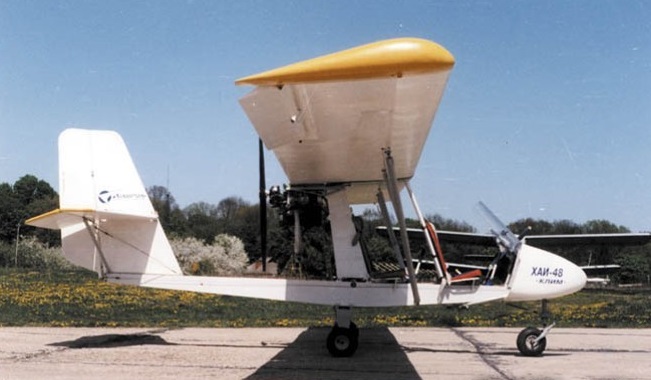
The JAI-48 (Russian: ХАИ-48) was developed by the SKB JAI student group as a two-seater light aircraft. This model, of a tricycle undercarriage, shows a clear descent from the previous models of the group.

Structurally it was similar in its construction to the JAI-35, with a minimalist fuselage made up of a structure of tubes and metal sheets to which a vertical bar was fixed on which the wing plane was supported, braced by uprights. As control structures the wings had ailerons.

The tail unit was of the conventional type with a mid-set empennage, braced by uprights.

The landing gear is fixed tricycle type, with the main wheels on titanium legs and the front wheel, steerable, with oil-pneumatic suspension.

The crew members were located in an open cockpit with a simple instrument panel and a transparent windshield.

The engine was located under the wing, driving a two-bladed propeller in pusher configuration.

Only one was built.

JAI JAI-47

The JAI-47 (Russian: ХАИ-47) two-seater sport deltaplane was developed by a group of JAI students in 1989.

Only the one was built.

JAI-47
Engine: RMZ-640, 35 hp
Wingspan: 9.0 m
Length: 2.2 m
Wing area: 12.0 m²
Empty weight: 125 kg
Maximum takeoff weight: 295 kg
Maximum speed at sea level: 50 km / h
Range: 200 km
Take-off run: 25 m
Landing run: 25 m
Accommodation: 2

JAI JAI-46

The JAI-46 (Russian: ХАИ-46) sport deltaplane was developed by a group of JAI students in 1988.

The JAI-41 participated in the First Soviet Glider Championship, which took place in September 1988 in Crimea, receiving the gold medal of the competition for its category.

Only the one was built.

JAI-46
Engine: RMZ-640, 35 hp
Wingspan: 9.0 m
Length: 2.2 m
Wing area: 12.0 m²
Empty weight: 120 kg
Maximum takeoff weight: 215 kg
Maximum speed at sea level: 45 km / h
Range: 250 km
Take-off run: 25 m
Landing run: 15 m
Accommodation: 1

JAI JAI-45

The JAI-45 (Russian: ХАИ-45) light sports aircraft was developed at SKB JAI in 1989.

Metal tubes were used in its construction and due to the lack of experience in this construction, the plane was not as simple as its builders expected.

JAI-45
Engine: 35 hp RMZ-640
Wingspan: 6.1 m
Length: 4.3 m
Wing area: 8.8 m²
Empty weight: 142 kg
Maximum takeoff weight: 283 kg
Maximum speed at sea level: 116 km / h
Landing speed: 54 km / h
Range: 130 km
Accommodation: 1

JAI JAI-44

The JAI-44 (Russian: ХАИ-44) was developed by the SKB JAI student collective as a light sports aircraft and was released in 1989.

Engine: 54 hp FW-1600
Wingspan: 7.5 m
Length: 5.5 m
Wing area: 14.25 m²
Empty weight: 230 kg
Maximum takeoff weight: 330 kg
Maximum speed at sea level: 110 km / h
Landing speed: 52 km / h
Accommodation: 1