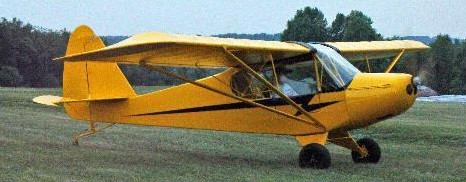
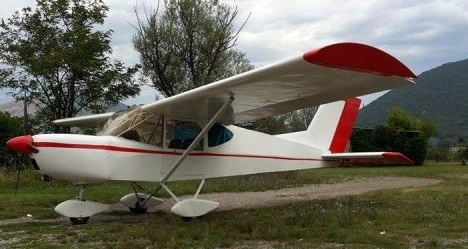
The LSA Tiger Cub Sport II has a wide enough cockpit to seat 2 full grown adults in comfort. Wide main gear and a large rudder aid ground handling and the ailerons have a 2.7 to 1 differential throw, this virtually eliminates adverse yaw. Control surfaces are large, giving good control response throughout the flight envelope. With a 912 Rotax or an O200 Contenental the Sport II needs only 300 ft of hard surface runway to get airborne, and will climb out at 800 ft per min. at gross weight. The landing roll is under 400 ft, It can be ordered as a Tri gear or tail dragger and there were 2 engine options available. The airframe is built of aluminum tubing with aluminum gussets and brackets at the joints, fastened together with bolts and rivets.
Engine: Continental O-200, 100 hp Empty weight: 840 lb MTOW: 1320 lb Wing span: 33′ Wing area: 165 sq. ft. Fuselage length (nose to tail): 22′ 6″ Folded width: 6′ 6″ (width of main gear) Stall full flap: 35 mph. Cruise: 105 mph. Climb: 800 fpm. Glide Ratio: 8 to 1 Take off Roll: 300′ Landing Roll: 400′ Wing Loading: 7.6 lbs. per sq. ft Power Loading: 12.5 lbs. per hp. Stress Loading: 5+ 3- G’s. Vne: 130 mph Cockpit width: 42 in
Engine: 912 Rotax, 100 hp Empty weight: 700 lb MTOW: 1320 lb Wing span: 33 ft Wing area: 165 sq. ft. Fuselage length (nose to tail): 22′ 6″ Folded width: 6′ 6″ (width of main gear) Stall full flap: 35 mph. Cruise: 105 mph. Climb: 800 fpm. Glide Ratio: 8 to 1 Take off Roll: 300′ Landing Roll: 400′ Wing Loading: 7.6 lbs. per sq. ft.@ gross. Power Loading: 12.5 lbs. per hp. @ gross. Stress Loading: 5+ 3- G’s. Vne: 130 mph. Cockpit width: 42 in
The LSA Tiger Cub UL has a wide enough cowl to keep the exhaust inside, (no unsightly two stroke exhaust hanging out) a folding wing and tail, fully enclosed cockpit (large enough to accommodate a 6’6″-250 lb. pilot in comfort) full three axis controls with flaperons and a steerable tail wheel, a wide speed range and rugged landing gear. The first Tiger Cub first flew on 1 April 1996.
The ailerons have a 2.7 to 1 differential throw ro virtually eliminate adverse yaw. With a 447 Rotax engine a 170 pound pilot needs about 150 ft. of hard surface runway to get airborne, and will climb out at 800 ft per min. Landing roll out is under 300 ft, even with out brakes.
The airframe is built of aluminum tubing with aluminum gussets and brackets at the joints, fastened together with bolts and rivets. A drill and pop rivet tool are all that is needed. The plans include a complete materials and vender list . The material list gives a list of the sizes and amounts of all the aluminum and chrome molly tube and sheet needed to build the airframe, a list of all the AN hardware sizes and quantities needed and a list of all the rest of the materials needed to complete the airplane, with descriptions and venders part numbers for hard to find or describe parts. The gusset prints are organized by thickness from .025 to .125 the patterns can be cut out and traced onto the aluminum sheet with a fine tipped marker. No scaling from the plans is required. Directions and tips for cutting out the gussets are included in part one of the assembly manual. Full size prints, of the chromemoly and machined parts, are included.
The panel prints have all the measurements needed to lay out the part on your work table, so you don’t have to scale your measurements from the prints, eliminating a common source of errors. ¼ scale prints (19″ by 30″ prints) of the wings, tail surfaces, fuselage and bulkhead panels. The plans also include an assembly manual (over 200 – 11″ by 17″ ) pages of pictures and text), that gives step by step directions and tips to guide you through assembly, rigging, covering, wiring, plumbing and finishing. Available since Jan. of 2000 over 300 sets of plans have been shipped (as of 1/2007). Est. build time for scratch built…650 hrs. Price for a complete set of plans was $250.00 in 2007.
The basic kit includes, a set of plans, all of the Parts Packages, listed on the previous page, and all of the additional materials needed to build a covered airframe (less engine prop instruments and paint.) The kit will also include the main bulkhead, rear cross tube and the flaperon mixer, already assembled. These three subassembly’s are the most critical and the most difficult to build. Having them built in drill guides and assembly jigs, assures a strong and square part, and reduces building problems considerably. The basic kit eliminates the hassle of having to order materials from six or seven different sources and tracking down all of the numerous small parts needed.
Tiger Cub UL Engine: 447 Rotax, 40 hp Gearbox (2.58 to 1) Empty weight: 275 lb MTOW: 600 lb Wing span: 29 ‘ 4″ Wing area: 130 sq. ft. Fuselage length: 19′ 11″ Folded length: 22′ 8″ Folded width: 6′ 6″ (width of main gear) Stall full flap: 25 mph. Cruise: 65 mph. Climb: 800 fpm. Glide Ratio: 8 to 1 Take off Roll: 150′ Landing Roll: 300′ Wing Loading: 4.6 lbs. per sq. ft.@ gross. Power Loading: 15 lbs. per hp. @ gross. Stress Loading: 6+ 4- G’s. Vne: 90 mph. Cockpit width: 27 in
Tiger Cub UL Engine: 503 Rotax, 52 hp Gearbox (2.58 to 1) Empty weight: 320 MTOW: 650 lb Wing span: 29 ‘ 4″ Wing area: 130 sq. ft. Fuselage length: 19′ 11″ Folded length: 22′ 8″ Folded width: 6′ 6″ (width of main gear) Stall full flap: 27 mph. Cruise: 48 kt / 55 mph / 89 kmh Climb: 1000 fpm. Glide Ratio: 8 to 1 Take off Roll: 75′ Landing Roll: 300′ Wing Loading: 5.0 lbs. per sq. ft.@ gross. Power Loading: 12.5 lbs. per hp. @ gross. Stress Loading: 6+ 4- G’s. Vne: 78 kt / 90 mph / 145 kmh
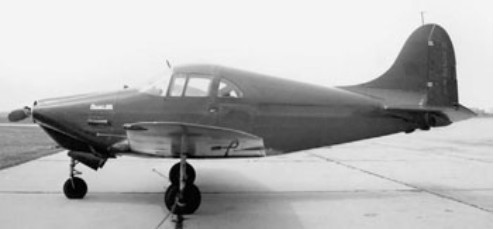
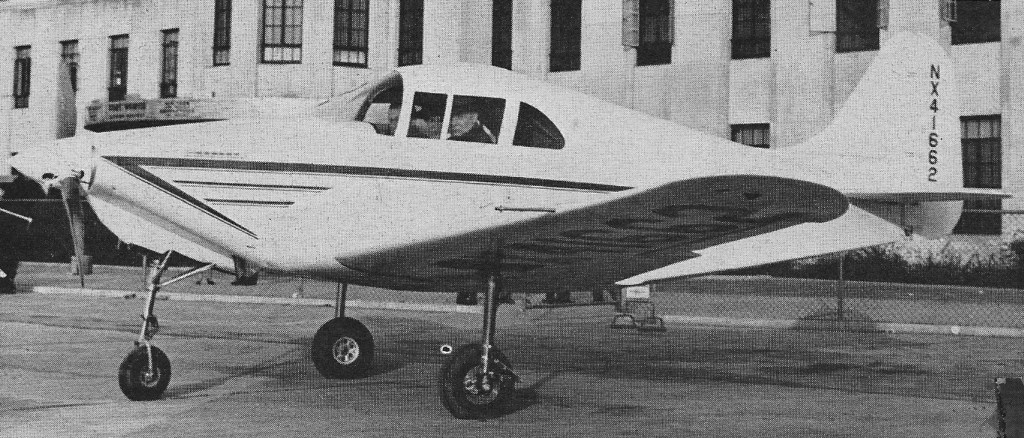
This high-performance, three-seat, cabin monoplane was first built in 1946 by Johnson Aircraft, Inc. and was ultimately manufactured in small numbers. The quick and light aircraft was built of all-metal construction with a fabric-covered fuselage. Two persons are seated side-by-side with full dual controls while the third is seated centrally just behind the front seats. In 1950, Aircraft Manufacturing Co. acquired the rights to produce a refined four-seat version of the Rocket, which it called the Texas Bullet.
The original Rocket was powered by a 185-hp four cylinder Lycoming engine; the Texas Bullet changed over to a Continental of the same rating. Also, the fabric covering of the Rocket was traded for an all-metal, flushriveted skin, and a redesigned tail was added. Overall, the new refinements added only 100 pounds to the empty weight, and 50 pounds were added to the fully loaded weight. Exhaust gasses from the engine of the Rocket and Bullet were led into a unique “jet assist” cylinder below the fuselage. It was claimed that the device converted engine exhaust into useful thrust at speeds faster than 40 mph. Also, both aircraft made use of a Hartzell hydro-selective two-blade variable-pitch propeller.
The Rocket 185 received its Approved Type Certificate in April 1946.
Owner Orval Fairbairn, Mountain View, CA. Lycoming O-435-1
Engine 185-hp Lycoming/185-hp Continental. Gross wt. 2,250 lb Empty wt. 1,550 lb Fuel capacity 55 gal Top speed 207 mph Cruise 185 mph Stall 50 mph Initial climb rate 900 fpm Ceiling 24,500 ft Takeoff run 600 ft Landing roll 400 ft Seats 4.
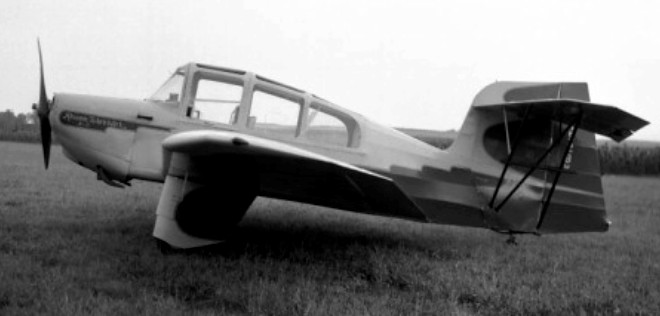
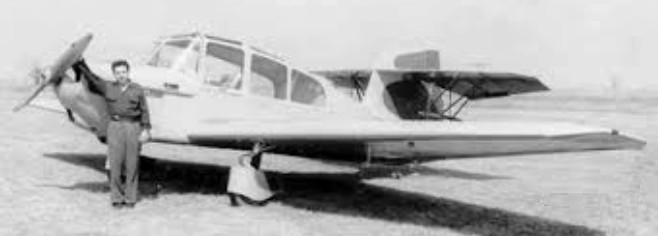
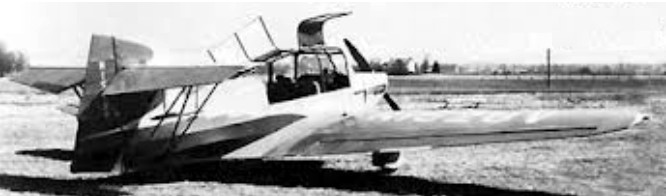
Alvis R. “Ray” Johns, of Chambersburg, Pennsylvania, USA, designed in 1947 the Rason Warrior, that was constructed in four years of part-time work, in collaboration with Paul L. Witmer, completed in 1952.
The five-seat aircraft was designed for short-field operations in remote areas and had a large wide-chord wing, fixed panted undercarriage and could easily be converted to a cargo-carrier loading through a pair of oversized gullwing cabin doors. Power came from an 185 hp Lycoming O-435-I six-cylinder horizontally-opposed air-cooled engine and can lift a 1,000 lb (454 kg) payload. The taildragger aircraft uses a large tapered low wing, with a large horizontal tail surface mounted close to the trailing edge of the wing. The fuselage is welded steel tube construction with fabric covering. The wings use wooden spars and ribs with fabric covering.
It received the EAA Award for Achievement in 1963 and was still registered in 2006 in Shippensburg, PA 17257, United States.
Construction Number (C/N): 3-1-J Registration Number: N1528V Engine: 1 × Lycoming O-435-1, 185 hp (138 kW) Wingspan: 38 ft 0 in (11.60 m) Length: 22 ft 3 in (6.78 m) Empty weight: 1,820 lb (826 kg) Gross weight: 3,450 lb (1,565 kg) Fuel capacity: 45 gal (170 litres) Maximum speed: 122 kn; 225 km/h (140 mph) Cruise speed: 103 kn; 190 km/h (118 mph) Stall speed: 36 kn; 68 km/h (42 mph) Rate of climb: 1,000 ft/min (5.1 m/s) Takeoff roll: 350 ft (107 m) Service ceiling: 9,842 ft (3,000 m) Capacity: 5
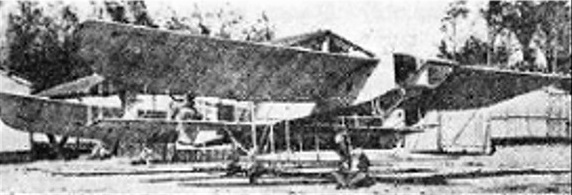
Polish engineer working in Berlin, Alfred Marceli Joachimczyk, at Deutsche Flugmaschinenbau-Gesselschaft built an experimental triplane with tandem wings but the design was apparently a complete failure.
The Jeof Candiana (named for the town of its origin) is an Italian homebuilt aircraft that was designed and produced by Jeof srl of Candiana, introduced in the mid-1990s. When it was available the aircraft was supplied as a kit for amateur construction.
The Candiana features a strut-braced high-wing, a two-seats-in-side-by-side configuration enclosed cabin accessed via doors, fixed conventional landing gear and a single engine in tractor configuration. Tricycle landing gear is optional. It has a spaceframe fuselage and sheet dural wings. The engine is derived from a Fiat car engine.
The aircraft is made from a combination of welded steel tubing and aluminum. The aircraft was designed as a testbed for the Sax 86 engine, a derivative of the Fiat Punto 1.3 liter four-cylinder four-stroke automotive powerplant with dual electronic ignition and a 2.54 : 1 reduction drive (gears). It has a motorcycle carburetor Dell’Orto PHF 32. It gives 92 HP at 6000 rpm max continuous.
The standard day, sea level, no wind, takeoff and landing roll is 100 m (328 ft).
By 1998 the company reported that ten kits had been sold, were completed and flying.
Candania GV Engine: Sax 86, 86 hp Wing span: 8.65 m Wing area: 13 sq.m MAUW: 450 kg Empty weight: 279 kg Fuel capacity: 45 lt Max speed: 260 kph Cruise speed: 160 kph Minimum speed: 60 kph Fuel consumption: 9 lt/hr Seats: 2 side by side Price (1998): 70 000 000 lire
Engine: 1 × Sax 86, 96 hp Propellers: 2-bladed fixed pitch Wingspan: 9 m (28.4 ft) Length: 7 m (21.9 ft) Empty weight: 282 kg (622 lb) Maximum speed: 209 km/h; 113 kn (130 mph) Cruise speed: 171 km/h; 92 kn (106 mph) Fuel consumption: 12 liters (3 gals)per hour at 4800 rpm at 120 km/h (75 MPH) Stall speed: 63 km/h; 34 kn (39 mph) Range: 901 km; 487 nmi (560 mi)
After the D150, a D160 prototype was built. It was to become a six seater fitted with a six cylinder 235 hp Lycoming engine. The interior was fitted with two sets of individual seats and a rear bench seat. It had an electrically actuated canopy, hinged on the port side. It featured a wing span of 10,86 meters and had a length of 8,32 meters. A version with retractable gear and a constant speed prop was envisioned, but ultimately, the D160 never saw production.
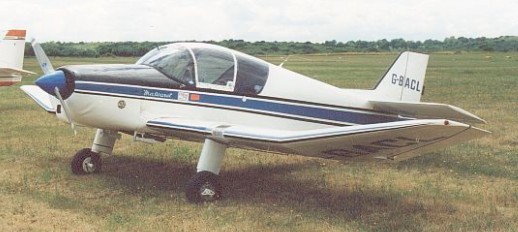
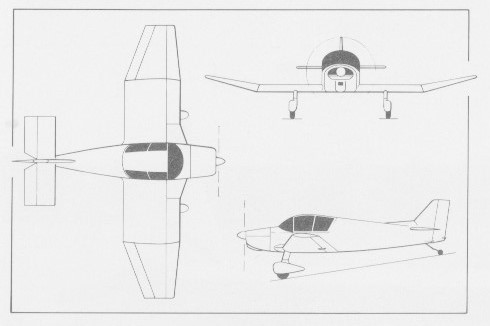
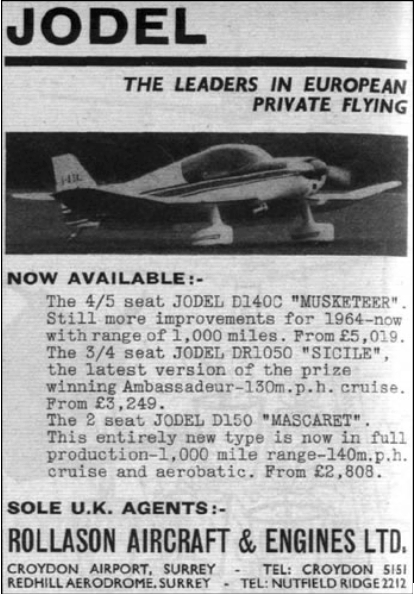
The D150 Mascaret was intended to be the successor of the D11 series. The two seater design, which was created by Delemontez for the S.A.N. factories in Normandie, leaned heavily on the DR1050. The wing was narrowed a little and the fuselage was shortened. A new tailplane construction with a two piece vertical and one piece horizontal tailplane was used. This tail was later adopted by the DR1050 series. The aircraft was given a single large fuel tank behind the seats, carrying 110 litres of fuel. Furthermore, two tanks of 40 litres each were housed in the inboard wing leading edge, giving a total of 190 litres of fuel, good for a staggering 10 hour endurance. The tank behind the panel that is installed in the DR1050 did not reappear in the D150, resulting in much more space behind the panel, which has always been a problem in the DR1050. The new tailplane configuration, and in particular the one piece all moving horizontal tail, is so much more powerful than the original narrower two piece version that the CG envelope has been opened quite a bit farther. This is also why Delemontez could get away with just the fuel tank under the bench seat, and without the tank behind the panel to balance it. All the models following the D150 (the DR200 series and so on) have this larger rear tank and no panel tank. It was fitted with a 100 hp Continental O-200A engine. Interesting note is that the D150 prototype (F-BJST) was originally fitted with the new two piece vertical tail, but still had the old style two piece horizontal. The subsequent production aircraft all had the new tail configuration, which was later also retrofitted to the prototype.
D.150 Mascaret
The prototype was fitted with the rather blunt wheelpants of the DR1050 Ambassadeur, whereas production models received the sleeker Sicile pants. 2 June 1962 – First flight SAN Jodel D.150 Mascaret French two-seat single-engined light aircraft built by Société Aeronautique Normande The D150 design proved successfull, even though only 61 of the breed were produced at S.A.N. in Bernay. S.A.N. decided to market it at a lower price than the 3/4 seater DR1050. This despite the fact that it didn’t cost less to build. In fact, S.A.N. lost money on every D150 that was produced. Among other things, this was what in the end led them into bankrupcy. S.A.B. was still selling plans and even kits for homebuilding.
Like the DR1050 / 1051, the Mascaret is also fitted with either a Continental O-200 or a Potez 4E20 engine. The latter model being desgnated D150 A. A 135 hp Franklin engine has been tried, and a few of these have actually been built. Homebuilt D150’s usually mount O-200’s, even though an O-320 fitted “Super Mascaret” is flying in the UK. The Mascaret is cleared for mild aerobatics.
Variant: Kenny Jodel D 150X Governor
D150 Engine: Continental O-200, 100 hp Length: 20.6 ft / 6.3 m Wing span: 26.7 ft / 8.15 m Empty weight (with oil): 900 lbs / 410 kg Max Take off weight: 1585 lbs / 720 kg Usefull load: 685 lbs / 310 kg Bagage shelf: 130 lbs / 60 kg Power loading: 15.9 lbs/hp / 7.2 kg/hp Fuel capacity (wings): 2 x 9 imperial gal / 2 x 40 lt Fuel capacity (rear): 24 imperial gal / 110 lt Max speed, sea level: 165 mph / 265 km/h Cruise speed: 130 mph / 210 km/h Stall speed (with flaps): 38 mph / 60 km/h Climb rate: 630 fpm / 3.2 m/s Service ceiling: 15000 ft / 4500 m Endurance: 10 hours Fuel burn, 75% pwr: 5.5 gph / 21 liter/hour Fuel burn, 55% pwr: 4 gph / 15 liter/hour Gear: Tailwheel Seats: 2 Controls: Stick and rudder Material: Wood and fabric
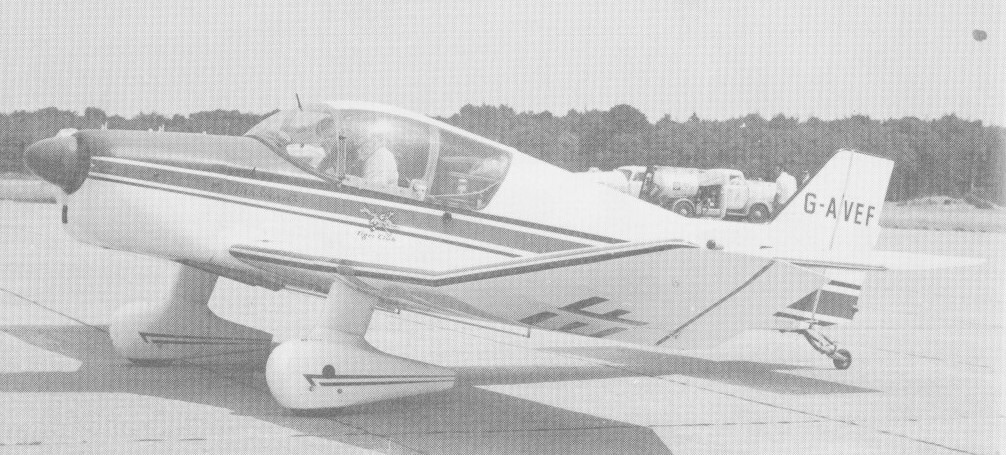
By the time, the whole range of aircraft had been taken over by Robin. Meanwhile, Joly and Delemontez were not sitting idle. Having built the D9, D10 series (=DR100) and D11 series, it was time to move on. After some ideas that never materialised, the D140 Mousquetaire was introduced. In 1956, the Jumbo Jodel was developed by Delemontez and Lucien Querey (founder of SAN) as a touring machine, seating 4 people. It was to become the biggest jodel ever built: a 180 hp tailwheel design with four/five seat capacity. Early Mousquetaires featured a rather ugly triangle vertical tailplane, later ones were fitted with tailplanes like on the DR 1050 M and DR 200 series.
Aft of the cabin, a huge cargo door hides a very roomy space to stow a lot of camping goods, making this aircraft a very nice go places platform. The D140s have been used as air ambulances and originally the cargo door was meant as an entry point for stretchers carrying injured people. SAN evolved the four/five-seat model that first flew in July 1958 as the D.140 with a 134-kW (180-hp) 0-360 engine. Curious detail of the D140 is that the factory prototype carried the serial number 4. The first three (F-BIZE, F-BIZA AND F-BIZB) had already been sold to the launching customer: le Service de la Formation Aeronautique, a French governmental institution. The D140 has been built in several variants, D140A, B, C, E and R. The A and B model had a very distict vertical tailplane, of rather dubious esthetical quality. Later models received the more pleasing tail layout as on the DR1050M models. The D140 C model is very interesting in this respect, since it had both the modern two piece swept vertical tail and the old style two piece horizontal tail.
A total of 193 of the D.140A, B, C, D, and E were built.
The D.140R Abeille was developed from the D.140E for glider towing. Twenty-two were built.
A variant of the Mousquetaire is the D.140R Abeille glider tug, and this is identical to the D.140 apart from its glider-towing fitment and a more extensively glazed cabin for improved rearward fields of vision. In 1969 SAN went into liquidation and production of the two D.140 variants was shifted to Avions Pierre Robin. Avions Mudry purchased the manufacturing rights to the Mousquetaire and continued building them, naming them Abeille (Bee). The abeille has been built with glider towing in mind. This resulted in a lowered turtledeck, omission of the cargo bay and lengthened glass area.
Jodel D.140
D 140 Mousquetaire four/five-seat sport and touring lightplane. Span: 10.27m (33ft 8.25 in). Length: 7.82m (25ft 8in). Engine: 1 x Avco Lycoming O-360-A2A, 134kW (180 hp). Max T/O weight: 1200 kg (2,646 lb). Max speed: 158 mph at sea level. Operational range: 870 miles.
D140A Mousquetaire Introduced: 31/10/1958 Vertical tail: Triangle, rounded top Horizontal tail: Two piece Fuselage: High turtledeck with cargo door Seats: 4
D140B Mousquetaire II Introduced: Soon after the A model Vertical tail: Triangle, straight top Horizontal tail: Two piece Fuselage: High turtledeck with cargo door
D140C Mousquetaire III Introduced: 1962 Vertical tail: Swept Horizontal tail: Two piece Fuselage: High turtledeck with cargo door
D140E Mousquetaire IV Introduced: 1964 Vertical tail: Swept Horizontal tail: Single piece Fuselage: High turtledeck with cargo door Span: 10.27 m / 33 ft 8.25 in Length: 7.92 m / 25 ft 11.75 in Height: 2.13 m Wing area: 18.5 sq.m Engine: Lycoming O-360 A1A, O-360 A2A, IO-360 B2F6 / 180 hp Landing gear Track: 2.27 m Main tires: 500 x 150 Tail wheel: 3.00 x 4 Seats: 5 Front seats: 154 kg Rear seats: 210 kg Front shelf: 60 kg Rear shelf: 90 kg Empty weight: 610/660 kg Max takeoff: 1200 kg / 2645 lb Front fuel tank: 90 lt Rear fuel tank: 125 lt Supplementary front fuel tank: 45 lt Vne: 290 km/h Max speed: 240 km/h Cruise speed 75% 7000ft/2300m: 240 km/h / 129 kt / 149 mph Landing speed: 115 km/h Rate of climb: 3.6 – 4.0 m/s (710 – 780 fpm) Takoff distance (grass, clearing 15 meter obstacle): 520 m Landing distance: 400 m
D140 R Introduced: 1965 Vertical tail: Swept Horizontal tail: Single piece Fuselage: Extended glass, no cargo bay No built: 22 Glider towing: Yes