Keystone K-55 Pronto

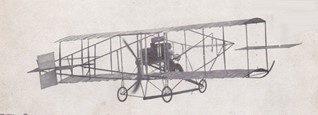
The Keystone K-55 Pronto was a mail plane developed in the United States in the late 1920s. It was a conventional single-bay, unequal-span biplane design with slightly staggered wings. The pilot sat in an open cockpit, in tandem with a forward cockpit that could carry two passengers side-by-side. The fixed, tailskid undercarriage had divided main units.

Pronto was the first aircraft Keystone made for the civil market. However, like many aircraft manufacturers of the late 1920s – early 1930s, this attempt was not successful. A number of these aircraft were purchased by the government of Peru. Operated by the aviation arm of the Peruvian Navy, these aircraft initiated the first airmail service into the Peruvian Amazon. The first flight of this service was made by two Prontos, piloted by Leonardo Alvariño Herr and Harold B. Grow from Lima to San Ramón on 26 October 1927.

At least one Peruvian Pronto was fitted with pontoons and used to survey the Amazon River for locations suitable for seaplane operations.

In the Colombia-Peru War one Peruvian K-55 flow by Lieutenant Suero was captured by the Colombian Army.

Engine: 1 × Wright J-5, 220 hp (160 kW)
Wingspan: 39 ft 11 in (12.17 m)
Length: 26 ft 9 in (8.15 m)
Empty weight: 594 kg
Maximum take-off weight: 1100 kg
Maximum speed: 112 mph (180 km/h)
Cruising speed: 160 km / h
Range: 500 miles (800 km)
Crew: One pilot
Capacity: 2 passengers

Keystone LB-1 / LB-3

The XLB-1 three-seat, single-engine light bomber was tested in 1923.
The single engined configuration, mounting an 800 hp Packard, proved unsuitable and the basic LB 1 airframe was redesigned by Keystone in 1927 as the twin engined XLB-3A, with two 410 hp Pratt & Whitney R 1340-1 Wasp nine cylinder radials mounted midway between the equal span wings. The complement was increased from three to five (pilot, copilot, bombardier, and front and rear gunners) and the bombardier was located more conventionally in the nose, instead of amidships as in the LB 1.
In 1924 Huff-Daland was reorganized as Keystone Aircraft Corporation and the production bomber aircraft was known by this latter company name.

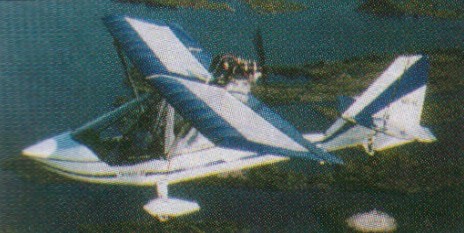
Keuthan Zephyr / Arnet Pereyra Zephyr II

Zephyr II

Detachable wings.

Zephyr II
Speed max: 90 mph.
Cruise: 73 mph.
Range: 200 sm.
Stall: 33 mph.
ROC: 1100 fpm.
Take-off dist: 125 ft.
Landing dist: 100 ft.
Service ceiling: 14,000 ft.
Engine: Rotax 582 DCDI, 65 hp.
HP range: 52-74.
Fuel cap: 12 USG.
Weight empty: 480 lbs.
Gross: 1100 lbs.
Height: 7 ft.
Length: 22.5 ft.
Wing span: 29.67 ft.
Wing area: 156 sq.ft.
Seats: 2.
Landing gear: tail wheel.

Keuthan Sabre / Arnet Pereyra Sabre II

Sabre II

The Sabre II was first flown in July 1992. Detachable wings.

Sabre I
Speed max: 82 mph.
Cruise: 65 mph.
Range: 200 sm.
Stall: 29 mph.
ROC: 1100 fpm.
Take-off dist: 125 ft.
Landing dist: 175 ft.
Service ceiling: 14,000 ft.
Engine: Rotax 503 DCDI, 52 hp.
HP range: 40-50.
Fuel cap: 10 USG.
Weight empty: 350 lbs.
Gross: 740 lbs.
Height: 6.25 ft.
Length: 20.1 ft.
Wing span: 29.67 ft.
Wing area: 143 sq.ft.
Seats: 1.
Landing gear: nose or tail wheel.

Sabre II
Speed max: 90 mph.
Cruise: 75 mph.
Range: 220 sm.
Stall: 28 mph.
ROC: 1000 fpm.
Take-off dist: 150 ft.
Landing dist: 175 ft.
Service ceiling: 14,000 ft.
Engine: Rotax 582 DCDI, 65 hp.
HP range: 50-80.
Fuel cap: 10 USG.
Weight empty: 480 lbs.
Gross: 1100 lbs.
Height: 7 ft.
Length: 22.33 ft.
Wing span: 29.67 ft.
Wing area: 156 sq.ft.
Seats: 2.
Landing gear: tail wheel.

Kestrel K-350 / JP10 / JP100 / Farnborough Aircraft F1

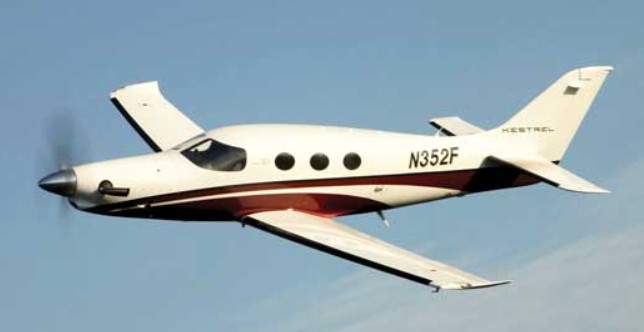
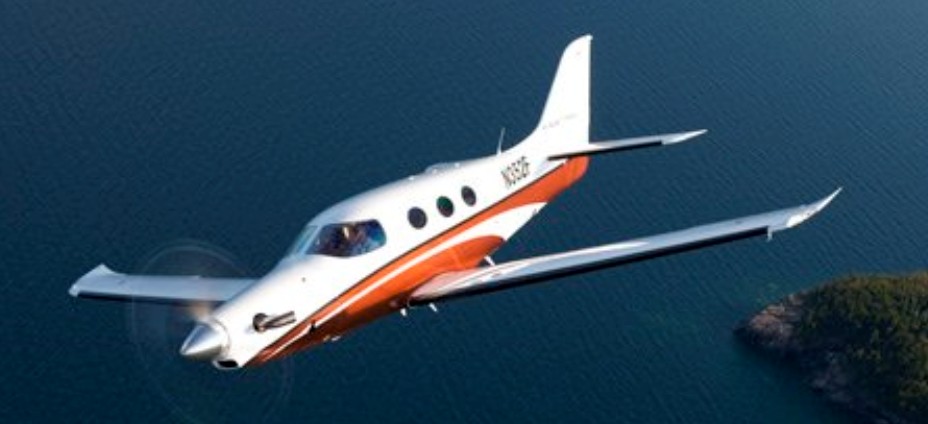
The Kestrel JP10, Kestral K-350, or Kestral is a high-performance single turboprop-engined all-composite six-seat aircraft. Its layout is low-wing with tailplanes mid-set on a single fin. The tricycle undercarriage is fully retractable. Its construction uses composites incorporating carbon fibre. The wing is also of carbon-fibre construction and features a high lift laminar flow design worked out mostly by aerodynamicist Dr. Gordon Robinson.

The cabin features a pressurized area.

Farnborough Aircraft formed a business alliance with Epic Aircraft to develop both companies aircraft and as a result the JP10 appears similar to the Epic LT. The wing is reportedly the same, while the Kestrel’s fuselage is 20 inches longer than the Epic’s.

The company formed in 2002 to build the aircraft was started by Richard Noble who was responsible for the team that first broke the sound barrier on land. Noble envisioned the aircraft’s primary role as being part of the fleet of “air taxis” flying over Europe that provide an alternative to both commercial airlines and chartered corporate jets. Noble named his Farnborough, England based company “Farnborough Aircraft” and the design for the then designated “F1” was detailed.

The name of the company has since been changed to Kestrel Aircraft Company and the aircraft’s designation was changed from “F1” to “JP100” and is now the “JP10”.

A business partnership formed to complete the Kestrel’s development named the Gulf Aircraft Partnership and located in the UAE did not proceed. Alan Klapmeier, co-founder of Cirrus Aircraft Corporation, has joined with Anthony Galley and others in the renamed Kestrel Aircraft Company. A business relationship has been formed with Liberty Aerospace of Melbourne, Florida, United States to provide assistance with Toray carbon fiber components.

Kestrel Aircraft’s Adrian Norris reported that the company was ready to freeze the design and build conformal prototypes in efforts to seek part-23 certification. On 23 July 2010 Kestrel Aircraft announced that they would be relocating to large, relatively newly built hangars at the soon to be closed Brunswick Naval Air Station in Brunswick, Maine. The company was to receive some local financial assistance in exchange for an anticipated eventual creation of some 300 jobs.

The prototype first flew on 29 July 2006. The engine that has been powering the prototype is a Pratt & Whitney PT6-67A turboprop flat rated to 1,000 hp (746 kW). As of April 2010, the prototype, registered N352F, had logged about 260 hours.

In 2011 the company selected the Honeywell TPE331-14GR engine as first choice for the aircraft, also flat rated to 1,000 hp (746 kW).

On January 17, 2012, it was announced that the aircraft will be produced in Wisconsin due to tax incentives totalling US$50 million.

In July 2013 Kestrel CEO Alan Klapmeier stated that funding delays had slowed progress on the aircraft and that a conforming prototype was now expected to be ready in the summer of 2014, with the first customer delivery forecast for the end of 2015 or early 2016. Certification costs were estimated at US$175M, with US$50M already spent.

By September 2013 employees were reporting that the company was short of money and that salaries and insurance payments were missing or late, and that vendors had not been paid. The company indicated that development had been delayed due to lack of investment and that the first flight of a production aircraft would not occur in 2014.

In early 2014 it was reported that Kestrel Aircraft had fallen months behind on loan payments to the Wisconsin Economic Development Corporation due to financing delays. It was also reported that the delay in financing had impacted hiring, causing the company to reduce its staff in Superior. The WEDC and Kestrel have agreed upon new terms that will defer the payments until November 2014.

Kestrel JP10
Engine: Pratt & Whitney PT6-67A turboprop, 1,000 hp (746 kW)
Wingspan: 44 ft 11 in (13.7 m)
Length: 38 ft 5 in (11.7 m)
Height: 13 ft 0 in (3.96 m)
Empty weight: 5,200 lb (2,359 kg)
Max takeoff weight: 8,500 lb (3,856 kg)
Fuel capacity: 319 US gal (1,208 l)
Maximum cabin altitude: 8,000 feet (2,400 m) at FL 310
Pressurization: 7.5 psi (52 kPa)
Cruise speed: 320 kn (368 mph; 593 km/h)
Stall speed: 53 kn (61 mph; 98 km/h)
Range: 1,300 nmi (1,496 mi; 2,408 km)
Service ceiling: 31,000 ft (9,400 m)
Rate of climb: 2,250 ft/min (11.4 m/s)
Capacity: six standard/seven-eight optional
Crew: 1 or 2

Kerr Stuker

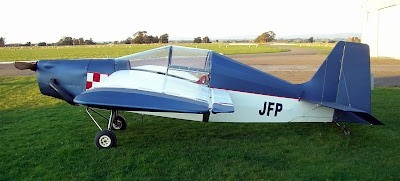
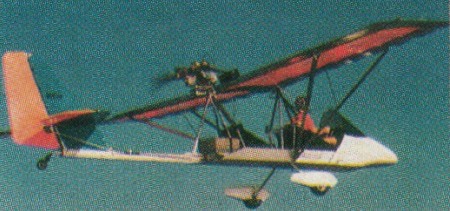
The Stewart Kerr Stuker was built by Stewart Kerr of Dunedin in the mid 1990’s.

It is a mid wing design and construction is of steel tube fuselage and alloy tube wings, all fabric covered. The motor is a Rotax 503, swinging a Brent Thompson propeller.

First registered ZK-JFP (c/n 001) to S.L.Kerr, Invercargill, New Zealand, on 13 May 1997.

It was sold to Andrew Gilmour of Taieri on 6/8/03 and then to Noel Wilson of Reefton on 8/4/08. Finally, it was purchased by Robin Baker of Palmerston North on 22/4/08. Robin refurbished the aircraft and painted it in its current blue and white scheme. It is hangared at Feilding Aerodrome where the photos were taken. ZK-JFP had flown 215 hours.

Kerestesi MG-1 Motorglider

Kerestesi MG-1 Motorglider had its beginnings as the G-1 Formula racer. It resembled the Fournier RF-1, but was built of metal for protection against the weather. It has a constant chord wing for higher drag penalty, and the trailing edge of the inboard wing panels are all flap, and the outer edges all aileron. Both are operated by push-pull tubes. The fuselage is built of composite materials. An all-moving stabilator was used in place of conventional two-piece elevator surfaces.

Gross Wt. 940 lb
Empty Wt. 731 lb
Fuel capaci¬ty 4 USG
Wingspan 45’
Length 21’.
Engine 50-hp 1200cc VW
Top glide mph 120 (power on 80 mph)
Takeoff run 800 ft
Landing roll 300 ft