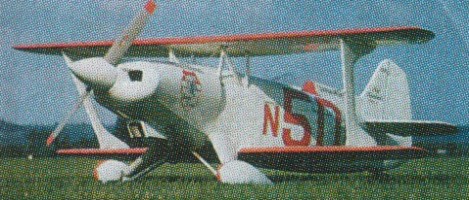
Designed by Vernon Payne in the USA in 1933, the Payne Knight Twister is a single seat biplane with a tube construction fuselage and wooden wings. All fabric covered.
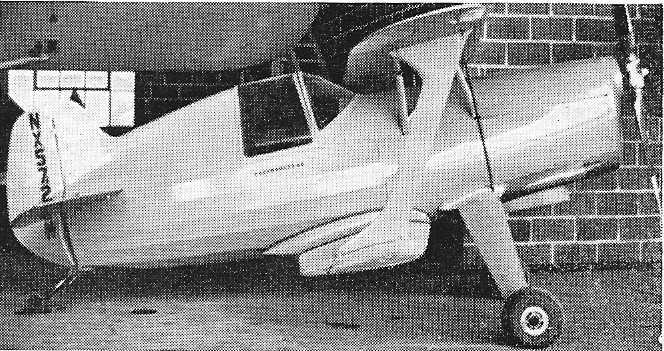
Twister NX5726N built by Ed Effenheim, Milwaukee, 67 hp Tank engine circa 1956. Later repowered with 85 hp Continental
Engine: Lycoming, 108 hp. HP range: 85-160. Span upper: 15.00 ft Span lower: 13 ft Wing area: 55 sq.ft. Length: 13.5 ft. Height: 5 ft. Weight empty: 517 lbs. Gross: 865 lbs. Fuel cap: 20 USG. Speed max: 180 mph. Cruise: 165 mph. Range: 610 sm. Stall: 55 mph. ROC: 1800 fpm. Take-off dist: 400 ft. Landing dist: 800 ft. Seats: 1-2. Landing gear: tail wheel.
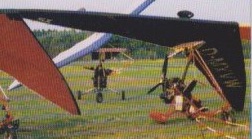
Single seat single engined flex wing aircraft with hybrid control. Rogallo wing; tail carries rudder and horizontal stabiliser. Pilot suspended below wing in trike unit, using bar to control pitch and roll by altering relative positions of trike unit and wing. Control input through pedals for yaw. Wing braced from above by kingpost and cables, from below by cables. Undercarriage has three wheels in tricycle formation. Engine mounted below wing driving pusher propeller. Two Rogallo winged microlights are known to have been produced under the umbrella of this organisation, both of them attributed to Yevgueni Chevcheriko. As such they are hybrid control aircraft and are best described as ‘trike plus rudder on trike unit’. The trike unit is hung from the Rogallo in the normal way and the relative positions of the two can be altered to give pitch and roll control, just as in any other trike, but instead of relying on roll to initiate yaw, a separate rudder is attached to the rear of the trike unit, controlled by rudder pedals. The Russian aircraft have a horizontal stabiliser behind the pilot. The Ptica 2, the earlier of the two Russian designs, has a large windscreen. The Ptica 2 has a 42 hp engine, 4 hp less than the SPM. The initials SPM stand for Siniaya Ptica Modernisovanna, and it is basically an updated version of the Ptica 2.
Engine: 46 hp. Total wing area 221 sq.ft, 20.5 sq.m. Power per unit area 0.21 hp/sq.ft, 2.2 hp/sq.m. Max take off weight: 401 lb, 182 kg. Max wing loading: 1.81 1b/sq.ft, 8.9 kg/sq.m. Max power loading 8.7 lb/hp, 4.0 kg/hp. Take off speed 25mph, 40 kph. Take off distance 100 130ft, 30 40m. Landing dis¬tance 80 100 ft, 25 30 m.
Single seat single engined flex wing aircraft with hybrid control. Rogallo wing; tail carries rudder and horizontal stabiliser. Pilot suspended below wing in trike unit, using bar to control pitch and roll by altering relative positions of trike unit and wing. Control input through pedals for yaw. Wing braced from above by kingpost and cables, from below by cables. Undercarriage has three wheels in tricycle formation. Engine mounted below wing driving pusher propeller. Two Rogallo winged microlights are known to have been produced under the umbrella of this organisation, both of them attributed to Yevgueni Chevcheriko. As such they are hybrid control aircraft and are best described as ‘trike plus rudder on trike unit’. The trike unit is hung from the Rogallo in the normal way and the relative positions of the two can be altered to give pitch and roll control, just as in any other trike, but instead of relying on roll to initiate yaw, a separate rudder is attached to the rear of the trike unit, controlled by rudder pedals. The Russian aircraft have a horizontal stabiliser behind the pilot. The Ptica 2, the earlier of the two Russian designs, has a large windscreen. The Ptica 2 has a 42 hp engine, 4 hp less than the SPM.
Engine: 42hp. Propeller diameter: 15in, 0.38m. Total wing area 242 sq.ft, 22.5sq.m. Power per unit area 0. 17 hp/sq.ft, 1.9hp/sq.m. Take off speed 40mph, 65kph. Cruising speed 62 mph, 100 kph.
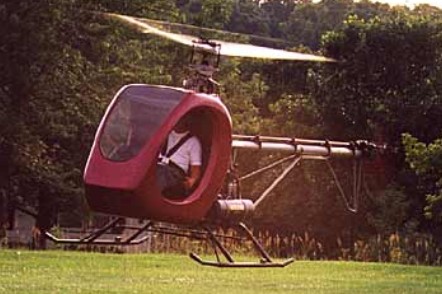
This helicopter was designed, completed, and flown in one year, one month, one week and one day. It’s named the Kinney HRH (Hot Rod Helicopter) because of the lack of doors and hood and an air cleaner from a dual quad setup. The helicopter is small enough to fit in a home garage, and the counter-clockwise rotation of the Waitman blades is the same as standard America helicopters. The HRH uses a 165 hp 4-cycle, 4 cylinder Subaru. It employs a computer-controlled fuel-air mixture, redundant fuel pumps, and multi-port fuel injection. It uses regular gasoline. The rotor head provides full cyclic and collective pitch, with an electronic system for maintaining rotor speed. The main blades are constructed of composite materials and the tail rotor is shaft driven. The fully enclosed composite cabin features a fully equipped panel with both digital and analog instrumentation; a vinyl-covered seat with a “crumple-zone” support; a 4-point aircraft seat belt; and a tinted polycarbonate windshield. Addition of doors and a catalytic heater provide year-round comfort. The powder-coated airframe is formed of aircraft-grade 4130 chromemoly steel, the primary structure both welded and bolted together with aircraft hardware. Most of the aluminum parts are black anodized.
Engine: Subaru EJ-25, 165 hp Cruise speed: 80-90 mph Empty weight: 1000 lbs Useful load: 350 lbs Gross weight: 1,350 lbs Main rotor diameter: 25 ft Main rotor chord: 8 in Tail rotor diameter: 46 in Length: 20 ft Height: 7.25 ft Width: 5.55 ft (175 cm) Fuel capacity: 18.5 USgal. Main rotor RPM: 520 Tail rotor RPM: 2,900 Endurance: 2 hours Top speed: 103 mph VNE: 115 mph Blade: Waitman composite Tail rotor chord: 4.5 in
The VL-3 is an ultralight, single-engine, low-wing aeroplane of classical design with a bow-type retractable or fixed landing-gear and two side-by-side seats. The plane has been certified according to regulation UL-2 of the Amateur Aeronautical Association of the Czech Republic for maximum take-off weight (MTOW) of 450 kg. Harmonious aerodynamic shape and excellent flying performance make the aeroplane suitable for touring or recreational flying. The VL 3 is being certified in UL catagory for MTOW 450 kg and for MTOW 560 kg according JAR – VLA. The KLN VL3 airplane is manufactured by Karel Klenor – KLN, Choceň, Czech Republic.
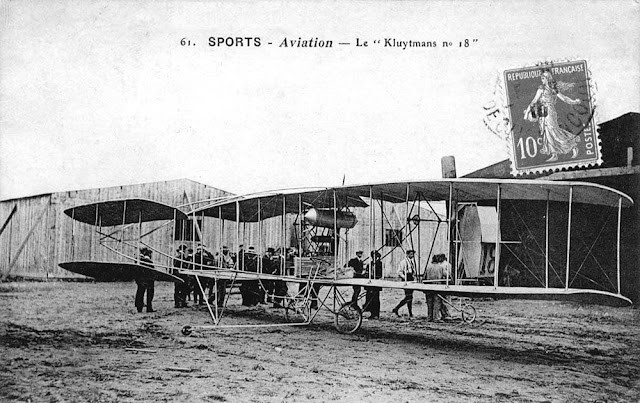
W. Klemperer and a group of friends had built around 90 flying models since high school years in Germany, several of them canards, powered by compressed gas engines. In 1911 they started on a full-scale machine with 22 sq.m of wing area. Construction was started at the “Schiffswerft” in Uebigau a.d. Elbe and completed in Chemnitz and Altchemnitz. At Christmas 1913 it was ready to roll and after various ground tests it was flown in the spring of 1914 by LVG pilot E. Kunze. Problems with the quickly wearing 55 hp Haacke engine and high weeds on the airfield caused difficulties, but finally some flights confirmed the designers’ expectations of stability, ease of control, pleasant flight characteristics and extremely easy landing. Just after these first encouraging successes, the outbreak of war put an end to their experiments.
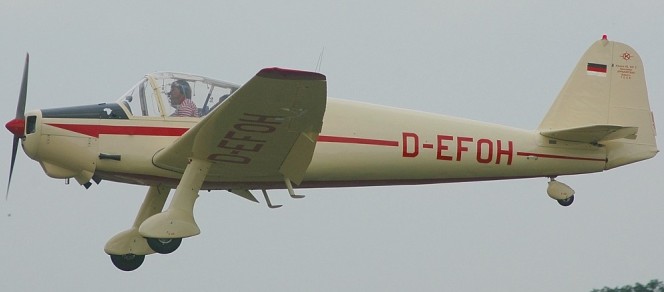
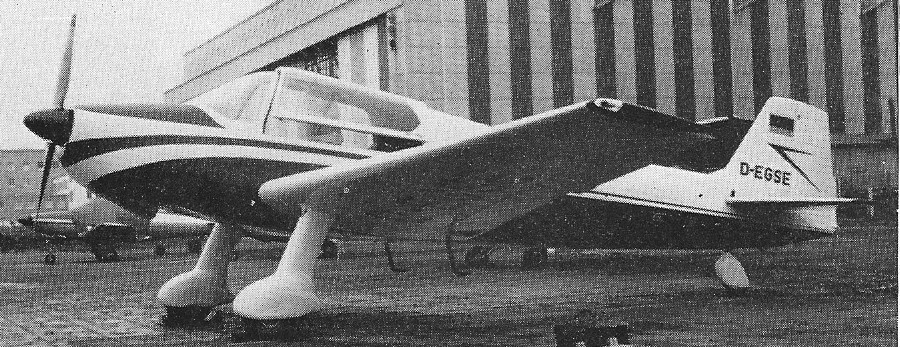
The Kl.107 low-wing, wooden-framed monoplane trainer was designed in Germany during World War II. Early versions were powered by the Hirth HM 500 100hp engine, and only a small number were completed before the factory was erased by Allied bombing. In 1956 it was decided to reintroduce the Kl-107 as a civil training/touring type, initially as the Kl-107B, but then as the three-seat Kl-107C. Rights to the design were acquired by what became the MBB consortium, and the final version became the Bo.207.
Klemm Kl-107C
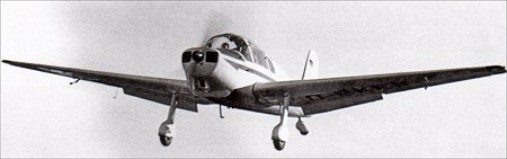
The Bolkow F.207 second prototype development of the Kl107C, originally called the Klemm Kl 107D, first flew on 21 April 1961, from Stuttgart-Echterdingen airport.
Bolkow F.207
Kl.107C Engine: 1 x 150hp Continental O-320 Wingspan: 10.80 m / 35 ft 5 in Length: 8.30 m / 27 ft 3 in Max. speed: 234 km/h / 145 mph Range: 820 km / 510 miles
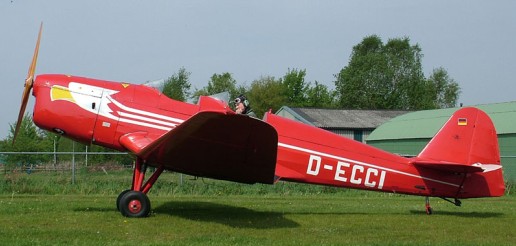
From its beginning in 1926 Klemm produced only cantilever monoplanes, and first flown February 1935 as a civil prototype, the Kl 35a was powered by a 60-kW (80-hp) Hirth HM 60R inline. The Klemm 35 entered production the same year. The Kl 35b second prototype featured the 78-kW (105-hp) HM 504A-2, and this engine was retained for the Kl 35B initial production variant. From this the company developed a primary trainer for the Luftwaffe as the Kl 35D, and this first flew in 1938. By comparison with the Kl 35B the wheel spats were omitted, and the landing gear was beefed up for wheels, floats or even skis. The Kl35 was generally similar in appearance, but instead of a straight wing, it had a gull wing. The Klemm Kl35D differed in being powered by a 105hp Hirth HM504 A-02 engine and it had a braced and strengthened undercarriage with spats removed. The Luftwaffe also used the type for liaison, courier and postal work, and the type was exported to Czechoslovakia, Hungary, Lithuania, Romania and Sweden, the last also producing the type under licence. The Klemm Kl.35 remained in production until 1941. About 2000 airframes were built.
Kl 35a Engine: Hirth HM 60R, 60-kW (80-hp).
Kl 35b Engine: Hirth HM 504A-2, 78-kW (105-hp).
Kl 35B XIV Engine: BMW Bramo (Siemens) Sh 14A seven cylinder radial, 160 hp. Prop: 2 blade. Wing span: 39 ft 4.5 in (12.00 m). Length: 23 ft 7.5 in (7.20 m). Wing area: 183 sq ft (17.00 sq.m). Gross weight: 2,094 lb (950 kg). Max speed: 130 mph (210kph) at S/L. Typical range: 495 miles (800 km). Seats: 3.
Kl 35D Engine: 1 x Hirth HM 6CR, 60kW (80 hp). Span: 10.40m (34ft 1.5in). Length: 7.50m (24ft 7.25 in). Armament: none. Max T/O weight: 750kg (1,654lb). Max speed: 132 mph at sea level. Operational range: 413 miles. Seats: 2