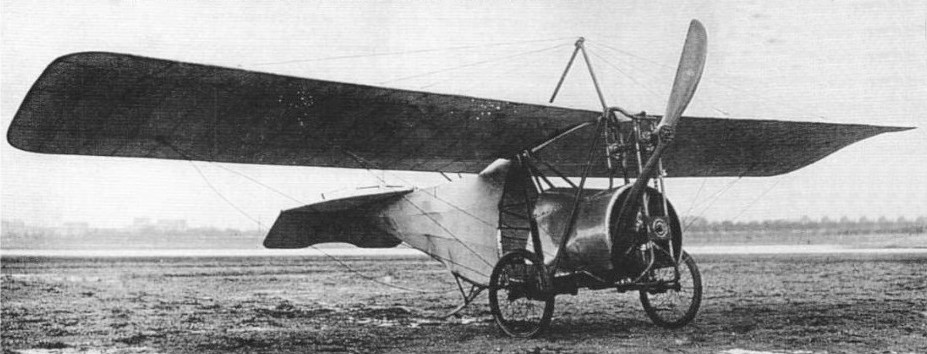
Lelièvre 1912 monoplane

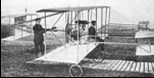
This stubby monoplane was designed by Lt Lelievre and built by Vendome in 1912 at Le Havre, France. The wing was mounted on the top of the short, covered fuselage, with the engine set almost at ground level, driving through a chain the tractor propeller that was mounted slightly forward of the leading edge. The pilot sat inside the fuselage under the wing, entering through one of the side doors.

It first flew on 18 July 1913, at Issy-les-Moulineaux. It was destroyed when it crashed in August during test flights, slightly injuring Lt Lelievre.

Engine: Gnome 50 hp

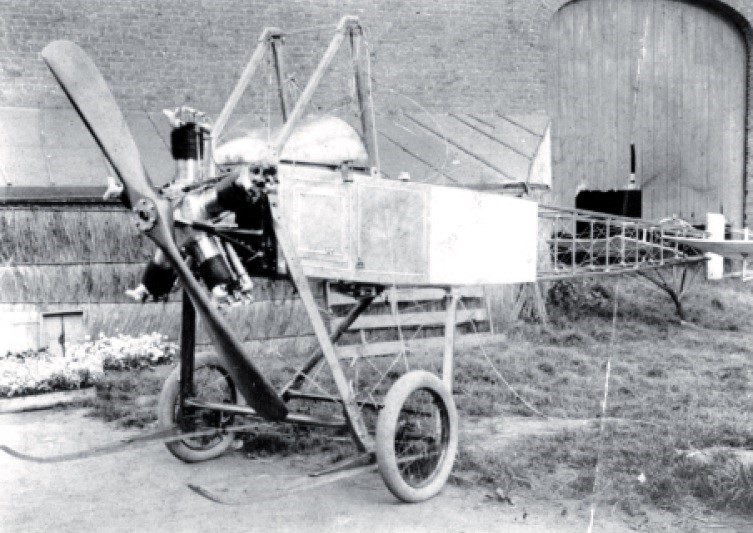
Leleu 1913 monoplane

Arthur Leleu, carpenter and father of 18 children, designed and built this somewhat Deperdussin-inspired monoplane, which was powered by a five-cylinder Anzani. It was tested at the La Briquette field outside Valencienne, France, by a pilot by the name of Boutaric. The first flight, on 18 May 1913, was successful, but on the next day the pilot was disturbed by some cattle, landed on a marker stone and broke the wheel axle. That was apparently the last that was heard of the machine.

Lejeune Biplane

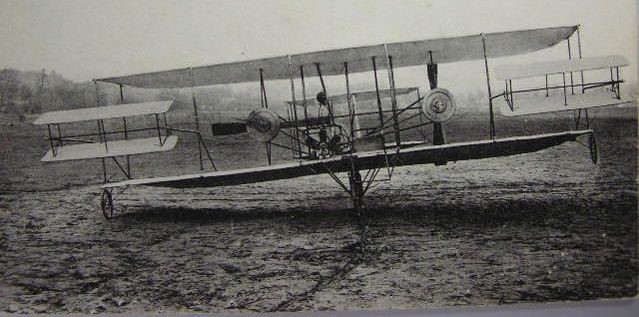
Designed by Louis Lejeune, built by de Pischoff et Koechlin, the 1909 Lejeune biplane was modified with forward extending biplane aileron control; possibly as the Lejeune No.3.

1909 Lejeune modified biplane

Powered with a 10-12 hp 3-cylinder Buchet radial engine chain-driving two 2-bladed pusher propellers and featuring bicycle gear in tandem with wingtip wheels, the Lejeune Biplane weighed 385 lb.

At the Prix de Lagatinerie, held May 23, 1909 – the official opening of Port-Aviation – Lejeune, who was not entered in the race, tried to fly his plane. Despite very long ground runs through the grass the little biplane never took off, managing only to earn itself the nickname “la moissoneuse”, (the harvester).

Span: 21’4″
Length: 16’6″
Weight: 385 lb

Leichtflugzeug Vagabund

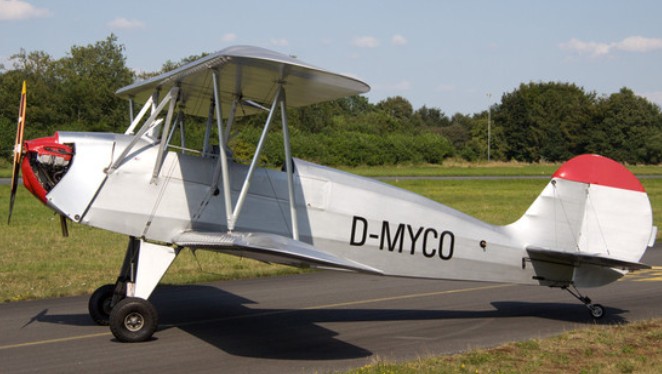
The AV Leichtflugzeuge Vagabund (English: Vagabond) is a German ultralight aircraft that was designed by Birk Meier, Hans Grannemann and Robert Kaps and produced by AV Leichtflugzeuge of Haren, Germany. The aircraft is supplied as a kit or plans for amateur construction or as a complete ready-to-fly-aircraft.

The Vagabund was designed to comply with the Fédération Aéronautique Internationale microlight rules. It features a strut-braced biplane layout, a two-seats-in-tandem open cockpit, fixed conventional landing gear and a single engine in tractor configuration. The aircraft closely resembles the 1930s Bücker Bü 131.

The aircraft is made from wood, with its flying surfaces covered in doped aircraft fabric. Its 7.55 m (24.8 ft) span wing employs ailerons on the lower wing only. The aircraft can use engines from 50 to 85 hp (37 to 63 kW) and the 80 hp (60 kW) Rotax 912UL, the 85 hp (63 kW) Jabiru 2200 and the 75 hp (56 kW) Limbach L2000 Volkswagen air-cooled engine have been fitted along with automotive conversions such as the Nissan 1.2 litre engine.

Unit cost assembled in 2011 was €48,900.

Engine: 1 × Jabiru 2200, 63 kW (85 hp)
Propellers: 2-bladed wooden
Wingspan: 7.55 m (24 ft 9 in)
Wing area: 18.2 sq.m (196 sq ft)
Empty weight: 114 kg (252 lb)
Gross weight: 450 kg (992 lb)
Fuel capacity: 50 litres (11 imp gal; 13 US gal)
Maximum speed: 140 km/h (87 mph; 76 kn)
Cruising speed: 115 km/h (71 mph; 62 kn)
Stall speed: 59 km/h (37 mph; 32 kn)
Rate of climb: 3 m/s (590 ft/min)
Wing loading: 24.73 kg/m2 (5.07 lb/sq ft)
Crew: one
Capacity: one passenger

Legrand-Simon LS 50

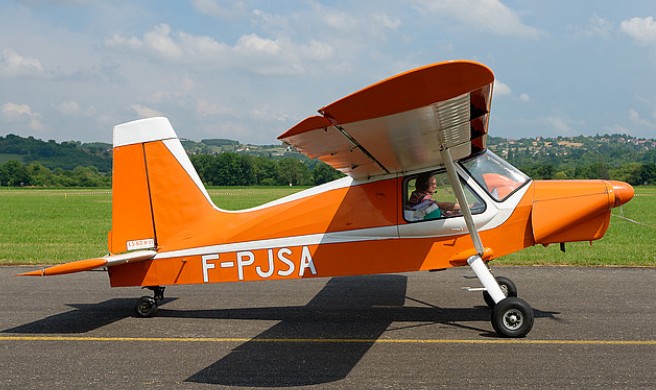
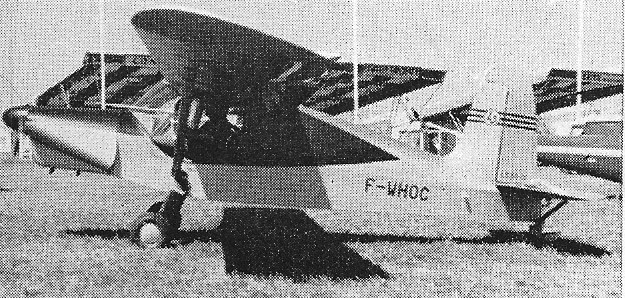
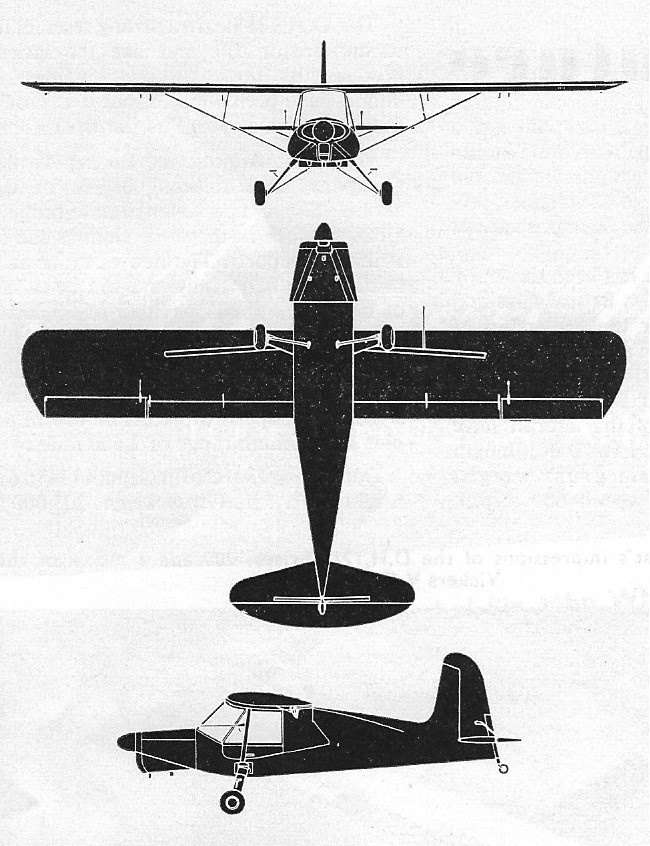
The LS 50 was designed to be suitable for touring, training, or towing. The craft is of mixed wood construction allowing sub-contracting and prefabrication.

On the prototype several components, such as cowling panels, wheel discs, spinner and door sills, had been made of fibreglass. The fuselage is basically rectangular, rigid wood box built up on four longerons. At the sear is a post for the rudder.

At the front a metal frame unites the cabin and wing supporting structure, the two side-by-side seats, the control column and its mechanism, and the undercarriage and shock absorbers. This welded steel structure supports the controls, flap mechanism, radio, doors and instrument panel. Full dual controls are fitted as standard, and the various trim controls are placed on the centrally mounted flap lever in the cabin roof, accessible to both seats.

The wing is built up on a single spar at 25% chord, and forward of this spar is plywood covered, forming a torsion box. The ailerons are cable-operated, the flaps by torsion tube. Ribs are built up of wood and the whole wing, braced by a single strut each side, is fabric covered. The tail unit is constructed of welded steel tube with a fabric cover.

Only the one was built.

Engine: 90 hp
Wingspan: 31 ft 6 in
Length: 21 ft 0 in
Height: 6 ft 6 in
Empty weight: 979 lb
Loaded weight: 1527 lb
Max speed at 3000ft: 118 mph
Cruise at 3000ft: 104 mph
Landing speed: 41 mph
Range: 620 mi
ROC: 700 fpm
Seats: 2