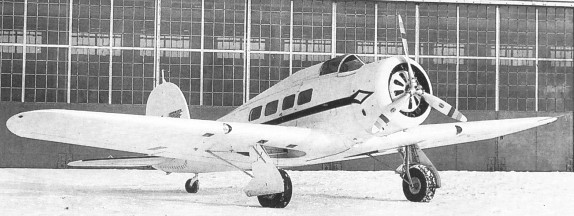
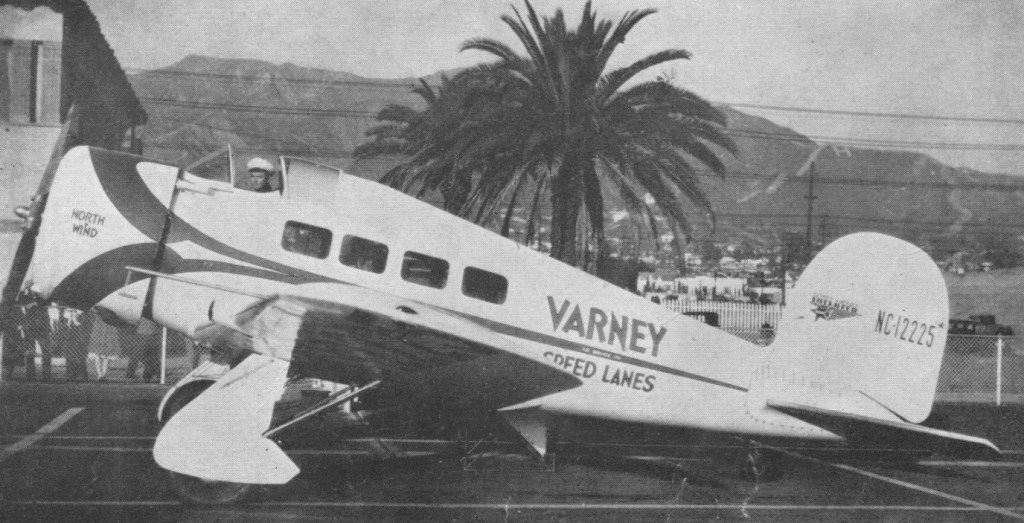
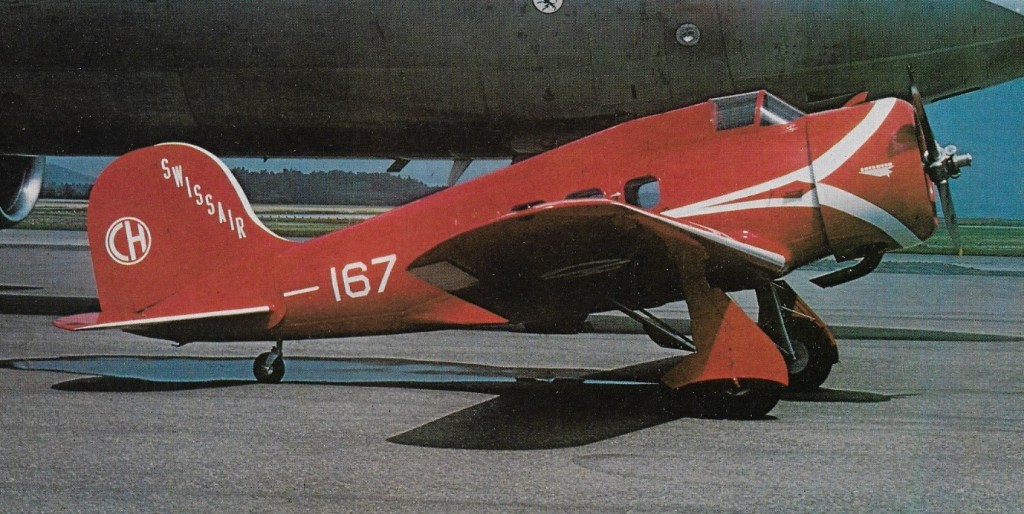
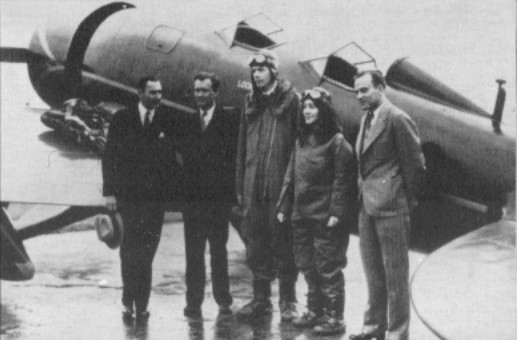
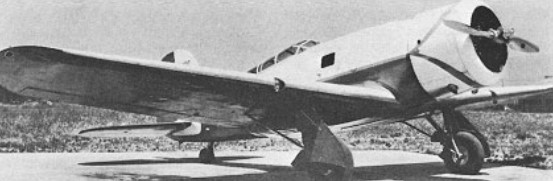
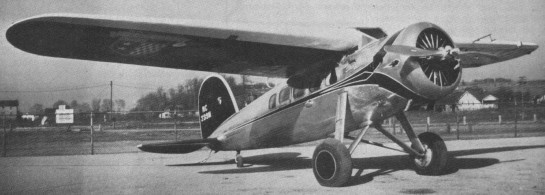
Seeing, in the latter part of 1930, a potential market for a light transport aircraft, Lockheed began development of the six-passenger Lockheed 9 Orion. This combined a Vega fuselage with the low-wing and landing gear of the Altair, and the NACA cowling introduced on the Air Express, the first being flown in early 1931.
The first Orion (NC960Y) entered service with Bowen Air Lines at Fort Worth, Texas, in May 1931.
The type found use with 12 other American airlines. At least 13 of these aircraft, from various sources, were supplied to the Spanish Republican air force in late 1936, soon after the beginning of the Spanish Civil War. Orion production totalled 35, and the single Altair DL-2A was also converted to Orion configuration.
Lockheed 9C Orion Engine: Wright Cyclone 1820-E, 567 hp Length: 28.051 ft / 8.55 m Height: 9.514 ft / 2.9 m Wingspan: 42.782 ft / 13.04 m Max take off weight: 5402.3 lb / 2450.0 kg Max. speed: 157 kts / 290 km/h Service ceiling: 16732 ft / 5100 m Range: 513 nm / 950 km Crew: 1+4
Lockheed 9D Orion Engine: 1 x Pratt & Whitney Wasp S1D1 radial, 410kW / 450 hp Max take-off weight: 2359 kg / 5201 lb Empty weight: 1651 kg / 3640 lb Wingspan: 13.04 m / 42 ft 9 in Length: 8.64 m / 28 ft 4 in Height: 2.95 m / 9 ft 8 in Wing area: 27.32 sq.m / 294.07 sq ft Cruise speed: 330 km/h / 205 mph Ceiling: 6705 m / 22000 ft Range: 1159 km / 720 miles Undercarriage: retractable. Pax cap: 5.
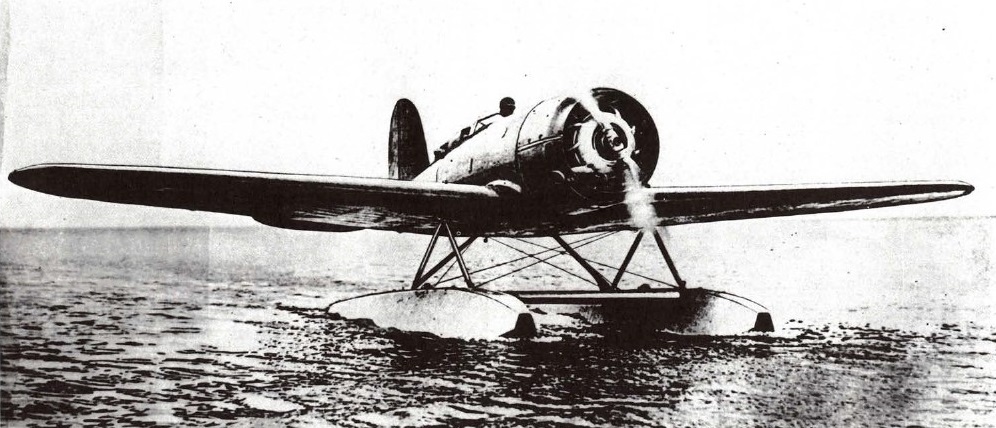
Developed originally to meet a requirement of Charles Lindbergh for a low-wing monoplane of high performance, the Lockheed 8 Sirius combined what was basically a Vega wooden monocoque fuselage with a new low-set cantilever wing. The fuselage is wood laminated and glued, covered with glued plywood. The wings are plywood covered. Ailerons and tail surfaces are plywood covered.
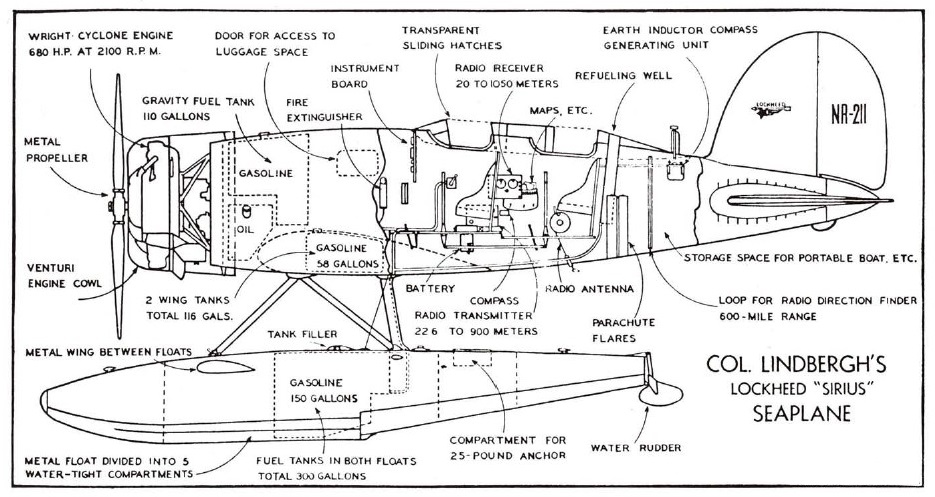
First flown in November 1929, and then powered by a 336kW Pratt & Whitney Wasp radial engine, the Sirius had non-retractable tailwheel landing gear and two open cockpits in tandem. Before accepting this aircraft, Lindbergh had a sliding canopy installed to enclose the two cockpits. In the following year, before Lindbergh set out on a survey flight for Pan American Airways, a 429kW Wright Cyclone engine and twin-float landing gear were installed. For its final survey flight in 1933, it was powered by a 529kW Wright Cyclone engine.
The success of Lindbergh’s aircraft led to the construction of 13 more by Lockheed, comprising four similar Sirius 8, eight Sirius 8A with enlarged tail surfaces, and a single four-seat Sirius 8C aircraft which had an enclosed cabin for two between the engine and pilot’s cockpit. One Sirius built by the Detroit Aircraft Corporation, with a metal fuselage and Lockheed wooden wing, had the designation DL-2 Lindbergh’s Sirius spanned 13.04m, weighed a maximum of 3220kg, was capable of a maximum of 298km/h, and had a range of 1570km, all in landplane configuration.
Sirius 8
When acquiring his Sirius, Charles Lindbergh had intimated that he might be interested in having retractable landing gear, with a result that the company designed an alternative wing to accept inward-retracting main landing gear units. Although this feature was not adopted by Lindbergh, it became available as a retrofit for Sirius aircraft, first flown on a company-owned Sirius 8A during September 1930. Redesignated Lockheed Altair 8D in this form, the aircraft was loaned to the US Army Air Corps during 1931 and in November of that year, with a new 336kW Pratt & Whitney R-1340-17 engine installed, was acquired by the USAAC under the designation Y1C-25.
Four more aircraft were converted, two Sirius 8As becoming Altair 8D aircraft, the Detroit Aircraft DL-2 being redesignated Altair DL-2A and, most famous of all, one Sirius receiving the designation Sirius 8 Special. This last aircraft was later acquired by Sir Charles Kingsford Smith and, modified to Altair 8D configuration and named Lady Southern Cross, was used by this pilot, with P. G. Taylor as his navigator, to make the first crossing of the Pacific Ocean from Australia to the United States between 20 October and 4 November 1934.
In addition to the conversions, six Altairs were built as new, one of them an Altair DL-2A built by Detroit Aircraft and powered by a 481kW Wright R-1820E Cyclone which was acquired by the US Navy under the designation XRO-1.
Lockheed Sirius Engine: Wright Cyclone, 680 hp at 2100 ft Prop: Hamilton Standard Wingspan: 42 ft 10 in Wing area: 275 sq.ft Airfoil section: Clark Y Length: 27 ft 6 in Height: 9 ft 2 in Empty weight: 2978 lb Gross weight: 4600 lb Gross wt w/pontoon overload: 6000 lb Power loading: 8.83 lb/hp Wing loading: 21.8 lb/sq.ft Top speed: 175 mph Cruise: 145 mph ROC: 1200 fpm Service ceiling: 20,000 ft Radius: 2000 mi Fuel capacity: 225 gal Pontoon fuel capacity: 300 gal
Sirius 8 Wing span: 13.04m Maximum weight: 3220kg Maximum speed: 298km/h Range: 1570km
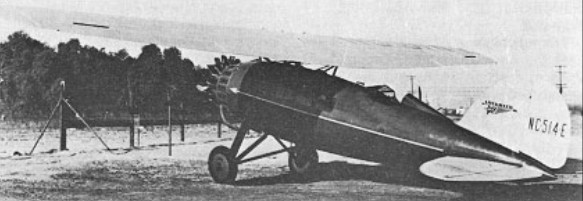
The success and reliability of the Vega made this aircraft of interest to many airlines, but Western Air Express required some of its own ideas incorporated. With a fuselage, landing gear and tail unit generally similar to the Vega, this aircraft differed primarily by having an increased-span parasol wing, a cabin seating four passengers or carrying 2.83cu.m of mail, with the pilot’s open cockpit moved to the rear of the cabin, as the Lockheed 3 Air Express.
Power was provided as standard by a 306kW Pratt & Whitney Wasp, but at least one was flown with a Wasp engine of 391kW, and some of these engines were enclosed by the NACA-developed low-drag cowling. A total of seven of these aircraft was built, plus one Air Express Special with which Laura Ingalls intended to make a non-stop transatlantic flight in 1931. Western Air Express, which had inspired this development of the Vega, acquired only a single example.
The Lockheed 4 Explorer variant of the Air Express/Vega series with low-set monoplane wing, fixed landing gear and 336kW Pratt & Whitney Wasp, had a wingspan was 14.78m and maximum take-off weight 4086kg. Designed for a non-stop trans-Pacific flight to Japan, only two were built. The first crashed during take-off for the record attempt in July 1929, and the replacement aircraft, with jettisonable landing gear, crashed during trials in September 1929. The theoretical range was 8850km.
The Lockheed 7 Explorer variant was an improved version of the Model 4 with a 336kW Wasp C. The first aircraft crashed during trials in May 1930, and second made some moderately successful flights before being written off
Roscoe Turner had a Lockheed Air Express modified with a parachute in a compartment for his attempts in parachuting an airplane safely to the ground.
Lockheed 3 Air Express Max take-off weight: 1984 kg / 4374 lb Wingspan: 12.95 m / 42 ft 6 in Max. speed: 269 km/h / 167 mph
Lockheed 4 Explorer Engine: 336kW Pratt & Whitney Wasp Wingspan: 14.78m Maximum take-off weight: 4086kg
Jack Northrop, with assistance from Gerard F. Vultee, was working on a project of his own while working for Douglas. It was an airplane design incorporating new structural and aerodynamic thinking that would make his air¬plane the most advanced of its time. Since Douglas was tied up with his World Cruiser project, Northrop took his design to Lockheed, where the airplane became known as the Lockheed Vega, with fully cantilevered wooden wings and finely streamlined monocoque, wooden stressed skin fuselage, made in two halves and glued together.
The two half-shells of plywood had been pressure-formed to shape in a concrete mould. Low-drag landing gear was of fixed tailwheel type (but Vegas were used frequently with floats or skis), enclosed cabin for a pilot and four passengers, and powerplant for the initial version of the Vega, later identified as the Vega 1, was a 168kW Wright J-5 Whirlwind radial engine. The initial aircraft was flown for the first time on 4 July 1927 and was acquired by newspaper-owner George Hearst to compete in the Oakland to Hawaii Dole Race, sponsored by James D. Dole, which began on 16 August 1927. The Vega, by then named Golden Eagle and flown by Jack Forst and Gordon Scott, disappeared without a trace en route.
The unexplained loss of this aircraft did not prohibit further sales. A host of achievements brought fame. These included the first trans-Arctic flight and the first exploratory flight over Antarctica (Wilkins and Eielson in the Vega 1 X3903); the first solo transatlantic flight by a woman from Newfoundland to Ireland (Amelia Earhart in the Vega 5B NC7952); and the first solo round-the-world flight (Wiley Post in the Vega 5B The Winnie Mae). In 1931 Wiley Post flew around the world in 8 days, 15 hours and 51 minutes in a Vega with a jettisonable undercarriage. Wiley Post his navigator, Harold Gatty, and the Winnie Mae left New York on June 23, 1931, flying east. Fourteen stops later, after only eight days, 15 hours and 51 minutes, it was back in New York. The actual flying time was four days, 10 hours, and 8 minutes.
The Vega DL 1 was fitted with a metal fuselage. At least one Vega 5C was sold to the AAF and designated UC 101.
Vega S Special
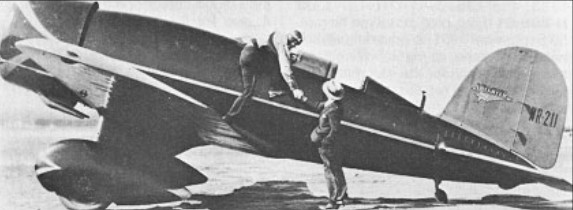
A “one-off” Vega S Special which was modified for attacks on speed records. The wing was lowered and the angle of attack changed, but equally important was the adoption, for the first time, of the now familiar “bubble” canopy. The inscriptions indicate that NR-496M (c/n. 619) was owned by Crosley Radio Corporation, on loan to the record-breaking aviatrix Ruth Nichols – sponsored by Life Savers Candy.
Vega S Special
When production ended a total of 128 Vegas had been built: 115 by Lockheed, nine by Detroit Aircraft Corporation (of which Lockheed was a division from 1929-31) and four by others.
Vega Engine: One 425 h.p. Pratt & Whitney Wasp. Length 27.5 ft (8.37 m). Wing span 41 ft (12.5 m). Weight empty 2,050 lb (930 kg). Seats: 7. Cruise speed: 135 mph (218 kph). Max speed: 204 mph. Ceiling: 17,250 ft (5,250 m) fully loaded. Range: 900 miles (1,450 km).
Vega 5C (landplane) Engine: 1 x Pratt & Whitney Wasp SC-1 radial, 336kW / 550hp Max take-off weight: 2155 kg / 4751 lb Empty weight: 1163 kg / 2564 lb Wingspan: 12.5 m / 41 ft 0 in Length: 8.38 m / 27 ft 6 in Height: 2.59 m / 8 ft 6 in Wing area: 25.55 sq.m / 275.02 sq ft Max. speed: 298 km/h / 185 mph Ceiling: 5485 m / 18000 ft Range: 885 km / 550 miles
John Thorp had designed the Lockheed Model 33 Little Dipper also known as the Air Trooper in 1944. Only one example was built and flown before the program was cancelled.
After WWII, Thorp designed the Thorp T-211 Sky Skooter and allowed his employee George Robertson to manufacture extra parts and convert a T-211 back into a single seat aircraft to replicate the original Lockheed Air Trooper.
The original Lockheed Com¬pany built the moulded-plywood monocoque fuselage S-1 sports plane in 1916. Far ahead of its day, it could not compete with cheap war-surplus aircraft, and the company suspended manufac¬ture in 1920.
A commercial flop in spite of its innovative monocoque fuselage and folding wings.
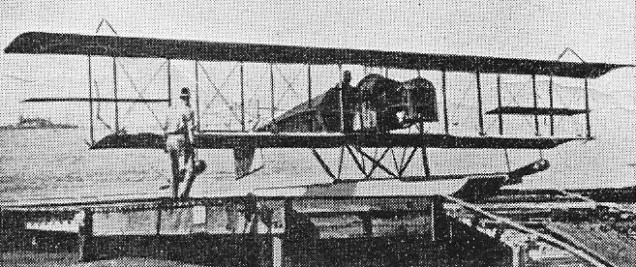
Allan and Malcolm Loughead built their first aircraft, the seaplane, in 1913. A wood and fabric covered three-seat seaplane with flat bottom floats. The aircraft featured ailerons mounted midway between the unequal-span mainplanes.
The Model G was test flown by the Loughead brothers at Santa Barbara, California.
The Model G was a main attraction at the Panama Pacific International Exposition held at San Francisco. Hundreds of visitors to the exhibition had their first experience of air travel in the Model G.
Engine: Curtiss O Span upper: 46 ft Span lower: 36 ft Length: 30 ft Height: 10 ft AUW: 2200 lb Useful load: 584 lb Max speed: 63 mpg at SL Seats: 3
The two- seat Mini-twin was developed from the TEAM “Z” Hi-Max which was a single seater, with the width and wingspan both increased.
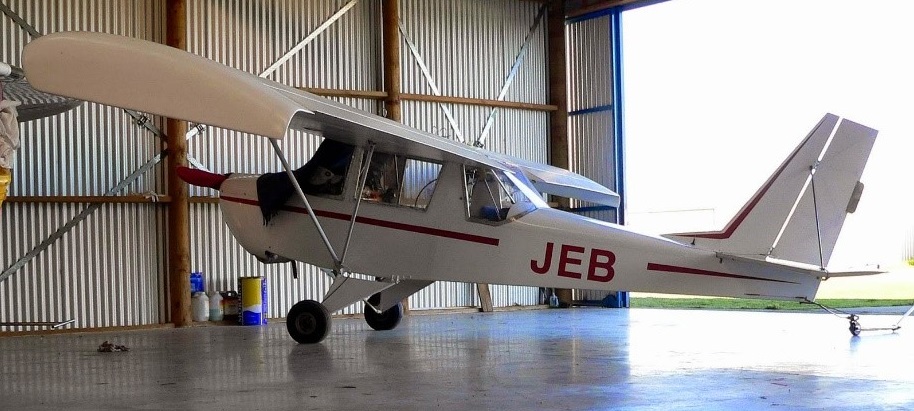
First registered ZK-JEB in 13 May 1996, David Locke test flew the aircraft in May 1996. ZK-JEB (c/n DBL 3) is officially a David Boehm Locke Hi Max Minitwin, and it took 1500 hours to construct over a period of 2 years. Powered by a 45 HP Zenoah engine it has a cruise of 65 mph. MAUW is 660 pound (299 Kg). It was a good aeroplane but not really fast enough for cross country flying so Dave Locke turned his attention to the Minitwin Mk II. On 15/1/01 ownership transferred to B StC C McKenzie of Auckland, then on 25/6/02 to S A Hyde, also of Auckland. It then headed to the South Island, to C G L Pennell of Rangiora with whom it had a forced landing following power loss on 8/12/05. It then went to A C Reid of Fairlie and finally to J D Simpson of Karamea.
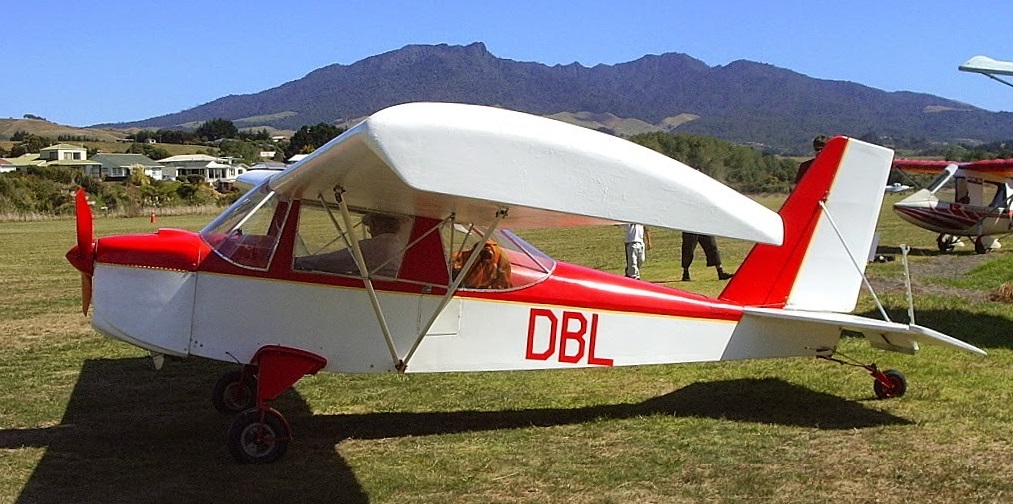
ZK-DBL (c/n DBL 4) is officially a D Locke Mintwin II. It took 2500 hours to construct and it is powered by a 63 HP 3 cylinder 657cc DOHC water cooled engine from a Suzuki Cappucino sports car. It has a 3:1 reduction gearbox that Dave designed and built himself. Cruise is around 85 to 90mph. Empty weight is 630 pounds (287 Kg) and MAUW is 1,070 pounds (485 Kg). It is still owned by Dave Locke.
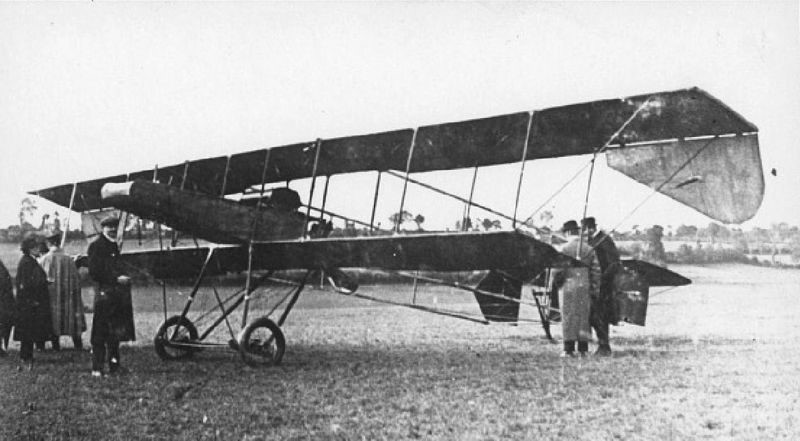
This 1912 Gnôme-engined pusher biplane was also known as the Lochner Rennzweidecker. It was built by Weyl in Germany with financing from Lochner, and was flown by Weyl.
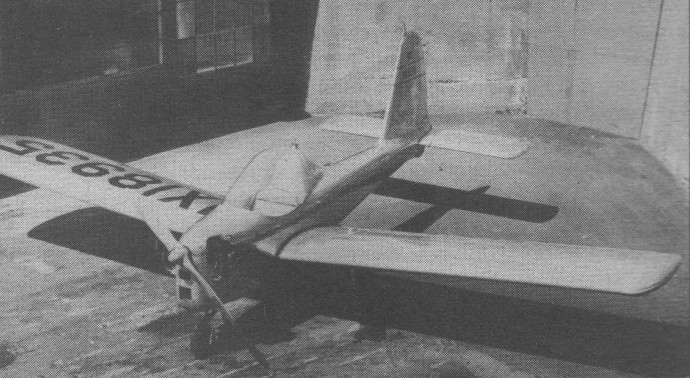
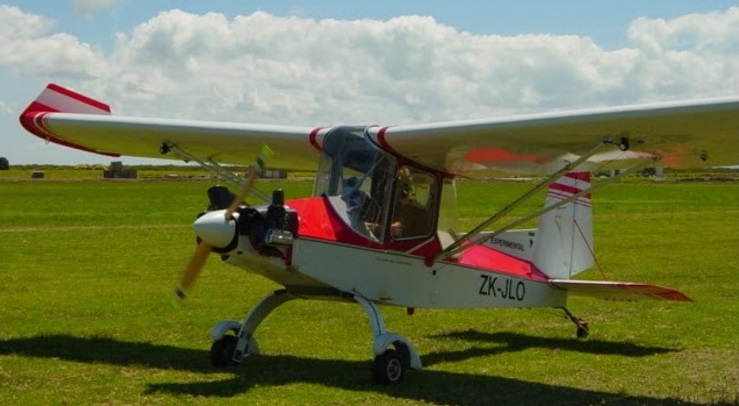
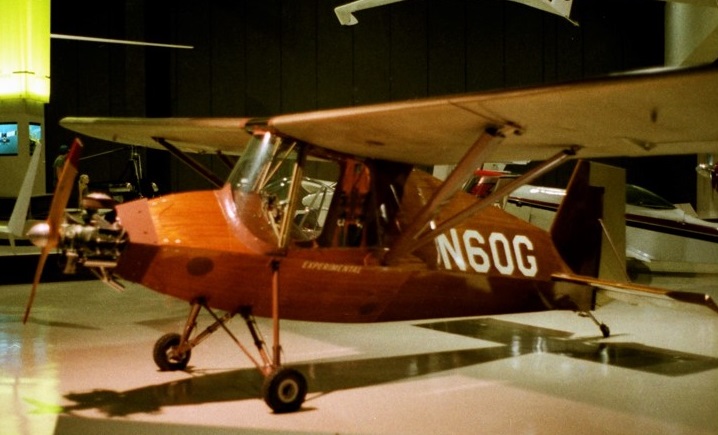
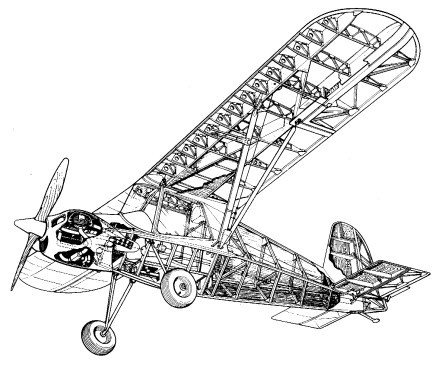
Of all wood construction the first Gangobie was designed and built by two brothers, William and James Lobet, in 1953. The result of intensive wind tunnel testing, the prototype got airborne behind a l6hp Clerget engine. Since built in small numbers in North America, and achieved kitset production status as a peanut scale 13” wing span balsa model.
Grounded after 30 hours of flight time by the failure of the nearly 50 year old engine, the Ganagobie concept was given a new lease of life by a Canadian engineer, Mr George Jacquemin. Mr Jacquemin, an aerospace engineer with Lockheed in California, suggested the modification of the design to accommodate the large numbers of war surplus target drone engines available in the mid fifties. The fuselage was given a boost in size to fit a larger framed pilot and a second prototype begun in Toronto, Canada, by an Experimental Aircraft Chapter. Completed by a Mr Pierre Descamps, the American Ganagobie was engined by a 1934 French-built Poinsard 35hp flat four. A subsequent flight report by De Havilland Canada’s chief test pilot gave the design a boost and some ten Ganagobie 03 projects were begun, largely in the United States and Canada. The original Canadian built Ganagobie was later re-engined with a Volkswagen 1200cc engine, standard fare for a number of homebuilts, and led to the latest in the family, the Lobet Ganagobie 05. The one and only Ganagobie 05, begun in Australia in 1974 after James Lobet migrated there, was shipped to New Zealand in 1982.