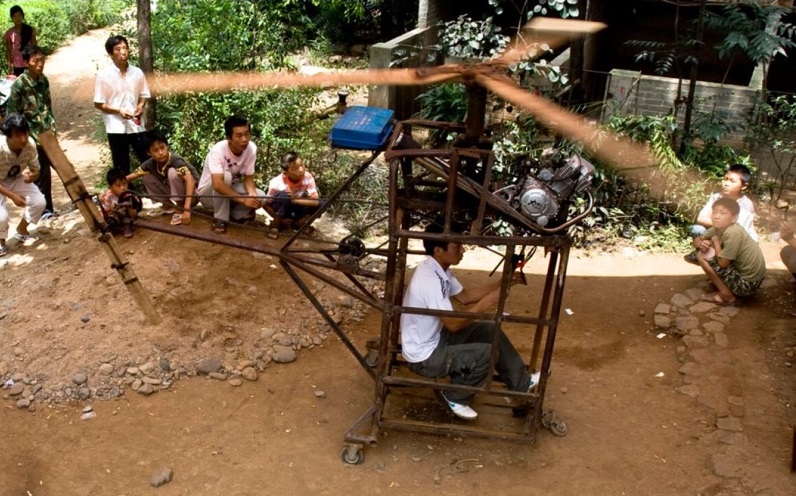
20-year-old Wu Zhongyuan, a farmer from Henan province. He has since childhood dreamed of flying and spent three months and $1,600 building a shanzai helicopter. The airframe is fabricated from a steel scaffold. Power comes from an old 150cc motorcycle engine driving Elm wood blades. Zhongyuan claims the chopper will fly to 800 meters (2,600 feet), but so far hasn’t been able to prove it.
Provincial authorities have forbidden him from flying on safety grounds.
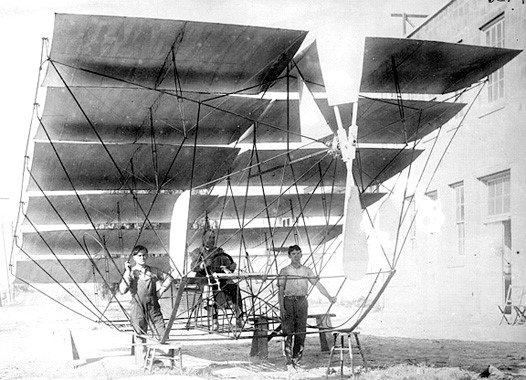
Californian Professor Jerome S. Zerbe produced a sextuplane with six 15′ wings forward-staggered over a framework bearing two tractor props, but there are no records of its success, if any.
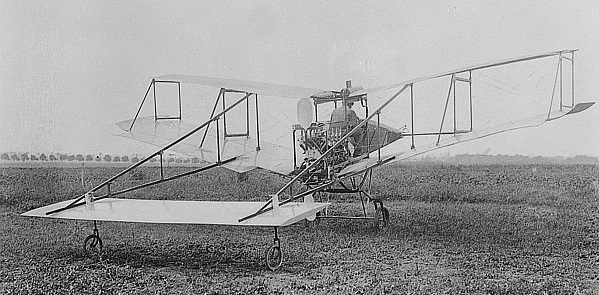
In 1909 Californian Professor Jerome S. Zerbe built the four place cabin quadruplane Air Sedan. There were four short-span, double-cambered, forward-staggered wings, apparently with a ganged variable angle of attack. The cabin was plywood-clad.
Powered by a 100hp Gnôme or 90hp LeRhône rotary, it was flown by Tom Flannery from a field on the Washington County fairgrounds for a distance of about 1,000′ before being damaged on landing. No other flights were recorded.
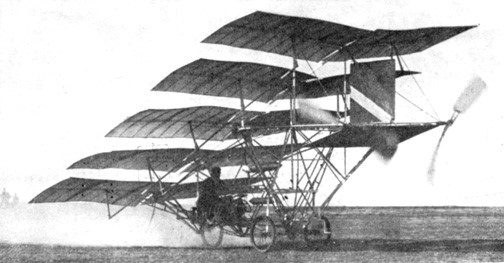
James Slough Zerbe, known as Professor Jerome S. Zerbe built three multiplanes circa 1910. The Quintaplane of 1910 had five wings attached to what appears to be a flying motorcycle.
Whether or not it ever flew is unknown, but the second five-wing multiplane built by Californian Professor Jerome S. Zerbe, came to grief on January 11, 1910 during the 1910 Los Angeles International Air Meet at Dominguez Mesa. It was reported as being “a casualty before becoming airborne.”
James Slough Zerbe, known as Professor Jerome S. Zerbe built three multiplanes circa 1910. Multiplane of 1910.
The second five-wing multiplane built by Californian Professor Jerome S. Zerbe, came to grief on January 11, 1910 during the 1910 Los Angeles International Air Meet at Dominguez Mesa.
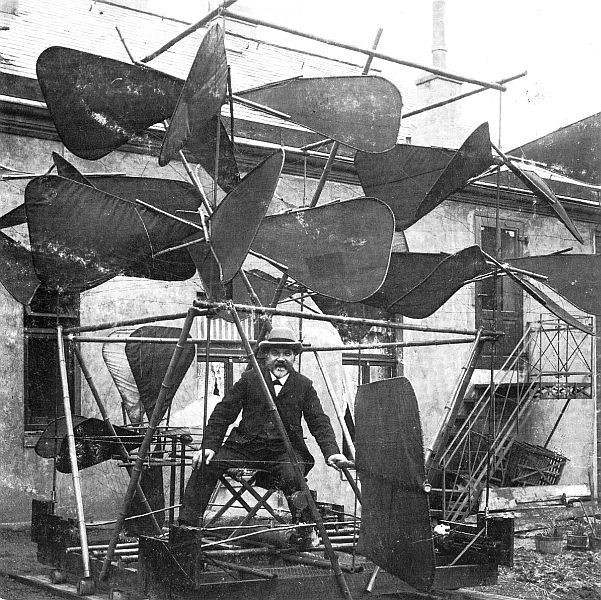
Carl Zenker, of Bremen, Germany, designed this “steerable airship” Eight horizontal propellers provided vertical lift. Its construction from bamboo rods and cloth took from August 1873 till March 1900, and cost about 40,000 Marks. Herr Zenker stated proudly that the craft, “Requires no balloon to become airborne, and operates at a nominal 6hp”. Weighing 660lb and driven by “fluid air and compressed air”, a speed of 1km in 2mins (about 18.5mph) was estimated. Horizontal flight was to be achieved by means of twin propellers, and the craft was steered by a single rudder. One could own a Zenker contraption for a mere 10,000 Marks, from four to six months after receipt of the order.
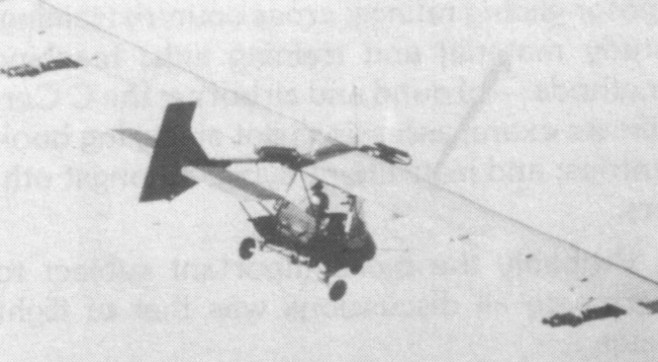
A French-designed and built two-seat Zenith-Aviation Baroudeur microlight, capable of being parachuted and assembled, has been equipped with two rocket tubes under each wing, firing a total of four 89mm projectiles. Firing tests have been reported as very satisfactory.
Designed by Charles Rocheville, the sole 1928 American Albatross B-1 NX6772 was sold in 1929 to (Alva Roy) Ebrite Aero Corp of Long Beach CA, for charter work and is sometimes seen as Ebrite New Albatross, reportedly repowered with 400hp P&W Wasp. It was used for 1929 endurance record attempts by John Gugliemetti and Lee Schoenhair, but without success.
The 1927 Albatross Z-6 six place biplane was designed by Charles Rocheville, Albin Peterson. Three were built: NX578K, N7076, and NX707E, and one conversion: NX7580.
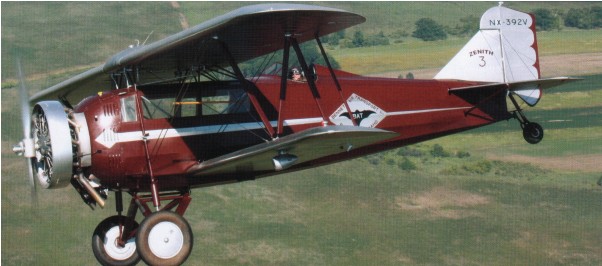
The two Albatross Z-6-A (ATC 2-269) of 1928 seated four in the cabin. For $20,000, one was for Bennett Air Lines in Idaho (NC392V), and one with ATC 2-212 for 450hp Wasp SC conversion (NC134W).
Zenith Z-6-A NC392V
NC392V was restored in 2006 at PAR, Maryland Heights MO.
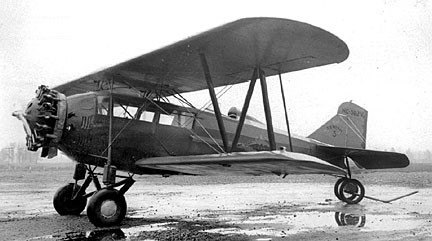
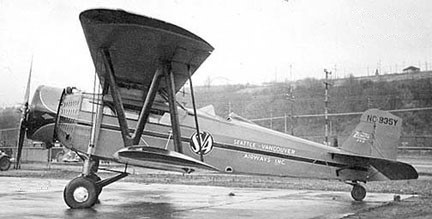
Three Albatross Z-6-B were built in 1929 (ATC 2-315). At $20,000, they were NC835Y, NC935Y, and NC977Y.





 All Aero