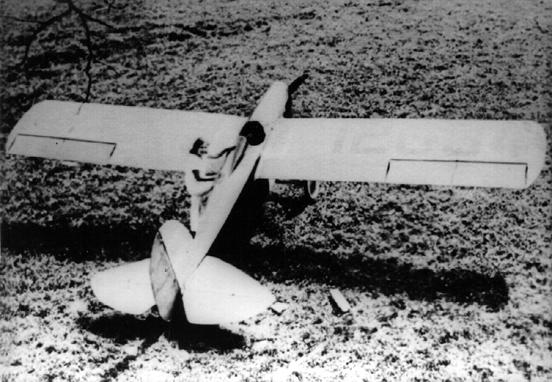
Belford Maule dropped out of school to apprentice himself as an auto mechanic. Shortly after he got his first taste of aircraft as a motor en¬gineer on Army dirigibles. Deciding he should learn to fly, he built himself an airplane: the M 1.
Built around 1930-1931, this homebuilt plane was powered by a 27 hp Henderson motorcycle engine. It flew both as a taildragger and as a floatplane.
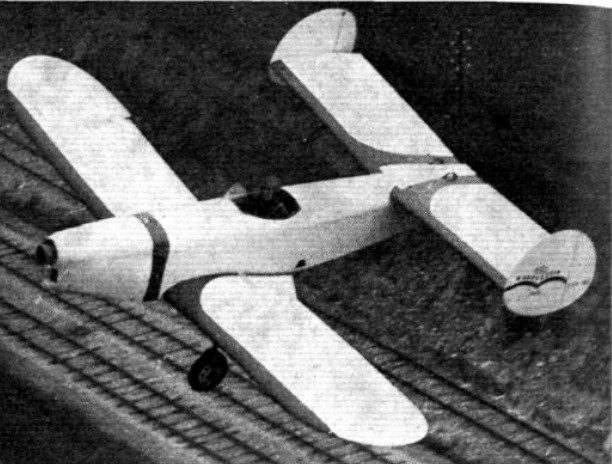
A single-seat tandem-wing research aircraft of 1936. Mauboussin argued that with the tandem wing arrangement of the wings, and the c of g is properly located, the front wing will stall first, putting the machine into a dive before it can go into a spin. If, therefore, the ailerons are transferred from the fron to the rear wing, there should be adequate control on the unstalled wing; and even if the front should have a slight tndency to spin it will be prevented by the unstalled and fully controlled rear wing from dragging the machine as a whole into a spin.
The fundamental design of the Hémiptère involves front and rear wings of different aerofoil sections, and arranged with the rear wing mounted on top of the fuselage, while the front wing is attached to the bottom of the fuselage. There is a decalage of three degrees, as the front wing is at an angle of three degrees when the wing is a 0 degree incidence. The arrangement is that of a heavy negative stagger, the distance between the front and rear wing being equal to the chord of the front wing.
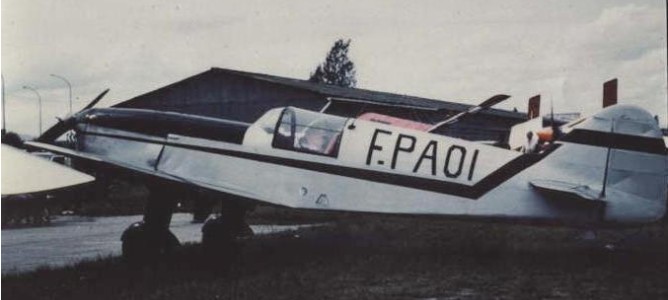
M.40: c/n 01 F-AOYZ, endplate fins on high rear wing, influenced by Peyret project.
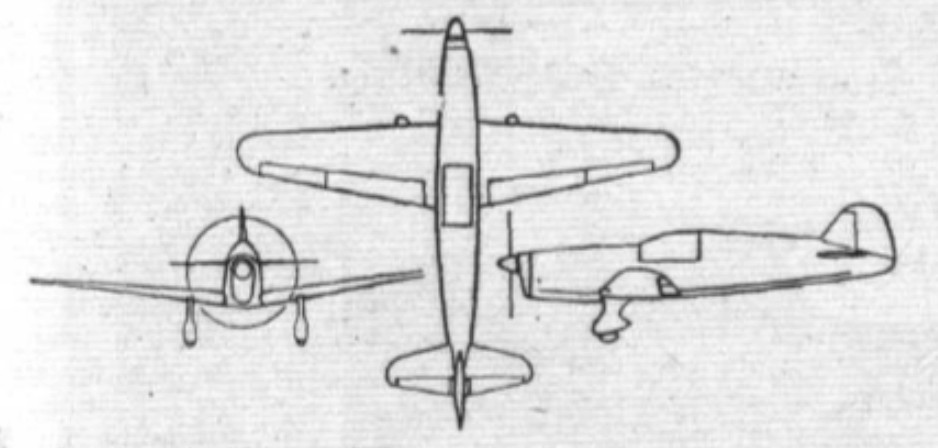
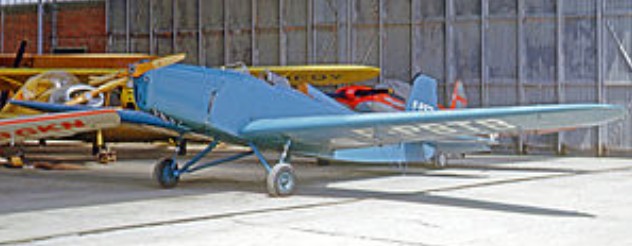
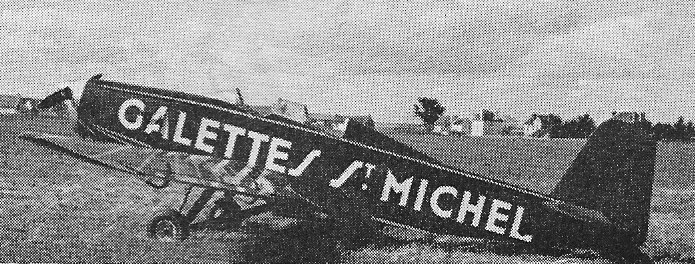
The Mauboussin M.200 was 1939 single-seat low-wing monoplane racer built by Fouga (F-AROP).
The M.200 set an FAI record of 255km/h over 1000 km on 7 May 1939.
The Mauboussin M.201 was a 1939 single-seat trainer with 1 x 150 hp Régnier 4Eo and 7.28 m span. It was never completed. The unfinished M.201 airframe may have been basis for the M.202
M.200 Engine: 1 x 115 hp Régnier 4Eohp Wingspan: 28m
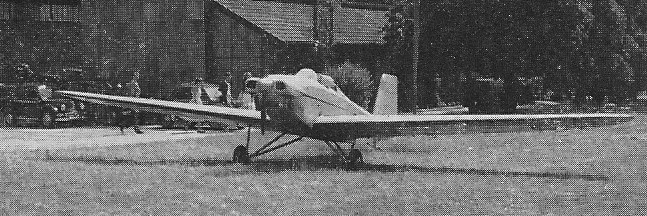
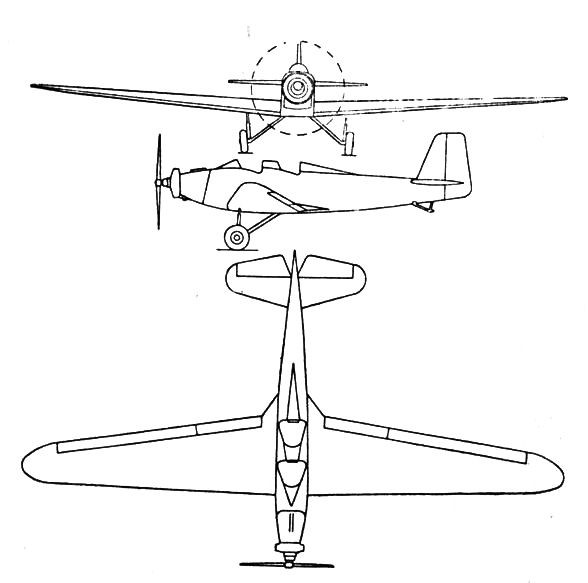
The Mauboussin M.120 was based on a 1931 collaboration between Louis Peyret and Pierre Mauboussin, the Peyret-Mauboussin PM.XII, and like it, was a low-wing cantilever monoplane of wooden construction. The undercarriage was of fixed tailskid type, and the pilot and instructor sat in tandem, open cockpits. Mauboussin built a number of prototypes himself, followed by a small series manufactured for him by Breguet in 1934.
One of first M.120s took part in the international touring aircraft contest Challenge 1932, flown by André Nicolle. It completed contest on the last 24th place, but it had the weakest engine of all participants and completing this contest was quite a success anyway.
In 1935 Maryse Hilz set a women’s altitude record of 7,388 metres on 24 September in the M.122.
In 1936, Fouga, then a builder of railway rolling stock, purchased all rights to the design as part of an effort to enter the aircraft industry, and was able to secure a contract from the Armée de l’Air to supply the type as the M.123.
The Mauboussin 123 was built 1937-1938.
M.125 F-BCEL cn.87
Production was restarted by Fouga after the war for the French flying clubs.
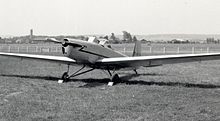
The M.129-28 Corsaire post-war production version was built 1947-1948. Fifty were built powered by a 60 hp Salmson 9 Adr. Twenty M.129-28 Corsaire were produced in 1948 by Fouga et Cie, the first flying on 20 March 1948.
M.129-48 Corsaire
Mauboussin M.123 derivative Metalair 1 at Persan airfield in northern France in 1957
One of first M.120s took part in the international touring aircraft contest Challenge 1932, flown by André Nicolle. It completed contest on the last 24th place, but it had the weakest engine of all participants and completing this contest was quite a success anyway. Two competed the following year, one of them with an all-women crew for probably the first time. Again, low engine power left them low in the final table. After the Angers competition on 2 August 1933, one of the women (Hélène Boucher) set a new women’s world altitude record at 5,900 m (19,357 ft) in the M.120. In 1935 Maryse Hilsz increased it to 7,388 m (24,239 ft) on 24 September in the M.122.
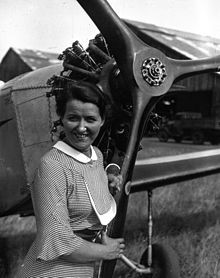
Maryse Hilsz holding the propeller of her Mauboussin M.122, 1935
Variants M.120 – 1932 low-wing monoplane trainer/tourer, 1 x 60 hp Salmson 9Adr, 116 built M.120: PM XII deriv. (PM XII consid. prototype), wooden constr. M.120/32: 1932 Zodiac-built M.120, 3 built (c/n 104, 106, 109) NB: M.120/32 c/n 106 subsequently rebuilt by Brequet as an M.120/34 M.120/34: Breguet-built M.120, 10 built (c/n 111-121, 113 was rebuilt M.112) NB: count incl. c/n 113 (rebuilt M.112) but not c/n 106 (rebuilt 120/32) M.120/37: [Project] 2-seat tandem trainer, became M.123 Corsaire M.121: as M.120 but with supercharged Salmson 9A 68–80 hp (51–60 kW) (2 built) M.121P 1935 Corsaire Major: version with 75 hp Pobjoy R Cataract engine, aka M.121-35, (1 built F-AMHS) M.122 – 1935 Corsaire Major, record a/c for Maryse Hilz, 75 hp Salmson 9 Aers, 1 built For women’s light aircraft altitude record (7338 m category), 24 Sept 1935 M.123 – 1937 2-seat low-wing monoplane trainer, 1 x 60 hp Salmson 9Adr, 11.75m span (65 built) M.123: Corsaire, 60 for Aviation Populaire, wooden const., 1st flight Dec 1937 M.123 stemmed from 1936 Fouga contract for para-military training aircraft M.123C: M 129/48 (F-PJKQ) with Minié replaced by flat 4-cyl Continental M.123M: [Project] 70 hp Minié flat 4-cyl, later produced with 75hp Minié M.123M Corsaire: post-WWII mod, 75 hp Minié 4DC32 flat 4-cyl, canopy, M = Minié M.123M re-engined with 60 hp geared Salmson 9Adr by Gilbert Pollono, 1954 NB: 1958 Pollono re-engined with 75 hp Régnier, turning M.123M into M.125 M.123M (F-BCEP) re-engined with a Continental by Simon Glotin at Nates M.123M re-engined with a 105 hp Hirth engine by M Grenet of Beynes, 1960 M.123R: [Project] 60 hp Régnier inverted 4 cyl engine, not built M.123T: [Project] 60 hp Train 6T 6-cyl inline, not built M.124 – first postwar version with 1 x 60 hp Aster 4A inline 4-cyl, 1 built Aster engine (a licenced Walter Mikron) produced 100 hp M.125 – 1946 M.123 variant, 1 x 60 hp Régnier 4Jo inline 4-cyl, 5 built Differed from M.123 in powerplant and shorter 10.35 m wingspan M.126 – 1946 M.123 variant, 1 x 80 hp Salmson Salmson 5Ap radial, 1 built Differed from M.123 in powerplant and shorter 10.35 m wingspan M.127 – 1946 M.123 variant, 1 x 95 hp Régnier 4Eo inline 4-cyl, 2 built M.128 – 1946 M.123 variant, 1 x 95 hp Mathis G4G flat 4-cyl, 1 built M.129 – 1939, sim, to M-123M, 1 x 75 hp Minié flat 4-cyl, 29 built M.129-48: 1944 M-123 variant (F-BBSK, c/n 191), 1 x 75 hp Régnier 157 4.JO 4-cy l (23 built) M.129-48: postwar production by Fouga, 1 x 75 hp Minié flat 4-cyl M.129 (F-PJKQ) re-engined with Minié replaced by flat 4-cyl Continental Metalair 1: a derivative of the M.123 Grenet PG-2 Bison Mauboussin-Zodiac 17: Designation for Zodiac produced M.120 aircraft
Specifications: M.123 Engine: 1 × Salmson 9Adr, 45 kW (60 hp) Wingspan: 11.74 m (38 ft 6 in) Wing area: 13.0 sq.m (140 sq.ft) Length: 6.8 m (22 ft 4 in) Height: 2.52 m (8 ft 3 in) Empty weight: 349 kg (769 lb) Gross weight: 609 kg (1,343 lb) Maximum speed: 160 km/h (100 mph) Range: 650 km (405 miles) Service ceiling: 4,000 m (13,120 ft) Crew: Two, pilot and instructor
M.129-48 Corsaire Engine: 60 hp Salmson 9 Adr Max speed: 102 mph Cruise: 87 mph Range: 390 mph Empty weight: 876 lb Loaded weight: 1382 lb Wingspan: 38 ft 6 in Length: 22 ft 7.5 in Height: 8 ft 6 in Wing area: 146.3 sq.ft
Fouga M.129-28 Corsaire Engine: 70 hp Minie 4 DA-28
A 1932 redesign of the Zodiac-built Peyret-Mauboussin PM XII low-wing trainer. The M.112 Corsaire is considered the prototype for the production M.120 Corsaire series by Zodiac.
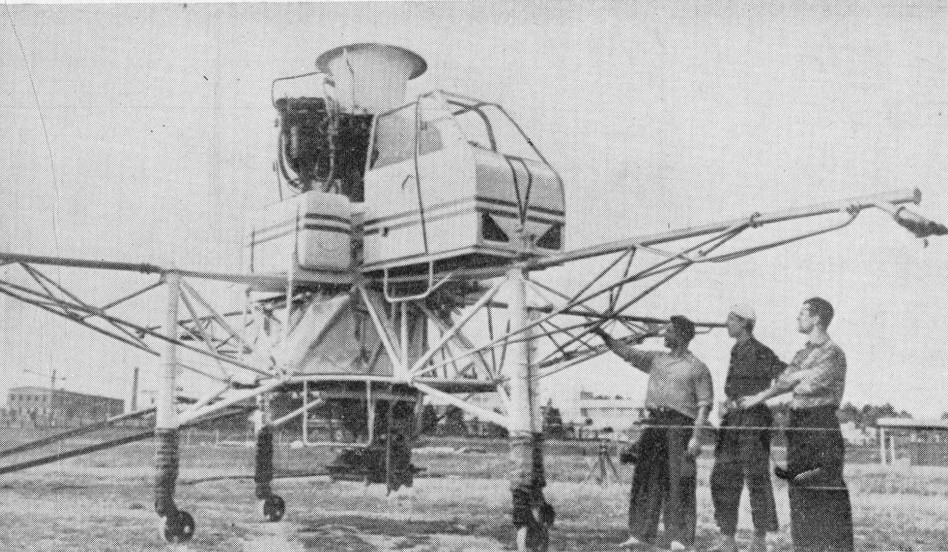
Demonstrated in Moscow during 1938, the Turbolet is a vertical take-off testbed developed by Prof. Vsevolod Matveyev. Comprising a turbojet engine mounted vertically, with fuel tanks and enclosed cockpit, the Turbolet is controlled by outrigger jet nozzles and vanes in the main jet stream.
In 1933 Mattley had in production a lightweight one/two-seat parasol-wing cabin monoplane named the Mattley Fliver, powered by a 40 hp Continental engine.
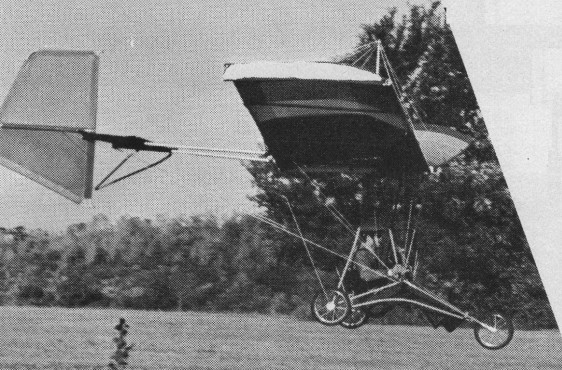
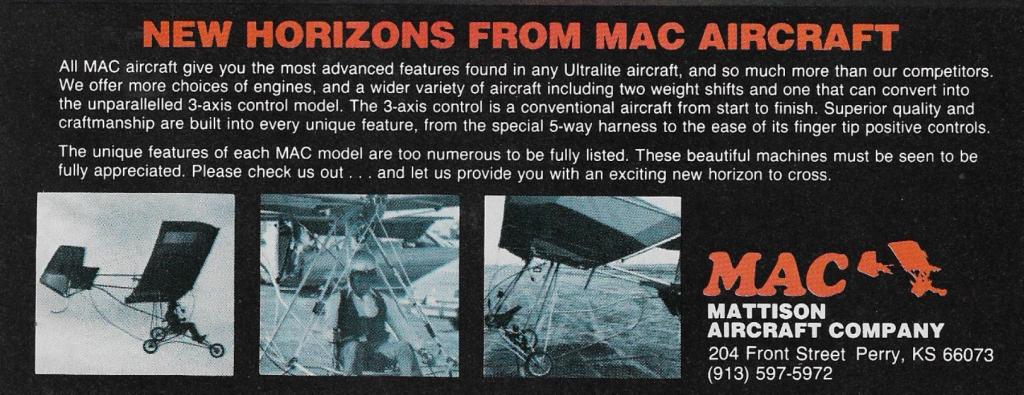
A monowing using weight shift and rudder control. The separate rudder is all flying and there are no ailerons, spoilers or wing warping to achieve roll. Construction is of aluminum tubing covered with dacron on the wings and tail surfaces. Power is a Yamaha mounted in pusher position forward of the wing. A 2:1 reduction unit turns a two-blade, wooden Ritz propeller. Fuel is carried in a plastic tank mounted above the wing. LANDING GEAR: Tricycle type shock mounted with spring action and a bicycle squeeze-type brake. The main and nose wheels are 16 inches in diameter.
In 1981 the complete MAC LST 400 sold for US$2995.
September 1982
All MAC ultralites convert to floats in minutes. Mac un-breakable floats retailed for $495.00 and fit any ultralite that has a main gear axle.
Each MAC. LST 400 series aircraft is built with 90% straight tubing joined with special fittings to allow faster assembly time, easier parts replacement and lower cost all around. Replacement parts consist of one straight tube to be cut and drilled to size. Special features are a spring shock system, sturdy all round construction. Simple engine mounting, quick folding for storage, all bags and covers included.
The MAC. MU-200 series is a sturdy constructed aircraft that has rear axle shock system, fashionable design with all the features of the 400 series. The MU-200 comes with or without the droop tips. The MU is fun, easy to fly and economic to own and operate.
The MAC. LST-300 series three axis control ultralight, everything before this was just a prototype. All the best features, design and prices. Conventional aircraft looks and operation. Just what the conventional pilot has been waiting for. A one place aircraft anyone can afford to fly. Electric start available in 40 H.P. models.
MAC Wingspan, 32 ft Wing area, 16.7 sq.ft Aspect ratio, 7.1 Overall length, 16 ft Empty weight, 165 lb Usable payload (include fuel), 300 lb L/D power-off glide ratio, 7:1 Cruise speed (85% power), 32 mph Stall speed, 16 mph Approach speed, 16 mph Flair speed, 10 mph Liftoff speed, 18 mph Takeoff roll distance, 100 ft Rate of climb, 300 fpm Fuel capacity, 3 Usgal Range at cruise, 75-100 mi Engine displacement, 100cc, 15 hp Static thrust, 120 lbs.
MU-215 15 hp Cruise speed: 35-45 mph Stall speed: 17-19 mph Take off: 18-22 mph Take off: 50-100 feet Landing roll: 25-50 feet Climb: 300-350 fpm
MU-230 30 hp Cruise speed: 35-55 mph Stall speed: 17-19 mph Take off: 18-25 mph Take off: 30-75 feet Landing roll: 30-60 feet Climb: 650-750 fpm
MU-240 40 hp Cruise speed: 40-60 mph Stall speed: 18-20 mph Take off: 18-30 mph Take off: 30-75 feet Landing roll: 30-75 feet Climb: 750 fpm
LST-315 15 hp Cruise speed: 35-45 mph Stall speed: 17-19 mph Take off: 18-22 mph Take off: 50-100 feet Landing roll: 25-50 feet Climb: 300-350 fpm
LST-330 30 hp Cruise speed: 35-55 mph Stall speed: 17-19 mph Take off: 18-25 mph Take off: 30-75 feet Landing roll: 30-60 feet Climb: 650-750 fpm
LST-340 40 hp Cruise speed: 40-60 mph Stall speed: 18-20 mph Take off: 18-30 mph Take off: 30-75 feet Landing roll: 30-75 feet Climb: 750 fpm
LST-415 15 hp Cruise speed: 35-45 mph Stall speed: 17-19 mph Take off: 18-22 mph Take off: 50-100 feet Landing roll: 25-50 feet Climb: 300-350 fpm
LST-430 30 hp Cruise speed: 35-55 mph Stall speed: 17-19 mph Take off: 18-25 mph Take off: 30-75 feet Landing roll: 30-60 feet Climb: 650-750 fpm
LST-440 40 hp Cruise speed: 40-60 mph Stall speed: 18-20 mph Take off: 18-30 mph Take off: 30-75 feet Landing roll: 30-75 feet Climb: 750 fpm