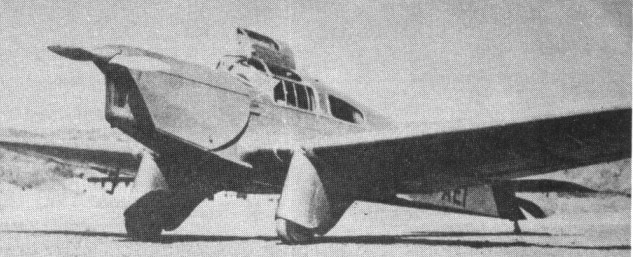
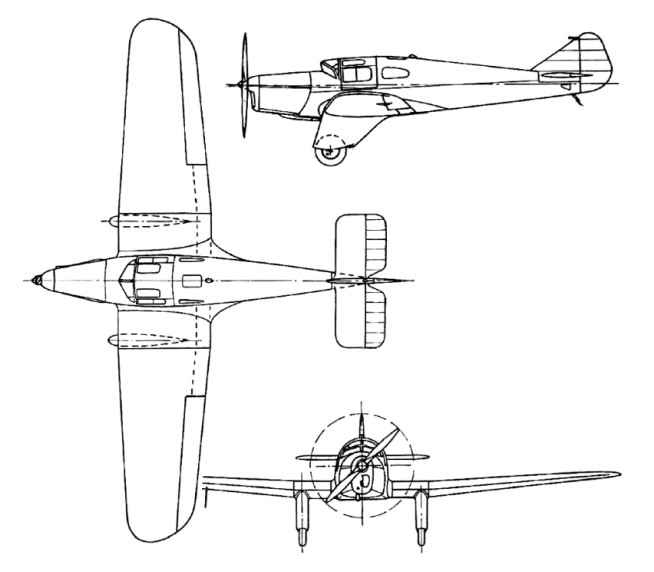
The first true cabin aircraft designed by F. G. Miles, the Miles M.3 Falcon prototype (G-ACTM) was flown first on 12 October 1934. This prototype was a three-seat cabin monoplane, but the first production example seated four in a wider cabin. A number of variants of the basic aircraft were flown under the names M.3A Falcon Major and M.3B Falcon Six.
Total production amounting to 36, of which six were impressed for service with the RAF at the outbreak of World War II. Powered by a 149kW de Havilland Gipsy Six inline engine, the 10.67m span Falcon had a maximum speed of 290km/h and normal range of 901km.
Miles M 3 B Falcon Six Engine: De Havilland Gipsy Six, 197 hp Length: 25.0 ft / 7.62 m Height: 6.496 ft / 1.98 m Wingspan: 35.007 ft / 10.67 m Wing area: 173.946 sq.ft / 16.16 sq.m Max take off weight: 2650.4 lb / 1202.0 kg Weight empty: 1550.1 lb / 703.0 kg Max. speed: 157 kts / 290 km/h Cruising speed: 139 kts / 257 km/h Wing loading: 15.17 lb/sq.ft / 74.0 kg/sq.m Range: 487 nm / 901 km Crew: 1 Payload: 2-3pax
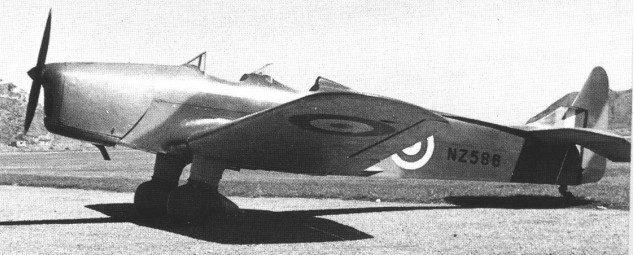
Miles’ previous experience with the Southern Martlet and Metal Martlet biplanes led to the desire to build a two-seat monoplane replacement for biplanes. The result was the M.2 Hawk, flown on 29 March 1933 and powered originally by a 95 hp / 71kW Cirrus IIIA engine. The selling price was £395.
Variants included the M.2a with an enclosed cabin, M.2b single-seat long-range version with an 89kW Hermes IV engine. Later M.2c aircraft offered the 89kW de Havilland Gipsy III, and the three-seat M.2d.
Hawk Trainer III – previously a Magister with RAF, the coupe to add as a ‘station modification’
Hawk production totalled 55.
Further development of the basic type led to the Hawk Major series (64 built), beginning with the M.2F with the 97kW de Havilland Gipsy Major engine. The prototype Hawk, designated the Miles M.2F Hawk Major, was temporarily a single seater and finished second in the 1934 Kings Cup race at an average speed of 147.78 mph.
Hawk Major
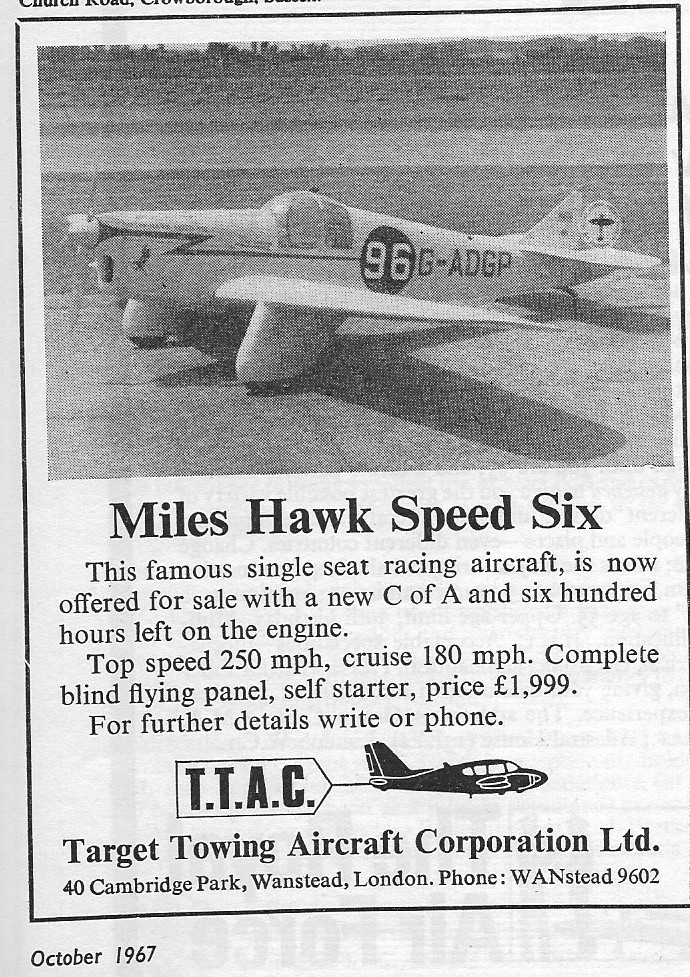
A range of variants up to the M.2T were built. Single-seat racing models were known as the Hawk Speed Six; three were built with 149kW Gipsy Six engines, and another somewhat smaller racing variant was the M.77 Sparrowhawk, of which five were built.
The final pre-war development was the Hawk Trainer, of which 25 were built
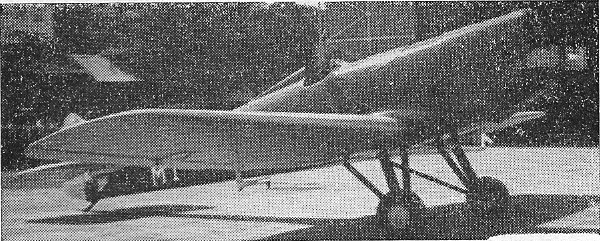
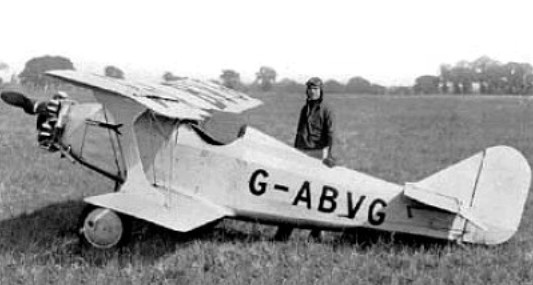
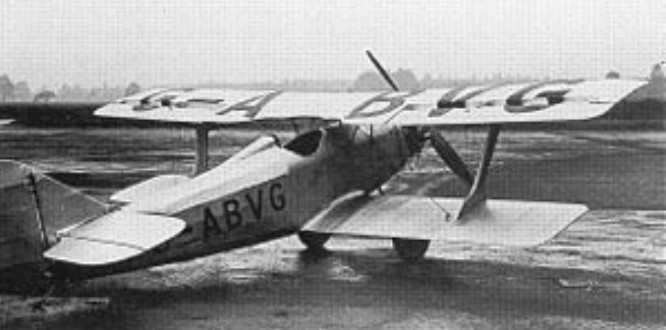
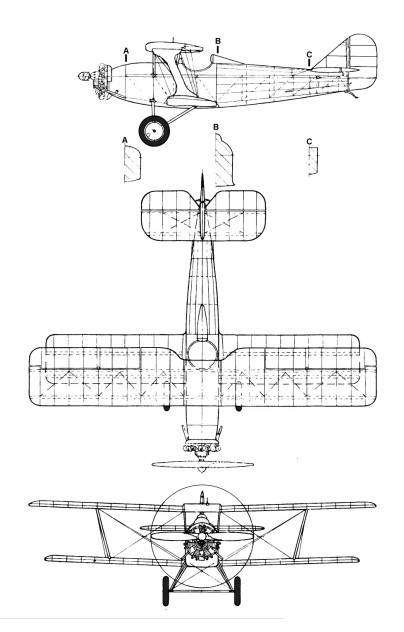
The single-seat, aerobatic, Satyr biplane was designed in 1932 by F.G. Milesat Shoreham, Sussex. It was a wooden single-seat aerobatic biplane powered by a 75 hp Pobjoy R engine. Built by Parnall at Yate, Gloucestershire, the aircraft (registered G-ABVG) first flew in August 1932. Although the aircraft flew well Miles decided to concentrate on monoplane designs and only one was built. The only Satyr crashed in August or September 1936.
In ‘Miles Aircraft since 1925’ Don Brown recounts the crash as follows:
“The end of the Satyr was unusual and dramatic. One day in September 1936 Mrs Victor Bruce was approaching to land in a small field and, at the last moment, when it was too late to take evasive action, she noticed a large mass of telephone wires dead ahead, so close that there was no time either to climb or dive under them. Thinking what bad luck it would be on all the people whose telephones would be disconnected, she sailed on gaily into the wires expecting to go straight through them. However, she had overlooked the number of wires and the low momentum of the little Satyr. Instead of passing through the wires and landing in the field, the wires stretched but did not break. In a matter of seconds the Satyr was stopped dead in the air and then catapulted backwards into the field over which it had just flown. It was all over in a flash. Mrs Victor Bruce was unhurt but it was the end of the Satyr. This must be one of the few instances in which an aeroplane has landed backwards, although not very successfully.”
The autobiography of the Hon. Mrs Victor Bruce (‘Nine Lives Plus’) deals with the circumstances of the crash (“on the green outside Stafford”) she says:
“Suddenly there was an almighty crash. I thought that I had hit one of the houses, because the noise was terrific. Then I realised that I had flown into the telephone wires. The Satyr and I must have remained hanging inthe wires for at least half a minute. Then the wires gave way and we fell fifteen feet to the ground with a bang”. “The Satyr, of course, was badly damaged…………..” and then: “While the Satyr was being repaired I hired a Gipsy Moth to take its place in the show……….”.
So did the Satyr survive the crash and was repaired.
M.1 Engine: 1 × Pobjoy R, 75 hp (56 kW) Wingspan: 21 ft 0 in (6.4 m) Length: 17 ft 8 in (5.38 m) Empty weight: 594 lb (269 kg) Gross weight: 900 lb (408 kg) Maximum speed: 122 mph (196 km/h) Crew: One
F.G. Miles started his career in 1926 by combining a flying club with barn-storming and joyriding, and went on to design the single seat Southern Martlet and ultralight Miles Satyr biplanes at Shoreham, Sussex, the latter being built by Parnall at Yate, Gloucestershire.
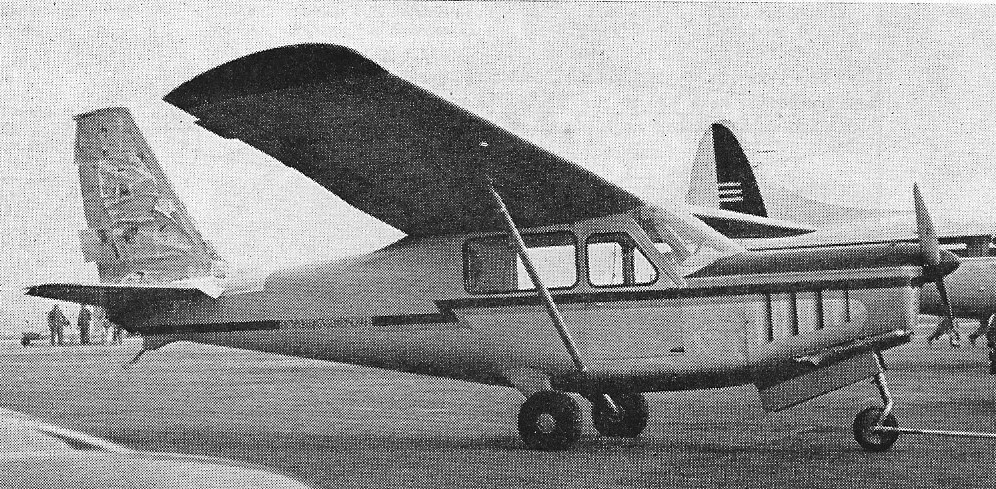
Under test during June 1959 at Stuttgart-Echterdingen, airfield in Germany, the Milan M.S,6 prototype was powered by a 105 hp Walter Minor 4-III engine.
The four-seat G.S.6 was designed by Graf v. Saurma-Jeltsch and Alfred Vogt.
During testing the prototype underwent modifications to the tail assembly.
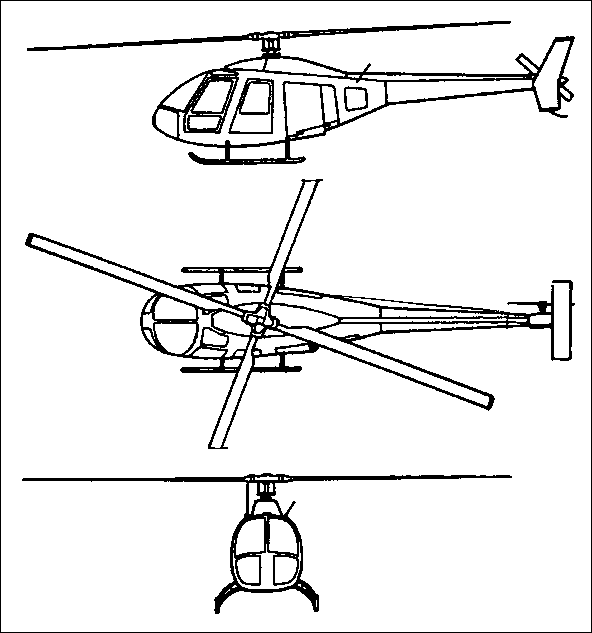
Codenamed ‘Hermit’ by NATO, the Mi-34 is a two/four-seat light helicopter powered by a piston engine. The first of two prototypes flew for the first time in 1986, and the type was revealed to the West for the first time at the Paris air show in June 1987. First flown on 17 November 1986, two prototypes and a structure test airframe were completed by mid-1987.
An acrobatic helicopter, it was the first helicopter built in former USSR to perform normal loop and roll. Intended initially for training and international competition flying, it has a conventional pod and boom configuration, powered is from a 325 h.p. Vedeneyev M-14-V26 engine.
Aerobatic capabilities include backwards flight at 130km/h and rotation about main rotor axis at 120 degrees/s. The flying controls are manual, with no hydraulic boost. The semi-articulated four-blade main rotor with flapping and cyclic pitch hinges, has natural flexing in the lead/lag plane. Blades are of GFRP with CFRP reinforcement, attached by flexible steel straps to the head. The two-blade tail rotor is of similar composites construction, on the starboard side. The riveted light alloy fuselage has a sweptback tailfin with small unswept T tailplane.
Landing gear is conventional fixed skids on arched support tubes and a small tailskid protects the tail rotor. One 239kW VOKBM M-14V-26V nine-cylinder radial air-cooled engine is mounted sideways in the centre of the fuselage. Fuel capacity is 176 litres in a system for inverted flight.
The normally one or two pilots, side by side, are in an enclosed cabin, with optional dual controls. The rear of the cabin contains a low bench seat, available for two passengers and offering a flat floor for cargo carrying. There is a forward-hinged door on each side of flight deck and on each side of rear cabin.
The primary electric power is provided by 27V 3kW engine-driven generator. A secondary power supplys 115V AC, 400 Hz, single-phase and 36V AC, 400 Hz, three-phase; 27V 17Ah battery.
The Mi-34S/34C completion was at Moscow plant of LVM, but subsequently reverted to Arsenyev.
Planned completion of 30 in 1994-95 was hampered by a lack of funding, with five delivered in 1995, and one in the first half of 1996.
Trials in 1999 by a civil pilot training school at Omsk showed Mi-34 to be 2.8 times cheaper and more effective to operate than current fleet and the school was to acquire three Mi-34Cs and obtain up to 10 more in long term. In 2001, an upgraded variant was proposed with M-14 engine rated at 272kW, IFR instrumentation and auxiliary fuel tank. An agricultural variant was planned for debut in 2003.
The Mi-34S is the basic version, marketed in Russia as the Mi-34, and certified by the Interstate Aviation Committee Aviation Register (initially at 1,350kg max take-off weight), with helicopter, engine and noise type certificates, meets FAR Pt 27 requirements. (Note that until 1999, all marketing literature for this version used the hybrid Roman/Cyrillic ‘Mi-34C’ to indicate certified status.)
Total of 23 sold and 18 delivered by mid-2002, compared with estimated 425 called for in Russia’s 1992-2000 civil aviation development plan. Had increased to 21 deliveries (from Arsenyev) by March 2003. First three for Mayor’s office, Moscow. Others used by Bashkir Airlines and Mi-Avia for patrol and training. One operated by Bosniac and Croat Federation Air Force. Three delivered to Nigerian Air Force in 2001, along with six Mi-35s; these were from first batch of six Mi-34s built at Arsenyev, after pause of several years; further five delivered to Nigeria by end of 2002. LVM reportedly ordered 20 Mi-34s for construction at Arsenyev in 2001, but only delivery in that year apart from Nigerians was one to Sibneft. In June 2002, Russian sources reported foreign (assumed Nigerian) negotiations for “several dozen” Mi-34s although only known 2003 production commitment is follow-on batch of four for Nigeria and five for Omsk Civil Aviation Flying and Technical College by end of 2005.
Costs: US$400,000, fully equipped (2003).
A twin-engine version is built by the VAZ motor car works at Tolyatti. The Mi-34VAZ features a totally new rotor head made from carbon fibre.
A development was under way to re-engine the Mi-34 with two 164kW VAZ-430 rotary engines normally used to power VAZ cars, and which run on Mogas. First flight of the prototype, designated Mi-34V, was scheduled for 1993.
The Mi-34P (patrulnyi: patrol) is a version of the Mi-34S, equipped for police duties. Renewed interest in 2001 from Gazprom for pipeline patrol.
Mi-34 Engine: 1 x VMKB M-14V-26 Instant pwr: 243 kW Main rotor diameter: 10.0m Tail rotor diameter: 1.48m Overall length, rotors turning: 11.415m Fuselage length: 8.71m Max width: 1.42m Overall height: 2.75m Normal take-off weight: 1280kg Max take-off weight: 1450kg Empty weight: 950kg Max level speed: 210km/h Max cruising speed: 170km/h Service ceiling: 4000m Hovering ceiling, OGE: 900m Range with max fuel at 500m: 356km Crew: ½ Pax: 2 Seats: 4
Mi-34VAZ Engine: 2 x VAZ-430 rotary Instant pwr: 170 kW Rotor dia: 10 m MTOW: 1960 kg Useful load: 550 kg Max cruise: 110 kts Max range: 600 km Crew: 1-2 Pax: 2 Seats: 4
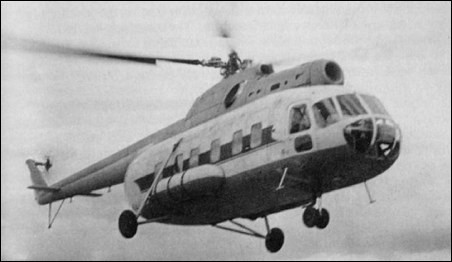
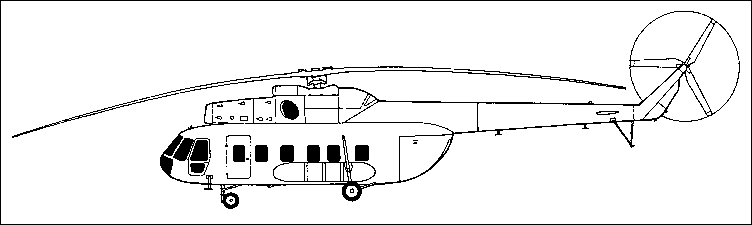
The Mi-8 prototype incorporating an Mi-4 main rotor and transmission and one 2700shp Soloviev AI-24V turbine mounted on top of fuselage. First flown on 24 June 1961 and subsequently fitted with 5-blade rotor and two 1400shp Isotov TV2-117 engines, being the standard for the Mi-8.
V-8 Crew: 3 Passengers: 18 Engine: 1 x AI-24V turboshaft, 1425kW Main rotor diameter: 21.0m Max take-off weight: 11200kg Empty weight: 5726kg Payload: 1500-2000kg
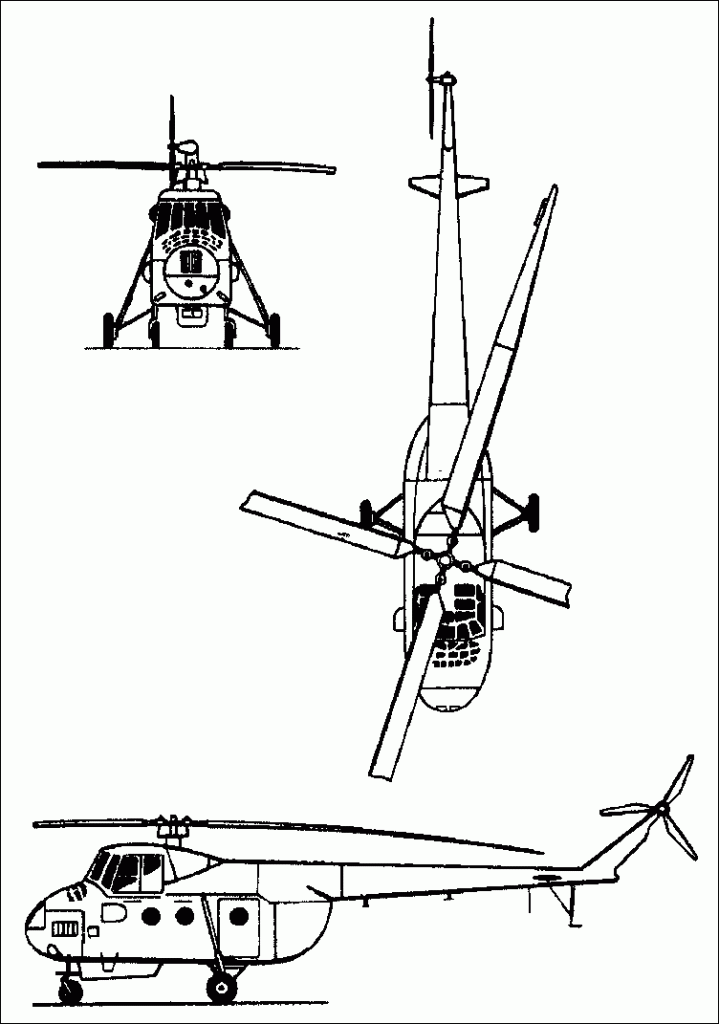
At a Kremlin meeting of constructors in September 1951 Stalin insisted on sudden great advance in Soviet helicopters. On following day Mil and Yakovlev were given one year to design, build and fly prototypes, Mil’s assignment being single-engined 12-passenger machine. Mil had prepared outline design beforehand which he produced at Kremlin; basically scaled-up rotors of Mi-1 with added fourth main rotor blade, rotor axis inclined forwards 5 degrees, and a fuselage of light-alloy semi-monocoque with extensive use of magnesium. The engine installed at 25 degrees in the nose, accessible through upper/lower hinged nose doors and left/right hinged side doors. Cooling fan and centrifugal clutch immediately to rear of engine, with inclined shaft between pilots to main gearbox. Separate cooling systems for oil radiator and hydraulics for flight control. Straight tail boom with adjustable stabilizers, deep skid/bumper and narrow fin carrying tail rotor on right, with three bakelite-ply blades. Main fuel tank welded aluminium, 960 lit, behind gearbox; optional aux tank 500 lit in hold or externally. Quad landing gear with pneumatic-braked mainwheels and castoring nosewheels, optional pontoons for water. Main hold 4.15m long, about 1.8m square section. Max internal load 1740kg including small vehicles loaded through left/right rear doors and clip-on ramps. Slung load to 1.3t. Alcohol de-icing of blades and windscreens as on Mi-1.
First flight delayed several weeks by blade flutter in ground-running from 14 April 1952. First flight May, Vinitsky assisted by Brovtsev. Remarkably few subsequent snags and NII testing completed before end of year. The Mi-4 was already in Soviet Air Force service by August 1953, when it was first seen publicly at the Tushino Aviation Day display. NATO code name ‘Hound’.
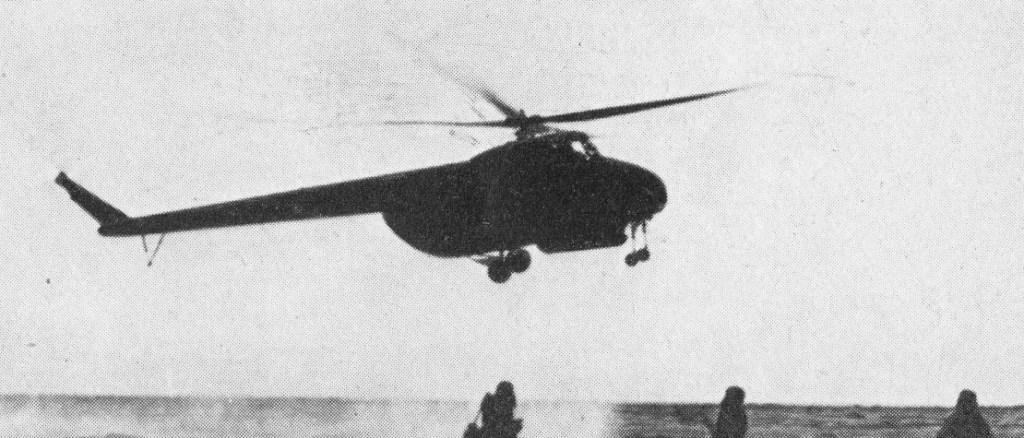
At the 1953 Soviet Aviation Day Display, 18 flew, 13 unloaded jeeps through rear clamshell doors under their tailbooms. The others each unloaded two motor-cycle and sidecar combinations.
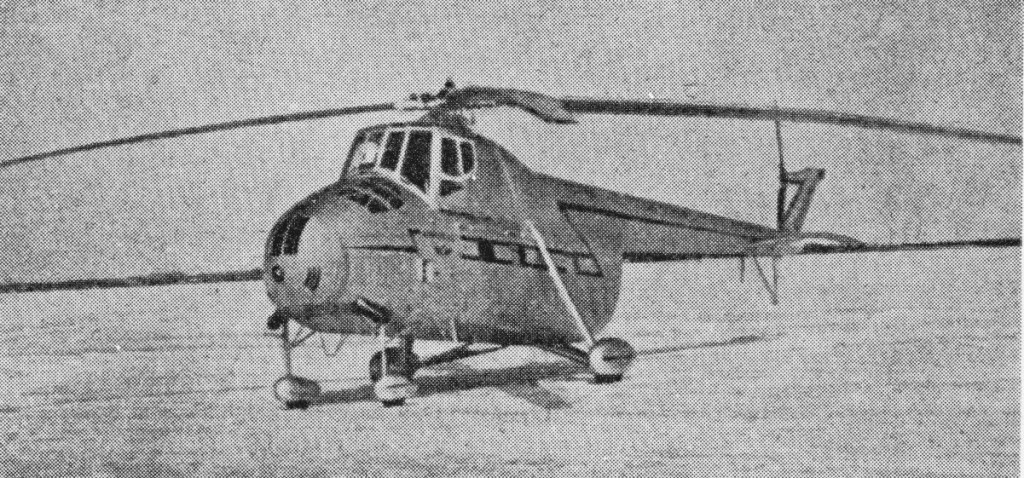
Featuring a four-blade main rotor with hydraulic servo-control and three-blade anti-torque rotor at starboard side of tailboom. The main rotor blades were originally tapered, with steel spars and plywood covering; since 1961 they have been of constant-chord all-metal construction.
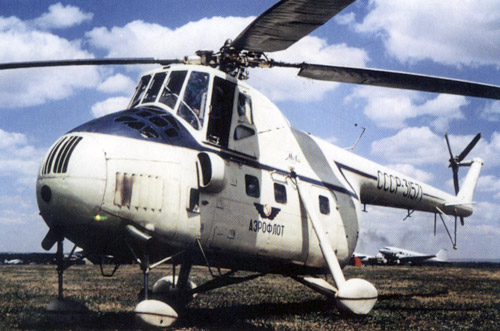
All-metal semi-monocoque structure of pod and boom type, with access to the main cabin via a normal side door, with provision for clamshell doors under the tailboom attachment point in freight-carrying version. The landing gear is a non-retractable four-wheel type. All units fitted with shock-absorbers. Nosewheels are fully castoring. Spats optional. Provision for fitting pontoons. Power is from one 1,700hp ASh-82 V 18-cylinder air-cooled radial engine mounted in fuselage nose.
Accomodation is for a crew of two on the flight deck, with underfuselage gondola for observer in military version. Commercial version carries 8 to 16 passengers in heated, ventilated and soundproofed cabin, with door at rear on port side. Aft of cabin are a toilet, wardrobe and compartment for 100kg of baggage. Ambulance version carries eight stretchers and attendant. Freight version has clamshell rear doors. Military version carries up to 14 troops, 1,600kg of freight or vehicles such as a GAZ-69 ‘Jeep’, 76mm anti-tank gun or two motorcycle/sidecar combinations.
Radio and instrumentation for night and bad weather flying are standard equipment. A liquid leading-edge de-icing system.
Produced initially since about 1953 for use by the Soviet armed forces in assault and troop transport roles, the Mi-4 ‘Hound-A’ has clamshell rear doors to simplify the loading of vehicles and freight; alternatively, the cabin can accommodate 3,520 lb (1,600 kg) of cargo, or up to 14 troops. Military Mi-4s are recognisable easily by having a ventral gondola which was intended originally for a navigator or observer, but can also house avionics equipment. Produced in large numbers for Soviet military use, the Mi-4 was also exported for service with more than 20 foreign air arms. Conversions have been reported in Soviet use for ASW (‘Hound-B’) armed close support and ECM (‘Hound-C’). From 1964 production of civil versions was initiated and combined civil/military production by Mil was estimated at 3,500 when production terminated in 1969. All versions can be equipped with inflatable pontoons which, mounted so that the landing wheels project below them, can be used for amphibious operations.
Urgent development of improved metal blades 1954-60 culminating in dural blade with extruded spar and honeycomb box trailing sections. Magnesium fuselage skins replaced by aluminium, and better flight control and avionics.
Main production model military Mi-4T, with increased diameter main rotor, aluminium cargo floor, bulged circular windows with gun ports, ventral gondola for nav/observer, and tactical avionics.
Military Mi-4’s have been exported to a number of air forces in the Soviet bloc, among the largest users being India, which had sixty, and Cuba, which had twenty-four.
A stripped-down Mi-4 established a number of speed-with-payload and payload-to-altitude records in April 1956, including 500km circuit at 187.254km/h, and later 1012kg lifted to 7575m.
From 1964 civil versions of the Mi-4 were also built in considerable numbers. A basic Mi-4 for general use and freight transport followed by the Mi-4P (Passajirskii – passenger) and the Mi-4S (Selskokhoziaistvennii – rural economy). The Mi-4P is the standard version for Aeroflot, carrying 11 passengers normally or up to 16 in high density seating or, in the ambulance role, 8 stretchers and a medical attendant. The Mi-4P is distinguished by having square cabin windows, wheel spats and no ventral fairing; 100kg of baggage can be carried in addition to the normal passenger complement. The Mi-4P, which went into regular service with Aeroflot in November 1958, can carry up to 11 passengers or eight stretchers and a medical attendant for ambulance duties. The Mi-4S (SKh) is normally used for agricultural operations, when it can be fitted with a 1000kg dust hopper or a 1600-l tank holding pesticide or fire-fighting chemical.
First flown in 1962, the Mi-4PL ASW version for AV-MF carried four 250kg or six 100kg A/S bombs, chin radar (also fitted to various military variants), short but deeper gondola, and a towed MAD at rear and sonobuoys on external rack on right side. The Mi-4S Salon VIP version had a mtow of 7315kg. A small batch of Mi-4L (Lyuks, de luxe) six-seaters were built. Mi-4M tactical variant with gun turret and air/surface rockets 1968, and EW platform first seen 1977 with two pairs of lateral Yagi arrays and other aerials mainly for communications jamming.
In Spring 1965, details were given of a series of high-altitude tests made with an Mi-4 fitted with two-speed supercharger and all-metal main rotor. After engaging the second speed at 4,650m, the aircraft climbed to 8,000m. It was also operated at an airfield height of 5,000m.
Production ceased in 1964 after about 3,200 were built, of which about 700 were exported to 6 countries
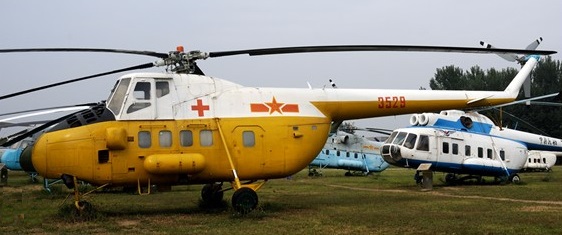
The Mi-4 was also manufactured under licence in China from 1959 as the Harbin Z-5 (Zhishengji 5) with many changes. A total of about 545 were built when production ended in 1979, and of which approximately two-thirds were for civil use.
Mi-4 Basic military version with underfuselage gondola for navigator. Production said to have started in 1952. Civil freight version is generally similar, with double clamshell rear-loading doors. Soviet films of military exercises, released in 1968, showed a close support version of the Mi-4, armed with a gun in the front of the underfuselage nacelle and air-to-surface rockets.
M-4A Soviet Army armed helicopter with two TRS-132 rocket pods fitted, or two TRS-132 rocket pods fitted, or six KARS-57 rocket pods fitted, 1960, or with eight UB-16-57 rocket pods with S-5K rockets, 1965
Mi-4A Agricultural version first flying prototype
Mi-4AV Fire-support helicopter, 1967
Mi-4A / Mi-4ADT Updated troop-carrier helicopter
Mi-4GF
Mi-4GR Helicopter with Grebeshok-3 wide-range reconnaissance station
Mi-4L Small batch of six-seat de luxe version; some equipped for medevac with eight stretchers and attendant.
Mi-4MK ECM helicopter with Mayak-3 countermeasures system
Mi-4MT Torpedo carrier helicopter
Mi-4M ASW helicopter with float-type gear during flight tests
Mi-4ME ASW helicopter
Mi-4P Civil transport version used extensively by Aeroflot and seating eight to 11 passengers in furnished cabin First flying prototype, 1955. Major use in ambulance configuration carrying up to eight stretchers and a medical attendant. Entered service on Aeroflot’s Simferopol’ to Yalta route in the Crimea in November 1958. This version has square windows instead of the circular windows of the military version and has no underfuselage gondola. The wheels are often fitted with spats.
Mi-4S Basically an agricultural version with a large chemical container in the main cabin, but used also for fire-fighting operations Spread through bifurcated ducts by hydraulically actuated fan in duct which replaces the military ventral gondola. Liquids are sprayed from bars mounted aft of mainwheels. Rate of spread is up to 18 litres or 20kg/s, with swath width of 40 to 80m, at forward speed of 60km/h.
Mi-4U Target acquisition helicopter with Uspekh system
Harbin Z-5 Chinese military version of the Mi-4, this being in service with both the army and navy
Harbin Xuanfeng Chinese name for civil version of the Mi-4, at least one of which is flying with the PT6T-6 twin turbine engine
Specifications:
Mi-4 Engine: Shvetsov ASh 82V eighteen cylinder radial, 1,700 hp Main rotor dia: 68 ft 11 in (21.00 m) Length: 55 ft 1 in (16.80m) Main rotor disc area: 3,724 sq ft (346.0 sq.m) Gross weight: 17,200 lb (7,800 kg) Max speed: 130 mph (210 km/h) at 4,920 ft (1,500 m) Typical range: 250 miles (400 km) Accommodation: Crew of 2 or 3 and up to 14 troops or 16 passengers
Mi-4 Crew: 2 Engine: 1 x ASh-82V piston engine, 1250kW Rotor diameter: 21.0m Length with rotors turning: 25.02m Height: 4.4m Fuselage width: 2.0m Max take-off weight: 7550kg Empty weight: 5100kg Max speed: 185km/h Rate of climb: 5.6m/s Service ceiling: 5500m Hovering ceiling: 2000m Range with max fuel: 500km Payload: 1600kg
Mil Mi 4 Engine: Shvetsov ASh 82 V, 1677 hp Length: 55.085 ft / 16.79 m Height: 16.995 ft / 5.18 m Rotor diameter: 68.898 ft / 21.0 m Max take off weight: 16647.8 lb / 7550.0 kg Weight empty: 10804.5 lb / 4900.0 kg Max. payload weight: 2646.0 lb / 1200.0 kg Max. speed: 100 kts / 185 km/h Landing speed: 86 kts / 160 km/h Service ceiling: 5577 ft / 1700 m Cruising altitude: 1640 ft / 500 m Maximum range: 221 nm / 410 km Range: 221 nm / 410 km Crew: 2-3 Payload: 8-14 Pax / 1200kg
Mi-4P Engine: Shvetsov Ash-82V, 1700 hp Rotor diameter: 68 ft 11 in / 21.00 m Fuselage length: 55 ft 1 in / 16.80 m Cabin volume: 565 cu.ft / 16.0 cu.m Max payload: 3835 lb / 1740 kg Normal TOW: 16535 lb / 7500 kg MTOW: 17,200 lb / 7800 kg Max level speed 4920ft / 1500m: 113 kt / 130 mph / 210 kph Econ cruise: 86 kt / 99 mph / 160 kph Service ceiling: 18,000 ft / 5500 m Range 11 pax, 220lb/100 kg baggage: 134 nm / 155 mi / 250 km Range 8 pax, 220lb/100 kg baggage: 217 nm / 250 mi / 400 km Crew: 2 Passengers: 8-11 Baggage: 220 lb / 100 kg
Mi-4S Agricultural version Hopper capacity: 2200 lb / 1000 kg / 352 Imp.Gal / 1600 lt
Mikhail Mil was a contemporary of Nikolai Kamov at the TsAGI (Central Aero and Hydrodynamic Institute) during the 1930s, was given charge of his own design bureau in 1947 and became responsible for the first Soviet helicopter to go into quantity production. The GM-1 / Mi-1.
Designed to meet a requirement for a three seat communications machine which was issued in late 1947 and originally designated GM-1 (Gelikopter Mil, or Mil helicopter), the Mi-1 first of three prototypes was completed and flown in September 1948 piloted by M.K. Baikalov (ex-Bratukhin).
1105 PZL-Swidnik SM-1 Sz 01105
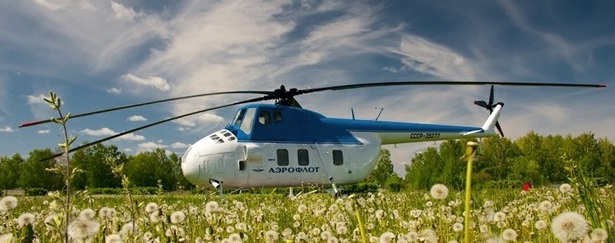
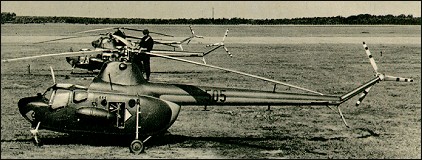
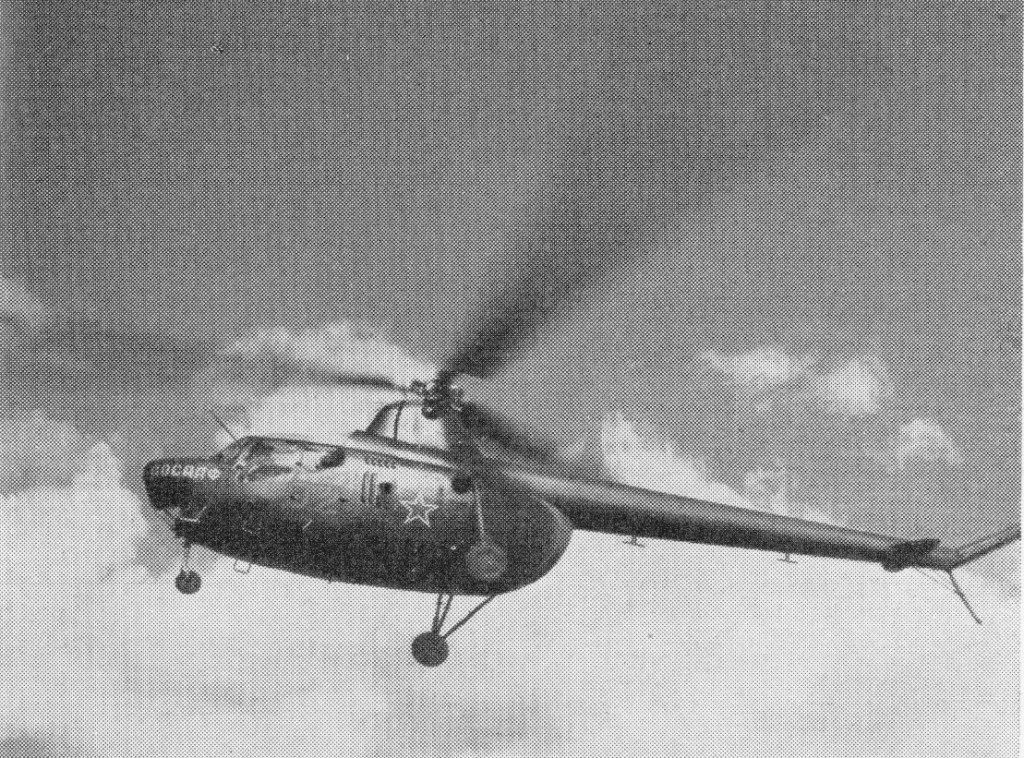
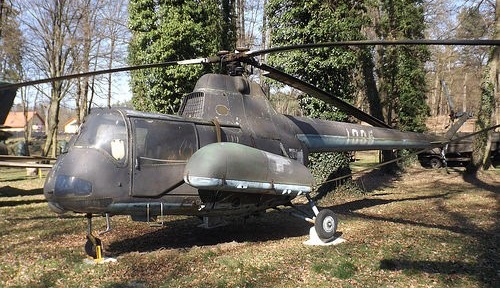
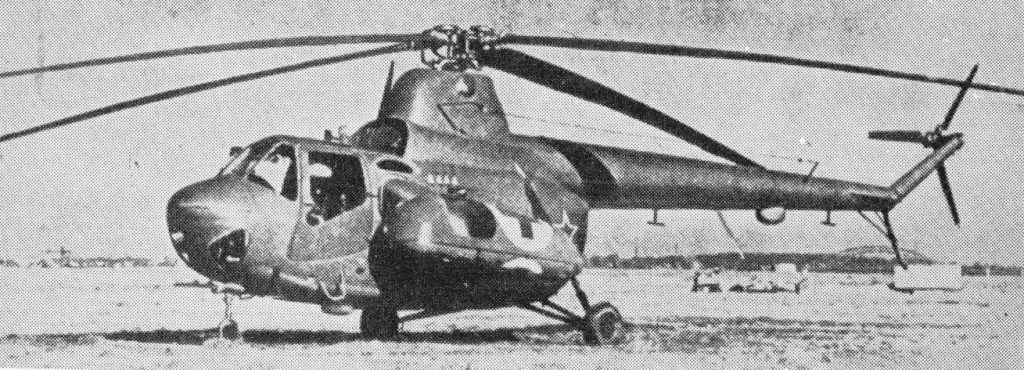
The Mi-1 was a compact machine with a fully-enclosed metal-skinned fuselage. Fuselage light alloy, except for welded steel tube basis of mid-section housing engine with crankshaft horizontal and cooling fan, driving through angle box to transmission with centrifugal clutch and rotor brake. Four-seat cabin with left/right hinged doors. Fuel in welded aluminium tank 240 lit behind engine and, from about 40th production, provision for external supplementary tank of 160 lit on left side. Monocoque tail boom and pylon for tail rotor with three wooden blades. A 2.5m shaft runs from the gearbox to the tail rotor. Fixed nosewheel-type landing gear with brakes, plus long rear skid to protect tail rotor. Three-blade main rotor, blades based on A-15 and related autogyros, mixed steel/ply/fabric NACA-230 profile, fully articulated hub with friction dampers, normal speed 232 rpm. The powerplant was an Ivcheriko AI 26V radial engine driving a three bladed rotor and producing 575 hp at takeoff. Like Soviet equipment during World War II, the Mi-1 is designed to operate at very low temperatures and has anti-freeze sprays for not only the rotors but also the windscreen.
Both the first two GM-1 were lost, the second killing Baikalov after a weld failure in the tail-rotor bearing. Project taken over by Mark Gallai and V.V.Vinitskii, followed in summer 1949 by NII testing by G.A.Tinyakov and S.G.Brovtsyev. The Mi-1 reached a height of 6800m and speed of 190.5km/h. Yak-100 delayed so production was authorized as Mi-1 and delivery of the production models began in 1951. The Mi-1 made its public debut when eight took part at the Tushino Air Display in 1951, by which time it was already in production and service with the Soviet armed forces. The four seat Mi 1 was ordered into production in September 1949. NATO code name ‘Hare’.
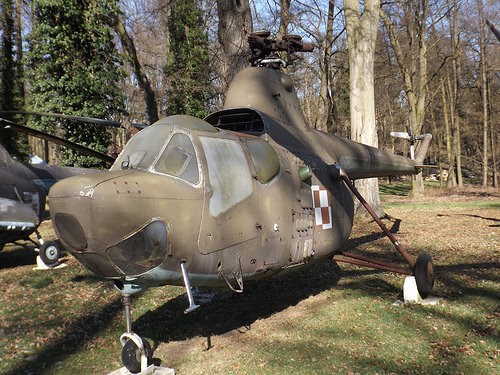
Subsequent production of the Mi-1, both in the Soviet Union and in Poland, has been extensive. Polish production began with the standard Mi-1 late in 1955, this being built at the WSK works at Swidnik under the designation SM-1 with a licence-built version of the AI-26V engine.
Once military requirements had been met by a production run of several hundred, the Mi-1 was also widely adopted for a great variety of civil tasks, such as air ambulance duties, fish-spotting or whaling, ice patrol in polar regions, highway patrol and for carrying mail.
Mi-1
From about the 40th, the Mi-1M was produced with a 0.32m adjustable stabilizer (tailplane).
From 1957 new blades with extruded steel-tube spar. By this time the basic model was the Mi-1T, which carries only 2 passengers plus radio and fluid de-icing, the 1950 Mi-1MU which is a dual-control trainer and the 1956 Mi-1NKh (Narodnoye Khozyaistvo), a utility model for such duties as freight and mail carriage, ambulance and agricultural operations. In an agricultural role it can be fitted with spraying bars and two 250-litre tanks, carrying 400kg at the sides of the fuselage.
In 1961, the Mi-1 Moskvich passenger version was developed for Aeroflot, with an all-metal rotor of almost untapered plan, hydraulic controls, better cabin soundproofing and night flying or all-weather instrumentation. The name was dropped and the improvements were mostly standardized.
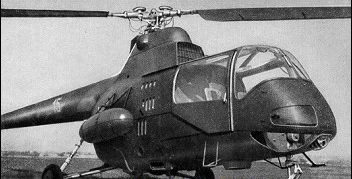
Mil produced an ambulance version, the patients carried on stretchers in streamlined pods on either side of the fuselage. Pipes connected the pods to the fuselage to allow the temperature to be controlled.
The final production run was the Mi-1T, a three-seater with different operational equipment.
In 1956, a prototype (identified in the West as Mi-3) was also evaluated. This had a four-blade rotor, wider cabin, and various other external modifications, such as two lateral stretcher panniers, but it did not enter production.
Several of the Mi-1’s supplied to foreign air forces were Polish-built, and subsequent versions included the SM-1W (pilot and 3 passengers), SM-1WS (2-stretcher ambulance), SM-1WZ (agricultural) and SM-1WSZ (dual-control trainer). Production of the Mi-1/SM-1 is thought to have been phased out around 1963 in favour of the later turbine-powered developments.
1005 PZL-Swidnik SM-2 S2-01005
The PZL Swidnik SM-2, Polish development of the basic design was flown late in 1959. This has a longer nose, enlarging the cabin to accommodate 4 passengers in addition to the pilot. In the ambulance role, the SM-2 can take a third stretcher inside the cabin in addition to the two carried on external panniers. Production of the SM-2 was initiated in 1961 to fulfil both military and civil orders.
PZL Swidnik SM-2
Other variants include the Mi-1MRK reconnaissance and fire adjusting helicopter of 1960, Mi-1MG (Mi-1G) helicopter with float-type gear, SM-1/300 experimental helicopter with additional wing of 1971, and Mi-1M experimental helicopter with additional servo-tab of 1959.
The first armed Mi-1MU helicopter had TRS-132 rocket pods in 1958, and 4 Falanga anti-tank guided missiles in 1961. In addition to those built for the Soviet armed forces, military Mi-1’s have also been supplied to the DOSAAF and the air forces of Albania, Afghanistan, Cuba, Czechoslovakia, Finland, Iraq, Poland, Syria, the United Arab Republic and the Yemen. A wide range of duties has included those of observation, liaison, rescue, ambulance and training.
Production of the Mi-1 ended in 1961 in the Soviet Union and in 1965 in Poland.
Developed from the Mi-1, the Mi-3 has a four blade main rotor and other modifications.
Mi-1 Engine: 1 x Rybinsk AI-26V piston, 432kW Main rotor diameter: 14.35m Length without rotors: 12.05m Height: 3.28m Max take-off weight: 2550kg Empty weight: 1900kg Max speed: 190km/h Cruising speed: 140km/h Service ceiling: 4000m Hovering ceiling: 2000m Range: 360km Payload: 500kg Crew: 1 Passengers: 2
Mil Mi 1 Engine: Ivchenko AL-25 V, 424 hp Length: 39.698 ft / 12.1 m Height: 10.827 ft / 3.3 m Rotor diameter: 46.916 ft / 14.3 m Max take off weight: 5622.8 lb / 2550.0 kg Weight empty: 3880.8 lb / 1760.0 kg Max. speed: 111 kts / 205 km/h Cruising speed: 76 kts / 140 km/h Initial climb rate: 1377.95 ft/min / 7.00 m/s Service ceiling: 18045 ft / 5500 m Range: 319 nm / 590 km Crew: 1+2
Mi-1NKh Utility freight / ambulance / mail / agricultural version Engine: Ivchenko Al-26V, 575 hp Main rotor diameter: 46 ft 11 in / 14.30 m Length overall: 43 ft 6 in / 13.26 m Fuselage length: 39 ft 4.75 in / 12.01 m Empty weight: 3964 lb / 1798 kg MTOW: 4960 lb / 2250 kg Mas speed SL: 102 kt / 118 mph / 190 kph Econ cruise: 76 kt / 87 mph / 140 kph Service ceiling: 9850 ft / 3000 m Range max fuel: 205 nm / 236 mi / 380 km Range 330 lb / 150 kg payload: 188 nm / 217 mi / 350 km Crew: 1 Passengers: 5 External hopper capacity: 770 lb / 400 kg
Mi-1T Seats: 3
Mi-1U Dual control
Mi-1 Moskvich Aeroflot version Hydraulic controls
SM-1W Crew: 1 Passengers: 3
SM-1WS Ambulance version
SM-1WZ Agricultural version
SM-1WSZ Dual control trainer
PZL Swidnik SM-2 Engine: 1 x Lit-3, 425kW Main rotor diameter: 14.3m Length: 17.0m Height: 3.1m Max take-off weight: 2550kg Empty weight: 1934kg Max speed: 170km/h Cruising speed: 130km/h Ceiling: 3700m Range with max fuel: 550km