National Aerospace Laboratories NM5 / C-NM5 / Mahindra Aerospace NM5 / C-NM5

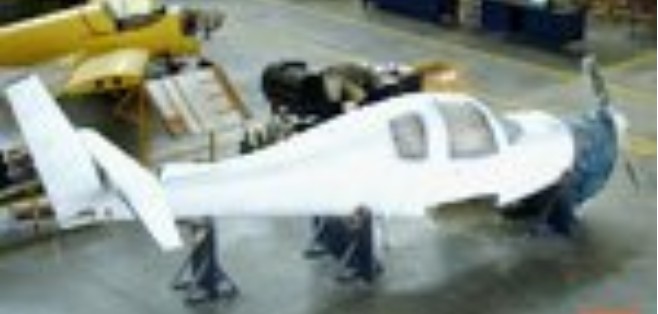
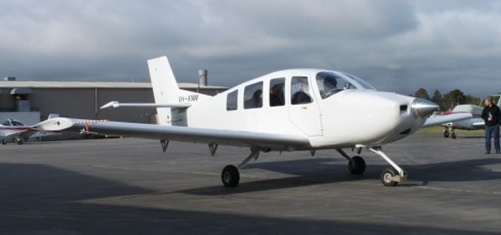
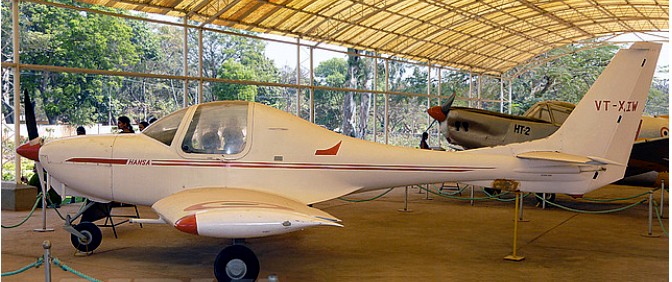
The NM5 or C-NM5 is a multi-role, multi-mission aircraft being jointly developed by National Aerospace Laboratories (NAL) and Mahindra Aerospace. It is a 5-seater civil aircraft and an extension of the Hansa project. The NM5 has been entirely designed and developed by NAL and Mahindra Aerospace on a 50:50 partnership basis. The NM5 can be used as a trainer, for transporting cargo, medical evacuation, tourism, VIP travel and for training pilots.

This new 4/5 passenger General Aviation aircraft programme was launched as a part of the 10th FYP network programme. Following the successful certification of HANSA-3, NAL proposed the development of a 5-seater general aviation aircraft to be carried out during the 10th plan. However the proposal was approved only in May 2005 and thus spilled over into the 11th plan also. Work on preliminary design of the aircraft commenced in October 2006.

NAL signed an MoU with M/s Mahindra Plexion Pvt Ltd (MP) to jointly develop the 5 seater general aviation aircraft, NM5 and to undertake its production and marketing. This represents the one of the recent public-private partnership programmes in aircraft design for NAL and in the civil aviation sector in India.

At the Indian Civil Aviation Airshow (2008) held at Begumpet Airport, Hyderabad between 15–18 October 2008, the 5 seat NM5 aircraft (general aviation aircraft) attracted a lot of interest in business visitors and the general public. The NM5 was exhibited during Aero India for people to see. The NM5 and the Saras models were the biggest attractions in seventh edition in the 160 square metre Indian stall at the Aero India was held from February 11–15, 2009.

The engine, propeller and certified seats of the aircraft have been imported as the raw material like aluminium alloy sheets and hardware such as, nuts, bolts, washers and rivets. Prototypes of NM-5 are ready and the certification will take a year. The Directorate General of Civil Aviation is expected to certify the aircraft by December next year. The first prototype of the 5-seater civil aircraft made its maiden flight on 1st sept 2011 at GippsAero’s flight testing facilities near Melbourne, Australia.

An NM-5 was expected to be priced around $400,000; between Rs 1.2 crore and Rs 1.4 crore.

NM5-100
Engine: Lycoming IO-540, 300 hp at 2700 rpm
Prop: 3 blade CS
Wingspan: 10.9 m / 35 ft 8 in
Wing area: 16.0 sq,m / 172 sq.ft
Length: 8.8 m / 28 ft 9 in
Height: 3.1 m / 10 ft 2 in
MTOW: 1525 kg / 3362 lb
Empty weight: 945 kg / 2083 lb
Useful load: 580 kh / 1280 lb
TO dist: 500 m / 1640 ft
Landing dist: 450 m / 1476 ft
Max level speed: 296 kph / 160 kt
Max ROC: 335 m/min / 1100 fpm
Stall flaps up: 110 kph / 60 kt
Stall flaps down: 96 kph / 52 kt
Range w/320 kg load: 1295 km / 700 nm
Cruise alt: 3050 m / 10,000 ft
Electrics: 24 v
Generator: 26 v / 70 A

Nash Petrel / Procter Aircraft Associates Petrel

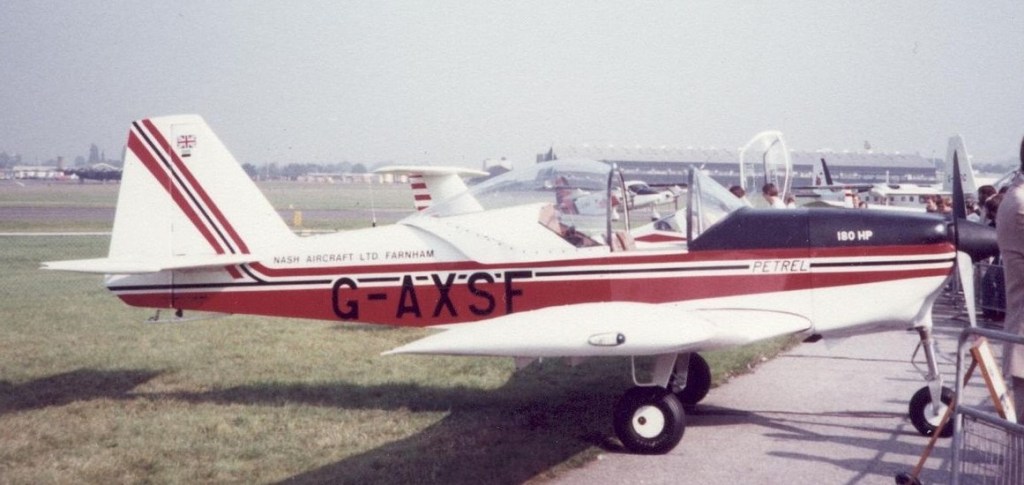
Prototype Nash Petrel at the Farnborough SBAC Show in September 1982

The Nash Petrel also known as the Procter Petrel is a two-seat aerobatic or glider tug aircraft. It was designed for amateur production by Procter Aircraft Associates of Camberley, Surrey, England.

Based on the earlier Mitchell-Procter Kittiwake design, the Petrel is an all-metal low-wing cantilever monoplane of conventional design powered by a 130 hp Rolls-Royce Continental O-240-A piston engine. By the time the aircraft first flew on 8 November 1980, Procter had changed ownership and had been renamed Nash Aircraft Ltd.

Only two aircraft were built, the prototype registered G-AXSF and one built by apprentices at the British Aircraft Corporation factory at Preston in 1973, registered G-BACA. G-BACA had a serious fault with the landing gear and only flew 15 hours before being grounded. The prototype still exists but without a current certificate of airworthiness. It is presently fitted with a Lycoming O-360-A3A engine.

Powerplant: 1 × Avco Lycoming O-320-D2A, 89 kW (119 hp)
Wingspan: 8.94 m (29 ft 4 in)
Wing area: 12.63 m2 (135.9 sq ft)
Aspect ratio: 6.6:1
Airfoil: NACA 3415
Length: 6.22 m (20 ft 5 in)
Height: 2.23 m (7 ft 4 in)
Empty weight: 540 kg (1,190 lb)
Max takeoff weight: 762 kg (1,680 lb)
Fuel capacity: 104.5 L (27.6 US gal; 23.0 imp gal)
Maximum speed: 210 km/h (130 mph, 110 kn)
Cruise speed: 195 km/h (121 mph, 105 kn)
Stall speed: 74 km/h (46 mph, 40 kn) (flaps down)
Rate of climb: 5.6 m/s (1,100 ft/min)
Crew: 2

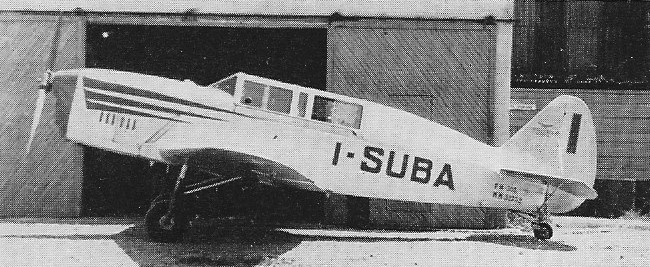
Nardi FN.315

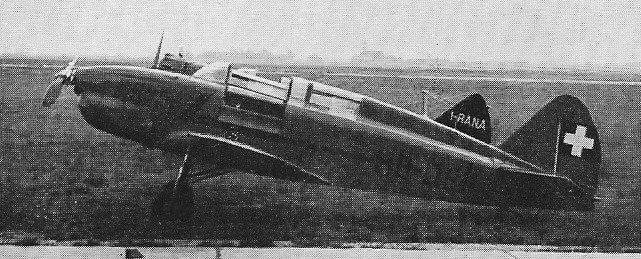
As a 1938 development of the FN305, there were also 25 F.N.315 intermediate trainers with the 172-kW (230-hp) Hirth HM 508D inline, a revised canopy, a new tail unit, flaps and increased dihedral on the outer wing panels.

The F.N.315 was also produced with the Alfa Romeo 115-1 of 185 hp.

The F.N.315 was exported to six countries, and a light-attack version was flown experimentally.

Engine: Hirth HM 508, 172 kW (230 hp).
Wingspan: 27 ft 9 in
Wing area: 129.12 sq.ft
Length: 22 ft 11 in
Height: 6 ft 10.5 in
Empty weight: 1562 lb
Loaded weight: 2255 lb
Max speed: 239 mph at 8200 ft
Cruise: 220 mph at 11,480 ft
Time to 13,120ft: 6 min 40 sec
Cruise range: 590 mi

Nardi FN.305

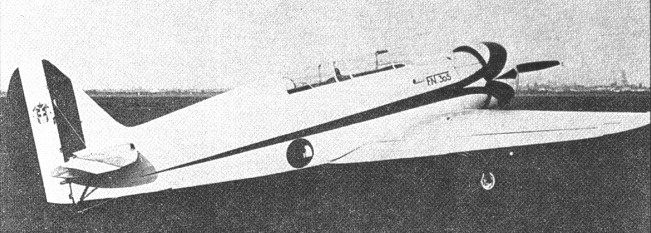
First flown in January 1935, the F.N.305 training, touring and sporting aeroplane had single or tandem seating under a large glasshouse canopy and, with a 149-kW (200-hp) Fiat A.70S radial, attained a fair level of performance thanks to its retractable landing gear. Several one-off variants were produced before Piaggio started building the F.N.305A two-seat version with the Alfa-Romeo 115 inline. The type was used by the Italian air force as a tighter trainer and liaison aeroplane. Between 1937 and 1943 production totalled 258 including small numbers of the F.N.305B and F.N.305C single-seaters with open and enclosed cockpits respectively.

An experimental version, the F.N.305-D, established s long-distance record by flying from Rome to Addis Ababa.

F.N.305
Wingspan: 27 ft 9 in
Wing area: 129.12 sq.ft
Length: 22 ft 11 in
Height: 6 ft 10.5 in
Empty weight: 1320 lb
Loaded weight: 1980 lb
Max speed: 211 mph
Cruise: 189 mph
Service ceiling: 22,950 ft
Range: 435 mi

F.N.305A
Powerplant: l x Alfa-Romeo 115-1, 142kW (190 hp)
Span: 8.47m (27ft 9.5in)
Length: 7m (22 ft 11.5 in)
Armament: 1 or 2 x 7.7-mm (0.303-in) mg
Max T/O weight: 900kg (1,9841b)
Max speed: 193 mph
Operational range: 311 miles.

Narahara No.5 Ohtori Nisei-go

While the Narahara No.4 Ohtori-go was touring Japan with demonstration flights by Shimo, the Narahara No.5 Ohtori Nisei-go (meaning Ohtori the 2nd) was built. It was almost identical to the No.4 but was powered by a 70hp Gnome rotary engine and had a strengthened undercarriage. This aeroplane was completed in June 1913 and made exhibition flights at Ibaragi, Toyama, Ishikawa and Niigata from June to September that year.

Sanji Narahara eventually retired completely from aviation at his family’s insistence. His aviation activities were first taken over by Einosuke Shirato who then began manufacturing aeroplanes under his own name and provided flying training at Inage beach. In addition to Shirato’s activities, Otojiro Itoh also became known for his aviation endeavours, and between the two, a new era of civil aviation began in 1913 stemming from Narahara’s works and now centred at the Shirato/ltoh Airfields.