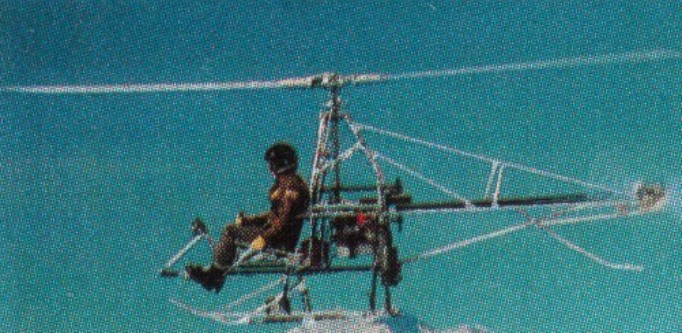
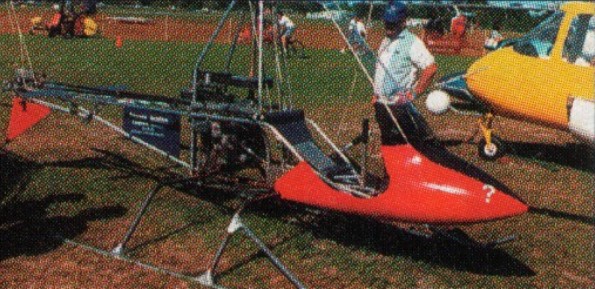
A kit helicopter, first flown in 1992, the kits had all major parts assembled, and all blades and parts balanced. Kit price in 1997 was US$15,500.
Engine: Hirth, 65 hp hp range: 65-110 Height: 7 ft Length: 15 ft Disk span: 21 ft Empty weight: 435 lb Gross weight: 825 lb Fuel capacity: 14 USG Max speed: 100 mph Cruise: 80 mph Range: 175 sm Rate of climb: 1000 fpm Service ceiling: 10,000 ft Seats: 1
Max speed: 95 mph Cruise: 80 mph Range: 175 sm Rate of climb: 1000 fpm Service ceiling: 10,000 ft Engine: Hirth, 65 hp hp range: 65-110 Fuel capacity: 10 USG Empty weight: 350 lb Gross weight: 700 lb Height: 7 ft Length: 20 ft Disk span: 21 ft Seats: 1
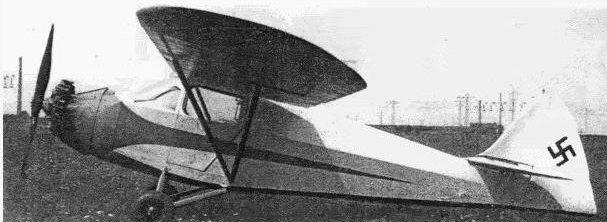
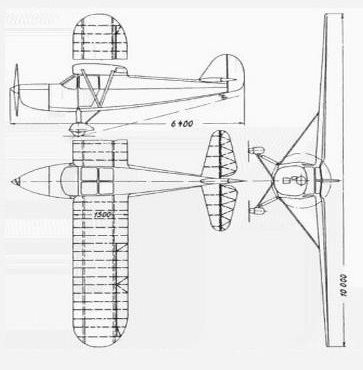
The “Pause-Mücke”, designed by Adalbert Schmid, a two-seater sports and touring aircraft developed in 1939, did not get beyond a prototype due to the war.
Engine: Salmson AD 9 Span: 10.00 m Length: 6,40 m Flying weight: 480 kg Max. speed: 145 km/h
Single seat single engined high wing monoplane with two axis control (optional conventional three axis control). Wing has unswept leading edge, swept forward trailing edge and tapering chord; cruciform tail. Pitch control by elevator on tail; yaw control by fin mounted rudder; no separate roll control (optional roll control by ailerons); control inputs through stick for pitch/yaw and (optionally) pedals for roll. Wing braced from below by struts; wing profile; double surface. Undercarriage has three wheels in tail dragger formation; bungee suspension on all wheels. Push right go right tailwheel steering connected to yaw control. No brakes. Aluminium tube/steel tube framework, without pod. Engine mounted below wing driving pusher propeller. Framework in 2024T3 aluminium and 4130 chrome moly steel. Wing covering is Stits Polyfiber, doped. Shown for the first time to the public at 0shkosh in August 1982, P Craft from D Paup appears to be a minimum aircraft and as such is directly descended from the Kolb Flyer and Ron Wheeler Scout.
This one offers the choice between two axis control, with steering by induced roll, or conventional three axis control when fitted with ailerons (an option on the standard kit). Where the lower longeron and a higher, nearly parallel tube which carries the pilot seat meet at the nose, there is a horizontal transverse tube on which can be hinged the rudder pedals.
Paup aircraft offers the two axis version in kit form, requiring 150 hours for completion, at the price of $3395 in 1983.
Engine: Cuyuna 215D, 20hp at 6000rpm Propeller diameter and pitch 36 x 12 inch, 0.91 x 0.30 m No reduction Power per unit area 0.15hp/sq.ft, 1.6hp/sq.m Fuel capacity 2.5 US gal, 2.1 Imp gal, 9.5 litre Wing span 32.5 ft, 9.88 m Total wing area 132 sq.ft, 12.3 sq.m Wing aspect ratio 8.0/1 Main wheels diameter overall 20 inch, 51 cm Empty weight 165 lb, 75kg Max take off weight 402 lb, 182 kg Payload 237 lb, 107 kg Max wing loading 3.05 lb/sq.ft, 14.8 kg/sq.m Max power loading 20.1 lb/hp, 9.1 kg/hp Max level speed 60 mph, 97 kph Never exceed speed 70 mph, 113 kph Max cruising speed 50 mph, 80 kph Economic cruising speed 35 mph, 56 kph Stalling speed 22 mph, 35 kph Max climb rate at sea level 300ft/min, 1.5m/s Take off distance 75 ft, 23 m
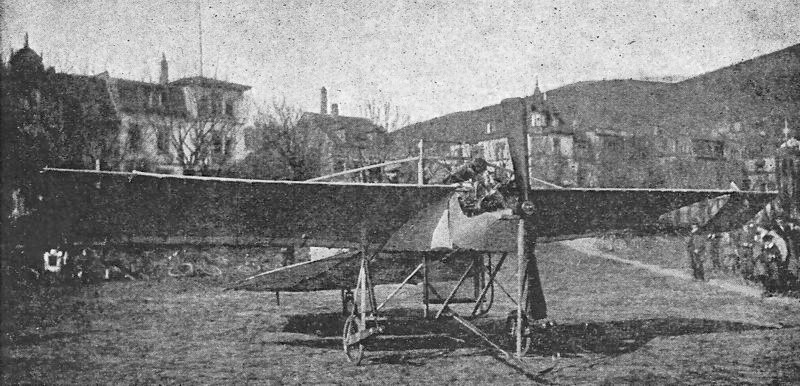
Albert Paulson, of Northwood ND., USA, built the single-place Aeronef, or Gold Bug, in 1910.
Built on the box-kite principle, with the forward box used for changing the angle of flight, while the rear box was adjusted for the direction of flight. Made its public appearance at the June 1910 Indianapolis Air Meet, but not known if it flew.
The Companhia Aeronáutica Paulista CAP-9 Carioca four-seat, single-engine high-wing monoplane with enclosed cockpit and fixed undercarriage, was CAP’s last attempt, in 1947, to remain in the aircraft market. The company had chosen to build the CAP-9 Carioca instead of the CAP-8. The CAP-8 (which reached the prototype stage) was a 4-seater low-wing aircraft and although the prototype was made of wood in order to gain time (the war was about to end but there was still a shortage of aluminum), the idea was to build an all-metal aircraft.
Without commercial success with its new projects and a vertiginous drop in its orders, CAP ends its activities in 1948.
The Companhia Aeronáutica Paulista CAP-8 of 1944 was a four-seat, single-engine low-wing monoplane with enclosed cockpit and fixed (retractable planned in series aircraft) undercarriage, inspired by Messerschmitt Bf 108 Taifun. Only one was built.
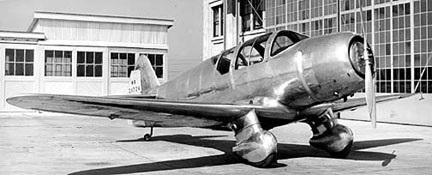
The four-seat Paulic XT3-B NX21726 was originally built in 1939 as a joint project of John W. Thorp and Rudy Paulic. A side-by-side trainer planned for Boeing School of Aeronautics in Oakland, where both Paulic and Thorp worked.
It was dismantled after several test flights and stored until July 1958, when it was redesigned and rebuilt by Paulic as four-place retractable-gear T-3B-1 with a 190hp Lycoming O-435 engine and re-registered NX6497C.