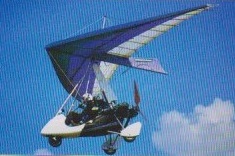
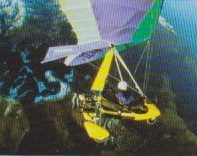
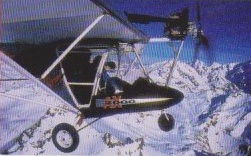
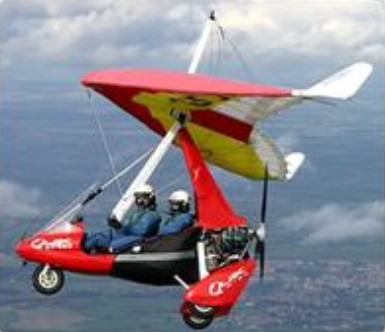
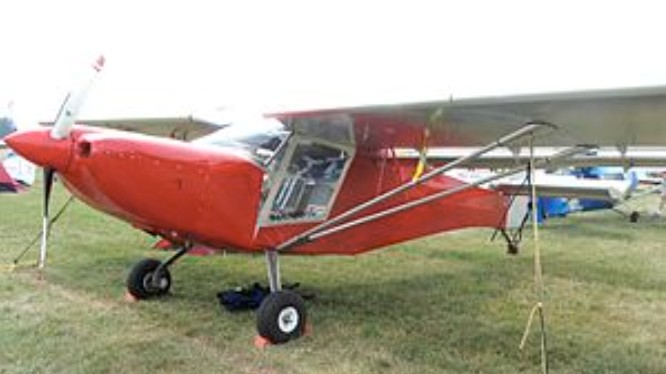
Conceived as a modular aircraft, the Quantum came in various forms from fairly simple to very slick. The Quantum came with the Rotax 462 or 582, and Q2 wing.
The top of the range Quantum 912 is structurally essentially the same as the Quantum Sport, complete with articulated monopole, fairings and under seat storage bins.
Quantum 912
Quantum Sport Empty weight: 185 kg Wing span: 10.35 m Wing area: 15.60 sq.m Fuel capacity: 49 lt Certification: BCAR S Engine: Rotax 582, 65 hp MAUW: 390 kg Seats: 2 Max speed: 125 kph Cruise speed: 100 kph Minimum speed: 42 kph Climb rate: 2.75 m/s Fuel consumption: 8.7 lt/hr Price (1998): £14,565
Quantum 912 Empty weight: 195 kg Wing span: 10.35 m Wing area: 15.60 sq.m Fuel capacity: 42 lt Certification: BCAR S Engine: Rotax 912, 80 hp MAUW: 930 kg Seats: 2 Max speed: 130 kph Cruise speed: 100 kph Minimum speed: 42 kph Climb rate: 3.4 m/s Fuel consumption: 10 lt/hr Price (1998): £20,499
The QUIK is a light handling small wing with a hands off trim speed in excess of 80 mph, and a level speed of 100 mph making distance touring a reality and ground handling simplicity itself. The Quantum’s 409 kg MAUW is retained, but the payload has increased due to the aircraft’s lighter weight. The Quik has larger seating, more rearward headroom for the passenger and more wind protection compared to the Quantum.
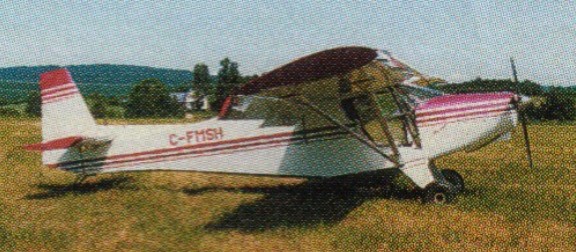
Publicly owned Pegasus Aviation bought the rights to the French edition of a highly modified Weedhopper. Some of these alterations were completed to bring the machine to a contemporary description. Others were done srictly to meet the demands of British certification under BCAR-S.
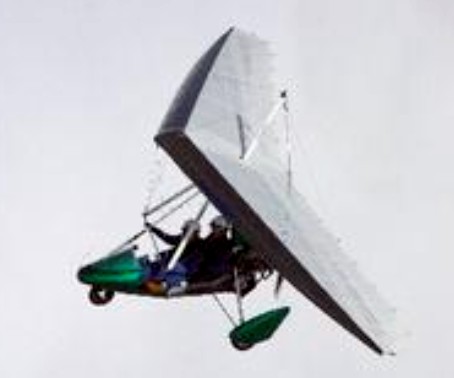
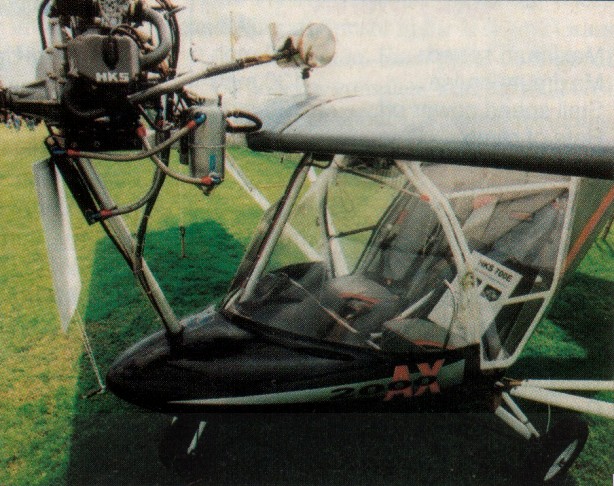
The AX2000 (previously known as the AX-3, for 3 axis) is now a fully enclosed, conventional three axis machine.
H-Power introduced the AX2000 to the US at Oshkosh 1997.
In 1998 the Rotax 582 powered version cost £17,619.
Engine: HKS 700, 60 hp Wing span: 10.3 m Wing area: 15.6 sq.m MAUW: 390 kg Empty weight: 202 kg Fuel capacity: 64 lt Max speed: 145 kph Cruise speed: 105 kph Minimum speed: 50 kph Climb rate: 3 m/s Seats: 2 Fuel consumption: 7.5 lt/hr Certification: BCAR S
In 1931 Pegasus Aircraft Mfg Co built a two-place, open cockpit, high wing monoplane, registered N11145 c/n 1A1. Powered by a 60hp LeBlond engine, after it crashed the registration was cancelled on 18 October 1932.
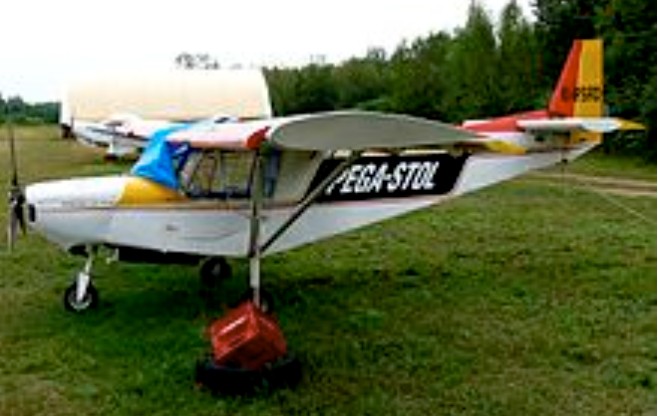
Development of the Pegazair started in 1985 by Serg Dufour of Mont-Saint-Michel, Quebec. Originally it consisted of a new set of Pega-STOL wings with retractable leading edge slats to be installed on Zenair CH 701 STOLs to replace its wing which has fixed leading edge slots, first flown in June 1991.
Zenair CH 701 STOL with the original Pega-STOL wing
Dufour went on to develop a new fuselage and tail to match the wings. The Pegazair is a two seats in side-by-side configuration, strut-braced, high-wing monoplane with conventional landing gear. Fuselage construction is welded steel tubing with aluminum skins. The wings employ full length flaperons and leading edge slats that deploy automatically. The tailplane is slotted for slow speed authority. The prototype was outfitted with a 65 hp (48 kW) Continental A-65 engine.
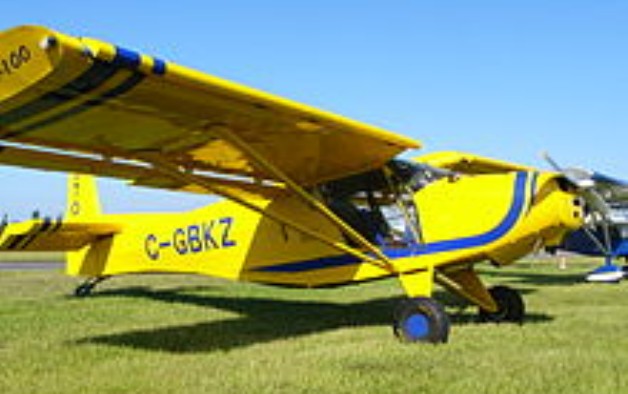
The aircraft was built as the Tapanee Pegazair-100 and the design was later developed into the four seat Tapanee Levitation 4.
Tapanee Pegazair-100 / slats extended
Variants
Pegazair P80 Powered by a 80 hp (60 kW) Rotax 912UL
Pegazair P100 Powered by a 80 hp (60 kW) Continental O-200 or 115 hp (86 kW) Rotax 914
Specifications:
P-80 Engine: Rotax 912 Seats: 2 side by side Length: 22.5 ft Wingspan: 29.0 ft Wing area: 150 sq/ft Max.flaps: 30 deg MAUW: 1200 lbs Empty Weight: 625 lbs Usefull load: 575 lbs VSO: 23 mph Min.speed 50 % pwr: 15 mph Cruise speed: 95 mph VNE: 110 mph Gross takeoff dist: 175 ft Climb rate at Gross: 900 ft / min. Usable fuel: 52 litres Range: 325 milles Ultimate Load: +6 -3,3 G
Pegazair-100 STOL Engine: 1 × Continental O-200, 75 kW (100 hp) Length: 6.83 m (22 ft 5 in) Wingspan: 9 m (29 ft) Wing area: 14 m2 (150 sq ft) Airfoil: NACA 2415 Max.flaps: 30 deg Empty weight: 374 kg (825 lb) Gross weight: 658 kg (1,450 lb) Usable Fuel capacity: 134 litres (29 imp gal; 35 US gal) Cruise speed: 169 km/h; 91 kn (105 mph) Stall speed: 45 km/h; 24 kn (28 mph) Never exceed speed: 201 km/h; 109 kn (125 mph) Min.speed 50 % pwr: 18 mph Gross takeoff dist: 300 ft Climb rate at Gross: 800 ft / min. Range: 1,014 km; 547 nmi (630 mi) g limits: +6/-3.3 Wing loading: 47 kg/m2 (9.7 lb/sq ft) Seats: 2 side by side
P-100 Engine: Rotax 914, 115 hp Seats: 2 side by side Length: 22.5 ft Wingspan: 29.0 ft Wing area: 150 sq/ft Max.flaps: 30 deg MAUW: 1350 lbs Empty Weight: 760 lbs Usefull load: 690 lbs VSO: 28 mph Min.speed 50 % pwr: 18 mph Cruise speed: 115 mph VNE: 125 mph Gross takeoff dist: 225 ft Climb rate at Gross: 950 ft / min. Usable fuel: 134 litres Range: 793 milles Ultimate Load: +6 -3,3 G
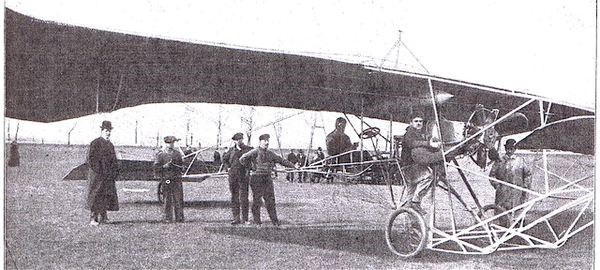
A tractor monoplane designed and recorded as a Deutsche Sommer aircraft, in respect to Pega & Emich (Griesheim am Main) being sold to the Deutsche Sommer-Flugzeugwerke early in 1911. Unsuccessfully powered by a 60 hp Hoffmann-Rotor engine, sporting an uncovered fuselage and elevator section in front.
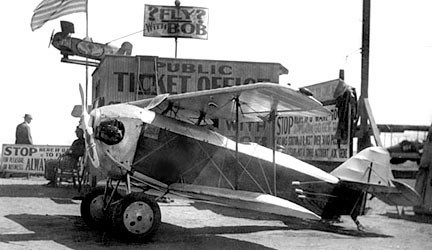
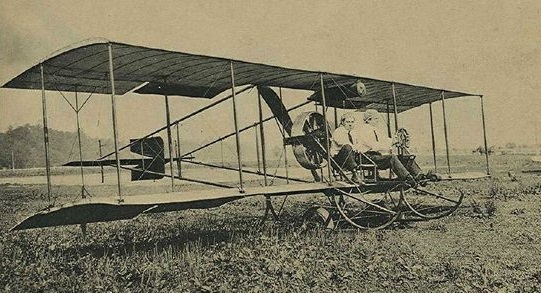
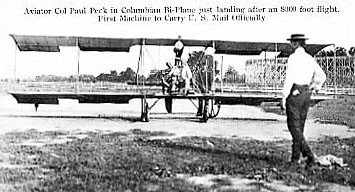
The Columbia Biplane designed by Colonel Paul Peck was fitted with a seven-cylinder, air-cooled rotary rated at 50 hp at 1500 rpm, built by the Gyro Motor Company (Washington), sponsored by, and designed under the direction of Emile Berliner.
A Gordon Bennett Cup entry did not compete.
In American Air Mail Catalogue, Vol 1, 6th Edition, Entry 3: Sep 23-Oct 1, 1911, Garden City-Mineola, NY, International Aviation Tournament. The first official US airmail was flown during the (event) at the Aerodrome on Nassau Boulevard in Garden City. Postmaster General Frank H Hitchcock authorized mail to be flown and Earle L Ovington was sworn in as the first official airmail pilot. T O M Sopwith and Capt Paul W Peck also flew mail during the meet. Ovington flew mail on the first day, and most covers and cards received a circular “Aeroplane Station #1” postmark and a 3-word (“Aerial Special Despatch”) cachet. Covers were postmarked during each day of the meet, but no mail was flown on Sep 29 or Oct 1 due to poor weather conditions. A total of 43,247 pieces of mail was serviced during the meet. [ibid.] Entry 41: July 19-21, 1912, Coney Island [an amusement park clone in Cincinnati; note roller coaster in background on postcard], Ohio. Paul Beck [spelling error] flew mail each of three days from Coney Island to California, Ohio [the town’s Post Office existed 1865-1935 on the outskirts of Cincinnati, about 1.5 miles from the park]. A Columbia biplane was used and the service was designated as Route 631,003.
Peck Columbian 1912 (postcard)
The heavy Gyro motor was fatal to Peck (and passenger) in his crash on Cicero Field, Chicago on September 11, 1912. Peck held American pilot licence No.57 and had set the American duration record at 4 hours 23 minutes, 15 seconds set on May 24, 1912.