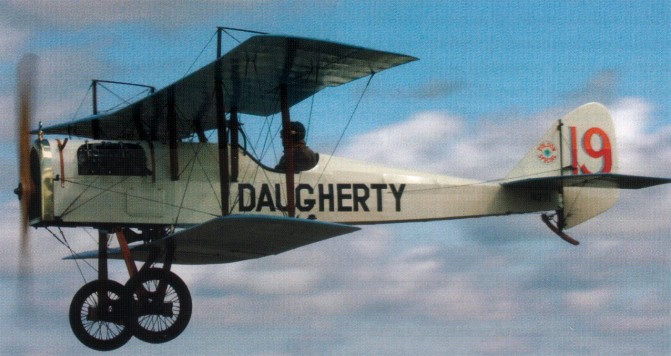
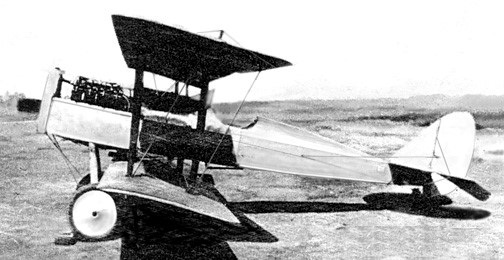
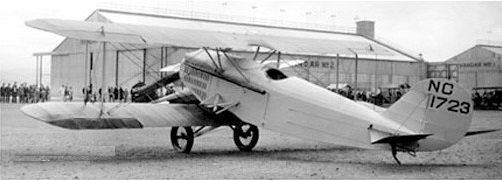
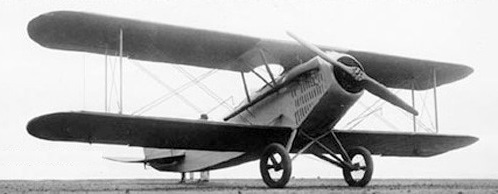
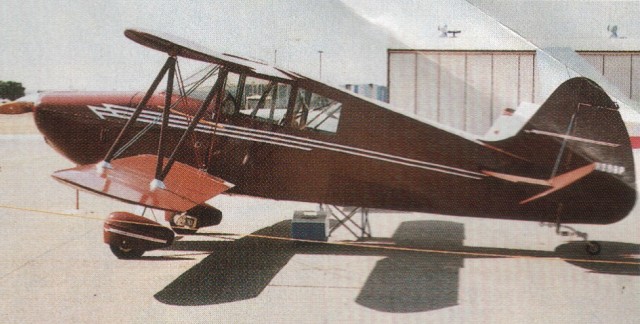
The Polson Special C/NC1723 was built between 1917 and 1925 by Thor Polson of Long Beach, California, for Earl Daugherty who was a regular participant in air shows, stunt displays and air racing post WW 1.
1922
The aircraft was restored by George Jenkins of St. Davids, PA, and flew again from Brodhead, after 83 years.
A one-of-a-kind, scratch built homebuilt biplane with reverse staggerwings. First flown in 2002 after eight yeas work, Poping’s Westfall, N99BP, is a side by side two seater fitted with a Lycoming O-320.
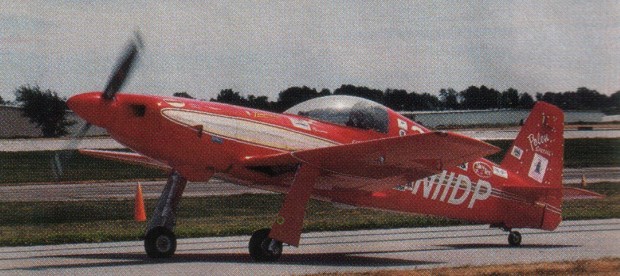
In October 2000, Richard Keyt, in his 30 year old Polen Special, won the Millennium Category at the sixth Annual Copperstate Dash Air Race. He covered the 504 nm course with a course speed record of 249 kts.
In 2001 Keyt unofficially broke a 500 km closed course record at 307.4 mph.
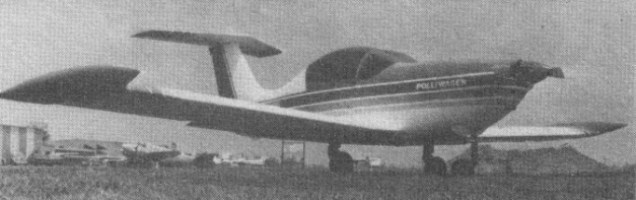
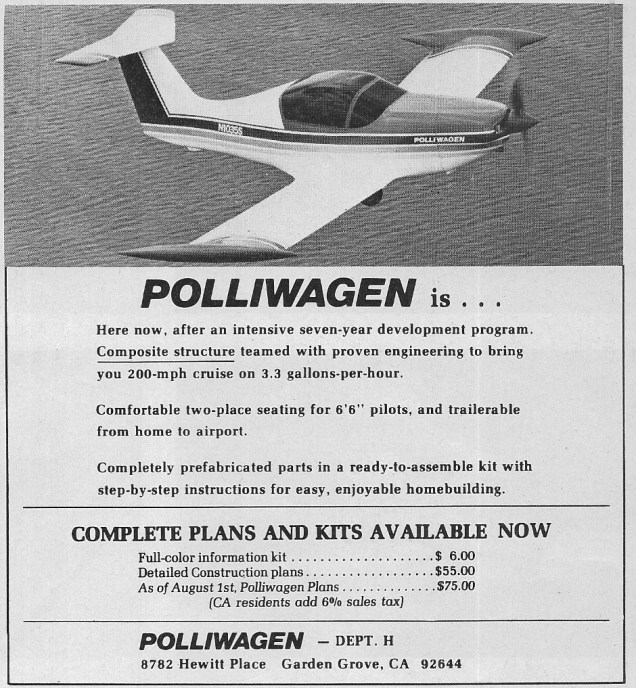
Designed by Argentine-born Joseph Alvarez in 1973, the Polliwagen derives its name from its appearance and its engine type. It is powered by a Revmaster R-2100-D turbocharged Volkswagen conversion. The Revmaster is closely cowled behind a two-position, constant-speed Maloof metal propeller of 59 inches diameter. The Polliwagen’s ex¬ceptionally clean lines give it an excellent speed-to-power ratio as well as fine aerodynamic handling characteristics. The wings are Wort¬mann FX-67-K-1 50 wing section with full-span trailing edge flaps and ailerons. Both the wings and fuselage make use of foam/epoxy com¬posite construction. Prefabricated parts are also offered in the Polliwagen kit including: molded windshield and canopy, landing gear, disc brakes, complete panels, composite structure wingtip fuel tanks, outward-breaking cabin structure, T-tail, etc. First year built: 1978. Units delivered to June 1981: 300 kits, 65 flying. Price 1982: $5,500 (Excludes engine).
April 1982
Engine 78-hp Revmaster VW Gross Wt. 1250 lb Empty Wt. 650 lb Fuel capacity 25 USG Wingspan 26 ft Length 16 ft Wing area: 90 sq.ft Top 200+ mph Cruise 180 mph Stall 51 mph Climb rate 925 fpm Range 1000 fpm Takeoff run 500 ft Landing roll 500 ft Seats: 2
Mikhail Vodopyanov during the salvation of the crew of the steamship Chelyuskin used an R-5 specially prepared for Arctic operations. On these flights Molokov used the containers for people designed by Grojovski, which allowed him to save 39.
In correspondence with the polar exploration plans of the 30s the management of the Glavsievmorputi prepared for 1936 a flight from Moscow to Franz Josef Land. This flight was not intended to break any records, it was only to study the access routes for the conquest of the North Pole, the recognition of flight paths and the conditions of the ice in the Kara and Barents Seas. Pilots were also required to collect information on climate and weather changes.
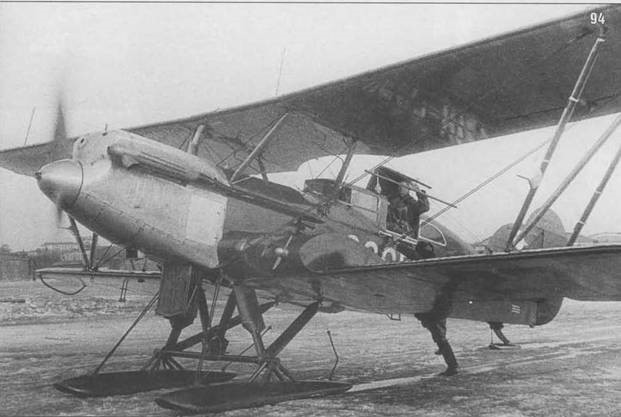
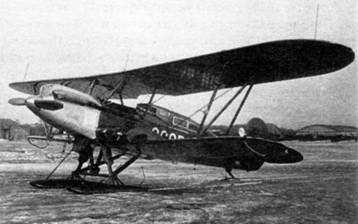
For this task two examples with closed cabins were modified. The changes in this case were very careful. This modification would be named Polikarpov ARK-5 (Russian: Поликарпов АРК-5) to highlight its Arctic use.
The crew of the ARK-5 was increased to three people. The cabin was modified and equipped with a heating system from hot air from the engine. The overboard containers, previously used on the LP-5s, were enlarged so that spare propellers, skis, tents and an inflatable boat could be stored.
All the equipment was calculated so that in case of a breakdown the crew would be able to return to the mainland by their own means, counting on food reserves for the three crew members for 45 days.
Built at Glavsievmorputi Workshops, both aircraft received registrations of the Glavsievmorputi СССР Н-127 and СССР Н-128 and were painted in intense green and red colors.
March 28, 1936
The main aircraft, with number Н-127 was equipped with radio beacon and radio compass, radio station MRK-0.04 with a rigid antenna on the upper plane. The Н-128 received lighter equipment, being equipped with a shortwave radio station for ground contacts and with the Н-127.
As commander of the expedition was appointed M. V. Vodopyanov. Its crew consisted of mechanic F. I. Bassein and radista S. A. Ivanov. The second aircraft was flown by V. M. Majotkin, with V. L. Ivashin as mechanic and V. I. Akkuratov as radio operator.
ARK-5 of M. V. Vodopyanov at Moscow airfield in March 1936.
The planes took off on March 28, 1936 and in general the route did not present problems, which demonstrated the feasibility of flights at high latitudes. This expedition allowed to gain experiences in the preparation of future expeditions and to develop the idea of landing groups at the North Pole, which would be carried out in 1937.
On May 21, only one plane, the Н-127, arrived in Moscow. The second plane was damaged on the way back, near Tijaya Bay.
At the time of the breakdown the crew was in good physical condition. The plane was abandoned and the crew picked up by an icebreaker.
In 1935, two new ARK-35s were prepared at the Repair Factory No.5 in Smolensk.
These aircraft were characterized by the structure of the cabin deck made of steel. Part of the fuselage structure was replaced by duralumin parts.
In the front cockpit was the pilot and in the rear the mechanic, the radista and two passengers. The side containers were enlarged. On the left a compressor was installed with its engine, which allowed the engine to be started from compressed air even after a long stay on land.
At the front of the containers electric current generators were installed using fans. The one on the left for the radio station and the one on the right for lighting. One of these aircraft received a radio compass.
In 1941, the Polikarpov OKB began work on an Istrebitel’ Tyazhely Pushechny – heavy cannon fighter – which was to mount a 37mm cannon between the cylinder banks of a 1,650hp Klimov M-107P 12- cylinder liquid-cooled Vee engine, and also carry two synchronised 20mm cannon. The aircraft was of mixed construction, the fuselage being a wooden monocoque and the wing of steel and dural. The first prototype, referred to as the M-1, was completed in October 1941, but difficulties with the engine delayed the initiation of flight testing until 23 February 1942. An M-107A replaced the M-107P late in 1942, but engine difficulties were still experienced, and a second prototype, the M-2, was completed with an AM-37 engine of 1,400hp with which it flew on 23 November 1943. The M-2 had an armament of three 20mm cannon and eight RS-82 unguided rocket projectiles, the engine eventually being replaced by an AM-39 of 1,700hp. Factory flight testing continued until June 1944 when the programme was abandoned.
M-1 Max take-off weight: 3570 kg / 7871 lb Empty weight: 2960 kg / 6526 lb Wingspan: 10.00 m / 33 ft 10 in Length: 8.95 m / 29 ft 4 in Wing area: 16.45 sq.m / 177.07 sq ft Max. speed: 655 km/h / 407 mph Range: 1280 km / 795 miles
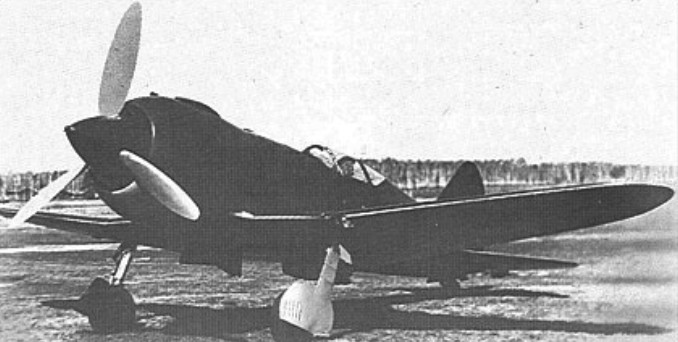
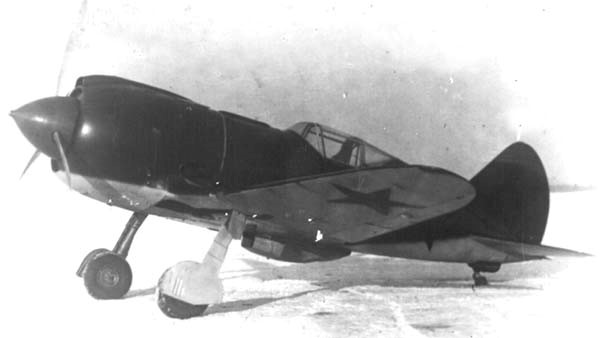
Acceptance that the concept of the I-180 was outmoded coupled with the prospect of the availability of powerful 18-cylinder radial engines led the Polikarpov OKB to design the I-185 within an extraordinarily short period of time (25 January to 10 March 1940). Intended for the 1,750hp Shvetsov M-90 engine, the I-185 was of mixed construction, having a wooden monocoque fuselage mated with metal wings featuring automatic leadingedge slats a la Bf 109. Armament consisted of twin 12.7mm and twin 7.62mm guns, all fuselage-mounted. Development delays with the M-90 – which, by December 1940, was cleared only for restricted flight testing – resulted in dismantling of the first prototype unflown, this having been known as Samolet (Aircraft) R.
A second prototype. Samolet RM, was completed with a Shvetsov M-81 18-cylinder two-row radial and a ducted propeller spinner. This was flown on 11 January 1941, but the M-81 was found to develop insufficient power and was replaced by the Shvetsov M-71 of 1,900hp in May 1941. A third prototype, Samolet I, was completed with a 14-cylinder Shvetsov M-82 engine rated at 1,330hp (later 1,400hp), the fuselage being lengthened for CG reasons from 7.68m to 8.10m, and fuselage-mounted armament being changed to three 20mm cannon. State Acceptance Tests were conducted successfully between 13 April and 5 July 1942. A fourth prototype reverted to the M-71 engine and this underwent operational evaluation on the Kalinin Front alongside Samolet I. A redesigned wing (of single- in place of two-spar construction) was featured by this aircraft, which was tested with both the four-machine gun and three-cannon armament arrangements. A pre-production prototype, the so-called I-185 Etalon (Standard), was flown on 10 June 1942. Regarded as the forerunner of the intended production derivative, the I-186, this standardised on the M-71 engine and three-cannon armament, and had a similarly lengthened fuselage to that of Samolet I. State Acceptance Testing was conducted between November 1942 and January 1943, the NIl VVS evaluation reports describing the I-185 Etalon as “superior to all contemporary fighters.” In the event, it was found impracticable to manufacture the M-71 in large numbers and airframe production capacity was unavailable.
Max take-off weight: 3735 kg / 8234 lb Empty weight: 3130 kg / 6901 lb Wingspan: 9.80 m / 32 ft 2 in Length: 8.05 m / 26 ft 5 in Wing area: 15.53 sq.m / 167.16 sq ft Max. speed: 680 km/h / 423 mph
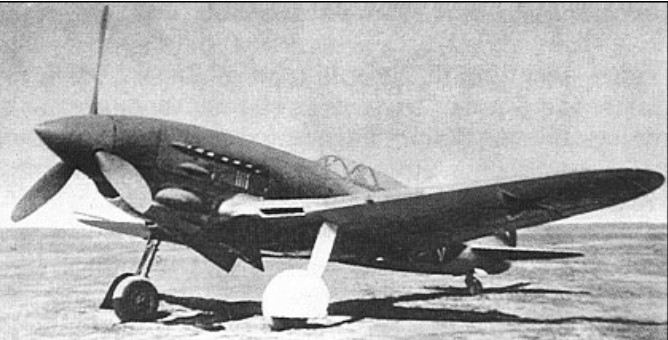
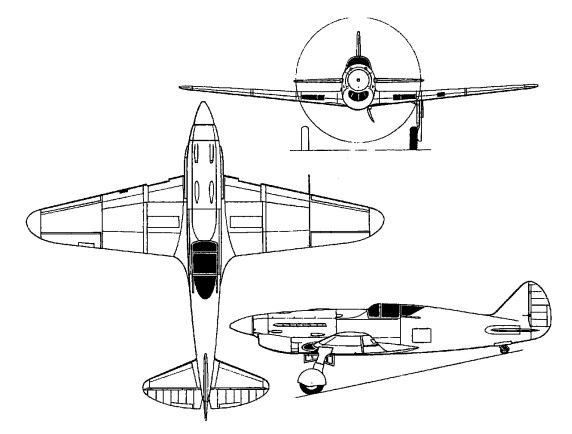
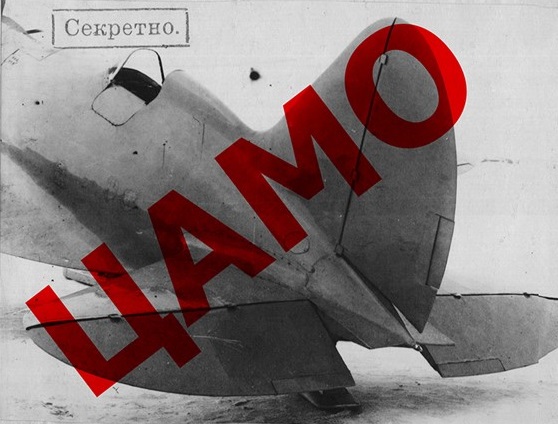
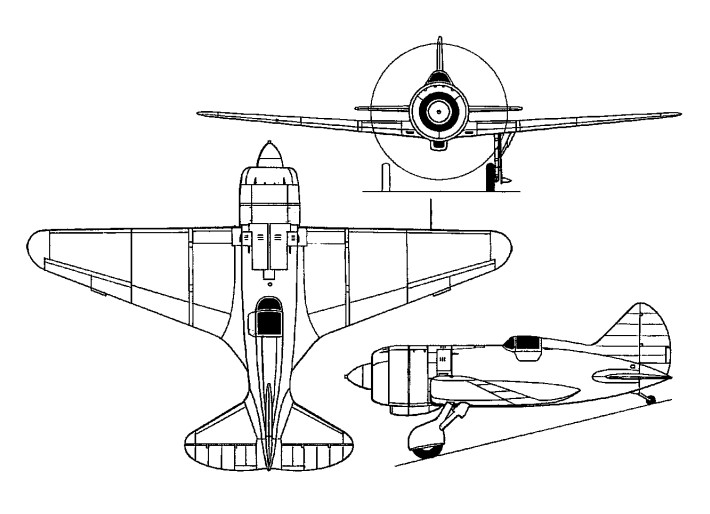
The preliminary design for the I-165 fighter was created in late 1937 and became the basis for the I-180 project design in March 1938. It was supposed to become a further evolution of the I-16 fighter with a slightly increased size and the M-88 engine. Developed by Dmitrii L Tomashevich (one of Polikarpov’s deputies), the I-180 was originally conceived with an all-metal structure. Limited all-metal construction experience, however, led the Polikarpov OKB to adopt an essentially similar structure to that of the earlier I-16, with a wooden monocoque fuselage and a fabric-skinned metal wing.
The machine took final form in its third prototype, and the first prototype was constructed in summer 1938. The first prototype, the I-180.1, was powered by a 1,100hp Tumansky M-88 14-cylinder two-row radial, intended armament being four 7.62mm guns. This aircraft was lost as a result of engine failure during its first flight on 15 December 1938 piloted by Valeriy Chkalov. Chkalov did not survive the accident. The second prototype, the I-180.2, differed primarily in having a 1,000hp Tumansky M-87A (later M-87B) 14-cylinder two-row radial and lengthened wing outer panels. These increased wing span from 9.00m to 10.05m and area from 14.68sq.m to 16.11sq.m. First flown on 19 April 1939, the I-180.2 was lost on its 53rd flight and the demise of another test pilot, Tomas Suzy.
Construction of the third prototype was started in mid-1939, the I-180.3 flown on 10 February 1940 with E. Ulyakhin as a test pilot, and featured a redesigned and more advanced wing structure, a 1,100hp M-88R engine, a cockpit canopy and an armament of two 12.7mm and two 7.62mm guns concentrated in the fuselage.
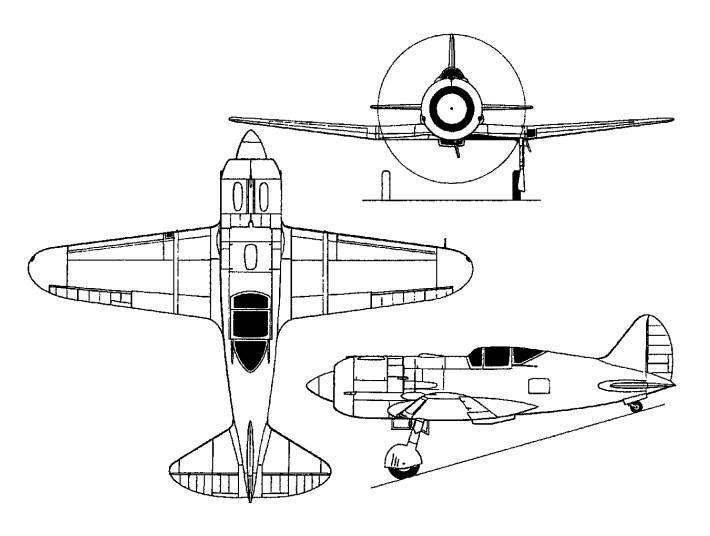
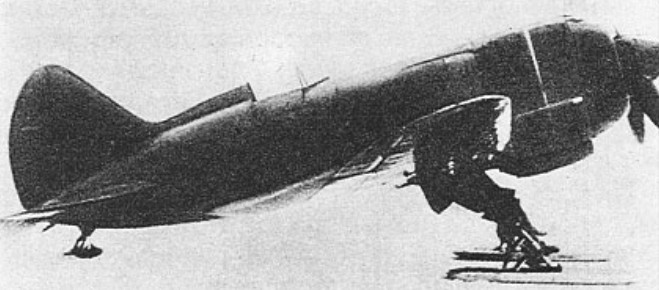
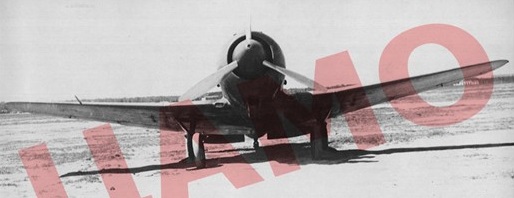
The I-180-3 was powered by an air-cooled M-88 engine that was not yet finished and proved to be quite problematic at the time of the aircraft’s testing. The motor passed the government testing only in December 1940, after the destiny of the I-180 project had already been decided. The aircraft strongly resembled the I-16 in its behaviour in the air, but had advantages over its predecessor in higher speed and faster climb times. It was also easier to control and more stable in manoeuvres, as well as during landing and take-off. Among the main drawbacks of the project were the lack of a canopy, various mechanical defects and poor plane surface finishing. Flown with both wheel and ski undercarriages, a lot of problems were fixed eventually but, on 6 July 1940 the third prototype was lost due to a pilot error accident during State Acceptance Trials.
In the meantime, a pre-series of 10 aircraft based on the I-180.2 had been under construction as the I-180S (Seriyny or Series), the first three of these having been completed in December 1939. Several I-180S machines took part in a May Day parade in Moscow. The I-180S was powered by the M-88R and carried an armament of two 12.7mm and two 7.62mm fuselage-mounted guns, and, like the I-180.3, featured an enclosed cockpit. The I-180S was cleared for service trials, but the results of these were academic as this fighter had been overtaken by the more advanced I-185.
As a part of the I-185 development programme, one pre-series I-180S fighter had the dated triangulated pattern mainwheel legs replaced with legs of cantilever type, this aircraft being referred to as the I-180Sh, the suffix indicating Shassi (chassis). In the event, it was not completed and flown.
A plethora of issues with the aircraft caused the work on its preparation for production to be stopped in late 1940 and the entire I-180 programme abandoned.
Max take-off weight: 2456 kg / 5415 lb Empty weight: 2046 kg / 4511 lb Wingspan: 10.09 m / 33 ft 1 in Length: 6.88 m / 23 ft 7 in Wing area: 16.11 sq.m / 173.41 sq ft Max. speed: 585 km/h / 364 mph
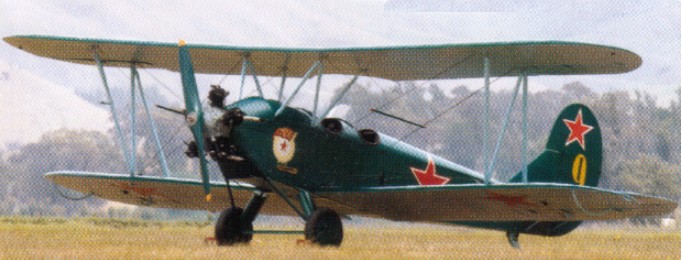
The U-2TPK prototype, which appeared in early 1927 was designed by N.N.Pellyakov, had been built to achieve economy in repair and maintenance, the wings comprising four identical thick-section interchangeable rectangular panels with square tips. Similarly, a common control surface was used for ailerons, elevators and rudder. The result was a biplane with very poor flight characteristics. It had thus to be redesigned, appearing as a neat, manoeuvrable biplane having staggered single-bay wing with rounded tips, conventional cross-axle landing gear, and tandem open cockpits for instructor and pupil. Powered by a 75kW radial engine, the new prototype made its first flight on 7 January 1928. An immediate success, it was placed in quantity production, deliveries starting in 1928, and by the time of the German invasion of the Soviet Union in mid-1941 over 13,000 had been completed.
Though its principle role was primary training, the U-2 was soon modified as a light passenger transport, air ambulance and agricultural aircraft. Production continued on a massive scale during World War II, and the U-2 took on an even wider range of duties, including liaison, light attack, night nuisance raider and propaganda aircraft complete with microphone and loudspeaker.
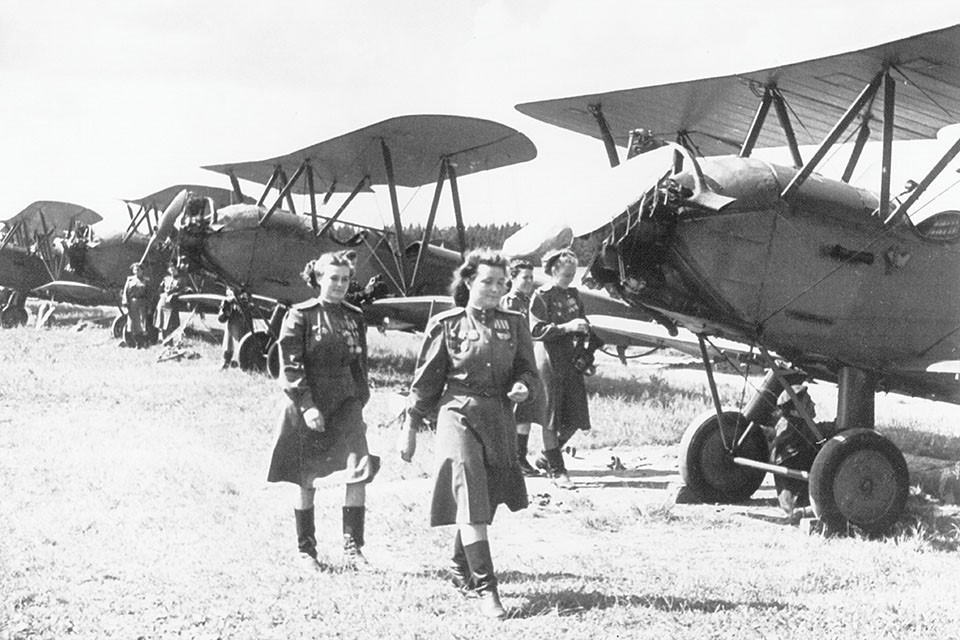
The Russians organized an entire regiment of women pilots to attack German targets at night. Called Nächthexen, or “Night Witches,” by the Germans, they operated Po-2s.
Pilots of the 588th Night Bomber Regiment, aka the “Night Witches,” in 1944
On 3 March 1944 the German 1st Easrwen Squadron ( I.Ostfliegerstaffel) was transferred to Lida airfield near Vilna (Lithuania). This unit consisted of Russian volunteers who flew captured Soviet U-3 biplanes, they called ‘sewing machines’. The unit had been set up in Daugavpils (Latvia) in December 1943, and now its members flew operations in the zone of Luftflotte 6 under General Ritter von Greim. The observers on board he U-2s dropped small-calibre bombs by hand. The aircraft flew every night when visibility permitted, crossing over the Soviet lines with nuisance raids.
In time, the Po-2 set a record for a basic design: A grand total of some 40,000 were produced. The Soviet Union built Po-2s from 1928 to 1951, and Poland turned them out under license from 1948 to 1955. But that was not the end of it. Numerous aeroclubs and enthusiasts kept constructing them in Russia until 1959.
After Polikarpov’s death, on 30 July 1944, the U-2 was redesignated Po-2 in his honour, and post-war it continued in production in the USSR for several years. Trainer and ambulance variants were built on a large scale in Poland from 1948 to 1953, Po-2s served with many Soviet allies and a small number still remain in flying condition in the USSR and several other countries. The total built is credibly reported to be in excess of 40,000.
In 1947, the aviation of the People’s Army of Poland turned to the Polish aviation industry with an order to start serial production of the Soviet Po-2 training and liaison aircraft. In the USSR, it was agreed to sell its license and in 1948, the Central Aircraft Study in Warsaw, under the direction of Stanisław Lassota, the licensing documentation for the aircraft was prepared. The license version of the aircraft differed from the Po-2 prototype in a different type of ailerons, had a trim on the elevator, different shock absorber fairings and some on-board instruments, minor improvements in the airframe design, as well as an improved engine, so the designation was changed to CSS-13.
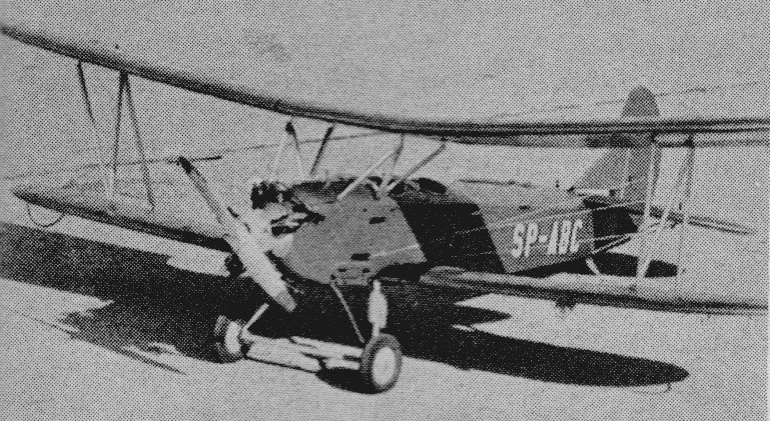
The production of the aircraft began at WSK-Mielec in December 1948. The prototype of the aircraft, SP-AKZ, made its first flight on December 18, 1948 and the pilots were Ludwik Lech and Kazimierz Tyrlik. In the following year, its testing was carried out at the Institute of Aviation in Warsaw. During the tests, it was found that the aircraft has good handling characteristics and behaved safely at take-off and landing.
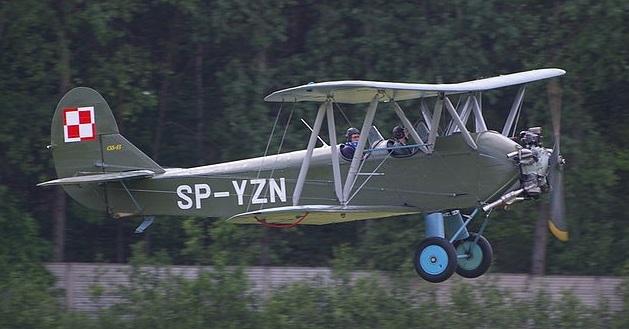
In 1999, the first serial model was flown. Serial production of the aircraft lasted at PZL Mielec from 1949 to 1950, and then 1952-1956 at WSK Okęcie in Warsaw. In total, 560 CSS-13 aircraft were produced in the years 1949–1956, of which 180 at PZL Mielec and 380 at WSK Okęcie. Airplanes of this type, popularly known as “Pociaki” or “Papayas”, were used by military, agricultural aviation as well as by flying clubs.
The first new aircraft were directed to aviation units and military schools as early as 1949. In the first half of the 1950s, CSS-13 aircraft were the basic aircraft in squadrons and liaison keys of the air forces. The following versions were used: liaison equipped with a double control system, bomber with a sight glass in the lower right wing for targeting with a gunsight and bomb locks under the wing and placed on the top of the fuselage, behind the second cabin on a rack, a movable aircraft machine gun. In addition to the air force, CSS-13 aircraft were used in the aviation units of the Navy and in the Border Protection Forces to patrol the state border.
During 1953–1955, LOT Polish Airlines operated 20 CSS-13 aircraft adapted for agricultural purposes (dusting crops and forests). In the flying clubs, CSS-13 aircraft were used in the 1960s for pilot training, training flights, glider towing, and parachute jumpers transport.
CSS-13
In 1953, a prototype of the version of the CSS-13 aircraft was built and flown at the Okęcie airport in Warsaw, marked as CSS S-13, designed by Tadeusz Sołtyk, M.Sc. A total of 59 aircraft of this type were produced.
CSS-13 (serial number 8-0511), Museum of Polish Arms in Kołobrzeg
Dozens of them have been exported, e.g. to Romania and Hungary. The last copy was withdrawn from use in 1978.
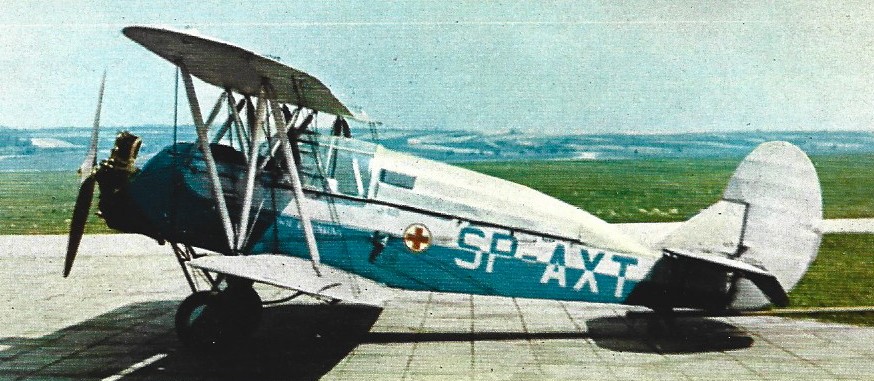
A Polish-built ambulance version has a raised rear decking.
U-2: Basic model, built in large numbers as a two-seat primary trainer. It was also built in many different versions, both as civil and military aircraft. The U-2 variants also included a light transport, utility, reconnaissance and training aircraft. Power plant was the M-11 radial piston engine of 75 kW (100 hp). Later models were also equipped with uprated M-11 engines of 111 kW (150 hp). Some aircraft were fitted with a rear closed cabin, other were fitted with sledges or floats.
U-2A: Two-seat agricultural crop dusting aircraft, powered by an 86 kW (115 hp) M-11K radial piston engine. Later redesignated Po-2A after 1944.
U-2AO: Two-seat agricultural aircraft.
U-2AP: Agricultural aircraft, with a rear cab replaced with a container for 200–250 kg (441-551 lb) of chemicals. 1,235 were built in 1930–1940.
U-2G: This experimental aircraft had all the controls linked to the control column. One aircraft only.
U-2KL: Two aircraft fitted with a bulged canopy over the rear cabin.
U-2LSh: Two-seat ground-attack, close-support aircraft. The aircraft were armed with one 7.62 mm (0.30 in) ShKAS machine-gun in the rear cockpit. It could also carry up to 120 kg (265 lb) of bombs and four RS-82 rockets. Also known as the U-2VOM-1.
U-2LPL: Experimental prone-pilot research aircraft.
U-2M: This floatplane version was fitted with a large central float and two small stabilizing floats. Not built in large numbers. Also known as the MU-2.
U-2P: Floatplane version, built only in limited numbers, in several variants with different designations.
U-2S: Air ambulance version, built from 1934. It could take a physician and an injured on a stretcher on a rear fuselage, under a cover. Variant U-2S-1 from 1939 had a raised fuselage top upon the stretcher. From 1941 there were also used two containers for stretchers, that could be fitted over lower wings or two containers for two seating injured each, fitted under lower wings.
U-2SS: Air ambulance aircraft.
U-2ShS: Staff liaison version, built from 1943. It had a wider fuselage and a closed 4-place rear cab.
U-2SP: Civil transport version, could carry two passengers in open individual cabs, built from 1933. Other roles included aerial survey, and aerial photography. A total of 861 were built between 1934 and 1939.
U-2SPL: This limousine version was fitted with rear cabin for two passengers.
U-2UT: Two-seat training aircraft, powered by an 86 kW (115 hp) M-11D radial piston engine. Built in limited numbers.
U-2LNB: Somewhat like the earlier -LSh version, a Soviet Air Force two-seat night attack version, built from 1942. Armed with one 7.62 mm (0.30 in) ShKAS for rear defense, plus up to 250 kg of bombs under the wings for land support. Earlier aircraft were converted to improvised bombers from 1941.
U-2VS: Two-seat training and utility aircraft. Later redesignated Po-2VS after 1944.
U-2NAK: Two-seat night artillery observation, reconnaissance aircraft. Built from 1943.
U-3: Improved flying training model, fitted a 149 kW (200 hp) seven cylinder M-48 radial engine.
U-4: Cleaned-up version with slimmer fuselage; not built in large numbers.
(Total U-2 manufacture: 33,000)
Po-2: Postwar basic trainer variant.
Po-2A: Postwar agricultural variant.
Po-2GN: “Voice from the sky” propaganda aircraft, fitted with a loud speaker.
Po-2L: Limousine version with an enclosed passenger cabin.
Po-2P: Postwar floatplane version; built in small numbers.
Po-2S: Postwar air ambulance variant, with a closed rear cab.
Po-2S-1: Postwar ambulance version, similar to the pre-war U-2S.
Po-2S-2: Postwar ambulance version, powered by a M-11D radial piston engine.
Po-2S-3: Postwar ambulance version, which had two underwing containers, each one was designed to transport one stretcher patient. Also known as the Po-2SKF.
Po-2ShS: Staff communications aircraft, fitted with an enclosed cabin for the pilot and two or three passengers.
RV-23: This floatplane version of the U-2 was built in 1937. It was used in a number of seaplane altitude record attempts. The RV-23 was powered by a 529 kW (710 hp) Wright R-1820-F3 Cyclone radial piston engine.
CSS-13: Polish licence version, built in Poland in WSK-Okęcie and WSK-Mielec after World War II (about 500 built in 1948–1956).
CSS S-13: Polish ambulance version with a closed rear cab and cockpit and Townend ring (53 built in WSK-Okęcie in 1954–1955, 38 converted to S-13).
E-23: Research version, built in the Soviet Union in 1934, for research into inverted flight.
Engine: 1 x Schvetsov M-11, 74-118kW Max take-off weight: 983 kg / 2167 lb Empty weight: 740 kg / 1631 lb Wingspan: 11.4 m / 37 ft 5 in Length: 8.2 m / 27 ft 11 in Height: 3.1 m / 10 ft 2 in Max. speed: 146 km/h / 91 mph Cruise speed: 100-130 km/h / 62 – 81 mph Ceiling: 5000 m / 16400 ft Range w/max.payload: 430 km / 267 miles Crew: 1 Passengers: 1-2
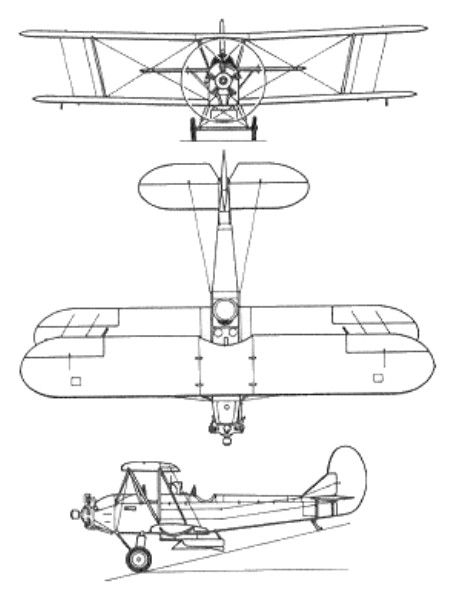
CSS-13 Engine: M-11D, 125 hp (92 kW) Wing span: 11,4 m Wing area: 33,15 m2 Length: 8,17 m Height: 3,1 m Empty weight: 723 kg MTOW: 1057 kg Maximum speed: 150 km/h Stall: 70 kph Ceiling: 3000 m ROC: 2.0 m/s Range: 650 km Armament: 1 x 7.62 mm ShKAS machine gun Bombload: 300 kg