The 1911 Ruehl monoplane was designed and built by Andre Ruehl in the USA
1 engine
Ruchonnet-Schemmel 1911 monoplane
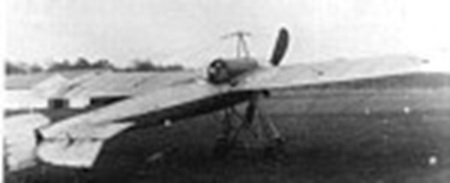
The 1911 Ruchonnet-Schemmel monoplane was designed and built by Ruchonnet (Swiss) and Schemmel but built in France.
Restan 1911 monoplane
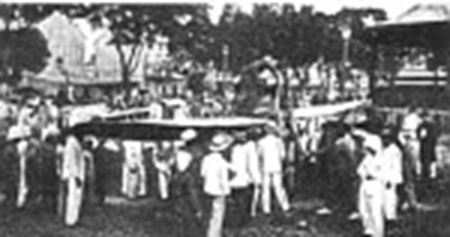
The Restan 1911 monoplane was designed and built by Restan in France
Span: 29’6″
Length: 23′
Rebikov 1911 biplane
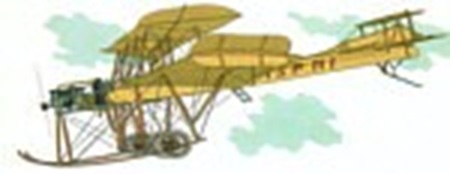
Designed and built by Rebikov in Russia
Raison 1911 monoplane
The 1911 Raison monoplane was designed and built by Alfred Louis Raison in South Africa
American Eagle A-1 / A-101 / 101

The American Eagle A-1 of 1926 was designed by Robert T McCrum and possibly Waverly Stearman. First flown on 9 April 1926, the model designation didn’t appear until late 1927.
The company’s initial effort was designed to replace war-surplus Standards at the Porterfield Flying School. The unit cost was $2,450, $2,515 in 1929, $2,985 in 1930. After receiving its ATC (17), the model designation was changed to A-101, offering 100hp Curtiss OXX-6, 150hp Hisso (2-55) as A Special in 1929 [511], 125hp Ryan-Siemens (2-48), 120hp Anzani, and 125hp Quick as A-1 Special [X4387] (length: 23’5″-24’6″).
The design had dangerous spin characteristics, resulting in several fatal crashes, and was dropped in 1928 in favor of A-129.
A-1 / A-101 / 101
Engine: 90hp Curtiss OX-5
Wingspan: 30’0″
Length: 24’1″
Useful load: 814 lb
Max speed: 100 mph
Cruise: 85 mph
Stall: 35 mph
Range: 400 mi
Seats: 3
A-101-T
1932 (ATC 2-425)
Engine: 115hp Milwaukee Tank V-470/V-502
One built
American Eagle 330
The 1929 American Eagle 330 (ATC 119) designed by Noel Hockaday was a four-place cabin high wing monoplane development of the Wallace Touroplane B. The 33o featured folding wings.
Engine: 100hp Kinner K-5
Wingspan: 37’0″
Length: 23’10”
Max speed: 115 mph
Cruise: 100 mph
Stall: 43 mph
Range: 500 mi
Ceiling: 14,000′
Aggergaard A-1
Designed and built by Arthur & Peter Aggergaard, the Aggergaard A-1 was a three-place open cockpit monoplane, registered N587W c/n 100.
It was built from parts supplied by Nicholas-Beazley Co at Marshall MO.Powered by a 180hp Hisso E, it first flew on 18 May 1931.
The registration was cancelled 1 February 1933.
Aetna Aerocraft 2SA
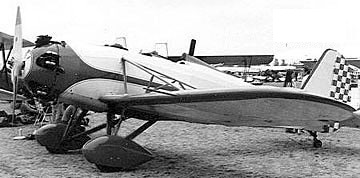
The 1940 Aerocraft 2SA (ATC 733) featured tandem cockpits, but the prototype was modified from a side-by-side Kinner B-2 NC14200. Later versions were known as Aetna 2SA.
Also available with 175hp R-5, six were built.
Engine: 160hp Kinner R-5
Wingspan: 34’6″
Length: 24’6″
Useful load: 614 lb
Max speed: 125 mph
Cruise: 110 mph
Stall: 45 mph
Range: 400 mi
Seats: 2
American Sunbeam Pup (LP-1)
One American Sunbeam Pup (LP-1), built in 1931 registered NC956Y (ATC 2-334), was a two-place open cockpit high wing monoplane.
Engine: 40hp Salmson AD-9
Wingspan: 36’4″
Length: 20’0″
Useful load: 500 lb
Max speed: 95 mph
Cruise: 72 mph
Stall: 27 mph
Range: 420 mi
Seats: 2
 All Aero