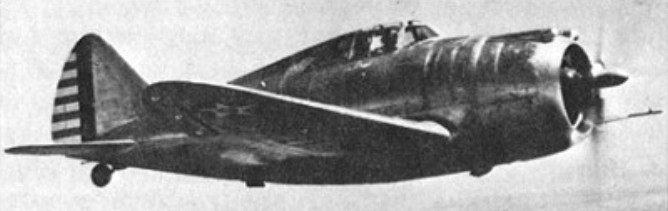
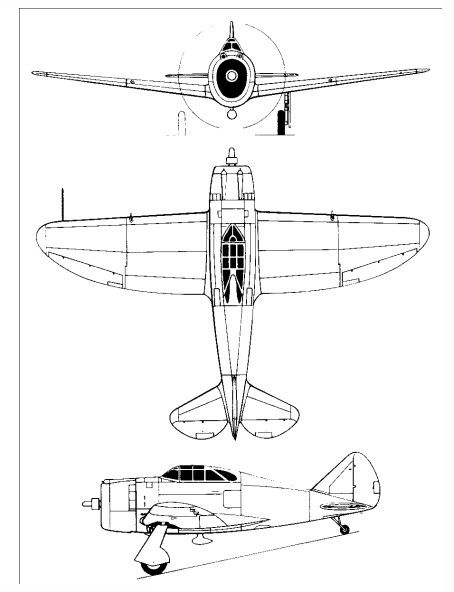
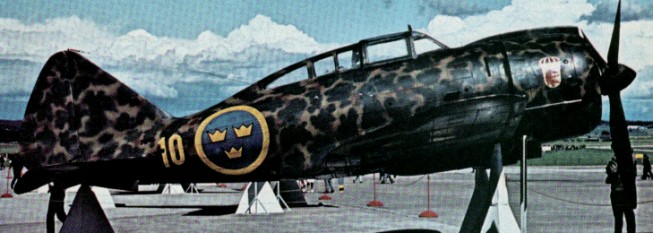
The Lancer was a single-seat interceptor fighter that first appeared in service evaluation YP-43 form in 1940. With a Pratt & Whitney R-1830 Twin Wasp radial engine and bulky fuselage, it was clearly a product of the Republic Aviation Corporation. Production for the USAAF, RAAF and China totalled 272 aircraft in three versions. Six P-43B reconnaissance fighters were allotted for Australian RAAF use, as PRU aircraft.
The P-43 Lancer design was developed further into the P-47 Thunderbolt.
P-43 Engine: 1 x Pratt-Whitney R-1830-47, 1167kW Length: 8.69 m / 29 ft 6 in Height: 4.27 m / 14 ft 0 in Wing area: 20.72 sq.m / 223.03 sq ft Max take-off weight: 3600 kg / 7937 lb Empty weight: 2565 kg / 5655 lb Wingspan: 10.97 m / 36 ft 0 in Max. speed: 562 km/h / 349 mph Ceiling: 11580 m / 38000 ft Range: 1287 km / 800 miles Crew: 1 Armament: 2 x 12.7mm machine-guns, 2 x 7.62mm machine-guns
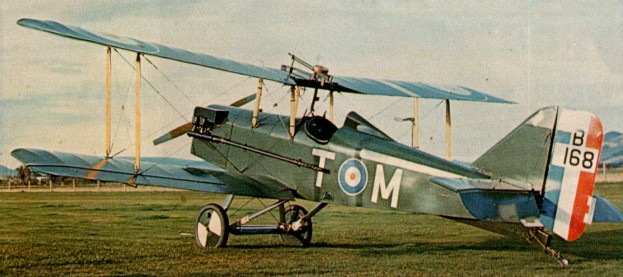
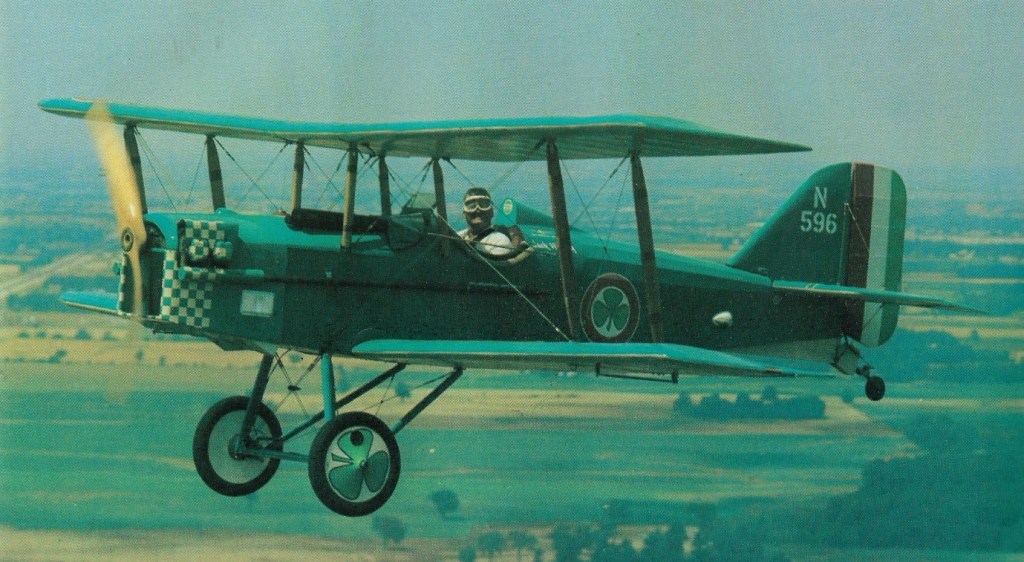
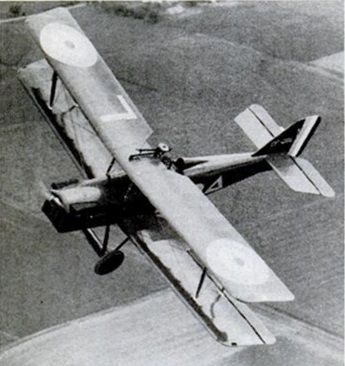
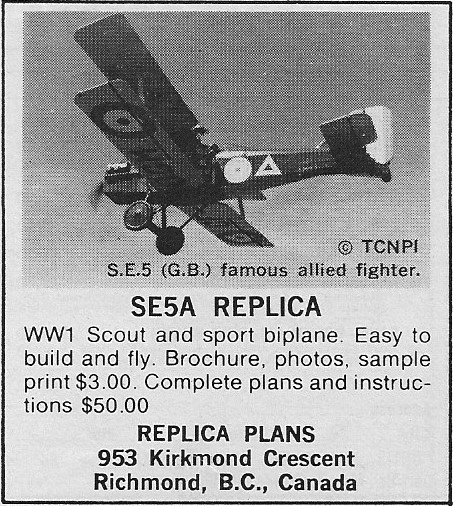
The 5/6th scale replica was designed as an easy and inexpensive representation of this famous First World War Fighter using modern materials and engines. The reduced scale allows for the use of 65 to 100 hp “flat four” engines although some examples have more powerful engines. Wood and fabric construction.
The prototype flew in Canada in 1970 and there were two flying in New Zealand with at least two more under construction. The wooden wing has a leading edge covered with either fibreglass or aluminum, the rest being fabric-covered. The plywood-covered box fuselage has a fabric-covered turtle-deck and aluminum-covered forward section. Performance from an 85 hp powered SE-5A Replica are a cruise speed of 135 km/h and 150 m/min climb rate.
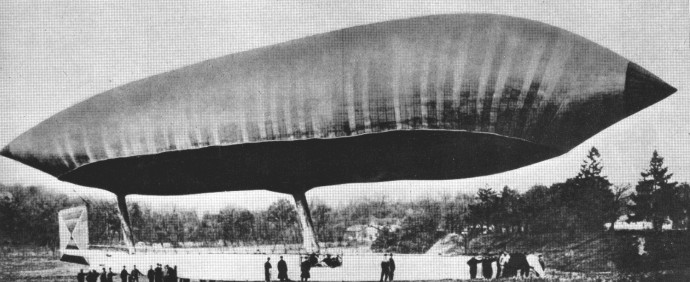
In 1884, under the direction of Renard and Krebs of the French army aeronautical establishment at Chalais Meudon, successful experiments were made employing electrical power with the airship La France.
At the French military balloon establishment at Chalais Meudon, in 1884, engineers Charles Renard and Captain A.C.Krebs designed and constructed the airship La France which was to prove capable of steady, navigable flight, and eas able to describe circular flights against the wind and return to its departure point.
La France, with a capacity of 66,000 cu.ft, was 165 ft long with a diameter of 28 ft, the envelope being made from Chinese varnished silk and of streamlined form. Below the envelope an enclosed car, 108 ft in length, contained a Gramme electric motor, developing 8.5-9 hp for a weight of 210 lb, together with the chromium-chloride batteries that drives a cloth covered tractor airscrew of 23 ft diameter. The battery weighed 435 kg.
The France was thirty-two feet in maximum diameter and nearly 200 feet long, the empennage planes aggregating about 400 square feet were placed forward of the stern.
Steering in the horizontal plane was effected by a large rectangular rudder at the stern, while vertical movement and attitude were controlled by a sliding weight mounted within the body of a car assistd by an ‘elevating rudder’.
In a series of trials the airship demonstrated controlled flight, achieved a speed of 14 mph and made several flights over Paris. The weight of the batteries, limited range and carrying capacity prevented further development.
The first trial of La France took place on 9 April 1884. The flight proving a limited success: making a circular flight of 5 miles in twenty-three minutes at a speed of around 12.5 mph in still air, then returning to its starting point, Chalais-Meudon – the first time this had ever been done. Six other flights were made during 1884-85, including two over Paris.
Chalais-Meudon Renard-Krebs “La France” Engine: 1 x Elektromoteur Gramme electric: 9 hp Batteries: Chromium chloride Contained volume: 65,695 cu.ft / 1860 cu.m Length: 165 ft / 50.0 m Width of hull: 27.887 ft / 8.5 m Height: 60 ft Gross lift: 2.0 ton Useful lift: 0.1 ton Max. speed: 13 mph / 11 kt / 20 km/h Crew: 3
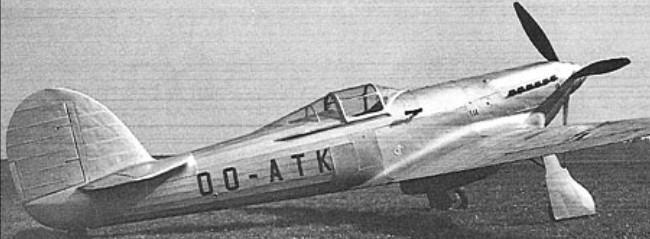
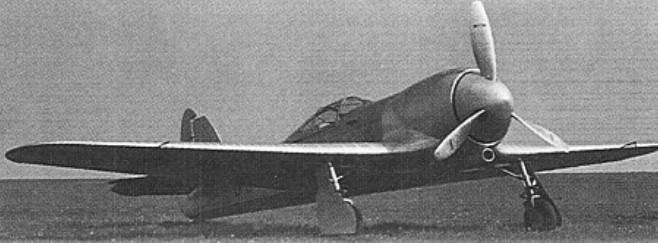
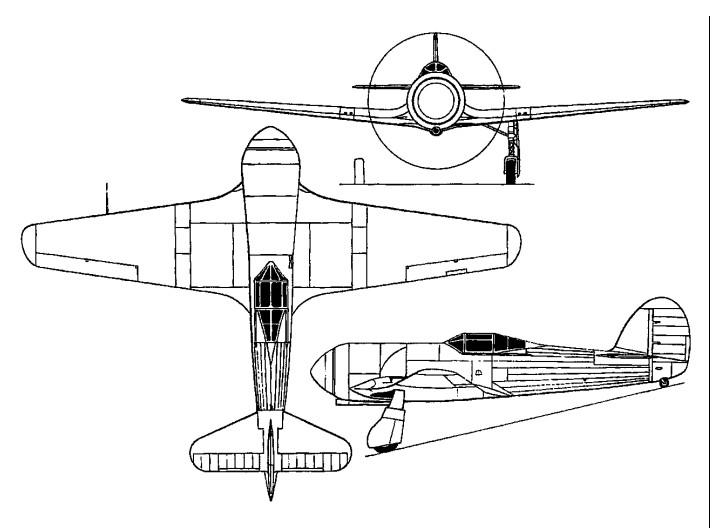
Developed in parallel with the R-37, the R-38 was essentially similar to the R-36 apart from having a 1030hp Rolls-Royce Merlin II engine. It was originally proposed with wings of two different sizes, but the sole prototype retained a similar wing to that of the R-36 and R-37. Armament comprised four wing-mounted 7.7mm or 13.2mm machine guns.
The R-38 flew for the first time on 4 August 1939, and gave excellent results during its test programme, which was still in process when German forces occupied Belgium. The sole prototype was flown to Bordeaux when the final collapse of Belgian resistance became inevitable, but was scrapped after capture in France by German forces.
Max take-off weight: 2600 kg / 5732 lb Empty weight: 1950 kg / 4299 lb Wingspan: 11.64 m / 38 ft 2 in Length: 8.80 m / 29 ft 10 in Height: 2.90 m / 10 ft 6 in Wing area: 20.00 sq.m / 215.28 sq ft Max. speed: 545 km/h / 339 mph Range: 1350 km / 839 miles
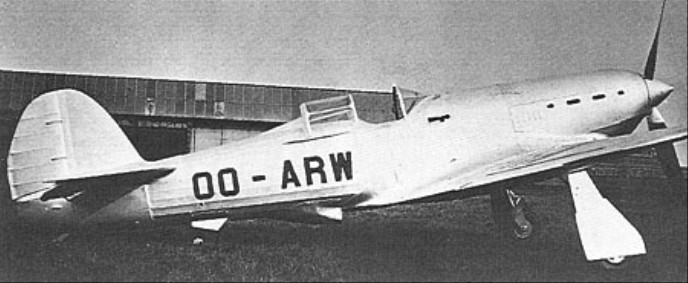
With an airframe fundamentally similar to that of the R-36, the R-37 differed primarily in having a close cowled 1100hp Gnome-Rhone 14N-21 14-cylinder radial engine. Cooling air reached the engine via a narrow annulus, was mixed with exhaust gases and ejected through two groups of nozzles to provide some thrust augmentation.
The proposed armament consisted of four 7.7mm or two 13.2mm machine guns mounted in the wings.
Although the R-37 was displayed statically at the Salon de Bruxelles in July 1939, no attempt had been made to fly this prototype before the German occupation of Belgium in May 1940. The R-37 was discovered at Evere by the occupation forces and a Luftwaffe pilot – possibly unaware that the aircraft had not previously been flown – flew the aircraft to Beauvechain. There is no record of any subsequent flight testing, although it is known that the R-37 was taken to Germany. Prior to the German occupation, Alfred Renard had prepared a project for a two-seat version, the R-37B, for use as a ground attack aircraft.
Max take-off weight: 2460 kg / 5423 lb Empty weight: 1810 kg / 3990 lb Wingspan: 11.64 m / 38 ft 2 in Length: 8.40 m / 28 ft 7 in Height: 2.90 m / 10 ft 6 in Wing area: 20.00 sq.m / 215.28 sq ft Max. speed: 510 km/h / 317 mph
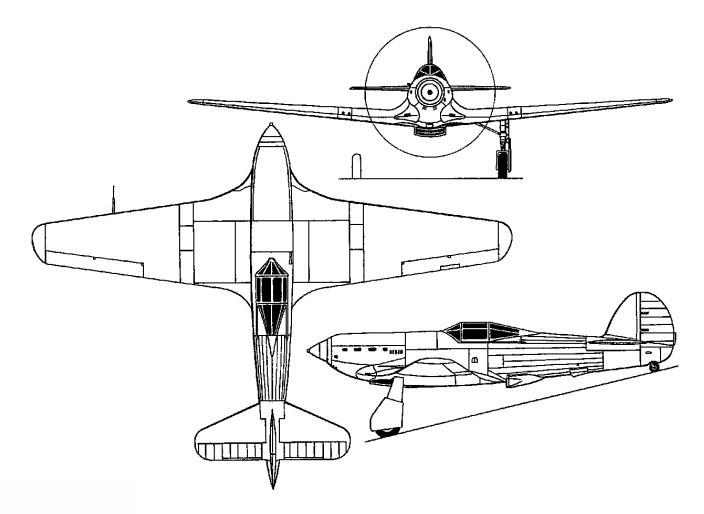
Designed by Alfred Renard as a replacement for the Fairey Firefly in service with the Aviation Militaire, the R-36 was flown for the first time on 5 November 1937.
An advanced low-wing single-seat fighter, the R-36 with Hispano-Suiza engine was exhibited at the 1937 Brussels Aero Show.
Of all-metal construction and carrying an armament of one engine-mounted 20mm cannon and four wing-mounted 7.7mm machine guns, the R-36 was powered by a 910hp Hispano-Suiza 12Ycrs 12-cylinder Vee-type liquid-cooled engine. Various modifications were introduced during the test programme – notably the relocation of the radiator bath and the enlargement of the rudder.
Late in 1938, the government took an option on a batch of 40 aircraft. The loss of the prototype on 17 January 1939 resulted in the programme being placed in abeyance and then dropped when the decision was taken to procure Hawker Hurricanes.
Max take-off weight: 2470 kg / 5445 lb Empty weight: 1770 kg / 3902 lb Wingspan: 11.64 m / 38 ft 2 in Length: 8.80 m / 29 ft 10 in Height: 2.90 m / 10 ft 6 in Wing area: 20.00 sq.m / 215.28 sq ft Max. speed: 505 km/h / 314 mph Range: 1000 km / 621 miles
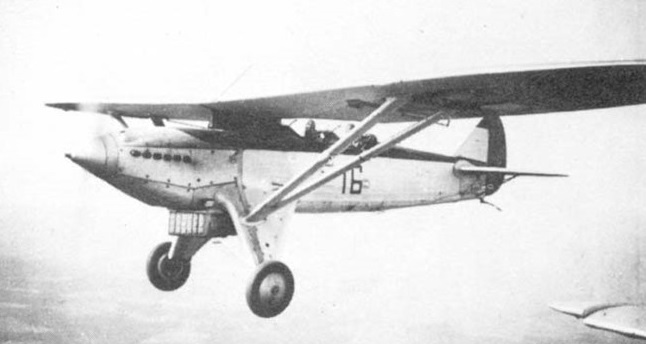
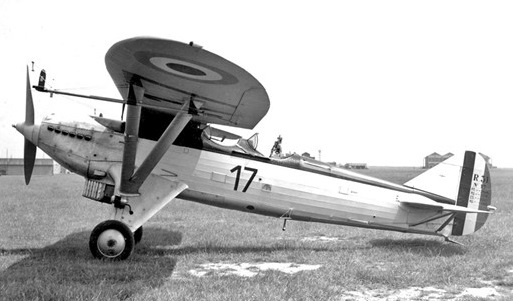
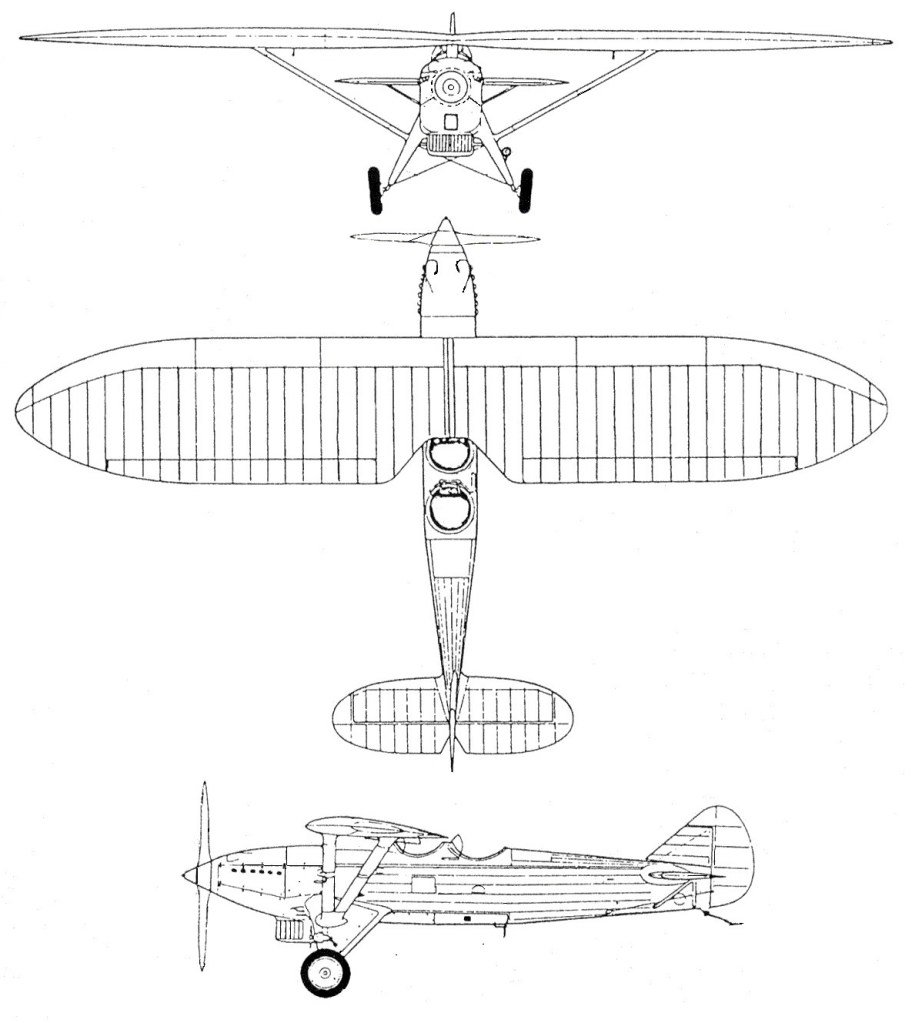
In view of replacing the ageing Breguet XIX observation aircraft of the Aéronautique Militaire Belge, the Renard company developed a twin seat parasol-wing aircraft which in the first studies was designated as Renard RR (for Rolls-Royce). The renamed Renard R.31 was designed by Alfred Renard of Constructions Aéronautiques G. Renard to meet a requirement of the Belgian Air Force for a short ranged reconnaissance and army co-operation aircraft.
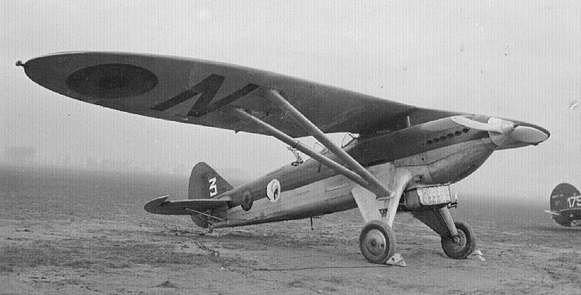
It was a parasol monoplane of mixed construction, powered by a Rolls-Royce Kestrel engine, with a welded steel tubing structure with metal sheet covering the forward fuselage and fabric covering of the remainder of the airframe. The wing was held in position by a single Vee strut on each side, conjoined with its fixed under carriage. Armament consisted of one or two forward-firing 7.62 mm Vickers machine guns and one 7.62 mm Lewis machine gun in flexible mount in rear cockpit. There was also a rarely used provision for dropping four 10 kg bombs under the wings.
Powered by a Rolls-Royce Kestrel II engine developing 487hp, it first flew at Haren airfield at Evere, near Brussels, on 16 October 1932, piloted by Renard test-pilot Charles Rooms.
The Aéronautique Militaire placed an order for 28 R.31s was placed in March 1934, with six to be built by Renard and the remainder by SABCA. One aircraft was fitted with a Lorraine Petrel engine for evaluation, but this was later replaced by the normal Kestrel engine.
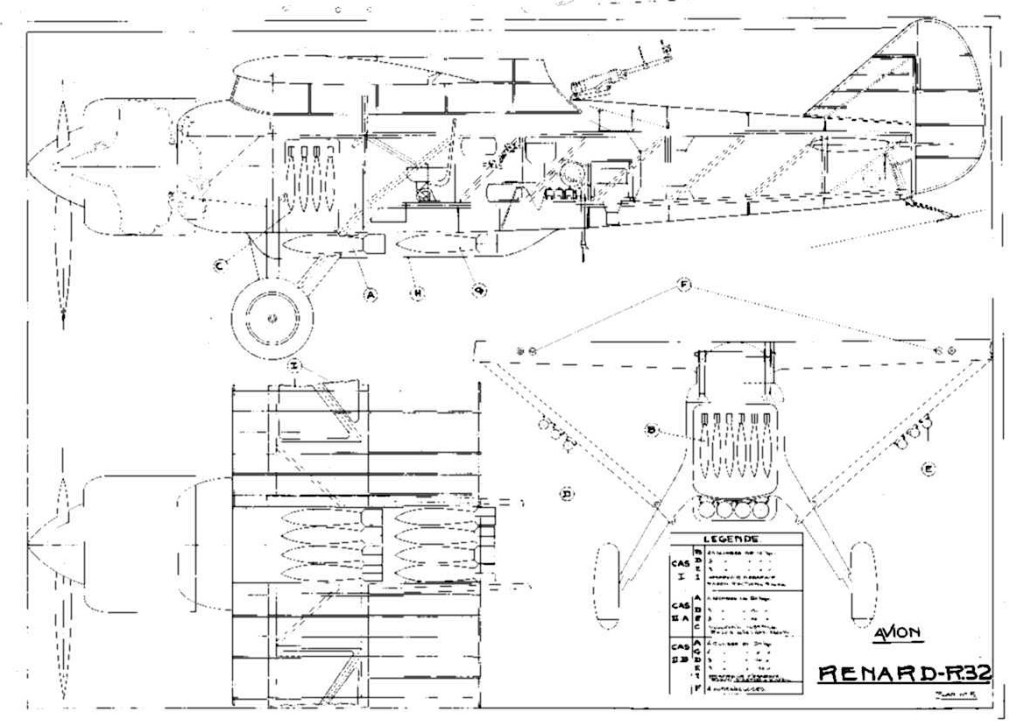
After 1936 a second aircraft was fitted with an enclosed canopy and a Gnome-Rhône Mistral Major radial engine, becoming the R-32, with this then being replaced by a Hispano-Suiza 12Y engine, but the R-32 did not show sufficiently improved performance to gain a production order. The Renard R-32 was reworked as a normal R.31 thus becoming the 35th machine for the AéM.
A further six R.31s were ordered in August 1935 by the AéM. The aircraft received the military registrations N-1 to N-35.
The R.31 entered service with the Belgian Air Force in 1935, replacing the Breguet 19 in the 9e and 11e Escadrilles d’Observation based at Liège. In service, it was not popular, as it had poor handling, being vulnerable to entering flat spins if mishandled, with all aerobatics therefore being banned.
All the Renard R-31’s were used by the Bierset based observation squadrons – 9/V/1Aé (Sioux on blue circle) and 11/VI/1Aé (Sioux on red circle). At the start of the war 21 aircraft were available who were operational during the whole of the “18 day Campaign” flying their last mission on May 27th, 1940.
The R.31 was hopelessly obsolete, and those that were not destroyed on the ground in the early hours of the German Blitzkrieg invasion of Belgium in May 1940 were ravaged by German fighters as they bravely attempted to gather information on the German invasion. None apparently functioned as ground support aircraft during the brief Belgian Army resistance, flying 54 reconnaissance sorties in support of the Allied forces defending Belgium, with the last mission (which was also the final mission flown by the Belgian Air Force in its attempt to repel the Germans, being flown on the afternoon of 27 May 1940. Following the German occupation of Belgium, the Luftwaffe had no interest in the machines and those that had survived the initial onslaught were unused or were destroyed. Overall, these machines had no significant impact on the war although they were briefly involved.
As not a single Renard R.31 remains anywhere in the world, a number of volunteers at the Royal Army Museum at Brussels is building a 1/1 scale replica using the original blueprints.