The Santos-Dumont No.15 Biplane of 1907 was a 100 hp Antoinette-powered tractor biplane with sharp dihedral wings similar to No.14 bis, although made of wood instead of fabric and with elevators on the outer forward corners of these planes. Its biplane empennage was enclosed by two vertical panels and acted as both an elevator and rudder, being mounted on a universal joint at the end of bamboo outriggers. Trials of the No.15 began March 22, 1907 and ended five days later when the machine collapsed while taxiing before a flight attempt. No successful flights appear to have been made.
The Brazilian aviator Alberto Santos Dumont, in January 1906 announced that he would compete for the prize offered by industrialist Henri Deutsche de la Meurthe for the first 1 km (0.6 mile) circle flown in an aircraft.
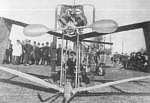
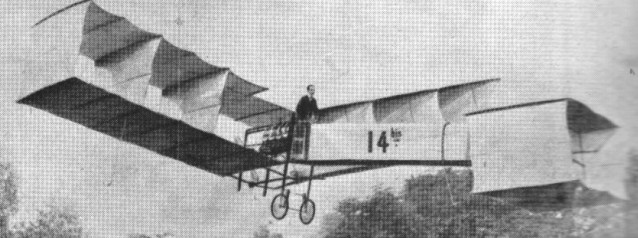
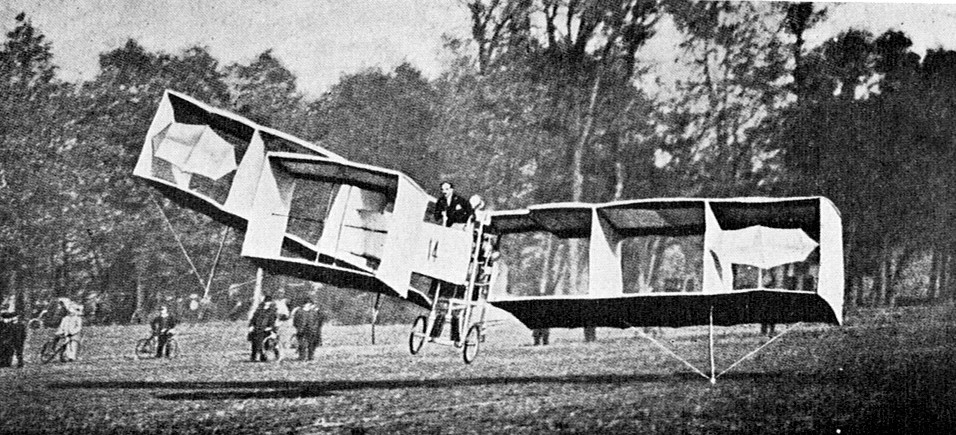
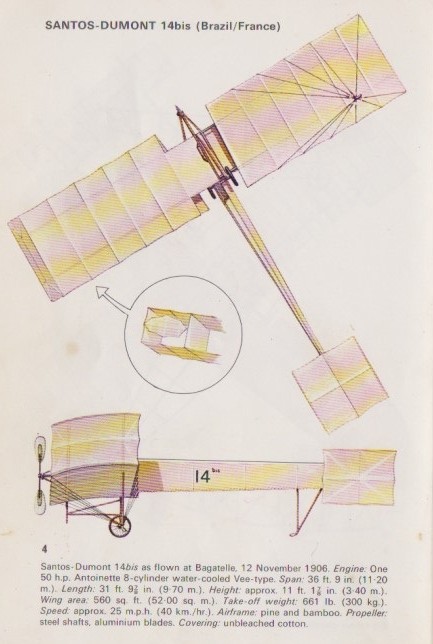
In 1906, Santos-Dumont took the nacelle of his dirigible balloon no. 14 and added to it a fuselage and biplane wings. An Antoinette V8 engine of 24 hp power was installed ahead of the wings, driving a propulsion propeller; the airplane flew rear-first and was denominated 14-bis (since it was descendent of the dirigible balloon no. 14). Santos’s entry was his No. 14bis, with a 12 m span wing consisting of six box kite cells joined in sharp dihedral. Another cell, which could be tilted up, down, or sideways for steering was mounted at the very front of the fuselage in canard configuration. Santos planned to fly the machine from a standing position just in front of the wing. His first tests were con¬ducted in typically bizarre fashion. Santos rigged up a tightrope and pulley contraption from which he suspended the machine, then hired a donkey to tow it back and forth while he tested the controls.
14bis at Bagatelle, near Paris in 1906
The first official flights at Bagatelle, near Paris in 1906 were only hops. The best lasting 21 seconds and covering 220 m / 721 ft.
On 21 August 1906 No.14bis showed no inclination to leave the ground and succeeded only in shattering its pusher propeller. On the next day the undercarriage collapsed during another abortive take off run. Santos decided that lack of power was the problem, and so substituted a new eight cylinder 50 hp Antoinette engine, which he obtained through Louis Bréguet, for the original 24 hp motor.
On September 13th, Santos Dumont made the first flight of 7 or 13 m (according to different accounts) above the ground, which ended with a violent landing, damaging the propeller and landing gear.
On October 23th, 1906 his 14Bis biplane flew a distance of about 60m (197ft) at a height of 3 to 5 m (10 to 16ft) during a seven-sec-long flight. The first officially recognised flight in Europe. The precise distance flown was never measured. In their excitement, official observers from the Aero Club quite forgot their primary task. Santos Dumont won the 3,000 Francs Prize Archdeacon, instituted in July 1906 by the American Ernest Archdeacon, to honor the first flyer to achieve a level flight of at least 25 m.
Before his next flight Santos-Dumont modified the 14-bis by the addition of large hexagonal ailerons, to give some control in roll. Since he already had his hands full with the rudder and elevator controls (and could not use peddles since he was standing), he operated these via a harness attached to his chest. If he wanted to roll right he would lean to his right, and vice versa. One witness likened Santos-Dumont’s contortions while flying the 14-bis to dancing the samba.
With the modified aircraft, on 12 November 1906, Santos-Dumont again had No. 14-bis at Bagatelle, Paris. This time the Brazilian made six increasingly successful flights. One of these flights was 21,4 sec long within a 220 m path at a height of 6 m. The Brazilian always used his Cartier wristwatch to check the duration of his flights. The flight experiments with the 14Bis took place at Le Bagatelle (air)field in Paris. Santos Dumont did not employ any catapult or similar device to place his craft aloft. As far as the world knew, it was the first airplane flight ever and Santos-Dumont became a hero to the world press. On that day he was to make an attempt to win a prize of 1,500 francs, offered by the Aero Club de France, for the first aeroplane able to exceed a distance of 100m (305 ft). Santos-Dumont and his aircraft rose to the occasion, cheered by an enormous crowd that had flocked to the large open space at Bagatelle, in the Bols de Boulogne. They had come in anticipation of seeing an aeroplane in flight for the first time. No.14-bis excelled itself to record a flight of just over 21 seconds, covering a distance of 220 m (722 ft) and set up the first official air speed record of 25.65 mph.
On April 4, 1907, at Saint-Cyr, the 14-bis flew about 50 m (164 ft) and crashed. Santos-Dumont did not attempt to repair it. For this flight, square ailerons were positioned mid-height in the outer cells of the wings, as opposed to the earlier octagonal type.
April 4, 1907, at Saint-Cyr
Though it had undoubtedly flown, it was unstable in pitch and was incapable of further useful de-velopment.
Engine One 50 hp Antoinette Wing span 38 ft 9 in / 11.5m Length: 31’10” Weight empty: 660 lb / 300 kg Seats: 1 Speed 25 mph (40 kph)
In 1906, Santos-Dumont took the nacelle of his dirigible balloon no. 14 and added to it a fuselage and biplane wings and an Antoinette V8 engine. The airplane flew rear-first and was denominated 14-bis (since it was descendent of the dirigible balloon no. 14).
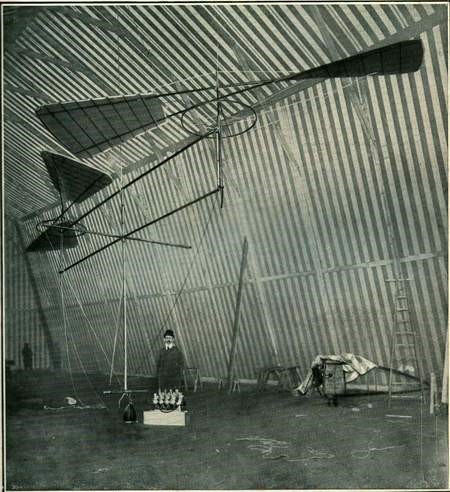
This helicopter was built to perform the first “kilomètre en circuit fermé” 50,000 francs challenge of Deutsch and Archdeacon. The challenge was won by Farman two years later.
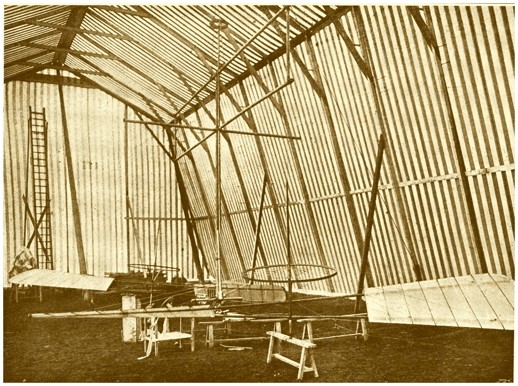
The Santos-Dumont No.12 was a bamboo framework hélicoptère designed and built during 1905/06 at Neuilly St. James. It had two rotors and a propeller, powered by a 24 hp Antoinette V-8.
The apparatus was abandoned soon after mechanical tests revealed inherent flaws in the transmission of power to the contra-rotating rotors.
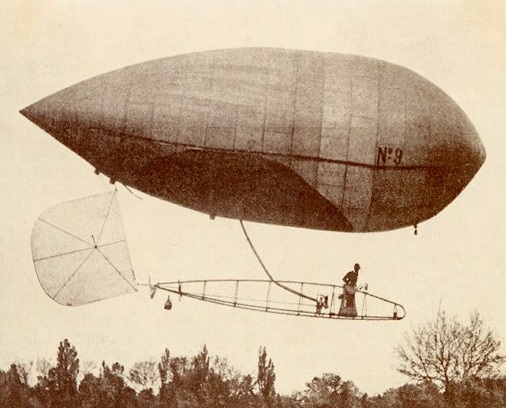
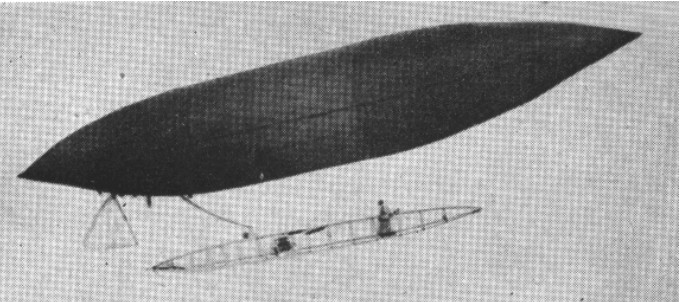
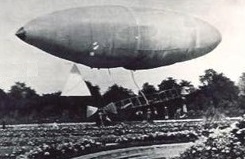
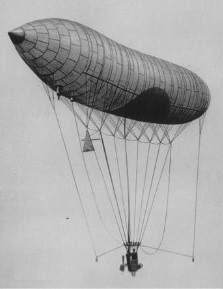
Santos built 14 airships in all, of which his diminutive No. 9 Baladeuse was the best-known and most successful. On this personal runabout he challenged a friend’s after-dinner remark that his dirigibles were no more than ‘scientific curiosities’ by flying right into the heart of Paris, landing in the Avenue des Champs-Elysées and mooring it on the railings of his house on the corner of Rue Washington while he went inside for coffee. Thereafter Parisians became quite blasé about the sight of No. 9 parked outside fashionable restaurants or in the grounds of the country houses of Santos’s many friends.
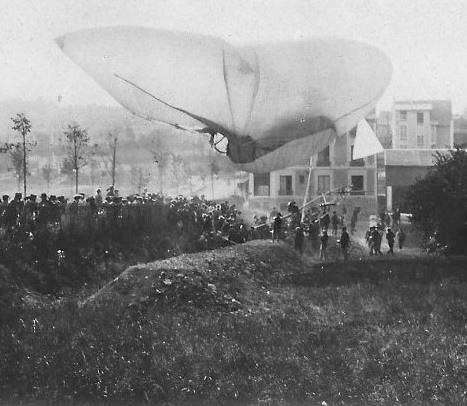
Alberto Santos-Dumont dirigible No.6 of 1898 was powered by a petrol motor of 12 hp. After some tethered trials on September 5th, 1901 Santos-Dumont made his first flight in the airship on 6 September. A series of mishaps ended with a hard landing which damaged the gondola. This accident, shown in the photo, took place at Gare des Coteaux in Saint-Cloud, west of central Paris and close to Santos-Dumont’s home base.
It was soon repaired and October 19th won the Deutsch de la Meurthe prize of 125,000 francs to the first machine capable of flying from the Aéro-Club de France’s flying field at Parc Saint-Cloud to the Eiffel Tower and back to the starting point; a distance of 7 miles, which he accomplished in thirty minutes. The ship had a length of 22 metres, a diameter of 6 metres and was powered by a Buchet four-cylinder inline water-cooled engine of 12 hp.
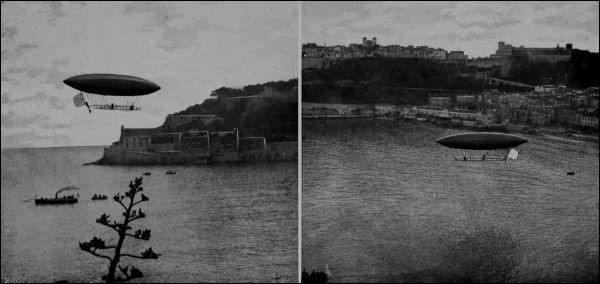
In the Bay of Monaco the Santos-Dumont’s No. 6 flight terminated with a fall into the sea, without injury to the operator
Santos embarked on an ambitious development programme after this modest triumph, and soon became a familiar sight puttering over the Paris suburb of Neuilly-Saint James on his latest dirigible. In the summer of 1901 he made two attempts to win a 125,000-franc prize offered by Henri Deutsche de la Meurthe for a flight from the parc d’aerostation at St Cloud to the Eiffel Tower and back, a distance of about 12 km (4 miles), in half an hour. The first began on 13 July. With a following wind Santos’s No. 5 dirigible was soon rounding the Eiffel Tower, but on his return trip the little airship could make no headway, the time limit elapsed and the engine stopped. Santos valved off hydrogen and settled into a large chestnut tree in the grounds of Edmund de Rothschild’s house. During his second attempt, on 8 August, Santos again circled the Eiffel Tower but was foiled on the way back, crashing noisily and explosively on to the roof of a hotel at Trocadéro. Shaken and singed he climbed through an attic window and was held by the manager on suspicion of cat burglary. Another dirigible was hastily constructed to replace the wrecked No. 5, and on 19 October 1901 Santos just succeeded in making the round trip within the specified 30 minutes. Typically philanthropic, he divided the prize between his workers and the Parisian poor, keeping not a centime for himself.
The first dirigible was 25 m (8½ ft) long and contained 180 cubic metres (6400 cubic feet) of hydrogen gas beneath which he suspended a 3½ hp petrol engine, called “Brazil”. On 18 September 1898 he took off from the jardin d’acclimatisation in the Bois de Boulogne and promptly ended up in a clump of trees. Know-all bystanders had advised him to take-off downwind. Two days later he was back, this time rising effortlessly into wind to complete a figure of eight 400 m (1300 ft) above an astonished, cheering crowd. ‘Le Petit Santos’ — for he weighed just 49 kg (108 lb) — was an instant hero.
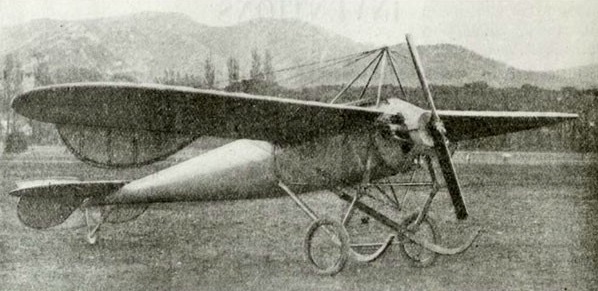
The Italian engineer M. Santo of Marseilles. France, designed this monoplane. Its streamlined circular cross section hull was made of wood covered with tarred fabric and was stated to be absolutely waterproof, allowing it to float indefinitely in the event of a fall to the sea. The fuselage of 7 meters length rested on a patented landing gear. The wing area was 16 square meters. The empennage of this aircraft was with two small surfaces on each side of the rear fuselage that provided lateral and longitudinal stability at the same time. Instead of being hinged, the surfaces rotated about an axis in the fuselage parallel with the direction of travel; they lowered or rose “like the wings of a bird”, depending on whether the pilot wants to descend or climb. They could also tilt to the right or left to restore the lateral balance, or to turn the device. It was intended for an 80 hp Anzani engine, but the photo shows a Dutheil & Chalmers engine giving only 18 hp.
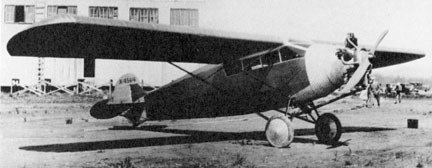
Designed by J O York and built by Santa Ana in 1928, the sole 1928 VM-1 three place semi-cantilever monoplane was registered NX4564 c/n J-1.
The production rights were bought from Santa Ana Aircraft Co by Grays Harbor Airways and the aircraft renamed Activian as a prototype, with possible modifactions for commercial use. Later it was repowered with a 100hp Kinner engine. The craft cost around $2,500.