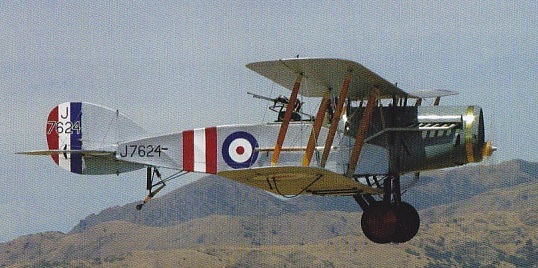
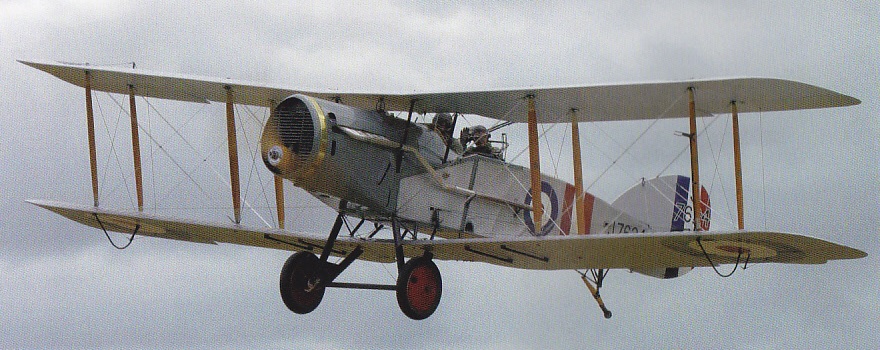
Ed and Pete Storo built a replica 1917 Bristol F.2B Fighter. The aircraft took seven years to build and was first registered in 1992 as N624.
The fuselage features chrome-molybdinium tubing and is based on an Australian replica. The wings, tail, undercarriage and other assemblies were all built from Bristol drawing and could be fitted to an original. The only accommodations to modern practicalities are the inclusion of brakes and a small tailwheel.
The replica is powered by a 200hp Ranger 440-5 engine which is installed in an upright position – which suits the propeller and cowl configuration of the F.2B.
The replica was first flown in 1993.
It was subsequently sold to TVAL in NZ in late 2001 for the Classics Fighters airshow and changed colour scheme.
After TVAL brought it to the Australian International Airshow at Avalon in February 2015, it remained in Australia and is now operated as part of the Australian Vintage Aviation Society (TAVAS) collection.
Registered ZK-PRK and carrying a ‘2’ behind the roundel it was operated by TVAL from 2001 to 2015, then to NZ Warbirds.
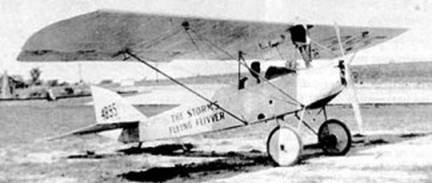
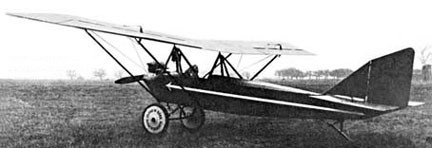
The 1928 Storms Aircraft Co Flying Flivver was a kit plane advertised in kit form, less motor, for $1135. Power was normally a 36hp Ford T engine, or optional 60hp Ford A. A parasol wing was $985.
Storms Flying Flivver
About seven were registered in the USA including; N4895, which a newspaper report had as crash-landing in 1928, piloted by A J Storm. N11917, appears in Texas registers as (Wyley J) Wood-Storms N882Y shows as Lee-Storms N627W N882Y N10212
One was constructed at Wesport, New Zealand in the 1930s. The aircraft kitset imported from the USA by Jack Kilkenny and partners was a Storms WhizBang. In April 1933 following assembly it was inspected by a member of the NZPAF and found to be built from substandard material. Nevertheless the group were not deterred and it was taken to Carters beach with intentions to fly it. However although one of the group had previously had two hours dual instruction, he and Kilkenny’s brother-in-law were unable to get it of the ground. A week or two later John Spencer Allan after additional dual flying tuition successfully flew the aircraft on several occasions however it crashed with Spencer Allan at the controls following engine failure and was badly damaged. Plans to rebuild the aircraft were shelved following a second visit from the PAF inspector who advised them of the consequences should they fly it again. In June 1970 John Spencer Allan was killed near Taupo in the crash of AESL Airtourer ZK-CXS. His passenger survived. By all accounts the WhizBang kit was a real “Heath Robinson” affair. The PAF inspector noted that the timber supplied for wings and fuselage was Sugar Pine, the aileron hinges were cheap cupboard hinges and the elevator and rudder hinges were fashioned from leather shoe tongues and tacked to the spars. The Westport aircraft was kit #7 and another kit is believed to have been imported by Mr Hildred, Te Aroha, New Zealand, but it seems probable construction of this aircraft was not completed
Eddie Campbell of Prineville, USA, had, in 1930, got hold of the plans for a homebuilt design called “The Storms Flying Flivver,” a tiny high-wing monoplane powered by a Ford Model A engine. The Model A engine was roughly the same size and weight as the Model T, but made twice as much power. And Eddie worked at a Ford dealership’s repair facility, so he had access to the equipment necessary to soup it up a bit. Ted was out of town for a week when Eddie finished his project, and not expected back for another four days. Eddie, already a fairly experienced glider pilot, grew impatient. Plus, it was his plane; he wanted to be the first to fly it. So, he pulled it out and fired it up and pointed it down the field. It would not take off. He tried it several times; at the proper speed, it simply would not leave the ground. Eddie looked it over, scratched his head, and decided the problem was that it was “nose heavy.” Getting his tools out, he took the wing loose and moved it a little bit forward. Then he climbed back in to try again. This time, the plane came off the ground, all right. It went straight into a steep climb, completely ignoring Eddie’s attempts to control it; stood on its tail, trying to hang from the prop, about 100 feet in the air; then stalled and pitched forward and slammed down into the ground, nose first, ending up in a tangled heap.
Flying Flivver Engine: 36hp Ford T Wingspan: 31’0″ Length: 20’6″ Useful load: 350 lb Max speed: 65 mph Cruise: 45 mph Stall: 20 mph Range: 135 mi Seats: 1
Flying Flivver Engine: 60hp Ford A Wingspan: 31’0″ Length: 20’6″ Max speed: 70 mph Cruise: 50 mph Stall: 20 mph Seats: 1
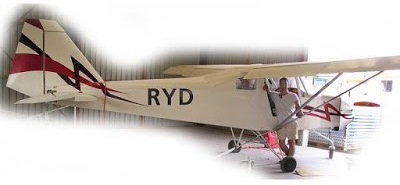
Rino Stoof of Cambridge, New Zealand, built his Stoof Joyrider in the late 1990s/early 2000s and got it to the stage of carrying out engine runs. Unfortunately it never made it into the air, but it was registered with CAA. The tri-gear Stoof Joyrider was of all-wooden construction and had removeable wings and tailplane. It had a wingspan of around 10 metres and a length of around 6 metres. It was powered by a 2 litre EJ 20 Subaru engine with a Hintz gearbox and was fitted with a Ballistic Recovery Parachute.
ZK-RYD (c/n 05/01) was registered to Rino P P Stoof of Cambridge on 14 April 2005. It was withdrawn and cancelled from the register on 8 May 2013.
In 1931 Edward R Stone of Wichita KS., USA, built the B-2 type of aircraft. It is known that it was registered N568Y and powered by a Packard diesel engine.
The ‘Hybrid’ was completed by C.B. Stone in 1936. The fuselage is part of a Heath Parasol built about three years prior. The landing gear and centre section were designed by Stone, and the radiator was from one bank of a Hisso engine.
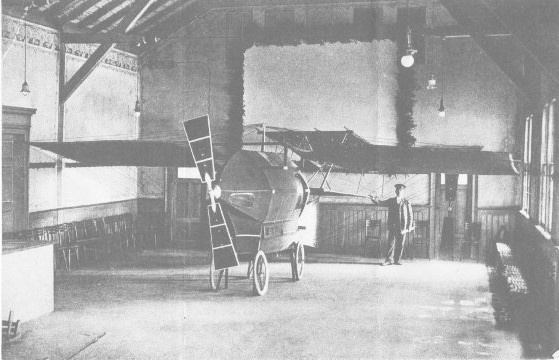
Franz Stolz built his design in 1909 in the German town Rastatt. Due to its form it was named the ‘Torpedo-Flugmaschine’ [Torpedo Flying machine]. To fund (further) construction the design of Stolz was exhibited against payment in the Carl Franz Halle, but this financial help was not enough. Stolz had to auction his machine in December 1909 and the machine never did fly.
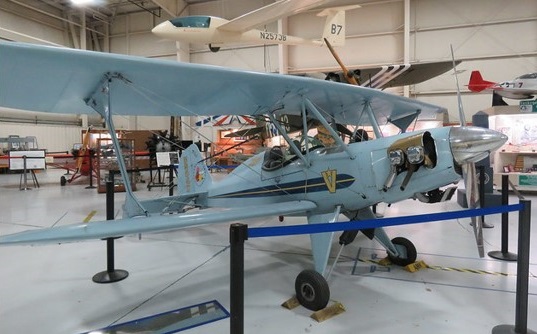
Designed by Lou Stolp as a low-cost, low-horsepower, fun machine, it is inexpensive, easy to build, and very easy to fly. Basically a biplane version of the parasol-winged Starlet. First flown in 1981, the light wing loading insures a slow landing speed and short takeoff. Stability is excellent and ample control surfaces give rapid response to light control pressures.
The structure is stressed to withstand both plus and minus 9 G’s, and horsepower may vary from 60 to 125. With the 65 HP Continental, the rate of climb is about 600 fpm, cruise speed is 75 mph, stall speed is 35 mph. This aircraft also flies well with a Rotax, Subaru, Suzuki, or Lycoming engine.
The fuselage is constructed of welded steel tubing, and the wings have spruce spars and plywood ribs with 1/4″ cap strips. Raw material kits as well as kits with the tubing cut to length and scribed for fitting are available. Wing Kits may be bought with finished spars, spar plates, ribs cut out, and fittings cut to size.
Engine 100-hp Con¬tinental. Gross Wt. 1000 lb Empty Wt. 650 lb Fuel capacity 20 USG Wingspan 23’ Length 17’2” Wing area: 141 sq.ft Top speed 150 mph Cruise 90 mph Stall 35 mph Climb rate 1800 fpm Takeoff run (50’) 300 ft Landing run (50’) 500 ft Range 350 miles Seats: 1
Engine: 65 hp Speed max: 90 mph Cruise: 75 mph Range: 275 sm Stall: 40 mph ROC: 600 fpm Take-off dist: 400 ft Landing dist: 600 ft HP range: 65-150 Fuel cap: 15 USG Weight empty: 700 lbs Gross: 1000 lbs Height: 7.4 ft Length: 17.1 ft Wing span: 23 ft Wing area: 141 sq.ft Seats: 1 Landing gear: tail wheel