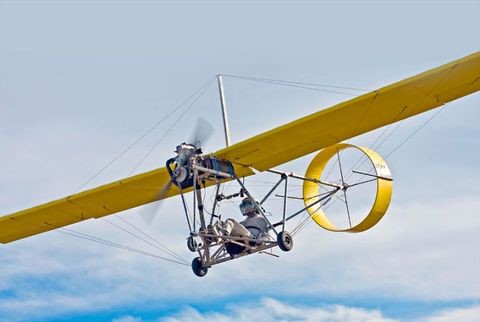
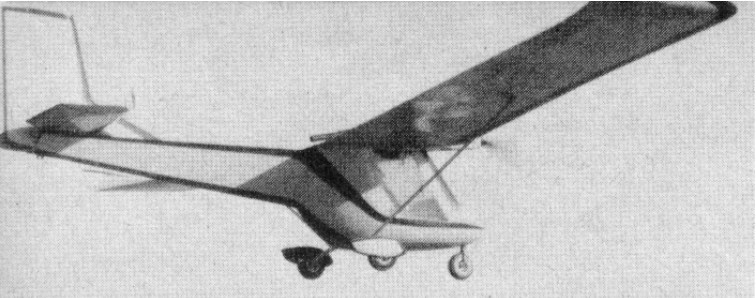
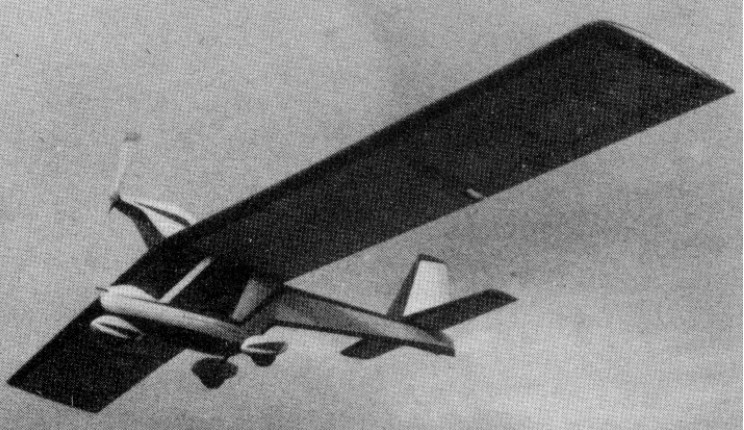
The prototype Lone Ranger made its first flight on the 23 October 1980. It is a development of the Super Flac with which it shares the integral cockpit, but unlike its predecessors, the Lone Ranger has a triangular section spar carrying a conventional tailplane and its wing is fitted with ailerons. Sold in kit form, one requiring 150 h for assembly (fast flight kit) and the other less elaborate (economy kit), the Lone Ranger was tried with various engines and in 1982 was offered with Yamaha KT100S 15 hp, Zenoah G25B 20 hp, or Cuyuna 215R 20 hp engines.
Striplin Lone Ranger Article
In a dramatic development at Sun’n’Fun in March 1983 at Lakeland, Florida, the company announced that it was renamed Ranger Aviation and released literature on a single seater named the Silver Cloud. Differing from the earlier Lone Ranger, the principal modifications involve the wing, which benefits from a new high lift profile, wind tunnel and flight tested, and which exhibits a coefficient of lift of 1.9. As well, the rectangular planform wing (without leading edge sweepback) of the Lone Ranger has been dropped for a tapered wing having 7 deg of leading edge sweepback.
The Lone Ranger shown at Sun ‘n’ Fun in 1983 had already abandoned the two V struts under each wing in favour of a single strut, which according to the previews will disappear altogether on the Silver Cloud to give a cantilever wing, an arrangement which was purely optional for the earlier models. Another modification is that the ailerons are not tacked on to the trailing edge but are integral within the wing profile and run full span, using the same new profile as the wing.
They are usable not only as ailerons but also together as flaps, coming down to 30 deg, and are quoted as giving a coefficient of lift of more than 2.4, which lowers the stalling speed to 25 mph (40 kph). Finally, the preview plans showed that the monobloc elevator of the new model is now carried midway down the tail cone instead of being level with its top surface.
The Silver Cloud is not only different in terms of design; it also represents a change of marketing policy, as it will be sold complete rather than in kit form one of the first composite construction ultralights to be produced in quantity. Ready to fly it costs around $10,000, exact price depending on specification. Options include wheel fairings for all three wheels for $100, larger diameter wheels (16 inch, 40 cm) $105, skis $150, floats $750, removable side windows $100, instrument panel, radio, shoulder harness $22, ballistic deployment parachute $850. Three engine types are offered: the Zenoah G25B with 22 hp, a Rotax whose type is not quoted giving 20 hp, and the Cuyuna 215R.
Single seat single engined high wing monoplane with conventional three axis control. Wing has swept back leading and trailing edges, and tapering chord; conventional tall. Pitch control by fully flying tail; yaw control by fin mounted rudder; roll control by full span ailerons; control inputs through stick for pitch/roll and pedals for yaw. Cantilever wing; wing profile; double surface. Undercarriage has three wheels in tricycle formation; suspension on all wheels. Push right go right nosewheel steering connected to yaw control.
Composite construction fuselage partially enclosed (totally enclosed optional). Engine mounted above wing driving tractor propeller. Construction uses carbon fibre, Keylar, fibreglass, various foams and epoxy resin; steel and aluminium fittings.
First year built 1980. Units delivered by June 1981 150.
The Sky Ranger Silver Cloud is a two-place version of Lone Ranger SC. The Silver Cloud II was basically the same as the Silver Cloud except being a side by side two seater. glass fibre on main wheels. Fuselage totally enclosed. As with the single seater, the reshuffle at Striplin reflects directly on this product. Previously called Sky Ranger, the company’s two seater is now called Silver Cloud II and is classified in the US as an experimental aircraft, requiring a pilot’s licence.
The prototype Sky Ranger, developed by Keith Striplin from the Lone Ranger, was on static display in August 1981 at Oshkosh and differs principally from its successor by having Fowler flaps and a T tail. The latter was dropped in 1982 for a conventional tail which is retained for the Silver Cloud II.
At Sun ‘n’ Fun in March 1983 Ken had on show the first prototype of the Sky Ranger, but this aircraft is being used as a flying test bed and has changed greatly since its debut in 1981. It sported not only a conventional tail but also a new wing with flaperons (ailerons usable as flaps) and the new profile destined for the Silver Cloud IL The two V struts carrying each wing had been replaced by single struts, although production models will be cantilevered. The landing gear had also been redesigned to give greater ground clearance.
Originally the Sky Ranger prototype used an engine mounted above the cabin and driving two twin blade propellers mounted on the leading edges, but at Sun ‘n’ Fun a similar motor was used to drive a single tractor propeller. An engine mount shaped like a fairing allows this propeller to operate in front of the fuselage nose, the engine intended for the standard Silver Cloud II being the Rotax 503.
The aircraft was sold ready to fly for $15,000 in 1983 in the standard version, which includes wheel fairings, removable side windows, shoulder harness, instrument panel and strobe. Otherwise, the options are as for the single seater.
Lone Ranger
Engine: Yamaha 100cc, 12 or 20 hp
Static thrust, 70 lbs or 110 lbs
Wingspan, 32 ft
Wing area, 144 sq.ft
Aspect ratio, 7:1
Overall length, 15 ft 8 in
Empty weight 196 lbs
Usable payload (include fuel), 240 lbs
Wing loading, 31 lbs/sq.ft
L/D power-off glide ratio, 17:1
Cruise speed (85% power), 61 mph
Stall speed, 21 mph
Approach speed, 40 mph
Flair speed, 29 mph
Liftoff speed, 27 mph
Takeoff roll distance, 225 ft
Rate of climb, 250 fpm
Fuel capacity, 5 Usgal
Range at cruise, 350 mi
Max pilot wt: 230 lbs
First year built: 1980
Lone Ranger Silver Cloud
Engine: Cuyuna 215R, 20 hp at 5500 rpm
Propeller diameter and pitch 54 x 27 inch, 1.37 x 0.68 m
Planetary gear reduction, ratio 2.2/1
Power per unit area 0.17 hp/sq.ft, 1.8hp/sq.m
Fuel capacity 5.0 US gal, 4.2 Imp gal, 18.9 litre
Length overall 16.0 ft, 4.87 m
Height overall 7.0ft, 2.13m
Wing span 32.0ft, 9.75m
Chord at root 4.0ft, 1.22m
Chord at tip 3.0ft, 0.91m
Dihedral 5 deg
Sweepback 7 deg
Total wing area 120 sq.ft, 11.14 sq.m
Wing aspect ratio 8.6/1
Wheel track 4.0 ft, 1.22 m
Wheel¬base 4.0 ft, 1.22 m
Nosewheel diameter over¬all 8 inch, 20 cm
Main wheels diameter overall 8 inch, 20cm
Empty weight 245 lb, 111kg
Max take off weight 500 lb, 227kg
Payload 255 lb, 116kg
Max wing loading 4.18 lb/sq.ft, 20.4kg/sq.m
Max power loading 25.0 lb/hp, 11.3kg/hp
Load factors +6.0, 4.0 design
Max level speed 63 mph, 101 kph
Never exceed speed 80 mph, 129 kph
Stalling speed 25 mph, 40 kph
Max climb rate at sea level 600 ft/min, 3.1 m/s
Best glide ratio with power off 14/1
Take off distance 75ft, 23m
Landing dis¬tance 75ft, 23m
Range at average cruising speed 210 mile, 338 km
Silver Cloud II
Engine: Rotax 503, 46hp at 6500rpm
Propeller diameter and pitch 60 x 36 inch, 1.52 x 0.91 m
Power per unit area 0.36hp/sq.ft, 3.9hp/sq.m
Fuel capacity 10.0 US gal, 8.3 Imp gal, 37.8 litre
Length overall 16. 0 ft, 4.87 m
Height overall 8.0ft, 2.44m
Wing span 33.4ft, 10.18m
Mean chord 3.8ft, 1.16m
Dihedral 5 deg
Sweepback 7 deg
Total wing area 127sq.ft, 11.8sq.m
Wing aspect ratio 8.6/1
Nosewheel diameter overall 8 inch, 20 cm
Main wheels diameter overall 8 inch, 20cm
Empty weight 350 lb, 159kg
Max take off weight 1000 lb, 453 kg
Payload 650 lb, 295 kg
Max wing loading 7.87 lb/sq.ft, 38.4 kg/sq.m
Max power loading 21.7 lb/hp, 38.6 kg/hp
Never exceed speed 100mph, 161kph
Max cruising speed 80mph, 129kph
Stalling speed 29mph, 47 kph
Max climb rate at sea level 600 ft/min, 3.1 m/s
Best glide ratio with power off 13/1
Take off distance 150ft, 23m
Range at average cruising speed 250 mile, 402 km