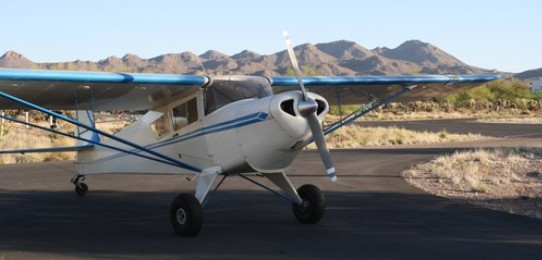
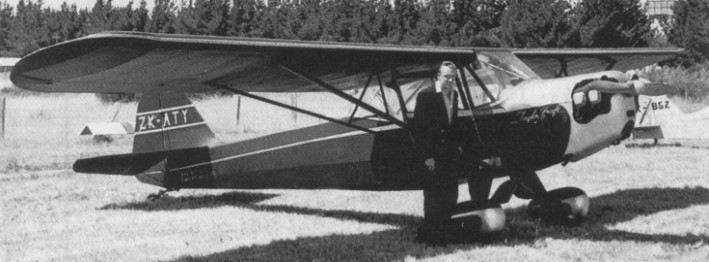
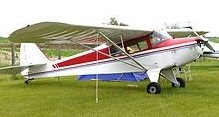
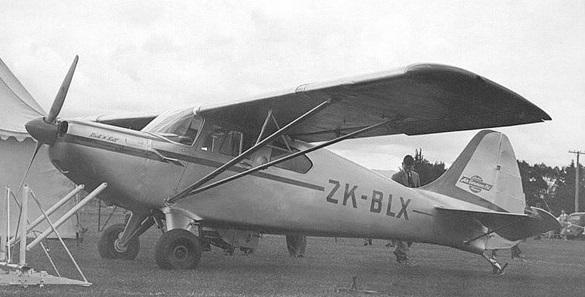
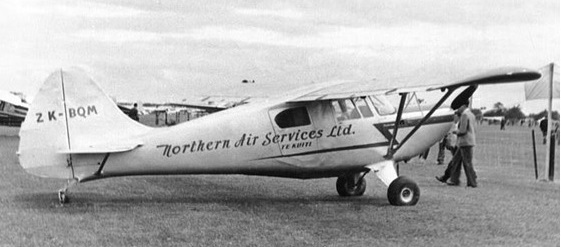
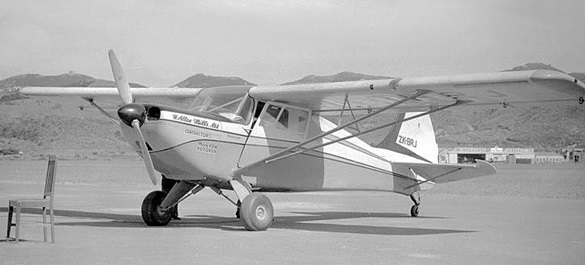
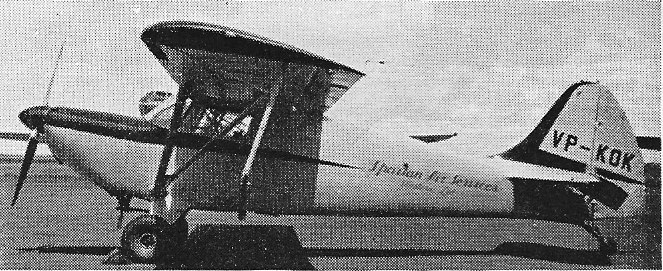
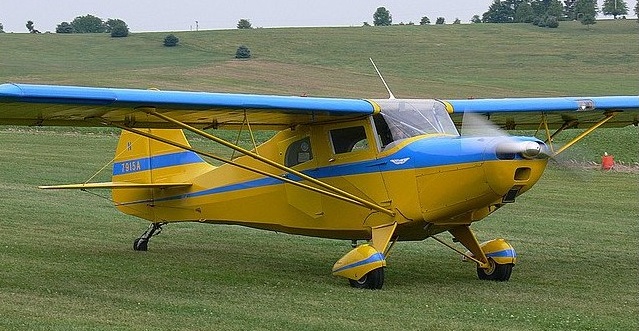
With origins in the Taylorcraft Model B of the early 1940s, the F-19 and F-20 are revived and improved versions of the Models 19 and 20. Three models of the F-19 Sportsman were offered as Standard, Custom, and Deluxe. There was a modernisation after Continental suspended production of the O-200 engine.
A higher-powered version, the F-21 two-seat sporting trainer, was designed with aluminium ‘T’-beam wing spars and a new fuel system. This in turn has given way to the F-22.
The F-21B has been certificated in Australia, and the manufacturer hoped that this would generate sufficient interest for the production line to start up again. The price for a standard, equipped aircraft had risen to $33,000, which Taylorcraft says reflected higher engine costs, which are “going out of sight”.
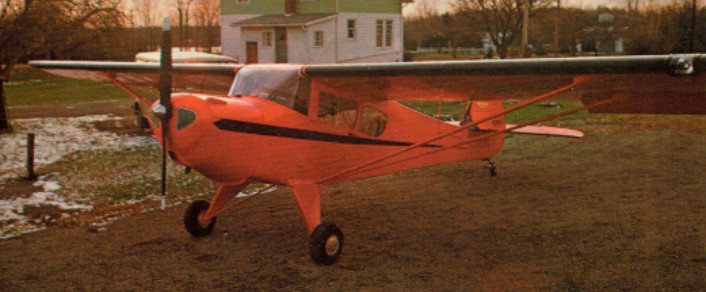
The 1979 T Craft was the F model. With 100 horsepower, it weighs 900 pounds and it can lift another 600 pounds. The T Craft tops out at 110 knots, it stalls at 37, and it departs or returns to Earth fully loaded over a 50 foot obstacle in 375 feet. It will cruise 350 miles while sipping six gallons an hour.
The F-19 was built until 1980.
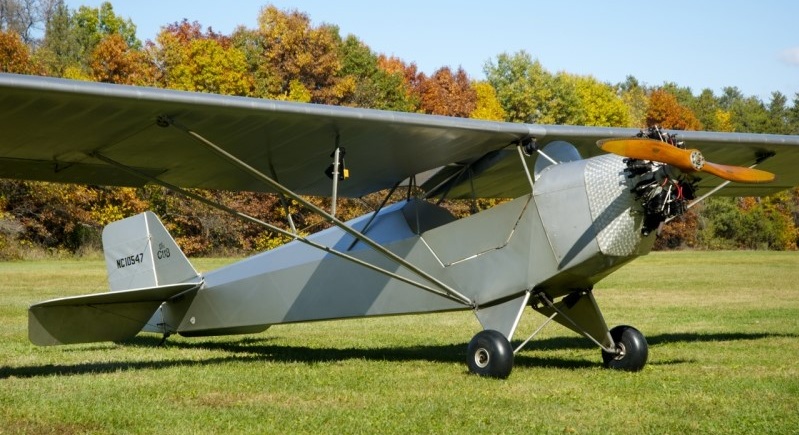
1975 model Taylorcraft F-19
Built in 1979 at the plant in Alliance, Ohio, wrapped in Dacron and painted, each T Craft is towed a couple of miles out to Barber Field for final assembly.
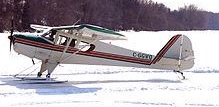
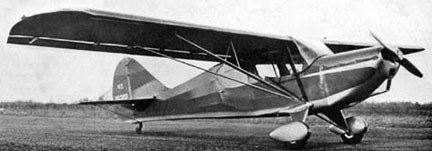
The F-21 was first built in 1980.
1980 Taylorcraft F-21
Taylorcraft production includes 100 prewar Model As, 1800 military L-2s, more than 2800 post-war BC-12Ds, and more than 120 F-19 Sportsmans.
19 Sportsman Engine: 1 × Continental C-85, 85 hp (63 kW) Prop: 2-bladed metal Wingspan: 36’0″ Length: 22’0″ Empty weight: 860 lb (390 kg) Gross weight: 1,500 lb (680 kg) Fuel capacity: 18 U.S. gallons (68 L; 15 imp gal) Maximum speed: 120 mph (193 km/h; 104 kn) Cruise speed: 110 mph (96 kn; 177 km/h) Stall speed: 38 mph (33 kn; 61 km/h) Range: 300 mi (261 nmi; 483 km) Service ceiling: 17,000 ft (5,182 m) Rate of climb: 700 ft/min (3.6 m/s) Crew: one Capacity: one passenger
F-19 Engine: 1 x Continental O-200-A, 100 hp Seats: 2 Wing loading: 8.17 lb/sq.ft Pwr loading: 15 lb/hp Gross wt: 1500 lb Empty wt: 870 lb Equipped useful load: 585 lb Payload max fuel: 441 lb Range max fuel/75% pwr: 401nm/3.9hr Service ceiling: 18,000 ft 75% cruise: 100 kt 55% cruise: 78 kt Stall: 37 kt 1.3 Vso: 49 kt ROC: 775 fpm Min field length: 400 ft Fuel cap: 144 lb
The 1941 DC and DF models (ATC 746) were tandem-seat trainers, priced at $1,685-1,995.
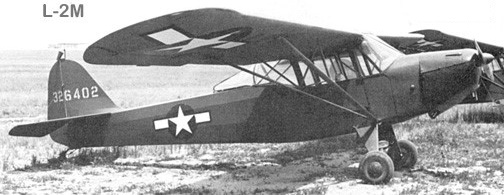
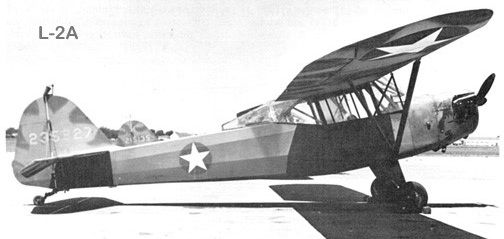
The 1941 Taylor DL (ATC 746) production totalled 2,348 D models, of which 2,119 DC and DL models went to the USAAF as L-2 and O-57. The L-2A with open cowling, L-2M with closed cowling, and observation as O-57.
L-2M 43-26402
The Auster Mk.I design originated with a pre-war American light cabin monoplane of 1938 built in England under licence. Successful trials with impressed civilian Taylorcraft Plus D aircraft by the Army for artillery spotting duties led to the introduction of the first fully militarised Taylorcraft, the unarmed two-seat Auster I.
L-2A 42-35927
In England, Taylocraft Ltd built 822 D models as Auster AOP-1 Mk III (130hp Cirrus Major) and IV/V (125hp Lycoming O-290).
Taylor D Engine: Lycoming O-145, 65hp Seats: 2
DC Engine: Continental A-65, 65hp Wingspan: 35’5″ Length: 22’9″ Useful load: 480 lb Max speed: 102 mph Cruise speed: 92 mph Stall: 35 mph Range: 270 mi Seats: 2
Developed from the Taylorcraft Model A, the side-by-side two-place, single-engine, Model B was constructed in large numbers during the late 1930s and early 1940s and was available for delivery from the factory as a land plane and a floatplane. Like many light aircraft of its day, the fuselage is constructed of welded steel tubing and covered with doped aircraft fabric. The wings are braced using steel-tube struts.
The Model B was mainly bought by private pilot owners. Large numbers were flown in the United States, and many were sold to owners in Canada and several overseas countries, including those in Europe.
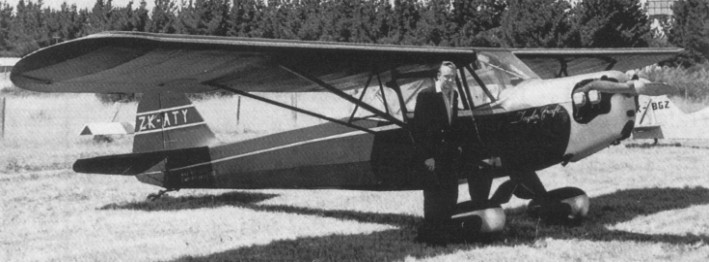
The BF (ATC 699) of 1938 sold for $1,549 and had an optional fully-cowled 65hp Franklin 4AC giving a slight increase in performance. The BF-12-65 added an elevator trim tab.
The Model B production was restored post-WW2 as the BC-12. Almost 4500 were built before replaced by the Model 19.
Taylorcraft BF-12-65
Many were still active in 2015.
The wing’s airfoil, rather than being the flat bottom Clark “Y” or USA 35 everyone else was using, was a semi-symmetrical 23000 series known for low drag and less gentle stall characteristics. For a wing that long to be that fast, it had to have a low-drag airfoil.
The pre-war airplanes used 1025 steel tube or a combination of 1025 and 4130. Postwar airplanes are all 4130. The wings use pressed-aluminium ribs over wooden spars. Most Taylorcrafts use Shinn brakes which are mechanical shoe types with the lining on the drums, not the shoes.
In 1939 and 1940, Taylorcraft built the BL-50 (with optional 65hp A-65), BC-65 and the BF-60. All three models were the same airframe with a Continental, Lycoming, or Franklin engine. The number in the model designation indicated the engine horsepower. The 1938 BL was ATC 700 and sold for $1,549-1,595.
The BC (ATC 696) sold for $1,495-1,565. Seating was side-by-side. A total of 2,401 of the B models were produced of which a large number went to Army and the USAAF as L-2, O-57, and TG-6 glider. One went to Great Britain for evaluation of production. 132 were built under license by Taylorcraft Aeroplanes Ltd in 1939-41 as C (with O-145) and Plus-D (90hp Cirrus Minor). The first military use of a personal lightplane was 18 civil models impressed into RAF as C/2.
A total of 4314 of the 1941 BL-12 Deluxe model with the 65hp Lycoming O-145 engine were sold, including export deliveries. The BLS-50 was powered with a 60hp 4AC-17 engine.
In England, from 1953 to 1968, Taylorcraft Ltd produced 798 B models as civil Auster Autocrat and military Auster VI, plus 1,150 other models, until the end of production in 1968.
Postwar versions were reintroduced in 1946 as BC-12-D Standard and Deluxe Traveller (ATC 696) with 65-85hp Continentals. Last production version, as F-22 by Taylorcraft-Ruckle of Lock Haven PA, had a list price of $34,110 in 1991.
As World War II broke out, all production of civilian airplanes ceased at the Taylorcraft Corporation. Taylorcraft submitted a tandem seat design for the U.S. Army Air Corps evaluation and the airplane was accepted and designated the L-2 liaison aircraft. Some 1800 were produced throughout the war.
L2A
The BC-12D retained the popular Continental A-65-8A engine. It had side-by-side seating and an enclosed engine cowling.
Taylorcraft production includes 100 prewar Model As, 1800 military L-2s, more than 2800 post-war BC-12Ds, and more than 120 F-19 Sportsmans.
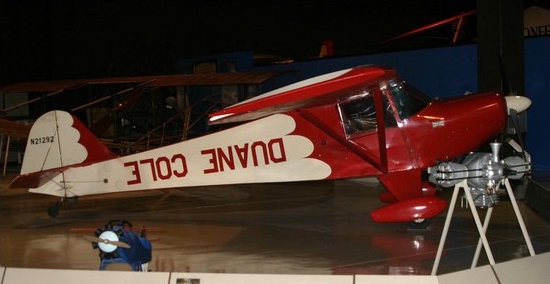
Duane Cole’s Taylorcraft, a BF-50, was built in 1938, the same year Cole earned his Private Pilot license. In 1950, it was acquired by John Vasey, a well-known aerobatic pilot and air show performer. Vasey shortened (“clipped”) the wingspan from 36 feet to 28 feet, 10 inches, and strengthened the wings. That gave the airplane more speed and a faster roll rate. Vasey also moved the pilot’s seat and control seat to the center of the cabin, making the two-seat BF-50 into a single-seat airplane, and shifting the airplane’s center of gravity. Finally, he replaced the original Franklin 50-horsepower engine with an 85 hp fuel-injected engine. His modifications turned the docile BF-50 into a powerful and agile aerobatic performer.
Taylorcraft BF, N21292
Duane Cole bought N21292 from Vasey in 1952. Thus began one of the longest running aerobatic “partnerships” in history. Duane Cole and his signature red and cream Taylorcraft entertained millions of air show spectators in 47 states and five foreign countries. Cole installed a new 150-horsepower engine on the plane, but otherwise left the basic structure and Vasey’s modifications unchanged. He had little use for radios or instrument flying, and flew all over the US using pilotage and dead reckoning skills.
In 1962 and 1964, Cole flew the Taylorcraft to win the US National Aerobatic Championship and was named in 1962 to the US aerobatic team to compete for the international title in Budapest, Hungary.
BC / BC-50 1938 – Based on the Model A with a 50 hp Continental A-50-1 engine and modified wing construction, also known as the BC-50 Wingspan: 36’0″ Length: 22’0″ Useful load: 468 lb Max speed: 97 mph Cruise speed: 88 mph Stall: 35 mph Range: 275 mi Seats: 2
BCS 1939 – Seaplane variant of the BC
BC-65 1939 – Model BC with a 65 hp Continental A-65-1 engine Wingspan: 36’0″ Length: 22’0″ Useful load: 510 Max speed: 105 mph Cruise speed: 95 mph Stall: 38 mph Range: 250 mi Seats: 2
BCS-65 1939 – Seaplane variant of the BC-65.
BC-12-65 / L-2H 1941 – As BC-65 except for minor structural changes and added elevator trim tab and a Continental A-65-7 engine.
BC-12D Twosome 1945 – Postwar production version of the BC-12-65 with a Continental A-65-8 engine with alternate tail surface, alternate one piece window and other minor changes.
BCS-12D 1946 – Seaplane variant of the BC-12D
BC-12D1 1946 – As the BC-12-D with left hand door, parking brake and right-hand wing tank removed
BCS-12-D1 1946 – Seaplane variant of the BC-12D1
BC-12D-85 Sportsman 1948 – A BC-12D fitted with a 85 hp Continental C85-8F engine and increased power and gross weight.
BCS-12D-85 1948 – Seaplane variant of the BC-12D1.
BC-12D-4-85 1949 – A BC-12D-85 fitted with an extra rear side window and a Continental C85-12F engine.
BCS-12D-4-85 1949 – Seaplane variant of the BC-12D-4-85.
The Taylorcraft 20 Ranch Wagon, later dubbed the Zephyr 400, covered with Fiberglas that was intended to be the best seller. The use of Fiberglas shells over the steel fuselage was considered a technological breakthrough, and Taylorcraft dubbed it “The bulletproof vest with wings.” In all, there was nearly 40 Model 20s made.
Each one was made on demand, and therefore, each was slightly different. Some of those differences would appear around the windows or doors or other nonstructural areas, former Taylorcraft engineer Jack Gilberti said. A fourth door was optional with the 15A and 20.
The model 20 was based on the 15A, but was different in three ways: It had a 225-horsepower Continental O-470 engine and the maximum gross weight jumped from 2,200 pounds to 2,750 pounds. It also had Fiberglas wing skins, gas tanks, and seats, and was among the first airplanes ever to make such extensive use of Fiberglas.
They needed something to stimulate sales, Gilberti said, and thought up the Fiberglas idea. He said it was the first use of Fiberglas covering on an aircraft. The company sought help from a man across town who made Fiberglas boats. Workers took the bare steel-tube frame, wrapped it with chicken wire, and slathered it with plaster of paris to make a mold for the Fiberglas. The aircraft was then touted in Taylorcraft ads in 1956 as the “new Fiberglas Taylorcraft, the most advanced design for safer flying.” During demonstrations journalists were invited to hit the airplane with a hammer to demonstrate the aircraft’s toughness, and it was no lie. Photos of two Model 20s that crashed in wooded areas show the fuselage intact; the passengers were unharmed. “It was a tank,” Gilberti said.
The model 20 repowered Ag Topper built at Collinsville around 1951 were specialised versions of the model 15 as crop sprayers. TC 3A3 was issued on 12 May 1955 for 208hp Continental O-470-A and 225hp O-470-J engines.
One Taylorcraft BC-12D, N6678N, was modified in 1950 for an unsuccessful military evaluation. It featured a flapped and slotted wing, and greenhouse cabin.
In the late 1940s and the early 1950s the people at Taylorcraft wanted to better cash in on the coming boom in general aviation. The boom never happened, but its promise generated a Taylorcraft big enough for the whole family.
The idea of a four-place aircraft began in 1945 as the war ended. A prototype was built at that time, but it never got out of the development stage. According to the book, The Taylorcraft Story by Chet Peek, the prototype began as a tube-and-fabric aircraft at the Taylorcraft plant in Alliance, Ohio, and was dubbed the Tourist. development stopped with the bankruptcy of the company.
Taylorcraft 15 prototype NX36320
When the Taylorcraft company was bought by Ben Mauro and moved to Conway, Pennsylvania, the model went with him but wasn’t developed further until 1949. Prototype NX36320] had a 125hp Franklin and the Model 15A, which retained the Tourist moniker, was intended to have a 125-horsepower Franklin engine. First flying on 1 December 1944, concerns that Franklin might go out of business caused a switch to 145-horsepower Continental C-145 engine.
The 15A features three large doors – a fourth was optional – slotted wing tips to improve aileron effectiveness at slow airspeeds, and the same door handles used for Nash automobiles.
It has a wing with wooden spars and stamped-aluminum ribs. C.G. Taylor, the founder and former owner, was working with Mauro as a vice president when he was asked to take weight out of the airplane; he took 150 pounds out but he never touched the wings. For stress testing during the wing’s design, it was hung from the roof of the factory and loaded with increasing weight over the course of an afternoon. Mauro got bored waiting for it to break and went back to his office. Finally the workers heard a crack and thought the wing had failed, but it hadn’t: The roof beam of the factory had cracked from the weight of the still-intact and heavily loaded wing.
Preflight includes draining two tank sumps and the gascolator. The tanks are covered by fabric. Features include side window panels that slide up and down and an overhead trim control. The preflight also includes the gas caps. Because they use forward-facing vent tubes, care must be taken not to install them backward, which can result in siphoning out gas in flight.
The interior is tight enough that you must fly with someone you like, but it is not uncomfortable. Steel tubes of the airframe limit foot space. Original avionics included Narco tube radios (an outside vent channeled air to cool the tubes).
Takeoff requires a 10-degree flap setting using a mechanical lever on the floor. (Takeoff with two people aboard took less than the advertised 500 feet). True airspeed measured at typical cruise power setting of 2,350 rpm was 85 knots (98 mph. Stalls with power on dropped the right wing.
Production began in 1947 at Conway, and later (c.1950) Collinsville. ATC 3A3 was first issued on April 3, 1951 for the 15-A with Franklin 6A4-150-B31 or 145hp Continental C-145-2 engines. Selling for $4,500 a total of 31 were built.
The original four-place 1953 demonstrator Taylorcraft 15A, N6653N, first went to a flight school in Texas where it was used for rides. Then it went to Alaska where in the 1950s and 1960s a church flew supplies to remote settlements until a shortage of parts led to dereliction. The aircraft sat in the weeds at Fairbanks International Airport in the 1970s until it left Alaska on a truck with the promise of restoration in Florida.
The restoration never happened, but two pilots in Alliance stepped in, restored it, then sold it to finance their North American T-6 restoration. Roe bought it in 1992 for $24,000 and brought it to Culpeper, Virginia. By 2010 it was owned by Robert Peterson of Mahaffey, Pennsylvania. It features a Lear Omnimatic navigation radio developed by Bill Lear, father of the Learjet.
Roe said. “I can use short fields – it probably made a heck of a bush plane in Alaska. If only it were a little faster.” He flight-plans for 105 mph and burns 8.5 gallons per hour; usable fuel totals 40 gallons. Roe uses 80 mph in the pattern, 70 on final, 60 over the numbers, and finds that touchdown occurs at 45 to 50 mph. The only modification he made was to add Fiberglas wing tips.
The Taylorcraft 16 of 1946 was an all-metal model 15 of which only one was built.
Taylorcraft 15-A Foursome Engine: Franklin 6A4-150-B31, 150hp Wingspan: 36’3″ Length: 24’0″ Useful load: 925 lb Max speed: 125 mph Cruise speed: 112 mph Stall: 38 mph Range: 450 mi Seats: 4 TC 3A3 / ATC 775
The 1959 Model 500 that was tested briefly before being canceled.
Mike Rodina of Hampshire, Illinois, has the only Taylorcraft 500 on the registry. Basically a Model 20, it had a fifth seat mounted at an angle in the cargo compartment. The rear seats tilted forward to allow access, but after brief experimentation the idea was dropped. The 500 was also to have a nosewheel and disk brakes. It got the brakes, but the nosewheel modification was never attempted.
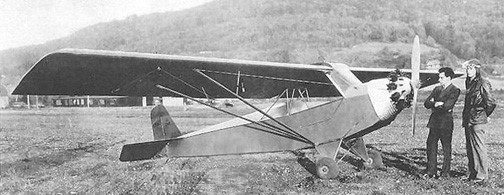
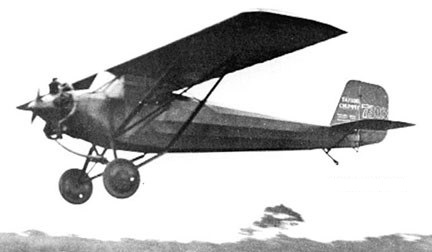
Taylor E-2 Prototype NC10547 with C G Taylor and company pilot Bud Havens
Taylor first built a glider that looked like a small Breezy and the E 2 Cub evolved from towing that glider behind a car up and down the Bradford runway.
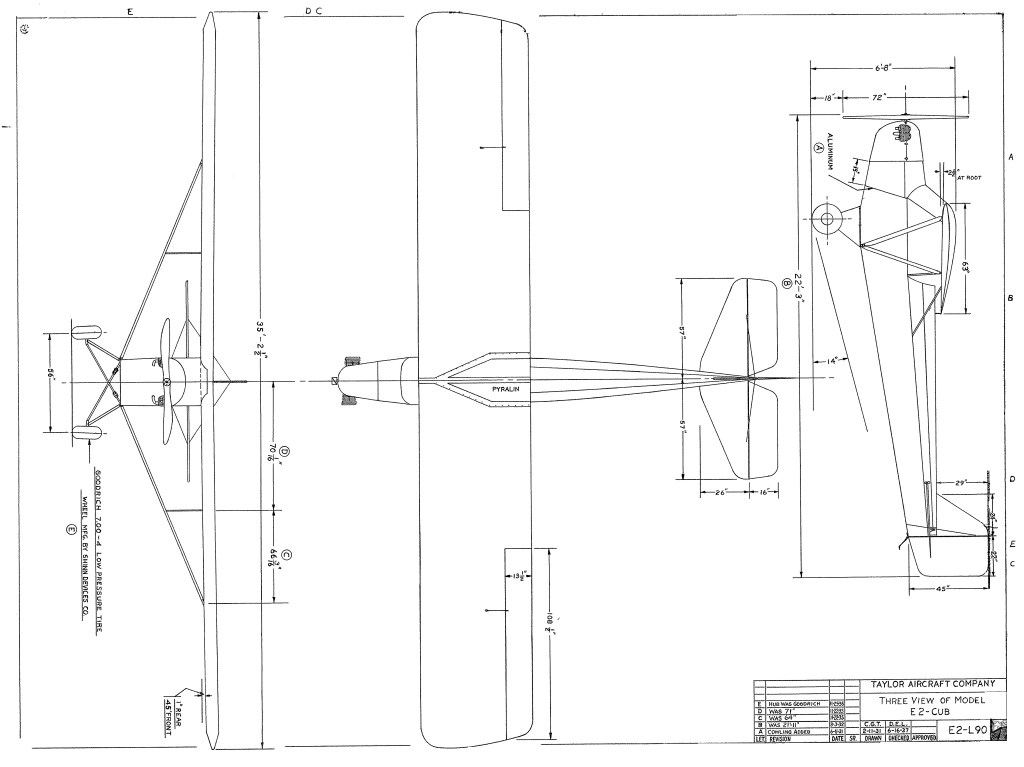
Designed by C. Gilbert Taylor in 1930 and produced as the Taylor E 2 Cub in 1931, much of the inspiration and many of the design goals for the airplane came from W.T. Piper, Sr. Taylor selected the U.S.A. 35B airfoil for the Cub. This airfoil had a reputation for providing favorable flying qualities at low speeds; all subsequent Cubs. The E 2 was open air except for a windshield and had squared off wingtips and tail surfaces. The tandem cockpit of the E 2 was without side windows, but a young man named Waiter Jamouneau, subsequently chief engineer and now a vice president at Piper, designed optional sliding side windows and a door arrangement that remain features of the Super Cub.
Reliable lightplane engines were virtually nonexistent when the E 2 was designed. For the first E 2, Taylor found a two cylinder engine of 20 horsepower. It was known as the Brownbach Tiger Kitten, and the name reportedly inspired the E 2 to be called the Cub. The plane handled fine on its first flight (in September 1930) but on 20 hp didn’t get too high five feet, actually The new Taylor E-2, now known as the “Cub,” was meant to be an affordable aircraft that would encourage interest in aviation and was awarded its type certificate on July 11, 1931 and licensed by the U.S. Department of Commerce for manufacture.
Twenty-two Taylor E-2 Cubs were sold during 1931, retailing for $1,325; by 1935, sales had increased to more than 200 E-2 Cubs.
A 45 hp, nine-cylinder French Salmson AD-9 was tried: its performance was spectacular, but it was too expensive.
Continental provided the solution with the A 40, a “40 hp” flat four that actually produced 37 hp. The E 2 was certified with this engine on June 15, 1932 and was put on the market for $1,325, or $1,495 with optional 40hp Aeromarine AR-3 engine, or $895 less motor.
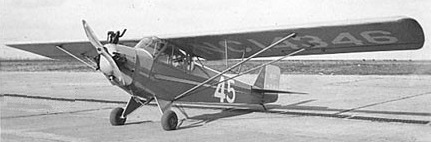
Taylor E-2 NC14346 with AR-3 engine
Unfortunately, the early Continentals were giving trouble, for the engine company was using the Cubs as test beds. One of Piper’s five children, Tony, said that he rarely got more than 20 miles per forced landing. Sales to people who wanted to fly longer between stops were, naturally, a little sluggish. There was a frustrating period before Continental improved the A 40 during which Taylor actually started designing his own engine.
Continental added dual ignition and cured the annoyances of blowing head gaskets and breaking crankshafts.
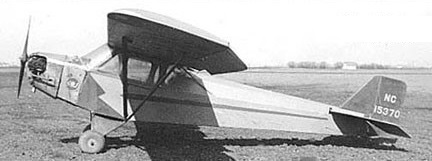
Taylor E-2 NC15370 with A-40 engine
The Prototype (s/n 11) was powered by a 20 hp Brownbach Tiger Kitten and was first flown on September 12, 1930. The E2 barely managed to leave the ground with the tiger kitten, however the engine left a legacy in that it prompted one of C.G. Taylor’s colleagues to remark that since the engine was called the Tiger Kitten the E2 should be called the cub. The engine was deemed too weak and a 40 hp French Salmson was tried and deemed too expensive. Ultimately the decision was made to try a brand new and untried 40 hp engine from continental. That engine was an air cooled flat four cylinder designated the A-40. An uncertified A-40 was fitted to s/n 12 which was completed on April 9, 1931. The engine had a number of teething problems and Taylor has been quoted as saying that in the first 30 days of flying with the A-40 the E2 had to make 26 forced landings. It was also discovered that the crankshaft’s tended to break at around 100 hours.
Continental eventually worked the bugs out and the A-40 received its certification on May 15, 1931 which cleared the way for the E2 aircraft certification on June 15, 1931. The E2 was originaly certified under group 2, no 2-358 which covered the first 14 aircraft. The remaining aircraft were certified under ATC A455 which was issued on November 7, 1931 (covering s/n 26 and up.) The aircraft originaly sold for $1325 and no options were offered. The fuel tank was moved from the wing as shown on s/n 12 to the fuselage where it was located between the panel and the firewall starting with s/n 13. A fully enclosed cockpit was introduced on February 9, 1932 and became standard starting with s/n 35 and up.
Sales reflected the improvements, and 351 E 2s were produced between 1931 and 1936.
E-2
In the midst of the depression Continental announced that they were getting out of the aircraft engine business (a decision they later changed.) As a result the Aeromarine AR3-40 (40 hp) was installed starting with s/n 75 (3 Jan 34). This new configuration was designated the F2 cub. The Aeromarine was not satisfactory and several further engines were tried (models G2 with a Taylor designed T-40 and the H2 with a 35 hp Szekely SR-3-35.) Eventually Continental updated to the A-40-3 and this engine was used for s/n 178 and up.
The company was always sensitive to customer desires, and in 1936, Taylor introduced a refined Cub in order to incorporate design improvements as well as suggestions from the field. A young man named Walter Jamouneau was given the job of improving the E 2 resulting in the Piper J 2. In 1937 a fire destroyed the plant, prompting the company to relocate to a defunct textile mill in a town called Lock Haven. In November of 1937, the relocated company changed its name and became the Piper Aircraft Corporation.
The 1934 Taylor F-2 Cub (ATC 525) featured and open-sided cabin with optional side panels. Selling for $1,470, about 30 were built.
The 1934 Taylor G-2 Cub was an F-2 with a 40hp Taylor T-50 experimental motor. Only the one was coverted, N14756, which was rebuilt as an H-2 Cub in 1935.
The 1935 Taylor H-2 Cub (ATC 572) featured an open-sided cabin with optional side panels. Selling for $1,425, at least four were built.
Production Summary
Year
Model
Quantity
S/N Range
Note
1931
E-2 Prototype
1
11
1931
E-2
21
12 to 32
1932
E-2
22
33 to 54
*
1933
E-2
18
55 to 72
1934
E-2
1
73
1934
F-2 Prototype
1
74
1934
E-2 & F-2
64
75 to 139
*
1934
H-2 Prototype
1
140
1934
E-2
8
141 to 148
1935
G-2
0
149
*
1935
E-2 & H-2
206
150 to 358
*
1936
E-2
5
359 to 380
*
Total Production: 348
22 Aircraft in the batches marked * were not delivered. They were either not built or they were completed as later models and assigned new serial numbers.
Taylor E 2 Cub Engine: Continental A 40, 36 hp Length: 23 ft 3 in / 6.78 m Wingspan: 35 ft 3 in / 10.74 m Chord: 5 ft 3 in Airfoil: USA 35B Wing Area: 183 sq.ft Empty Weight: 532 lb Gross Weight: 925 lb Useful Load: 393 lb Gross Weight (ATC 455): 970 lb Emp Weight (ATC 455): 556 lb Useful Load (ATC 455): 414 lb Fuel Qty: 9 gal (54 lb) Oil: 1 gal (7 lb) Fuel Consumption: 2.8 gph Max speed: 74 kts / 137 km/h / 80 mph Cruise speed: 68 mph Stall: 28 mph Best Climb: 450 fpm Ceiling: 12,000 ft Take off (ground run): 120 ft Landing (ground roll): 95 ft Range: 173 nm / 320 km Crew: 2 Original Sales Price: $1325 Datum: Rear of Wing LE (aft positive) CG Limits: +16 to +20.5 in Incidence at Root: 2.5 deg Incidence at Tip: 0 deg Diehedral at Front Spar: 3/4 deg Diehedral at Rear Spar: 1 deg Horiz Stab Area: 24.2 sq.ft Aileron Area: 9.77 sq.ft Rudder Area: 7 sq.ft Fin Area: 3 sq.ft