The two place cabin monoplane A-2 Sport N717Y built by Walter J Thomas in 1931 was powered by a 55hp Michigan Aero engine.
1 engine
Thomas A-1 Sport
The A-1 Sport built by Walter J Thomas c.1930 was a single place, open cockpit biplane. Two were built, N7112 powered by a 30hp Anzani, and N12921 with a 27hp Heath-Henderson engine.
Thomas-Morse TM-24
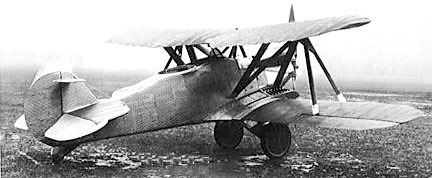
The Thomas-Morse TM-24 of 1924 was an all-metal, corrugated-skin pursuit improvement over the TM-23, but still had enough design problems to result in rejection by the Army after McCook Field tests (as P-380).
With bridge-truss struts and biplane tail, the sole example built was dismantled and stored away.
Engine: 440hp Curtiss D-12
Wingspan: (upper) 25’0″ (lower) 30’1″
Length: 20’5″
Useful load: 1500 lb
Max speed: 143
Cruise speed: 114 mph
Stall: 63 mph
Wing chord: 63″ upper, 52″ lower
Seats: 2
Thomas-Morse TM-23
The one Thomas-Morse M-23 built, in 1923, for Army evaluation was a single place open cockpit biplane. All-metal, corrugated-skin pursuit design, it had inherent design and cooling problems despite several modifications. It was evaluated at McCook Field but rejected for its flight characteristics and high landing speed. It was dismantled in 1926.
Engine: Curtiss D-12, 440 hp
Wingspan: 19’6″ (later 23’0″)
Length: 16’8″ (later 17’6″)
Useful load: 788 lb
Max speed: 167 mph
Cruise speed 125 mph
Stall: 80 mph
Range: 280 mi
Ceiling: 20,150′
Seats: 1
Thomas-Morse SH-4
The 1915 Thomas-Morse SH-4 was a USN float version of the Thomas T-2 with a single main pontoon and wingtip floats, larger tail, three-bay wings, and various engines including the Curtiss OX-5 and Hisso A.
The first design for Thomas-Morse by B D Thomas, it incorporated much of the same look as his Curtiss J, and sold for $7,575.
Fifteen were built; A134 to 136, and A395 to 406.
Wingspan: 44’0″
Length: 29’9″
Useful load: 897 lb
Speed: 83 mph
Thomas-Morse S-9
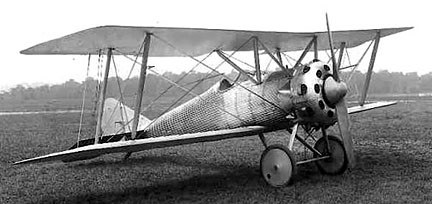
The 1923 Thomas-Morse S-9 Army trainer was a widened side-by-side cockpit in an all-metal corrugated fuselage, with wings from S-6 and tail from S-4C.
Only one was built but during Army flight tests at Kelly Field TX, it showed structural problems and the pilot bailed out; however, the plane reportedly glided to an “almost-successful landing” except for losing its wings when it went between two trees. It was sent back to Thomas-Morse, but never repaired.
Engine: 200hp Lawrance J-1
Max speed: 140 mph
Stall: 40 mph
Seats: 2
Thomas-Morse S-7
The sole 1919 Thomas-Morse S-7 was designed by W T Thomas, Agnew Larsen, and Raymond Dowd as a side-by-side cockpit two seater, advertised as “The Sociable Seater.”
Engine: LeRhône, 80hp
Wingspan: 32’0″
Max speed: 90 mph
Stall: 35 mph
Seats: 2
Thomas-Morse S-6
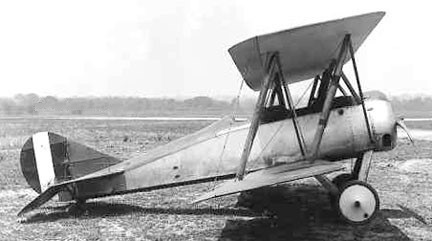
The Thomas-Morse S-6 of 1919 was Thomas-Morse’s only production with tandem cockpits and dual controls. The one built, NC98, was used in racing competitions, placed second in the 1919 Nationals.
Engine: LeRhône, 80hp
Wingspan: 29’0″
Length: 27’4″
Max speed: 105 mph
Stall: 35 mph
Ceiling: 19,500′
Seats: 2
Thomas-Morse O-6
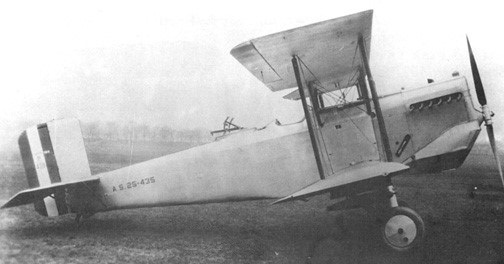
The 1926 Thomas-Morse O-6 is a metal-frame versions of Douglas O-2 built by Thomas-Morse under government contract. One went to McCook Field for testing as P-439 (25-435), and with a 435hp Liberty V-1650-1 was re-designated as O-6 (25-436).
Three production O-6 were built (25-437/439) with Liberty 12 engines.
The XO-6B of 1925 was a re-design of the O-6 with a 450hp P&W R-1340, revised wing covering and bracing, corrugated metal fuselage skin. One (25-440) was built as the prototype for O-19, McCook tested it as P-503.
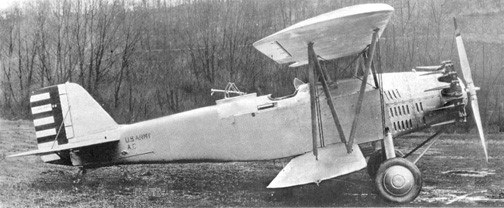
Thomas-Morse MB-2
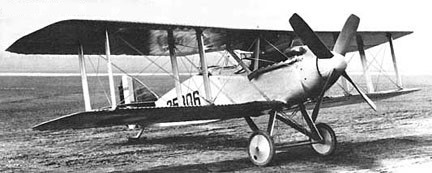
The sole Thomas-Morse MB-2 AS25806 of 1918 was powered with a 400hp Liberty 12-C but refitted with 450hp Liberty and four-bladed prop. It still lacked performance and it is not recorded if it ever completed flight tests.
Engine: 400hp Liberty 12-C
Wingspan: 31’0″
Length: 24’0″
Useful load: 726 lb
Seats: 2

