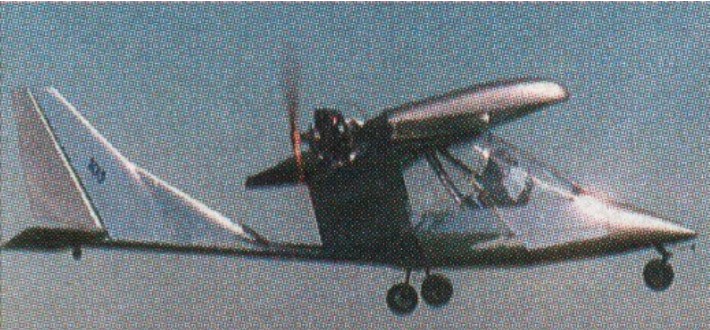
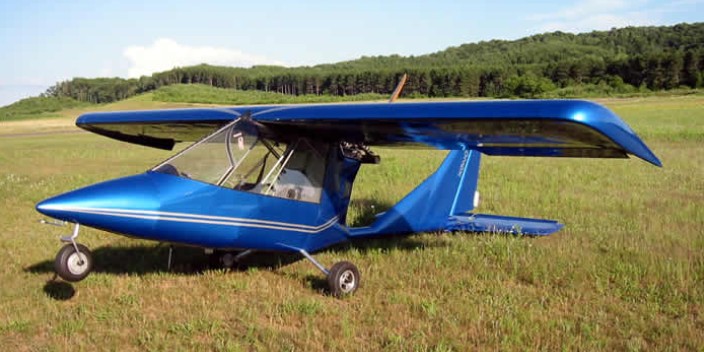
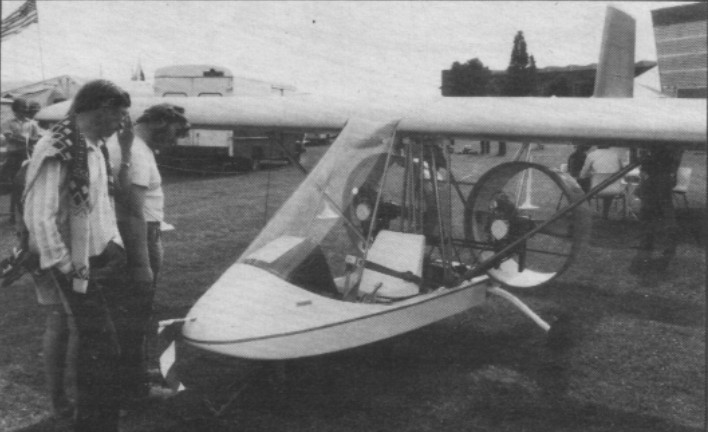
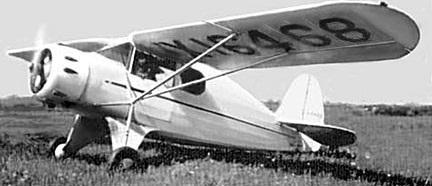
A single seat high wing pusher with full cantilevered wing and aluminum construction which qualifies as a Light Sport Aircraft.
Tornado I Engines: Rotax 503, 46 HP Empty weight: 375 lb Length: 18 ft 3 in Height: 6 ft 6 in Wing span: 20 ft Wing area: 93 sq ft Gross weight: 750 lb Cabin width: 26 in Cabin head room: 39 in Cabin leg room: 42 in Fuel capacity: 15 gal Vne: 120 mph Cruise speed: 95 mph Stall speed: 30 mph Range: 250 mi Climb rate: 1500 fpm Take off run: 200 ft Landing roll: 200 ft Ceiling: 12,500 ft Kit price 2010: $11,649 (U.S.D)
Tornado 1 Sport Engine: Rotax 503, 53 hp HP range: 40-80 Height: 6.5 ft Length: 18.5 ft Wing span: 20 ft Wing area: 93 sq.ft Weight empty: 320 lbs Gross: 700 lbs Fuel cap: 10 USG Speed max: 120 mph Cruise: 95 mph Range: 250 sm Stall: 30 mph ROC: 1500 fpm Take-off dist: 150 ft Landing dist: 150 ft Service ceiling: 12,500 ft Seats: 1. Landing gear: nose wheel Cockpit width: 24 in LSA: yes
Tornado MG Engine: Rotax 447, 40 hp HP range: 40-80 Height: 6.6 ft Length: 18.3 ft Wing span: 26 ft Wing area: 120 sq.ft Fuel capacity: 10 USG Empty weight: 330 lb Gross weight: 750 lb Top speed: 120 mph Cruise: 100 mph Stall: 30 mph Range: 375 sm Rate of climb: 1200 fpm Takeoff dist: 250 ft Landing dist: 250 ft Service ceiling: 12,500 ft Seats: 1 Landing gear: nose wheel
Tornado MG Engine: Rotax 503, 42 hp HP range: 42-100 Length: 18.3 ft Wing span: 26 ft Wing area: 120 sq.ft Aspect ratio: 5.62-1 Empty weight: 360 lb Gross weight: 750 lb Fuel capacity: 15 USG Cruise: 120 mph Stall: 35 mph L/D: 15-1 Min sink: 322 ft/min Seats: 1 Cockpit width: 26 in Landing gear: nosewheel LSA: yes
The contemporary engraving shows the Tissandier electric dirigible scale model – similar in appearance to the Giffard airship of 1852 – at the Conservatoire des Arts et Metiers in Paris. Seen at the Exposition d’électricité in 1881, the aérostat électrique was a demonstrative model of the later constructed full-scale Siemens electromotor-driven Tissandier airship. The model’s all important electromotor was designed and built by French inventor Gustave Trouvé.
In 1882 the Tissander brothers built a 92 ft long airship. At 37,000 cu.ft capacity, it was powered by a Siemens electric motor of 1.5 hp driving a primitive two-bladed airscrew, which drew its power from twenty-four bichromate of potash cells weighing 500 lb, contained in the car suspended by netting below the fuselage.
The first trial took place on 8 October 1883 when, despite a fair breeze, a measure of control was achieved with the aid of the sail rudder. A second trial on 26 September produced better results although due to the low power of the engine the craft was unable to make any headway in a wind of any magnitude and the brothers ended their works.
Single seat single engined high wing monoplane with conventional three axis control. Wing has unswept leading and trailing edges, and constant chord; flaps fitted. Conventional tail. Pitch control by elevator on tail; yaw control by fin mounted rudder; roll control by 39% span ailerons; control inputs through stick for pitch/roll and pedals for yaw. Wing braced from below by struts; wing profile Wortmann FS67 170 17; 100% double surface. Undercarriage has three wheels in tricycle formation; no suspension on nosewheel and glass fibre suspension on main wheels. Push right go right nosewheel steering connected to yaw control. No brakes. Aluminium tube framework, with pod. Engine mounted below wing, driving pusher propeller. Flying surfaces use foam/glassfibre/epoxy composite construction, not press moulded, with covering of rip stop reinforced Mylar.
In concept the Tirith Firebird is more of a mini aeroplane than a microlight. Designed by J Webb and Prof D Howe, both of Cranfield College of Aeronautics. Controls and flying surfaces are all thoroughly conventional and aircraft release materials have been used in all critical areas. There are no control cables, push rods being used instead. Moreover, the Firebird is fitted with 60% span flaps.
In 1982 the aircraft was still being tested and still at prototype stage.
This single seat microlight is a three axes design powered by two Weslake WAE342 engines. Firebird has a rigid composite structure, but Tirith Microplane is at pains to point out that only approved materials are used for critical areas. The Firebird was designed for Tirith Microplane by Cranfield’s Prof Hower and J. H. Webb.
Initial trials following the first flight in October 1982 found the single engine under some strain. This led to the prototype being cannibalised to provide the foundation for a twin engined machine. The powerplants are mounted side by side behind the pilot, and slightly forward of the trailing edge of the high wing. Shrouds surround the 30in diameter propellers, which are driven directly by Weslake twin cylinder two-stroke engines giving 45 hp. Flight testing was in the hands of Angus McVitie.
Engine: NGL WAE342, 25 hp at 5000 rpm Propeller diameter and pitch 36 x 16 in, 0.91 x 0.41 m No reduction Max static thrust 118 lb, 54 kg Power per unit area 0.16 hp/sq.ft, 1.8 hp/sq.m Fuel capacity 4.8 US gal, 4.0 Imp gal, 18.2 litre Length overall: 18.5 ft, 5.65 m Height overall: 8.7ft, 2.64m Wing span: 29.1ft, 8.86m Constant chord: 5.2ft, 1.60m Dihedral: 0 deg Sweepback 0 deg Tailplane span 11.5 ft, 3.52 m Fin height 3.4 ft, 1.05 m Total wing area 153 sq.ft, 14.2 sq.m Total aileron area 11.1 sq.ft, 1.03 sq.m Fin area 7.5 sq.ft, 0.70 sq.m Rudder area 3.1 sq.ft, 0.29 sq.m Tailplane area 20.2 sq.ft. 1.88 sq.m Total elevator area 10.4 sq.ft, 0.97 sq.m Wing aspect ratio 5.5/1 Wheel track 5.7 ft 1.75 m Wheelbase 5.8ft, 1.78 m Nosewheel diameter overall: 10 inch, 25 cm Main wheels diameter overall: 10 inch, 25 cm Empty weight 254 lb, 115kg Max take off weight 474 lb, 215kg Payload 220 lb, 100kg Max wing loading 3.10 lb/sq.ft, 15.2kg/sq.m Max power loading 19.0 lb/hp, 8.6kg/hp Load factors +4.0, 2.7 design; +6.0, 4.0 ultimate
Engine: Douglas Sprite 600cc Wing area: 9,50 sq.m Length: 5,72 m Span: 7,50 m Height: 1,45 m Empty weight: 130 kg Max weight: 250 kg Max. speed: 130 km/h (70 kts) Stall speed: 65 km/h (35 kts) Service ceiling: 5.000 ft (1500 m) Range: 650 km
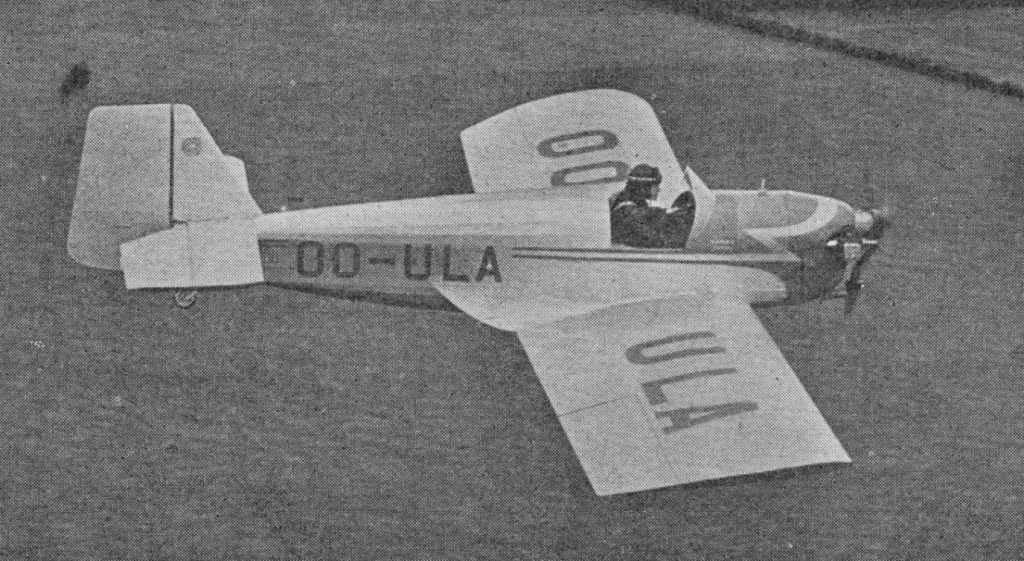
The Junior was one of a series of light aircraft designed by and named after E.O.Tips of Fairey Aviation’s Belgian subsidiary, Avions Fairey. Of wood and fabric construction, it was a conventional, low-wing monoplane with a tailwheel undercarriage and a single seat, open cockpit, though there was the option of a bubble hood. The constant chord wings were almost square ended and the tailplane, fin and rudder also angular. Both completed aircraft were initially powered by the 36 hp (27 kW) Aeronca JAP J-99 engine, later replaced by the more powerful, 62 hp (46 kW) Walter Mikron 2.
The Junior, registered OO-TIT, flew for the first time on 30 June 1947 from Gosselies in Belgium. The first Junior was written off after a hard landing in 1948.
The second example (construction number J.111, registration OO-ULA) was bought by Fairey and taken to England in 1953, where it was registered as G-AMVP. In 1957, it was used in a publicity stunt when Fairey test pilot Peter Twiss landed it on the aircraft carrier HMS Ark Royal. For part of its time it had the bubble canopy. Rebuilt after a long time in storage following a forced landing in 1993, it flew again late in 2006. It had a minor landing accident in 2008 but had a permit to fly until May 2009.
The Junior did not sell, and the third airframe was cancelled before completion. It was purchased incomplete by Fairey in 1961 and has been under construction in the hands of a number of owners in the intervening years, but never finished.
Powerplant: 1 × Walter Mikron II, 46 kW (62 hp) Propeller: 2-bladed fixed pitch Wingspan: 6.9 m (22 ft 8 in) Wing area: 10.5 m2 (113 sq ft) Length: 5.65 m (18 ft 6 in) Height: 1.48 m (4 ft 10 in) Empty weight: 220 kg (485 lb) Gross weight: 350 kg (772 lb) Maximum speed: 174 km/h (108 mph, 94 kn) Cruise speed: 158 km/h (98 mph, 85 kn) Range: 430 km (270 mi, 230 nmi) Service ceiling: 1,800 m (5,900 ft) Crew: 1
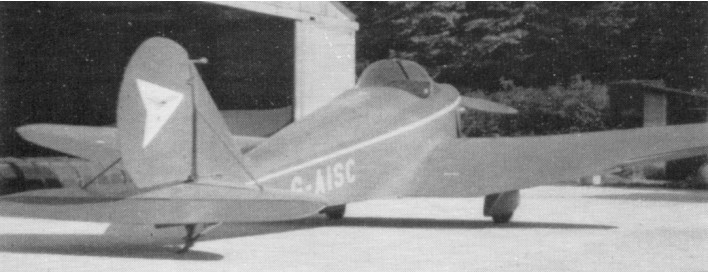
The Tipsy B is a small, open cockpit two seater designed by Belgian designer Oscar Tips and first flown in 1937. They were built at the Avions Fairey factory at Gosselies, near Charleroi, and powered by 62hp Walter Mikron engines. Pre-war products at Gosselies included two-seat B or B-2 (open cockpits). The B-2 was revived post-war as Tipsy Trainer.
A further refinement was the Tipsy Trainer, with the instructor’s seat beside the student’s but very slightly staggered behind, so the instructor had a better view of what the student was doing.
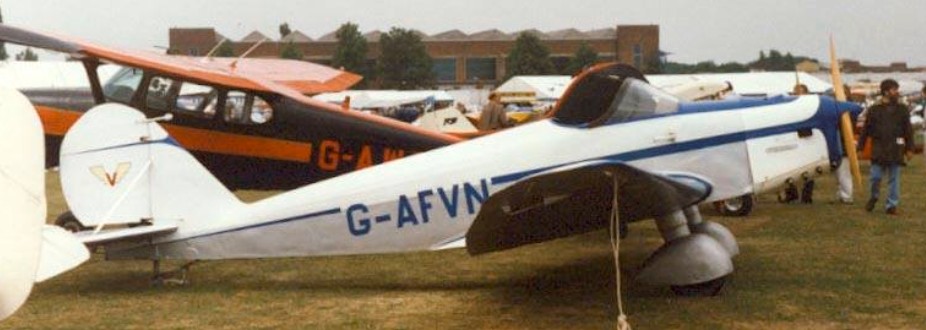
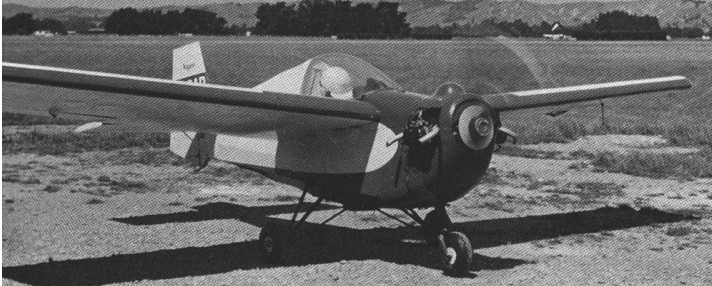
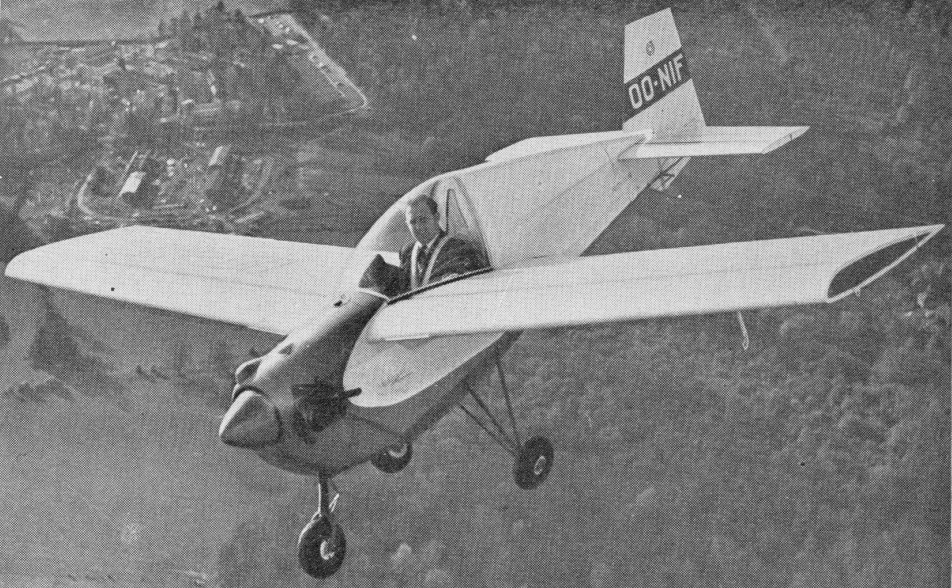
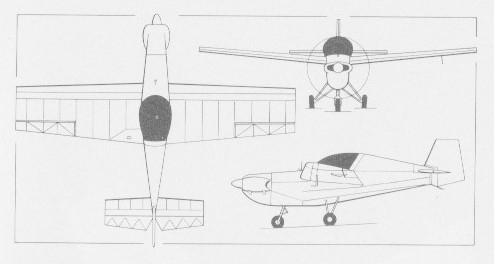
Conceived by Ernest Oscar Tips, managing director of Avions Fairey SA, and produced by Tipsy intended primarily for manufacture in kit form. The Nipper flew for the first time on 2 December 1957, powered by a 40 hp Pollmann HEP engine, entering production as the T.66 Mk.1. The first production model flyng on 10 March 1959.
Identical to the Mk.1 apart from its 45 hp Start Stamo 1400A engine, the Mk.2 first flew on 16 February 1959. Nipper production by Avions Fairey commenced almost immediately and the first production T66 Mk.II, flew on 20 October 1959.
Avions Fairey produced the Nipper in both fly-away and kit forms, the latter aimed at the developing amateur constructor market. However, it is not known how many units the company built. Construction numbers which are usually a reliable indication of production figures suggest at least eighty Nippers came off the company’s Gosselies production line before manufacturing rights were transferred to Coblevia in 1961, another Belgium company. Coblevia, after some design changes, produced aircraft marketed as the Coblevia Nipper III.
In June 1966 manufacturing rights to the Nipper were purchased by an English company Nipper Aircraft Ltd and a deal was negotiated with Slingsby to produce the aircraft at its Kirbymoorside glider factory. These aircraft were marketed by Nipper Aircraft in three vanants. The Nipper Mk.III powered by a 1500cc Rollason Ardem (converted VW auto engine), the Mk.IIIA fitted with a 1600cc Rollason Ardem and the Mk.IIIB kitset intended for amateur construction.
Slingsby Tipsy Nipper
Thirty-three Nippers were produced by Slingsby before production ceased toward the end of 1969. Acro Engines and Aeroframes, the company run by contest pilot Barry Smith, using his own Volkswagen engine conversion, with fuel injection and inverted fuel and oil systems, aerobats a relatively old lightweight design, the Tipsy Nipper.
After liquidation of Nipper Aircraft in May 1971 Nipper Kits and Components Ltd. was formed to support existing aircraft, and continued to market the aircraft in Mk III form as plans and some components. In 1998 the Nipper was still being marketed by Nipper Kits & Components.
Nipper Mk.I Engine: Pollman HEPU, 40 hp Wing span: 19 ft 8 in Length: 15 ft 0 in Height: 6 ft 2 in Wing area: 80.7 sq.ft
Nipper Mk.II Engine: Stark Stamo 1400A, 45 hp Wing span: 19 ft 8 in Length: 15 ft 0 in Height: 6 ft 2 in Wing area: 80.7 sq.ft Empty weight: 412 lb Loaded weight: 660 lb Max speed: 101 mph Max cruise: 93 mph Econ cruise: 84 mph ROC: 630 fpm Service ceiling: 13,100 ft Range: 200 mi
Nipper Mk.III Engine: Stark Stamo 1400A, 45 hp
Nipper Mk.III Engine: Ardem X, 45 hp Wingspan: 19 ft 8 in / 6.00 m Wingspan over tip tanks: 20 ft 6 in / 6.25 m Length: 15 ft 0 in / 4.56 m Empty weight: 465 lb / 210 kg MTOW normal: 750 lb / 340 kg MTOW aerobatic: 685 lb / 310 kg Cruise 75% no tanks SL: 81 kt / 93 mph / 150 kph ROC SL: 650 fpm / 198 m/min Service ceiling: 12,000 ft / 3660 m Range internal fuel 30min res: 173 nm / 200 mi / 320 km Range w/tip tanks: 390 nm / 450 mi / 720 km Seats: 1
Nipper Mk.IIIA Engine: Ardem 1600cc, 55 hp
Nipper Mk.IIIB Empty weight: 211 kg Wing area: 7.50 sq.m Fuel capacity: 34 lt Engine: VW, 60 hp MAUW: 340 kg Seats: 1 Max speed: 235 kph Cruise speed: 150 kph Minimum speed: 61 kph Climb rate: 3.3 m/s Fuel consumption: 12.5 lt/hr Plan price (1998): £55 Kit price (1998): £4004