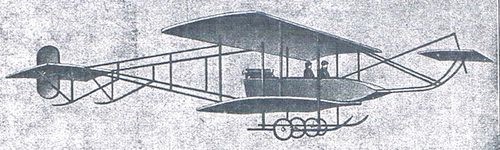
A Farman-copy built by Otto Trinks & Co Luftfahrt-material (Gitschinerstrasse 91, Berlin) during 1910/11 and fitted with a 44 hp eight-cylinder engine.
The Otto Trinks Doppelrumpfeindescker was presented at Johnnisthal in 1911 as the first bi-fuselage aircraft; its pusher prop between the two tail booms driven by a 50 hp Argus.
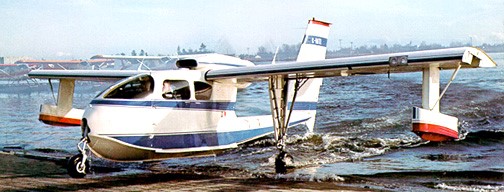
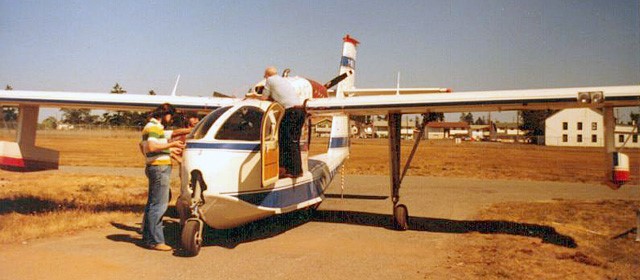
Canadian firm Trident Aircraft Ltd of Vancouver, BC, tried to resurrect the Seabee in the form of the TR-1 Trigull. Trident Aircraft was established in early 1970s to develop Trigull-320 six-seat light amphibian The factory was in Sydney, British Columbia, Canada. The Trigull resembled the Seabee closely enough to be confused with it, Spence Spencer apparently having a hand in the design. The Trigull could be distinguished from the Seabee by the angular swept tailfin, floats that retracted up to the wingtips, and tricycle landing gear, the long main gear hinging to retract outward into the wings, and the nose gear pivoting up to retract into the nose.
Two flight prototypes were built, first flown on 5 August 1973, the second taking to the air in 1973. The aircraft had a price tag of $111,360 in 1979. A Turbo Trigull was offered with turbocharged engines.
third prototype, c.1978, at Victoria, BC.
Production machines were to be powered by a Lycoming IO-540-M1A5 air-cooled flat-six engine, with 255 kW (340 HP), though the prototypes were powered by the less powerful Teledyne Continental Tiara flat-six. The Trigull was about a tenth longer and a tenth heavier than the Seabee, and could have seating for four or six, the rear seat in the six configuration apparently being intended for kids since it would be pretty cramped for adults.
The stop go progress of Trident Aircraft reached its fourth and probably final “stop” in 10 years in November 1980 as costs continued to escalate ahead of the latest funding programme. With $Can10m spent already, the company estimated that another $Can8.5m was needed to establish full production of the Tri Gull amphibian at the new plant set up for the purpose on Vancouver Island. All employees were dismissed and survival of the project appeared unlikely; the two prototypes of the Tri Gull have been put into storage, the company going under in the early 1980s.
Viking Air LTD of Vancouver obtained the rights to the Trigull; Viking, incidentally, also had rights to de Havilland Canada classics like the Beaver, Otter, and Twin Otter, performing turbo conversions of Beavers and Otters, plus building Twin Otters new. Viking has dropped hints of producing the Trigull, presumably to see if there was any interest, and saying that a production machine would have a turboprop powerplant. Apparently there wasn’t any interest, since it never happened.
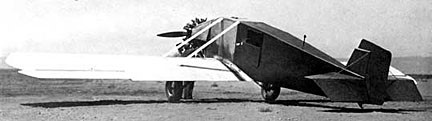
The 1928 Tremaine WT-2 was registered to W D Tremaine as NX7771 c/n 33, powered by a McClatchie-Panther engine. This one is also noted registered as a “Junker” by Pacific Aircraft Co, but with a Wizard motor.
Designed by Frederic Thaheld three were built, all based on the German Junkers design.
One was Dole Race entry Spirit of John Rodgers, piloyed by George A Covell and Richard Waggener, possibly registered N1239. It had 645-gallon fuel tanks, and was originally designed for a non-stop Japan flight attempt. Lack of forward visibility was because it covered the forward fuselage and required installation of a periscope in the manner of Lindbergh’s Spirit of St Louis. It crashed and was destroyed in fog at Point Loma enroute to Oakland from San Diego.
Another, also named Humming Bird, was a 1927 two place low wing monoplane sport plane with 120hp Super Rhône. The maximum speed was 130 mph, cruise of 105 mph, and stall of 35 mph.
The third with a Hisso engine was registered as a Pacific J-30 NX87N c/n 34.
The name bird was applied to a 1924 flivver-type, also designed by Thaheld, built in Tremaine’s garage.
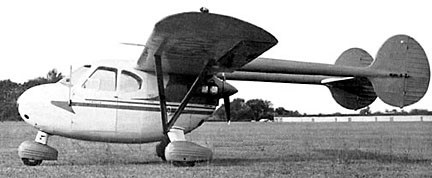
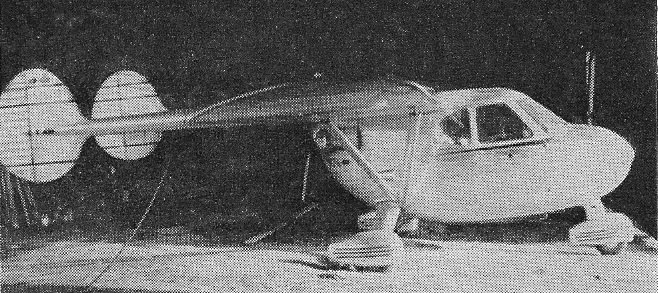
The 1949 Trella T-106 was a two place high wing cabin monoplane. All metal with twin tails on booms, the one built, N450C, was first flown in September 1949 by Paul Holst.
A highly-modified five place retractable gear twin version was planned in 1954 as T-107 never went past the mock-up stage because of funding problems.
The 1932 T-104 -105 was identical to the T-10 except for minor improvements. It was destroyed in a crash on a test flight,
Work on the two place high wing cabin monoplane T-105 was begun in 1935, but never finished because of lack of financing and the plane was eventually dismantled.