Turbay T-1 Tucan

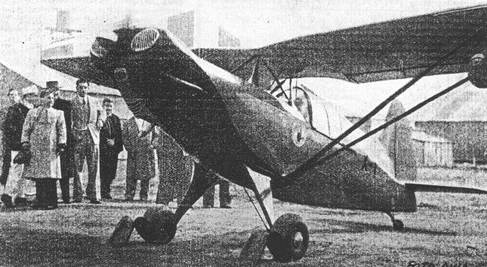
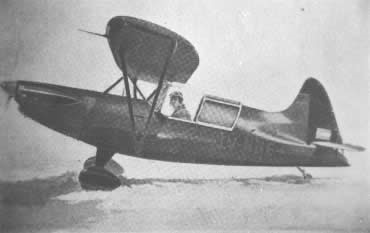
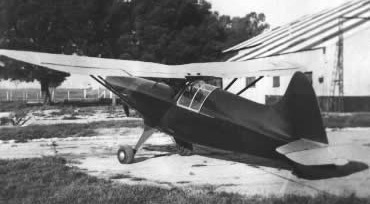
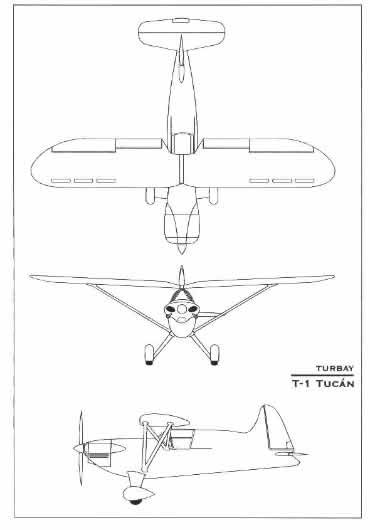
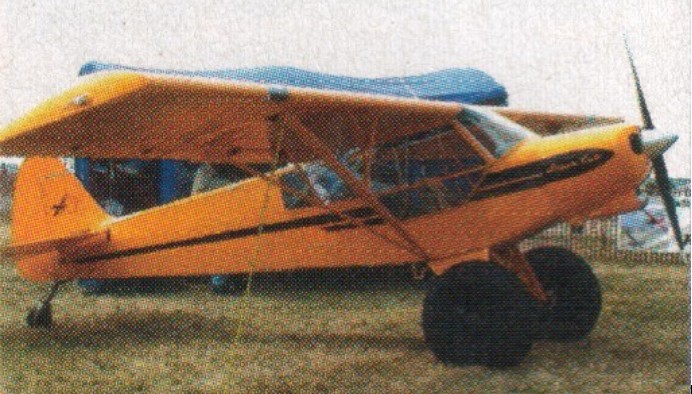
Designed by Alfredo Turbay and built by Sociedad Anonima Sfreddo & Paolini, the Tucán is a parasol-wing braced monoplane with a fixed cantilever type landing gear, tailwheel and powered by a 65 hp (48 kW) Continental A65 air-cooled piston engine. The design of the T-1 toucan started it in 1937, reaching its final form in 1939.

It had an enclosed cockpit just aft of the wing trailing-edge with a sliding canopy.

The first of January 1941 began with the construction of this prototype at the Technical Institute of the National University of Tucuman in the Popular Aviation Center founded by Los Tucanes Turbay himself and his colleagues a couple years earlier.

Construction was finished in April 1943 and between 2 and 5 February was statically tested and approved by the Directorate General of Civil Aviation granting the first experimental enrolment of registration, LV-X1.

The first flight was made on April 5, 1943 with an excellent performance, which made Turbay interested in taking it to Buenos Aires to get potential customers and try to manufacture in series. The plane arrived at Airfield San Fernando in Buenos Aires in May 1943 and on May 16 before national, military and aerospace Argentina and higher authorities. This made the Sfreddo and Paolini SA hire him as technical manager of the company. They planned to sell the aircraft at $10,000 National Currency each, which made it very accessible for the time. Turbay made some tweaks to the model and officially presented to the press and public at the airport on August 22 of that year.

Series production under license by Sfreddo and Paolini for the construction of 6 units were scheduled and minor modifications began with the works. The series aircraft would be equipped with the same engine as the prototype, the Continental A65 65 hp, but the Directorate General of Civil Aviation cancelled its commitment because of World War II for which production was suspended. Sfreddo & Paolini was seized and nationalized by the government.

While there were several attempts to build the plane in series, political and economic problems of the country prevented this. Plans to revive production in 1963 were thwarted. The prototype, once approved, was re-registered LV-NBE on September 13, 1944. On January 23, 1945 Turbay sold the aircraft to Bruno Zantini and to Orlando Harriet on September 25 of that year. On 22 November 1956 the record was transferred to Roberto Velazquez who completely destroyed it in an accident on April 18, 1957 in Bell Ville, province of Cordoba.

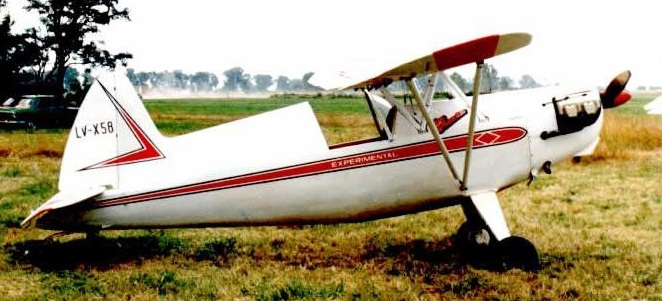
In 1975 Luis Fernandez finished building a second aircraft with planes bought in 1969 at the AVEX institution that Turbay. This aircraft was registered as LV-X58 and first flew on October 9, 1975.

Gallery

Engine: 1 × Continental A65, 48 kW (65 hp)
Length: 5.55 m (18 ft 2 in)
Wingspan: 7.22 m (23 ft 8 in)
Height: 1.90 m (6 ft 2½ in)
Wing area: 7.20 m2 (77.5 ft2)
Empty weight: 285 kg (627 lb)
Gross weight: 450 kg (990 lb)
Maximum speed: 205 km/h (127 mph)
Range: 1100 km (680 miles)
Endurance: 6 hours
Service ceiling: 4200 m (13780 ft)
Crew: 1
Tupolev Tu-91

At the end of the 1940s, the Soviet government took a decision to expand the Voenno Morskoi Plot (VMF, the Navy). It was decided to include an aircraft carrier fleet, and development of aircraft suitable for carriers was a part of the programme. Tupolev was given the task of designing a strike aircraft for the new fleet.

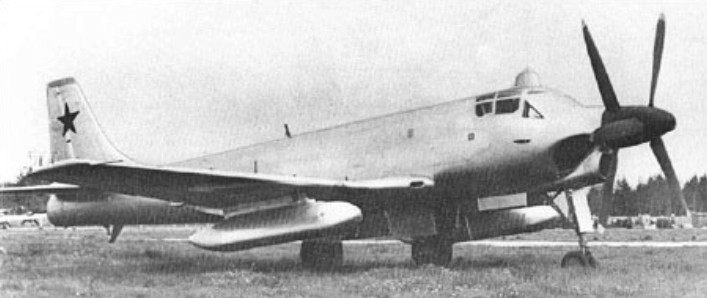
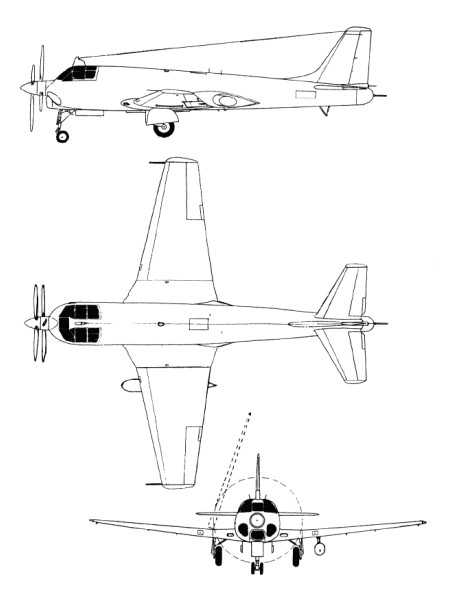
Vladimir Chizhevski was appointed chief designer. His team developed a two-seat low-wing monoplane, with a straight wing and with the engine located in the centre fuselage driving a long propeller shaft, which ran through the middle of the cockpit, and drove, through gears, two contra-rotating three-blade propellers.

Josef Stalin died in March 1953, and the new leaders cut back the VMF expansion plans and thus the requirements for carrier-borne aircraft was cancelled. The naval chiefs, however, still saw a need for a strike aircraft, and Tupolev was asked instead to prepare a land-based aircraft for the role. This time Chizhevski was requested to design a dive bomber for attacking naval surface and submarine vessels; instead of carriers, it had to be capable of operating from runways of limited length.

The Tu-91 required only relatively minor changes to meet the revised needs. The folding wings were now unnecessary and, with the arrestor hook, were removed and were replaced with conventional wings.

The test programme began in autumn 1954 and went well. Both the factory tests and the state tests gave good results, and the aircraft was approved for production. Only the politicians remained to give their approval.
In the summer of 1956, the latest examples of military aviation were unveiled to a group of high level officials, including the new General Secretary of the Communist Party, Nikita Khrushchev. Among all the gleaming examples of power and speed was the straight-winged Tu-91, one of very few propeller aircraft present and looking awkward in comparison with its neighbours. ‘What’s that?’ Khrushchev asked a naval officer attending the aircraft. Confused momentarily by being addressed by Khrushchev, the officer, instead of replying that the aircraft could deliver firepower equal or greater than that of a heavy cruiser, answered that it could do the job of a cruiser. The jovial Khrushchev then asked: ‘So why do we need cruisers?’

The career of the Tu-91 was over. Although Tupolev used all his connections and experience it was impossible to gain support from those under the leader.

Engine: 1 x TV-2M turboprop, 7650hp
Max take-off weight: 14400 kg / 31747 lb
Wingspan: 16.4 m / 54 ft 10 in
Length: 17.7 m / 58 ft 1 in
Height: 5.06 m / 17 ft 7 in
Wing area: 47.48 sq.m / 511.07 sq ft
Max. speed: 800 km/h / 497 mph
Ceiling: 11000 m / 36100 ft
Range: 2350 km / 1460 miles
Crew: 2

Tupolev Tu-91

Tupolev Tu-79 / Tu-89

The Tu-78 and Tu-79 were essentially the Tu-73 but with Soviet licence-built 5952-lb (2700-kg) Rolls-Royce engines. The two Nenes were now called the RD-45, and the Derwent, the RD-500. The prototype was built at factory N 156 with Sergei Yeger in charge. It made its first flight on 17 April 1948 and its state tests were completed by December. It was approved for serial production under the VVS designation Tu-20, but this was not actually carried out because of the shortage of production facilities. The Tu-20 designation would be used again later.
The Tu-79 was a long-range reconnaissance aircraft originally designated Tu-73R. By then, 1949, Klimov had developed the Nene/RD-45 to produce 2,700kg thrust, and the Tu-79 was to have been fitted with two of these VK-1 engines in place of the lower powered RD-45s. The VVS allocated the designation Tu-22 to planned production. Although this one was never actually built, the Tu-22 designation would also be used later.

Tu-79
Engines: 2 x VK-1 turbojets
Max speed: 535 mph (861 km/h) at 16,405 ft (5000 m)

Tupolev ANT-36 / DB-1

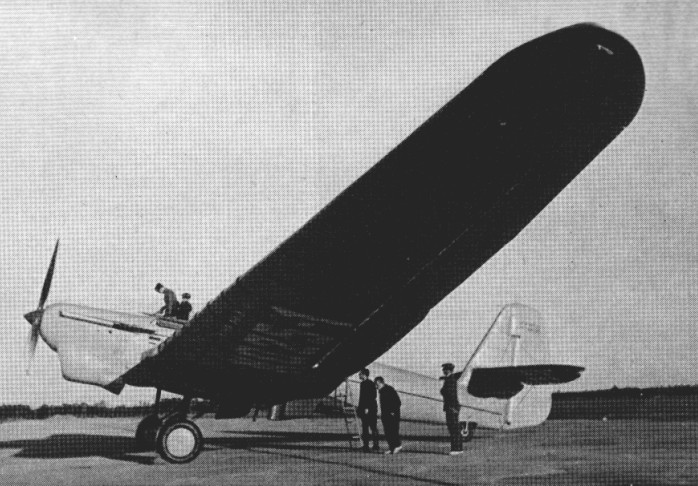
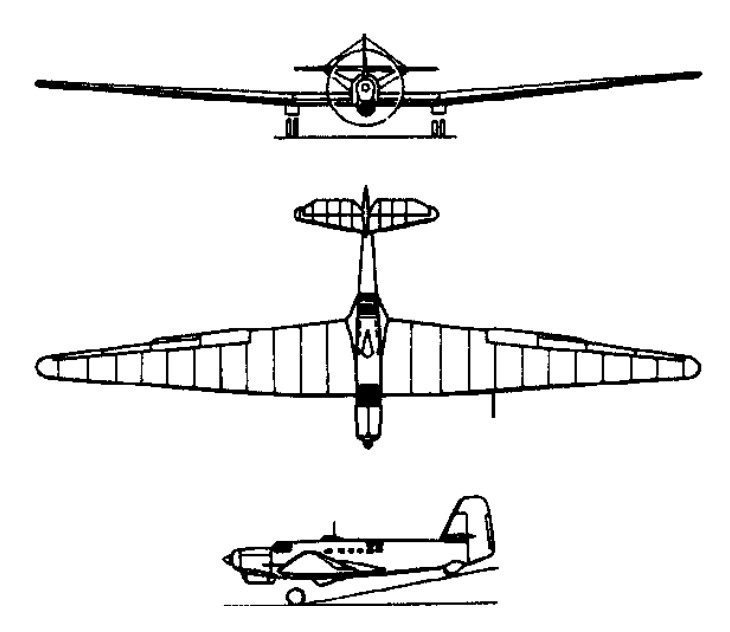
The ANT-36 was a redesigned ANT-25, and the twenty aircraft built for the Soviet Air Force under the military designation DB-1 were actually ANT-36s. This has caused some confusion as the sometimes reported production figures of the ANT-25 are quoted as two (the correct figure) and twenty-two, the total which includes both the -25 and the -36.

The major differences between the two Sukhoi-led programmes was armaments: on two aircraft, the Mikulin M-34R of the ANT-25 was changed for a Junkers Jumo 4 diesel and, later, the Soviet-built AN-1 diesel. But these engines left the DB-1 underpowered and slow, and its limited armaments, low service ceiling and large wing meant it was very vulnerable to fighters, so the planned production of fifty was cut to twenty which were never to see service in the role for which they were intended.

By spring 1936, these twenty had been delivered to the Air Force base at Ismailova, near Moscow. Two of these were fitted with diesel engines, and flight tests indicated that this version could achieve a range of 25,000km. It was planned to circumnavigate the world on the 57°N line of latitude, but the build-up to the Second World War caused the plans to be put aside. The remaining thirty aircraft were not built.

The aircraft was not a military success. Labelled the DB-1, the Air Force soon realised that the almost five years it took to develop had left the aircraft too slow, and that against contemporary fighters it was outclassed and virtually defenceless. But the twenty military aircraft went on to further flight trials; two were fitted with Junkers Jumo diesel engines, as has already been mentioned. Most of the others were used by the TsAGFs BOK, a department headed by Vladimir Chizhevski which was developing pressurised cabins for high-altitude test flights. In 1936, Chizhevski had worked in Kharkov developing pressurised cabins for high-altitude balloons. He lightened the airframe and shortened the span for his first version, the BOK-1. The engine chosen was the M-34RN with a turbocharger fitted to permit a ceiling of 10,000m to be attained. In early trials Piotr Stefanovski reached 10,700m; later, after further lightening of the aircraft, he brought it up to 14,100m. In June 1937, the engine was replaced by the new M-34RNV, fitted with two turbochargers. With some lightening, the aircraft reached heights of over 12,000m.

In 1938, Chizhevski modified another ANT-36 to BOK-7 standard. He substantially modified the cabin, so now the two crew sat with their heads in small doubleglazed domes which rose above the line of the fuselage. It was powered by a M-34FRN and had two superchargers. With this, the Soviet Air Force set its plans for a non-stop round the world flight approximately on the 53° North line of latitude. The programme was headed by Aleksander Filin, one of Chkalov’s crew, and targeted for 1939 or 1940. But Filin was arrested in Stalin’s purge, and executed in 1940. This and the war ended the project.

Tupolev ANT-31 / I-14

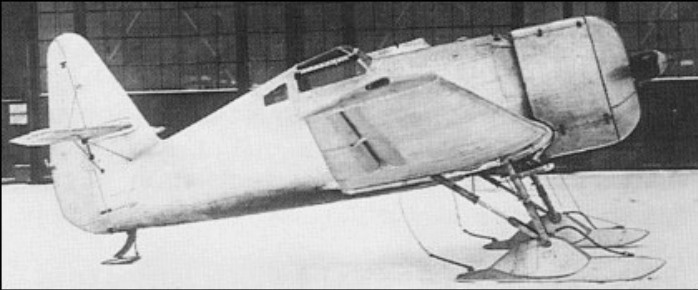
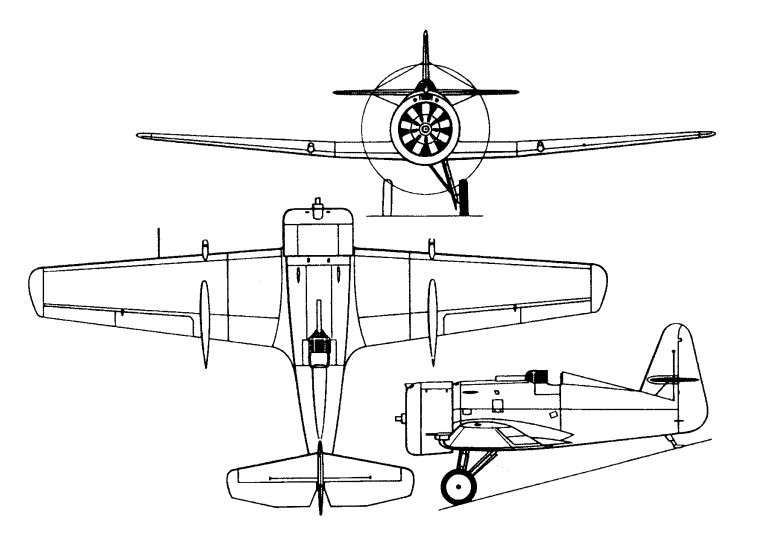
Possessing the distinction of being the world’s first all-metal single-seat cantilever monoplane fighter to be graced with a retractable main undercarriage and an enclosed cockpit, the ANT-31 was designed at the KOSOS TsAGI by Pavel O Sukhoi’s brigade. Featuring a smooth, stressed-skin fuselage with corrugated skinning for the wing, tailplane and rudder, the first prototype was powered by a 580hp nine-cylinder Bristol Mercury VIS2 radial, and had a manually-operated inwards-retracting undercarriage and an aft-hinging cockpit canopy incorporating the windscreen. This aircraft entered flight test with a fixed-ski undercarriage early in May 1933, by which time major redesign was being undertaken and work had begun on a second prototype, the ANT-31bis.

Fitted with a 712hp Wright Cyclone SGR-1820-F2, the ANT-31bis featured a new, narrow-track undercarriage retracting outwards and a narrower canopy which, sliding fore and aft on runners, still incorporated the windscreen. This aircraft, too, was initially flown with fixed skis, in March 1934, and, equipped with an armament of two 37mm Kurchevski APK-11 recoilless guns installed immediately outboard of the wing centre section and one fuselage-mounted 7.62mm machine gun, then underwent State testing from the following October.

The decision was taken to initiate series production of the ANT-31bis as the I-14bis, with smooth metal skinning overall, an open cockpit with fixed windscreen, the 700hp M-25 licence-built version of the Cyclone and armament of two 20mm cannon and two 7.62mm machine guns. Orders were placed for 55 I-14bis fighters, the intention being to install the 730hp M-25A engine at an early stage. The spin recovery characteristics of the I-14bis were not entirely satisfactory and difficulties were experienced with the narrow-track undercarriage. In consequence, the similarly-powered I-16 Tip 4 having meanwhile demonstrated generally superior characteristics, production was terminated in December 1936 with the 18th aircraft, the remaining 37 fighters of this type then under construction being scrapped.

Max take-off weight: 1540 kg / 3395 lb
Empty weight: 1170 kg / 2579 lb
Wingspan: 11.20 m / 37 ft 9 in
Length: 6.10 m / 20 ft 0 in
Wing area: 16.90 sq.m / 181.91 sq ft
Max. speed: 440 km/h / 273 mph

Tupolev ANT-31 (I-14)

Tupolev ANT-25

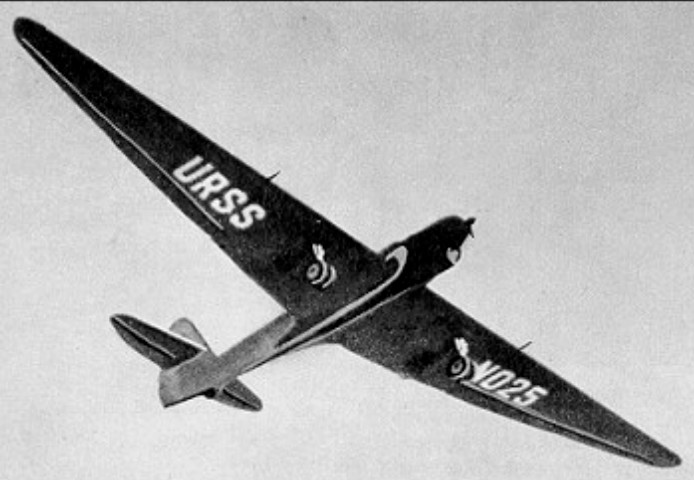
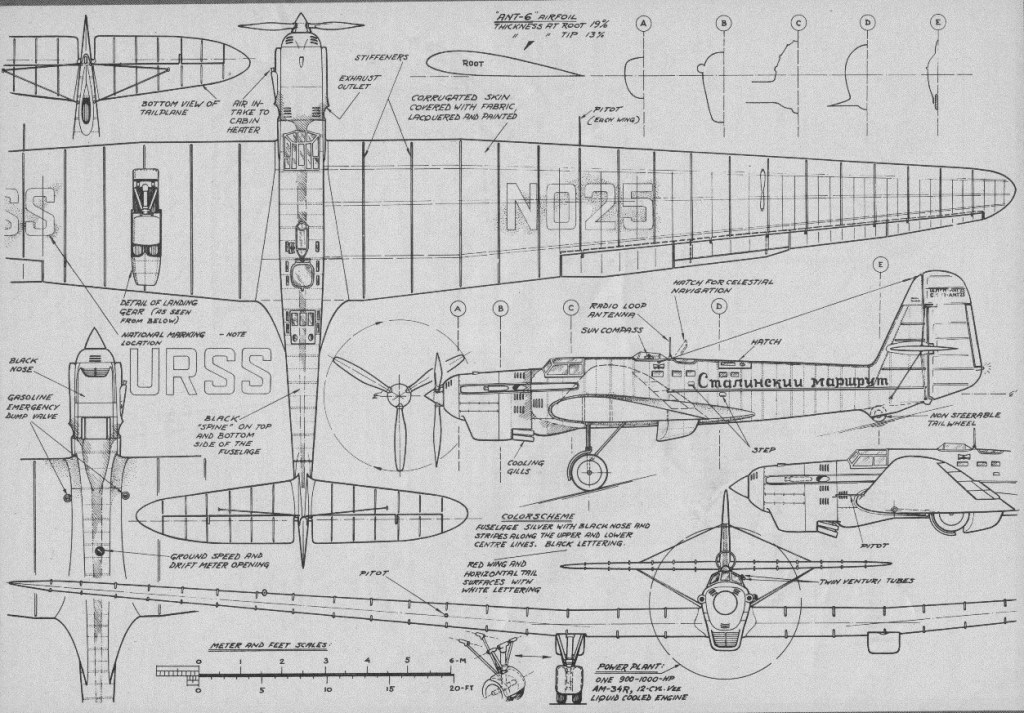
In 1924, Pavel Sukhoi joined the Central Aero and Hydrodynamic Institute, or TsAGI, collaborating in the design of the ANT 25. Design teams headed by P O Sukhoi and A A Arkhangelski but under Tupolev’s general direction, were responsible before the second World War for a series of high¬ speed and long range bombers, including the ANT 25 (RD).

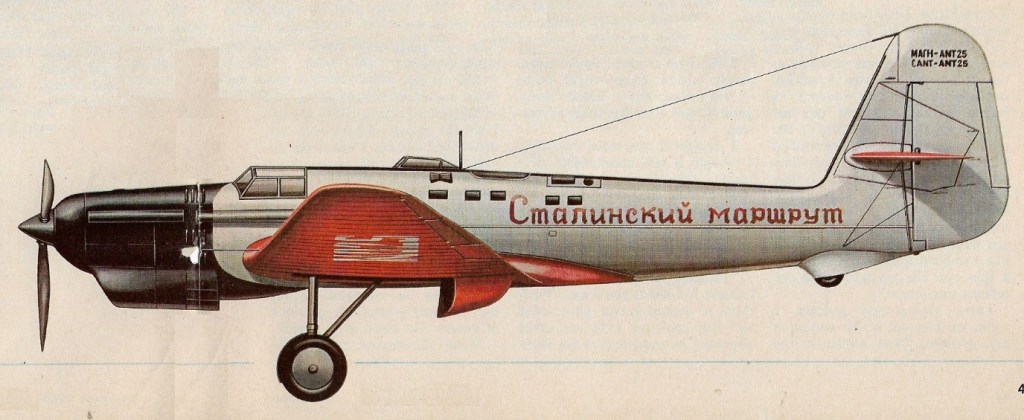
The ANT-25 was of conventiomal all-metal construction with additional fabric covering on the wings, lacquered and highly polished for maximum efficiency. The wing had a 10:1 aspect ratio and external chordwise ribbing. Engine was 900-1000 hp AM-3R liquid cooled V-12 with cooling system specialy modified for best cold weather operation. The narrow fuselage had cockpit fitted with blind flying instruments, but no autopilot. Next aft was a bunk, then navigator’s station, then second cockpit with full controls. Complete navigation and radio gear was carried. Cabin heat was supplied from exhaust system heat exchanger. Crew had oxygen system and emergency equipment including three inflatable floatation bags in wing and nose, inflatable rubber raft, electrically heated floatation suits and a month’s rations stowed in wing leading edge compartments.

The first prototype flew on June 22, 1933.

On June 18-20, 1937 RD piloted by Chkalov, Baidukov and Beljakov flew non-stop from Moscow to Portland (USA), covering 9130km in 63 hours and 25 minutes.

On July 12-14, 1937 RD piloted by Gromov, Yumashev and Danilin flew non-stop from Moscow via the North Pole to San Jacinto (USA), covering 11500km in 62 hours and 17 minutes.

A total of 2 aircraft were built, followed by 20 ANT-36s.

ANT-25
Engine: 1 x M-34
Max take-off weight: 11500 kg / 25353 lb
Empty weight: 4200 kg / 9259 lb
Wingspan: 34.0 m / 112 ft 7 in
Length: 13.9 m / 46 ft 7 in
Height: 5.5 m / 18 ft 1 in
Wing area: 87.9 sq.m / 946.15 sq ft
Max. speed: 210 km/h / 130 mph
Cruise speed: 165 km/h / 103 mph
Ceiling: 7000 m / 22950 ft
Range w/max.fuel: 13000 km / 8078 miles
Crew: 3

Tupolev ANT-25 / RD

Tupolev ANT-13 / I-8

Conceived to make use of new high-strength steels obtainable from Germany in the late 1920s, the ANT-13 was a small unequal-span staggered biplane single-seat fighter. Utilising steel for the wing spars and the welded truss fuselage – the remainder of the structure being dural – the ANT-13 was fabric covered and powered by a 600hp Curtiss V-1570 Conqueror 12-cylinder water-cooled engine. Armament consisted of twin 7.62mm synchronised guns.

Construction of the prototype, designated I-8, was threatened with cancellation in 1929 through the pressures of higher priority projects at the AGOS, but each worker donated 70 hours to completing the I-8, which was flown on 28 October 1930. Dubbed unofficially the Zhokei (Jockey), the fighter was the first aircraft to exceed 300km/h in the Soviet Union, but the decision not to licence manufacture the Conqueror engine worked against series production of the ANT-13.

Engine: 600hp Curtiss V-1570 Conqueror 12-cylinder water-cooled
Max take-off weight: 1424 kg / 3139 lb
Empty weight: 960 kg / 2116 lb
Wingspan: 9.00 m / 30 ft 6 in
Max. speed: 313 km/h / 194 mph
Range: 440 km / 273 miles
Armament: 2 x 7.62mm synchronised machine guns

Tupolev ANT-13 / I-8

Tupolev ANT-10 / R-7

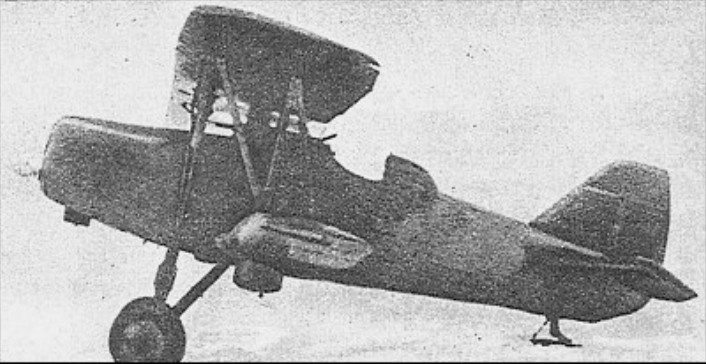
Under the military designation R-7, a single ANT-10 was built as a possible alternative to Polikarpov’s R-5, which first flew in 1928 and went on to have a production run of 4,995 in the 1930s.

Tupolev’s project was an all-metal sesquiplane. The shortage of metal was one of the factors which worked in favour of the simple wooden airframe chosen by Polikarpov. For both aircraft the BMW-VI engine was specified, due to its planned Soviet production as the Mikulin M-17.

TsAGI began design work on the R-7 in 1928, when the R-5 was already flying. Its first flight was made on 30 January 1930, flown by Mikhail Gromov. As it was not appreciably better than the R-5, the programme was discontinued six months later.

Engine: 1 x BMW VI, 500hp
Max take-off weight: 2920 kg / 6438 lb
Empty weight: 1720 kg / 3792 lb
Wingspan: 15.2 m / 50 ft 10 in
Length: 10.9 m / 36 ft 9 in
Height: 3.6 m / 12 ft 10 in
Wing area: 49 sq.m / 527.43 sq ft
Max. speed: 235 km/h / 146 mph
Ceiling: 5500 m / 18050 ft